
Originally published in March 2025 and comprehensively updated/edited in June 2026.
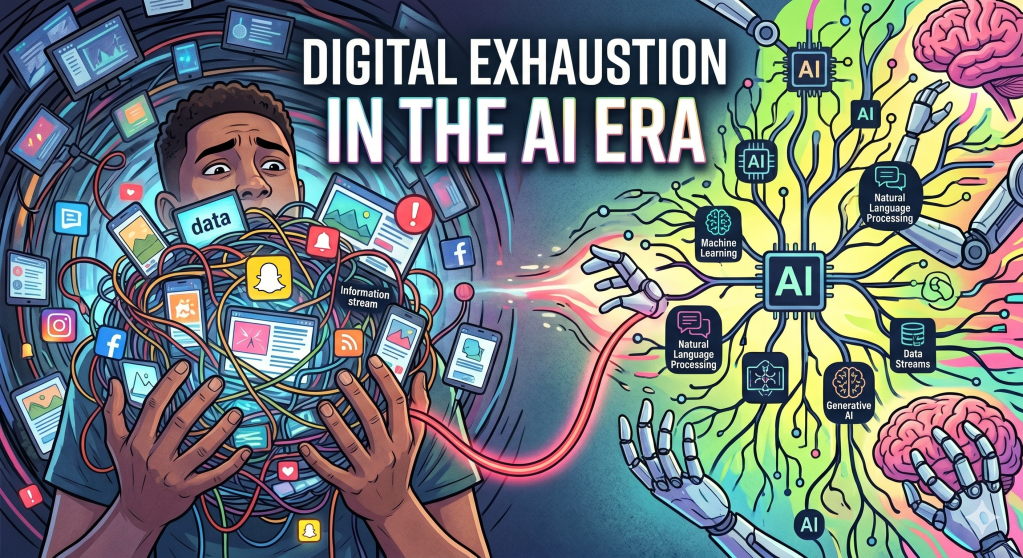
Digital exhaustion in the AI era is reshaping how millions of people think, work, and connect. Here’s what the science says about why — and what it means.
There is a particular kind of tired that has nothing to do with sleep. You recognize it if you’ve ever closed a laptop at the end of the day feeling simultaneously overstimulated and hollow — like you’ve consumed an enormous amount while somehow coming away empty. It isn’t burnout in the traditional sense, and it isn’t boredom. It’s something that didn’t have a clean name until recently, when researchers and clinicians started reaching for terms like “cognitive overload,” “AI fatigue,” and “digital exhaustion” to describe what millions of people were quietly experiencing as artificial intelligence became woven into the fabric of everyday life.
Digital exhaustion in the AI era is more than a buzzword. It represents a genuine shift in how human minds are being asked to operate — constantly, at machine speed, across an ever-expanding array of tools, interfaces, and information streams. Understanding it requires looking at the psychological, neurological, and social dimensions of a society that didn’t just adopt new technology but reorganized itself around it in the span of a few years.
This article examines what digital exhaustion actually is, why the rise of AI has amplified it in specific ways, what science tells us about what’s happening in the brain when we live this way, and what the broader social consequences look like when an entire culture reaches a state of chronic cognitive strain.
What We Mean When We Say “Digital Exhaustion”
Digital exhaustion isn’t a clinical diagnosis, at least not yet. But it describes a real cluster of symptoms that researchers have been documenting for years: difficulty concentrating, a reduced ability to feel satisfaction from achievements, irritability after prolonged screen time, a sense of being overwhelmed even when nothing catastrophically stressful is happening, and a strange compulsion to keep scrolling or checking even when you desperately want to stop.
For most of the 2010s, this was primarily discussed as a problem of social media. The infinite scroll, the dopamine cycle of likes and notifications, the algorithmic engineering of attention — these features of platforms like Instagram, Twitter, and TikTok were extensively studied and increasingly understood as genuinely taxing to the human nervous system. By the early 2020s, the average American adult was spending between ten and thirteen hours per day in front of screens of various kinds. That was already a significant psychological burden.
Then the AI era arrived, and the nature of the problem changed.
The shift began in earnest after the public release of ChatGPT in late 2022, but by 2025 AI had become deeply embedded across knowledge work, education, search, communication, and creative production. It was no longer a novelty people tried once. It was woven into email clients, word processors, search engines, coding environments, customer service platforms, and social feeds. People weren’t just consuming content anymore — they were now in constant negotiation with systems that generated it, filtered it, summarized it, and anticipated it on their behalf.
This created a qualitatively different kind of cognitive demand, and the psychological community began noticing the consequences.
The Neuroscience of an Overloaded Mind
To understand digital exhaustion, it helps to understand what the brain is actually doing when it processes the modern information environment. The relevant framework here is what neuroscientists call “cognitive load theory,” which describes the limits of working memory — the mental workspace you use to hold and process information at any given moment.
Working memory is remarkably limited. Most adults can hold about four chunks of information in active attention at once. When that capacity is exceeded, performance degrades: decisions become worse, learning becomes less effective, emotional regulation becomes harder, and errors become more frequent. This isn’t a matter of intelligence or willpower. It is a fundamental architectural constraint of the human brain.
The digital environment, and the AI-augmented version of it in particular, does not respect this constraint. Every notification, suggested response, auto-generated summary, recommendation, and AI-produced prompt is an additional item competing for limited attentional resources. Even when these tools are genuinely helpful — and often they are — the sheer density of inputs creates a continuous low-level tax on cognitive resources.
Research from institutions including Stanford, the Max Planck Institute, and University College London has consistently shown that multitasking — or what we more accurately call “rapid task-switching” — doesn’t actually save time or mental energy. It costs both. Several studies have associated heavy media multitasking with differences in brain regions involved in attention and cognitive control, and heavy media multitaskers perform worse on tests of sustained attention and are more susceptible to distraction even when they’re trying to focus.
The Attention Economy Grows More Sophisticated
Before AI, the attention economy operated primarily through volume and speed — more posts, more videos, more alerts, faster feeds. AI made those tools significantly sharper. Recommendation algorithms have become vastly more accurate at predicting what any individual user will engage with next, not just because they’ve grown more sophisticated but because they’ve been trained on vastly richer datasets. Increasingly sophisticated recommendation systems attempt to infer emotional states, attention patterns, and moments when users are most likely to engage.
On a practical level, this means the gap between “intentional engagement” and “pulled in by the algorithm” has narrowed considerably. People increasingly report that they can’t quite reconstruct how they ended up watching a particular video or reading a particular article. The path from intention to content consumption has become smoother, shorter, and harder to interrupt — which is precisely the engineering goal, but creates a psychological environment where it becomes increasingly difficult to maintain a sense of autonomous attention.
The sociologist Shoshana Zuboff, whose work on “surveillance capitalism” became widely read in the early 2020s, described this dynamic as the commodification of human behavioral data at an increasingly granular level. Whether or not one accepts every aspect of her framing, the core observation — that digital platforms have deep financial incentives to maximize engagement regardless of whether that engagement is good for the person — explains a great deal about why digital exhaustion has become so widespread. The systems are optimized for attention capture, not wellbeing.
AI Fatigue as a Distinct Phenomenon
By 2024, a more specific form of digital exhaustion had emerged that researchers began separating from general screen fatigue: AI fatigue. This referred specifically to the cognitive and emotional toll of working alongside, evaluating, and often compensating for AI-generated content as part of routine daily life.
Several distinct mechanisms contributed to this.
The first was the labor of verification. As AI tools became capable of producing fluent, confident, and sometimes incorrect text at high volume, users found themselves spending increasing mental energy fact-checking outputs, cross-referencing claims, and developing a kind of low-grade suspicion about any information they hadn’t personally verified. This is cognitively expensive work. It requires holding uncertainty in mind, resisting the temptation of plausible-sounding text, and bringing skepticism to a medium — written prose — that people are instinctively trained to trust. Psychologists studying what they called “epistemic vigilance” found that this kind of constant evaluation is particularly draining because it runs counter to our natural cognitive tendencies. We are wired to be efficient information processors, which means accepting input that seems coherent rather than scrutinizing it.
The second mechanism was what some researchers described as “output anxiety” — a new form of professional stress arising from the perception that AI could perform many knowledge work tasks faster and more fluently than humans. Even when this perception was exaggerated (and it often was), it created a psychological environment in which many workers felt pressure to produce more, faster, and to a higher standard of polish, using AI tools they were still learning to use effectively. The productivity paradox here is significant: AI tools that were supposed to reduce workload often, in practice, raised the expected floor of output while compressing timelines, leaving users running harder to stay in the same place.
The third mechanism was the erosion of deep work. Cal Newport, a computer scientist who wrote extensively about the value of sustained, distraction-free cognitive effort, had been warning since the mid-2010s that the digital environment was making it harder for people to enter states of genuine concentration. The AI era accelerated this dynamic. When a tool can generate a first draft in seconds, it becomes psychologically harder to justify sitting quietly with a problem for two hours. The short-term output of AI-assisted work often exceeded the short-term output of deliberate human effort — but many practitioners reported feeling, over time, that they were losing the capacity for depth. Their thinking felt shallower. Their tolerance for difficulty had decreased. They had become efficient, but at the cost of something harder to name.
The Social Dimension: Loneliness and the AI Companion Problem
Digital exhaustion doesn’t exist purely as a cognitive phenomenon. It unfolds within a social context that was already under significant strain before AI arrived.
The 2020s opened with a global pandemic that fundamentally disrupted patterns of social contact, and the social recovery that followed was slower and more uneven than many anticipated. Loneliness rates, which had been rising for years, remained elevated. Work-from-home arrangements persisted in many industries, removing the ambient social contact of office life. Young adults in particular showed concerning declines in the number of close friendships and in rates of participation in social activities.
Into this environment came AI companions and conversational agents — systems designed explicitly for social interaction, emotional support, and ongoing relationship-like engagement. Apps like Replika had been building AI companions since the late 2010s, but the quality and accessibility of conversational AI improved so dramatically after 2022 that the category exploded. By 2024, millions of people were regularly engaging with AI systems in ways that resembled friendship, mentorship, or even romantic partnership.
The psychological research on this remains genuinely complicated. Some studies found meaningful short-term benefits for socially isolated individuals who engaged with AI companions — reduced loneliness scores, improved mood, a sense of being heard. Other research raised concerns about substitution effects: whether AI interaction was satisfying the social drive just enough to reduce motivation for the harder, less predictable work of building human relationships. The neurological picture was particularly interesting. Conversations with AI systems activated some of the same neural circuits associated with social bonding, but typically not as fully or as durably as equivalent human interactions. The brain appeared to know the difference, even when people found the experience subjectively satisfying.
What this created, in many cases, was a form of social exhaustion layered on top of cognitive exhaustion — people who were simultaneously overstimulated by digital environments and undernourished by actual human connection.
How Society Adapted — and Didn’t
By mid-2025, public awareness of digital exhaustion had reached a level where it was being discussed not just in academic journals and mental health circles but in mainstream media, workplace policy conversations, and education. Schools began revisiting screen time guidelines. Companies introduced “AI-free” meeting blocks and asynchronous work policies designed to reduce the cognitive fragmentation of constant connectivity. A growing wellness industry built itself around “digital detox” products, retreats, and practices.
Some of these responses were meaningful. Research on work schedules consistently showed that uninterrupted focus periods improved both output quality and subjective wellbeing, and organizations that implemented structured boundaries around digital communication saw genuine improvements in employee satisfaction metrics. The science on this is relatively clear: the human brain performs better with rhythms of focused engagement and genuine rest than with continuous low-level stimulation.
Other responses were less effective, or merely cosmetic. The “digital detox” market was notable for selling the idea of disconnection while remaining entirely embedded in the attention economy. Many workplace AI policies were designed more around liability and optics than genuine worker wellbeing. And while public discourse about tech’s psychological costs was louder than it had ever been, the actual usage numbers continued to climb.
What became apparent, over time, was that individual behavioral responses to digital exhaustion — turning off notifications, setting screen time limits, taking weekends away from devices — were meaningful but insufficient at scale. The conditions producing exhaustion were structural. They were built into the design of platforms, the architecture of workplaces, the economic incentives of the companies developing and deploying AI tools, and the social expectations that had accumulated around constant connectivity.
What the Research Suggests About Recovery
Neuroscience offers some guidance on what genuine cognitive recovery requires, and the picture isn’t particularly compatible with the modern digital lifestyle.
Studies on attention restoration, building on work by environmental psychologists Rachel and Stephen Kaplan, suggest that the brain’s depleted attentional resources recover most effectively through exposure to what they called “soft fascination” — environments that hold interest without demanding active cognitive engagement. Time in nature is the most robustly studied example. Walking through a park or forest produces measurable improvements in working memory and directed attention capacity, effects that scrolling through a nature photography feed does not replicate. The distinction matters: passive engagement with digital content, even pleasant content, does not provide the same restoration as genuine disengagement.
Sleep research reinforces this picture. During sleep, and particularly during slow-wave and REM phases, the brain performs critical maintenance functions: consolidating memories, clearing metabolic waste products, and restoring the neurochemical balance that supports focused attention. Chronic undersleeping, which remained extremely common in high-income countries throughout the 2020s, compounds every other dimension of digital exhaustion. And the research on screen exposure before sleep — showing that the blue-light wavelengths emitted by screens suppress melatonin production and delay circadian rhythms — suggested that the habits most associated with the digital era were systematically undermining the very recovery mechanism most needed to address its effects.
The practical implication was uncomfortable: recovering from digital exhaustion requires actual distance from digital environments, and achieving that distance had become socially and professionally difficult in ways that weren’t simply a matter of individual choice.
What We’re Still Learning
One of the honest complications in writing about digital exhaustion in the AI era is that the science is moving fast and the phenomenon itself is still evolving. Many of the most important questions don’t yet have clean answers.
We don’t fully understand the long-term cognitive effects of working alongside AI systems for extended periods. Some researchers speculate that heavy reliance on AI for cognitive tasks that previously required sustained human effort — writing, analysis, problem-solving — may produce a kind of “cognitive offloading” that gradually reduces the brain’s capacity to perform those tasks independently. Others argue that cognitive capacities, like physical ones, adapt to the demands placed on them, and that humans working with AI will simply develop different cognitive strengths rather than diminished ones. The evidence is too recent and too limited to settle this question.
We also don’t know how the next generation of people — those who grew up using AI tools from early childhood — will relate to these technologies differently than adults who adopted them mid-career. The developmental psychology of AI-native children is a field that barely exists yet, and the conclusions being drawn from it are largely speculative.
What does seem clear, from the research available and from the observed social patterns of the past several years, is that digital exhaustion is not a niche problem affecting a few unusually sensitive individuals. It is a widespread condition with identifiable neurological, psychological, and social dimensions, produced by an environment that changed faster than human biology or social institutions could adapt to. And it is a condition whose full consequences are still unfolding.
Looking Forward
The relationship between human beings and artificial intelligence is too new, and too complex, to resolve into a simple narrative of harm or benefit. AI tools have genuinely improved productivity, democratized access to expertise, accelerated scientific research, and enabled creative possibilities that didn’t exist before. These are real. So is the exhaustion.
What the history of other major technological transitions suggests is that societies eventually develop norms, institutions, and individual practices that allow them to absorb powerful new technologies without being entirely defined by them. The industrial revolution produced its share of social disruption and psychological dislocation before labor movements, public health reforms, and cultural adaptation built structures that made industrial life more sustainable. There is reasonable historical precedent for the idea that what feels like a permanent condition of overwhelm is actually a transitional one.
What seems probable is that the version of digital life that characterized the mid-2020s — maximum connectivity, maximum availability, maximum AI integration across every domain of work and social life — will eventually be recognized as an early and somewhat unregulated phase, before collective experience, scientific understanding, and genuine design ethics caught up with the technology.
Digital exhaustion, as a phenomenon, may ultimately serve a useful social function: it is the signal that something in the current arrangement isn’t working. Not a signal to reject technology, but a signal to think more clearly about what we’re asking of human minds, what we’re willing to organize our institutions around, and what kind of cognitive and social life we actually want to sustain. Those are questions that any era of rapid technological change eventually forces people to face. The AI era is no different. It has simply accelerated the timeline on which we have to answer them.









