
Originally published in May 2025 and comprehensively updated/edited in June 2026.
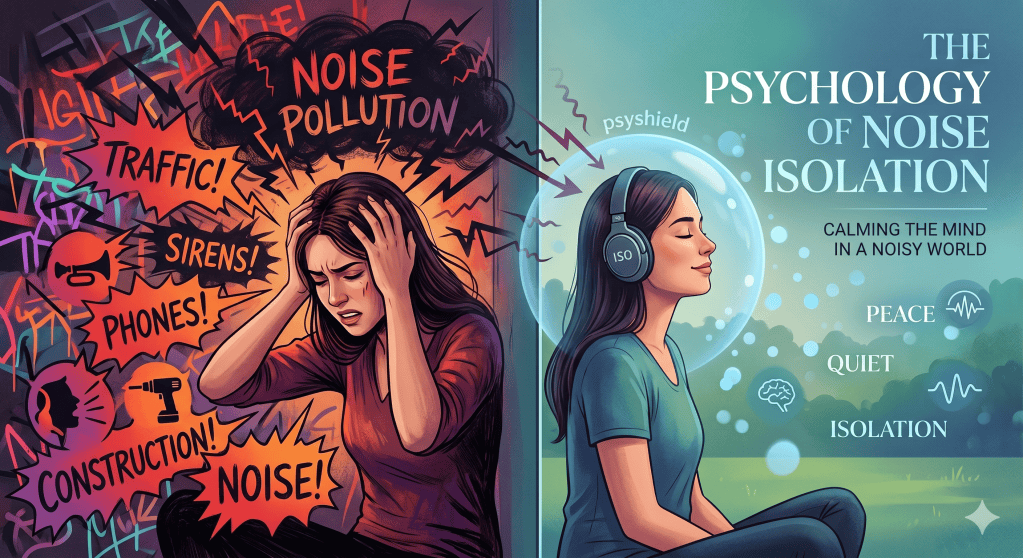
Explore the psychology of noise isolation — how noise affects the brain, why we seek silence, and what science says about acoustic control and mental well-being.
There is a moment most people recognize — the instant you put on a pair of noise-canceling headphones and the world goes quiet. The hum of an airplane engine fades. The office din dissolves. Traffic outside becomes a muffled, distant thing. And something inside you exhales.
That moment isn’t just about comfort. It’s about psychology — about the human brain’s strained relationship with a world that generates far more continuous sensory stimulation than previous generations experienced. The psychology of noise isolation sits at the intersection of neuroscience, sociology, behavioral economics, and plain human need. It explains why millions of people now move through daily life with earbuds planted firmly in their ears, why open-plan offices became notorious for killing productivity, and why silence has transformed from a passive state into something many people actively seek and pay a premium to obtain.
Understanding why we isolate ourselves from noise requires understanding what noise actually does to us — not just as an annoyance, but as a biological stressor with measurable cognitive, emotional, and physical consequences.
What Noise Does to the Brain
The brain never fully stops listening. Even during sleep, auditory processing continues at a low level, ready to sound an internal alarm if something threatening enters the environment. This isn’t a design flaw — it’s an ancient survival mechanism. For most of human evolutionary history, the ability to detect unexpected sounds meant the difference between life and death.
The problem is that this threat-detection system evolved in environments that were generally quieter and less acoustically complex than modern ones. In modern environments, it fires constantly. A notification chime, a colleague’s phone call, a car horn, a construction drill down the street — each of these triggers a small stress response. The brain briefly orients toward the sound, evaluates it, and decides it isn’t dangerous. This process happens in milliseconds, largely below conscious awareness. But it costs something every time.
Research consistently shows that chronic exposure to background noise elevates cortisol levels, the hormone most associated with stress. A landmark series of studies examining children in schools near airports and busy roads found that those exposed to higher ambient noise showed not only elevated stress markers but also measurable deficits in reading comprehension and memory. These weren’t children with any prior learning difficulties — the noise itself appeared to be degrading their cognitive performance.
The mechanism involves what psychologists call cognitive load. The brain has a finite pool of mental resources at any given moment. When background noise is present, a portion of those resources gets diverted toward monitoring and filtering it, even when we’re not consciously aware we’re doing so. This is sometimes described as the “cocktail party effect” in reverse — instead of the remarkable human ability to focus on one voice in a noisy room, we experience the cognitive tax of maintaining that focus.
This filtering process has a name in neuroscience: sensory gating. The brain normally suppresses irrelevant incoming stimuli before they reach conscious awareness, essentially performing its own form of noise cancellation. Sensory gating is what allows you to read in a café without consciously processing every background sound. But this mechanism has limits. Modern acoustic environments — layered with speech, electronic alerts, mechanical noise, and media — can overwhelm the brain’s internal filters, making external filtering tools neurologically appealing in a way that goes beyond simple preference. Noise isolation technology doesn’t just block sound; it offloads part of the sensory gatekeeping work the brain would otherwise have to do itself.
Working memory — the mental workspace where we hold information while actively using it — is particularly vulnerable. Studies using digit-span tasks and reading comprehension tests repeatedly demonstrate that irrelevant speech, even at moderate volumes, impairs the ability to process and retain information. The effect is strongest for speech-like sounds, which is why a conversation happening nearby is more cognitively disruptive than an equivalent volume of white noise. The brain can’t help but attempt to process language.
The Autonomic Nervous System and Sound
Beyond the cognitive effects, noise engages the body in ways that go deeper than the mind. The autonomic nervous system — the branch of the nervous system that governs involuntary functions like heart rate, blood pressure, and digestion — responds directly to acoustic stimulation.
Sudden loud sounds trigger an immediate sympathetic response: heart rate spikes, muscles tense, pupils dilate. Even when the conscious mind quickly recognizes the sound as non-threatening, the physiological response still occurs. Over time, repeated activation of this system — what researchers in environmental medicine call noise annoyance — has been linked to elevated cardiovascular risk. WHO analyses have identified environmental noise as one of the leading environmental health risks in Western Europe, second only to air pollution in some assessments, citing associations with heart disease, sleep disturbance, and cognitive impairment in children.
Sleep is perhaps where noise exposure does its most significant damage. During sleep, the brain cycles through stages of lighter and deeper rest, and environmental noise — even at levels that don’t fully wake the sleeper — can interrupt these cycles, particularly the deeper slow-wave sleep and REM stages. The result is that people living near airports, highways, or in dense urban environments often wake feeling unrested not because they slept fewer hours, but because the acoustic environment prevented them from sleeping well. This isn’t subjective. Studies using polysomnography (the technical monitoring of brain activity during sleep) have confirmed that sleep architecture degrades in proportion to nighttime noise exposure, independent of whether people consciously registered the sounds.
Why We Choose Isolation: The Psychology of Opting Out
Given what noise does to us, it makes intuitive sense that people would want to reduce it. But the modern behavior of active noise isolation — deliberately cutting oneself off from the acoustic environment — carries psychological dimensions beyond simple stress reduction.
One important factor is perceived control. Research in environmental psychology has long established that the negative effects of noise are partially mediated by whether the person feels they have control over it. People subjected to unpredictable noise they cannot stop show greater cognitive impairment and higher stress than people exposed to equivalent noise they believe they can control — even when they don’t actually use that control. This is one of the reasons open-plan offices have become so psychologically taxing. The noise isn’t just present; it’s uncontrollable. You cannot stop a colleague from talking on the phone or laughing loudly. That loss of agency compounds the direct effects of the noise itself.
Noise-canceling headphones and earbuds restore a sense of agency. They transform a passive victim of the acoustic environment into someone who has actively chosen their sensory inputs. This explains part of why people wear them even when not listening to music — the headphones function as a psychological tool as much as an acoustic one.
There’s also the concept of restorative environments, developed by environmental psychologists Rachel and Stephen Kaplan in the 1980s. Their Attention Restoration Theory proposes that directed attention — the focused, effortful concentration required for most work and complex tasks — is a fatigable resource. Environments that allow it to recover are described as restorative: they tend to be quiet, natural, and free from demands on directed attention. The popularity of nature sound playlists, rain recordings, and ambient soundscapes isn’t simply a matter of taste. These acoustic environments may actually facilitate cognitive recovery by engaging a lighter, more involuntary form of attention while allowing directed attention to rest.
The Social Dimension: Isolation as Communication
Noise isolation has a social meaning that complicates its psychology. Wearing headphones in a public space or an office sends a signal: I am not available. In some contexts, this is entirely unambiguous and accepted. On a subway or in a coffee shop, earbuds function as a kind of social contract — a visual shorthand for “I am in my own world right now.” Most people honor this signal without friction.
In workplaces and social environments, the calculus becomes more fraught. The rise of open-plan offices was, in part, a bet on spontaneous collaboration — the idea that removing physical barriers between people would increase information sharing and creative exchange. The evidence for this hypothesis has been mixed at best, and several studies have found that open-plan offices actually decrease face-to-face interaction while increasing noise complaints. Workers adapt by putting on headphones, which in turn reduces the casual conversation that open plans were supposed to encourage. The architecture creates the noise; the noise creates the isolation; the isolation undermines the original purpose.
This suggests that noise isolation is not purely an individual psychological response but also a social and organizational phenomenon. People are not retreating into their headphones because they are naturally antisocial. They are doing so because environments have been designed in ways that make unmediated attention nearly impossible. The headphones are a workaround — an individual solution to a collective problem.
Psychologists who study social withdrawal also note that chosen isolation is categorically different from forced or involuntary isolation. Voluntary solitude — the deliberate decision to be alone or acoustically sealed off — is associated with rest, creativity, self-reflection, and psychological renewal. People who report higher comfort with voluntary solitude tend to show lower rates of loneliness and greater emotional regulation. What matters, again, is control. Isolation chosen is experienced very differently from isolation imposed.
Noise and Cognition: Deeper Cuts
The relationship between noise and cognitive performance is not entirely negative, which introduces some important nuance. Research on optimal stimulation — going back to the Yerkes-Dodson law from the early twentieth century — suggests that performance on complex tasks tends to be best at intermediate levels of arousal. Too little stimulation can leave the mind wandering; too much overwhelms it. This is sometimes cited to explain why some people genuinely focus better with moderate background noise, such as the ambient sounds of a coffee shop, compared with total silence.
A paper by Mehta, Zhu, and Cheema published in the Journal of Consumer Research received considerable attention for suggesting that a moderate level of ambient noise (around 70 decibels) could enhance creative performance compared with both low noise and high noise conditions. The proposed mechanism involved a slight increase in cognitive disruption that forced the brain into more abstract, associative thinking — the kind of loose-connection processing that underlies creativity. This finding has been replicated imperfectly, and some subsequent research has questioned its generalizability, particularly for tasks requiring focused analytical rather than creative thinking.
The picture that emerges is one of individual variation and task specificity. For highly analytical, detail-oriented work — editing, coding, mathematical reasoning — quiet environments typically produce better results. For tasks that benefit from divergent thinking and the generation of new associations, a moderate ambient soundscape may actually be slightly helpful. Neither extreme is universally optimal.
This is why noise isolation, when used thoughtfully, becomes a kind of cognitive self-management tool. People learn, over time, what their own brains need. Some put on instrumental music for focused work; others use nature sounds; others need silence. The ability to create one’s own acoustic environment — to isolate from ambient noise and replace it with a chosen soundscape — represents a form of metacognitive control that was essentially unavailable to most people just a few decades ago.
The Technology of Silence
Active noise cancellation did not create the human need for acoustic refuge — that need is ancient. It made refuge portable. Before this technology became widely available in consumer devices in the early 2000s, managing auditory stimulation required physical changes to environment: closing a door, moving to a quieter room, using ear protection designed for industrial settings. These options either required access to a controlled space or used passive blocking that silenced chosen audio along with unwanted noise. Active noise cancellation decoupled acoustic isolation from sound deprivation — people could silence the world without silencing their music.
The behavioral effects have been significant. The proportion of knowledge workers using headphones while working has risen sharply over the past fifteen years. The subsequent development of true wireless earbuds — small, discrete, no connecting wire — removed even the visual marker of “someone with headphones on,” normalizing acoustic self-management across contexts where it would once have seemed antisocial or unusual. As the technology shrank, the behavior expanded.
The Dark Side of Noise Isolation
No honest examination of the psychology of noise isolation can ignore its costs. The same mechanisms that make acoustic isolation restorative can, in excess or in the wrong contexts, produce their own kind of harm.
The most straightforward cost is situational awareness. Pedestrians wearing earbuds are measurably less likely to hear approaching vehicles, bicycle bells, or other environmental warnings. Several cities have introduced guidance — and in some cases regulations — around earbud use while crossing streets or cycling. The brain’s background monitoring system, useful as it is for detecting threats, cannot operate through sealed ear canals.
Less obvious but arguably more significant is the effect on spontaneous social contact. The acoustic environment of a neighborhood, a park, or a shared office is not purely noise — it is also the texture of community life. An overheard exchange, a passing greeting, the ambient sound of other people present and engaged with the world — these are low-stakes social inputs that contribute, in aggregate, to a sense of belonging. People who consistently block that ambient layer report, across multiple studies, higher rates of loneliness and reduced sense of social connection. The tool designed to reduce unwanted intrusion can inadvertently reduce wanted contact as well.
There is also the subtler problem of attention fragmentation. Constant audio consumption — cycling through podcasts, music, and calls without acoustic pauses — keeps the mind in a state of continuous input. The silence that noise isolation is supposed to create often gets immediately filled with chosen content. This is understandable, but it means the restorative pause that cognitive science recommends — time when the brain is neither processing environmental noise nor consuming media — rarely arrives. Directed attention needs rest, not substitution.
None of this makes noise isolation a net negative. The harms of uncontrolled noise exposure are better documented and more severe than the harms of managing it. But the technology works best when used with some awareness of what gets lost, not just what gets blocked.
Finding the Balance
What the psychology of noise isolation ultimately reveals is something about the nature of modern life itself. We have built environments — cities, offices, transportation systems — that generate acoustic stimulation at levels the human nervous system was not designed to sustain indefinitely. The response has been to seek refuge. Increasingly, that refuge is portable and personal.
The science supports this response as largely rational. But it also makes clear that noise isolation is, at best, an individual solution to a structural problem. Managing noise one pair of earbuds at a time doesn’t address the environments that make that management necessary in the first place.
Understanding what noise does to us connects to larger questions about how we design the spaces we share — urban environments, workplaces, schools — and the social norms we establish around attention and availability. The earbuds in people’s ears are not just a consumer product. They are, in a quiet and literal way, a statement about the limits of what the human brain can absorb — and a reminder that many of our most personal habits are adaptations to environments we rarely stop to question.









