
riginally drafted in July 2025 and comprehensively updated and edited in June 2026
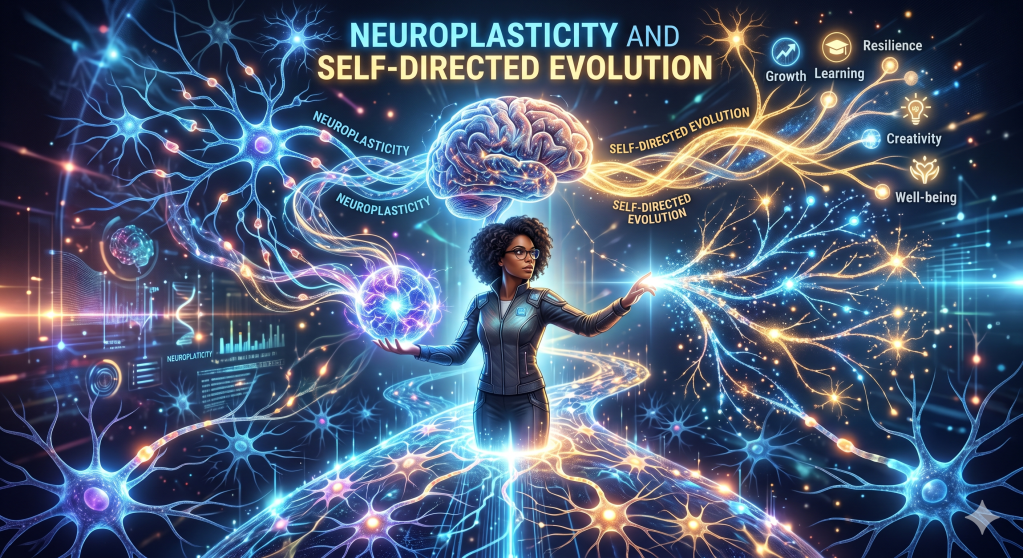
Explore how neuroplasticity reshapes the brain throughout life and how habits, technology, and environment influence human development.
Human beings have always been shaped by their environments. The societies we build, the technologies we create, the habits we practice, and the ideas we repeat gradually influence how we think and behave. For most of history, these changes unfolded slowly across generations. Today, they often occur within a single lifetime.
The early decades of the twenty-first century created a unique psychological environment. Smartphones became constant companions. Social media transformed communication. Digital platforms competed aggressively for attention. Information became abundant while focus became increasingly scarce. At the same time, advances in neuroscience were revealing something remarkable about the human brain: it is far more adaptable than previously believed.
The old view imagined the adult brain as relatively fixed. Personality, intelligence, habits, and behavioral tendencies were often treated as stable characteristics that changed little after childhood. Modern research has challenged that assumption. Scientists now understand that the brain remains capable of significant reorganization throughout life. Experiences, behaviors, environments, and deliberate practice can physically alter neural pathways.
This discovery has profound implications. If the brain continually adapts to what it repeatedly experiences, then every technology, habit, and social system participates in shaping who we become. More importantly, individuals are not merely passive products of these forces. To a meaningful degree, people can intentionally influence their own development.
This intersection of neuroscience, psychology, technology, and personal agency raises an important question: if the human brain is constantly changing, how much influence do we have over the direction of that change?
The answer lies within the concept of neuroplasticity and what might be called self-directed evolution—the ability of individuals to consciously shape aspects of their own cognitive and behavioral development.
Understanding Neuroplasticity
Neuroplasticity refers to the brain’s ability to modify its structure and function in response to experience.
Every thought, action, memory, skill, and habit emerges from networks of neurons communicating through electrical and chemical signals. These neural connections are not static. They strengthen, weaken, reorganize, and sometimes disappear entirely depending on how frequently they are used.
The principle is often summarized by the phrase, “neurons that fire together wire together.” While somewhat simplified, the phrase captures an important reality. Repeated experiences reinforce specific neural pathways, making certain patterns of thought and behavior increasingly automatic.
Learning a language provides a familiar example. At first, vocabulary and grammar require conscious effort. Over time, repeated practice strengthens neural connections involved in language processing. Eventually, comprehension and speech become more fluid and automatic.
The same process applies to far more than academic learning. Emotional responses, social behaviors, attention patterns, and even ways of interpreting reality can be reinforced through repetition.
Neuroplasticity is not inherently positive or negative. The brain adapts to whatever receives repeated attention. Beneficial habits can strengthen useful neural networks, but destructive habits can become deeply embedded as well.
The brain is constantly learning from experience, whether that learning is intentional or not.
The Historical Shift in Scientific Understanding
For much of the twentieth century, many neuroscientists believed that substantial brain development largely ended during childhood. Adult brains were viewed as relatively fixed structures.
This perspective began changing through decades of research involving rehabilitation, learning, and brain imaging.
The evidence accumulated from many directions. Stroke patients sometimes recovered functions once thought permanently lost. Musicians developed measurable differences in brain regions associated with fine motor control. Advances in neuroimaging revealed that learning and experience were continually reshaping neural networks throughout adulthood.
What emerged was a very different picture of the brain. It was not a finished machine that gradually wore down with age. It was an adaptive system that remained responsive to experience throughout life.
This shift represented one of the most significant developments in modern neuroscience because it changed how scientists think about learning, recovery, aging, and human potential.
The Brain as an Experience-Dependent Organ
One of the most important insights from neuroplasticity research is that the brain develops in response to experience.
This may sound obvious, but the implications are profound.
Every environment presents a collection of challenges, rewards, stimuli, and behavioral expectations. The brain adapts to meet those demands.
A hunter-gatherer living thousands of years ago developed cognitive skills suited to tracking animals, remembering landscapes, and navigating natural environments. A factory worker in the nineteenth century adapted to the rhythms and demands of industrial labor. A modern knowledge worker may spend much of the day interacting with screens, managing information, and shifting attention between multiple digital tasks.
Different environments encourage different forms of cognitive development.
Over time, neural systems tend to adapt toward the demands most frequently imposed by the environment.
The answer influences which neural pathways are strengthened and which are neglected.
This process occurs continuously throughout life.
Technology as a Force of Neural Adaptation
The digital revolution introduced an unprecedented form of environmental influence.
Unlike previous technologies, smartphones and internet-connected platforms accompany people throughout nearly every waking hour. They do not merely assist behavior. They actively shape patterns of attention, communication, memory, and social interaction.
Most people have experienced moments that would have seemed strange only a generation ago. A notification appears and attention immediately shifts. A hand reaches for a phone during a brief lull in conversation. Someone opens a browser tab, becomes distracted by another link, and forgets what they intended to do in the first place. Many people find themselves checking devices dozens or even hundreds of times per day without consciously deciding to do so.
These behaviors may seem insignificant in isolation. Neuroplasticity suggests they are not.
A person who checks a phone two hundred times a day is practicing a cognitive behavior whether they realize it or not. Each glance reinforces a habit of monitoring for novelty. The brain does not evaluate whether the practice is beneficial. It simply adapts to the behavior being repeated.
Attention has become one of the most heavily studied areas in this regard.
Many digital platforms are designed around frequent novelty. Notifications, feeds, recommendations, messages, and algorithmically selected content continually compete for awareness. This creates an environment that rewards rapid shifts in attention.
Research suggests that repeated exposure to such environments can influence attentional habits. People may become increasingly accustomed to fragmented information streams and frequent task-switching.
This does not mean technology is inherently harmful. Digital tools have expanded access to information, education, creativity, and social connection in extraordinary ways.
However, neuroplasticity reminds us that repeated behaviors have consequences.
The brain adapts to the environments it inhabits. If an environment rewards constant distraction, the brain may become more skilled at distraction. If an environment rewards sustained concentration, the brain may become better at deep focus.
Technology is not simply something we use. It is also something that uses repetition to shape us.
Habit Formation and the Architecture of Behavior
Habits provide one of the clearest examples of neuroplasticity in everyday life.
A habit begins as a conscious action. Through repetition, the brain gradually automates the behavior. This automation conserves mental energy and allows people to perform routine tasks without constant deliberation.
Driving a car illustrates this process. Beginners must consciously monitor every action. Experienced drivers perform many of the same actions automatically.
The same mechanism applies to emotional and behavioral habits.
People often think of habits as external behaviors such as exercising or brushing their teeth. Yet many habits occur internally.
Patterns of worry can become habitual.
Patterns of optimism can become habitual.
Patterns of self-criticism can become habitual.
Someone who repeatedly interprets setbacks as personal failures may gradually strengthen a habit of negative self-evaluation. Someone who consistently reframes difficulties as challenges to overcome may reinforce a very different pattern. Neither process happens overnight, but both involve repeated mental practice.
This does not mean thoughts directly rewire the brain in simplistic ways often portrayed in popular self-help literature. The scientific reality is more nuanced. However, repeated cognitive patterns do influence neural activity over time.
The brain learns what it repeatedly practices.
Self-Directed Evolution
The phrase “self-directed evolution” should not be confused with biological evolution in the traditional Darwinian sense.
Biological evolution operates across generations through genetic variation and natural selection.
Self-directed evolution refers to intentional influence over one’s own cognitive and behavioral development within a lifetime.
Neuroplasticity makes such influence possible.
Individuals cannot redesign their brains at will. Human behavior remains constrained by genetics, biology, circumstances, and countless environmental factors.
Yet people possess a meaningful degree of agency.
They can choose which skills to practice.
They can choose which environments to inhabit.
They can choose which habits to reinforce.
They can choose which forms of information they consume.
Because the brain adapts to repeated experience, these choices accumulate over time.
Small actions repeated consistently often produce larger changes than dramatic but short-lived efforts.
This principle appears repeatedly across domains ranging from education and athletics to psychotherapy and professional development.
The Role of Deliberate Practice
One of the strongest demonstrations of neuroplasticity comes from research on expertise.
Elite performers in fields such as music, sports, chess, mathematics, and medicine typically accumulate thousands of hours of focused practice.
Importantly, improvement does not result from repetition alone.
Researchers distinguish between ordinary repetition and deliberate practice.
Deliberate practice involves targeted effort aimed at improving specific weaknesses. It often requires feedback, concentration, and activities that stretch current abilities.
Such training places demands on neural systems responsible for learning and adaptation.
Over time, performance improves because the brain becomes more efficient at the relevant tasks.
This principle highlights an important aspect of self-directed evolution. Growth is rarely automatic. The brain changes most effectively when challenged in meaningful ways.
Comfort reinforces existing patterns.
Challenge encourages adaptation.
Neuroplasticity and Mental Health
The relationship between neuroplasticity and mental health has become an important area of research.
Conditions such as anxiety, depression, trauma-related disorders, and addiction involve complex biological, psychological, and social factors. No single explanation fully accounts for these experiences.
However, neuroplasticity helps explain why certain therapeutic approaches can be effective.
Psychotherapy often involves identifying and gradually changing patterns of thought, emotion, and behavior. Through repeated practice, individuals can develop alternative responses to situations that previously triggered distress.
Cognitive Behavioral Therapy, for example, focuses partly on recognizing habitual thinking patterns and replacing them with more accurate or constructive alternatives.
Mindfulness-based practices have also attracted scientific attention. Someone who regularly practices mindfulness is effectively training attention itself—repeatedly noticing distraction and gently returning focus to the present moment. Over time, that process may strengthen capacities related to self-awareness and emotional regulation.
These findings should not be interpreted as evidence that people can simply think their way out of serious mental health conditions. Mental health challenges are often complex and require professional support.
Nevertheless, neuroplasticity provides a framework for understanding how gradual psychological change can occur.
The Social Dimension of Brain Change
Humans are social creatures, and neuroplasticity does not occur in isolation.
Relationships, communities, institutions, and cultural norms all influence development.
People often absorb behaviors from those around them. Language, emotional expression, social expectations, and even patterns of attention can spread through groups.
Psychologists sometimes refer to this as social learning.
Children learn by observing parents and peers. Adults continue learning through workplaces, friendships, media environments, and broader cultural influences.
Modern communication technologies have expanded the scale of these influences dramatically.
For much of history, an individual’s social environment consisted primarily of people encountered physically. Today, millions of individuals spend substantial time interacting with digital communities, influencers, online discussions, and algorithmically curated content.
These environments contribute to ongoing neural adaptation.
The brain cannot easily distinguish between influences originating from physical communities and influences encountered repeatedly through digital media.
Both become part of the experience from which learning occurs.
The Limits of Neuroplasticity
Popular discussions sometimes exaggerate the implications of neuroplasticity.
Claims that individuals can become virtually anything through mindset alone are not supported by evidence.
Human development remains influenced by genetics, socioeconomic conditions, health, education, opportunity, and numerous environmental constraints.
Neuroplasticity is powerful, but it is not unlimited.
The brain’s adaptability varies across different functions and stages of life. Some abilities are easier to modify than others. Certain developmental windows appear particularly important for acquiring specific skills.
Furthermore, meaningful change often requires sustained effort over extended periods.
The existence of neuroplasticity does not eliminate biological realities.
What it does suggest is that people are generally more adaptable than earlier scientific models assumed.
The truth lies somewhere between rigid determinism and unlimited self-transformation.
Designing Environments for Better Outcomes
If the brain adapts to experience, then environments matter enormously.
This insight shifts attention away from motivation alone.
People often assume personal change depends primarily on willpower. Yet behavioral science consistently demonstrates the importance of environmental design.
A person attempting to read more may succeed more easily if books are visible and accessible. Someone trying to reduce screen time may benefit from removing distracting applications from their home screen. An individual seeking better physical health may structure routines that make exercise easier and unhealthy behaviors less convenient.
These changes work because they influence what experiences occur repeatedly.
The brain adapts to what it encounters most often.
Self-directed evolution therefore involves more than making decisions. It involves shaping the environments that make certain decisions more likely.
The Future of Human Development
The twenty-first century presents a unique situation in human history.
For the first time, large populations possess both advanced technologies capable of shaping attention and a growing scientific understanding of how those influences affect the brain.
This creates opportunities and challenges.
Artificial intelligence, immersive digital environments, wearable technologies, and personalized learning systems may eventually become significant forces in human cognitive development.
Some technologies may enhance learning and creativity. Others may intensify competition for attention and behavioral influence.
The outcome will depend partly on how societies choose to design and use these tools.
The growing understanding of neuroplasticity offers an important perspective. Human beings are neither passive victims of technological change nor completely independent from it.
We participate in an ongoing feedback loop. We create environments, and those environments help shape us.
Conclusion
The discovery of neuroplasticity fundamentally changed how scientists understand the human brain. Rather than a fixed structure that largely stops developing after childhood, the brain is now understood as a dynamic organ that continually adapts to experience.
This adaptability helps explain how people learn new skills, recover from injuries, develop habits, modify behavior, and respond to changing environments. It also reveals why modern technologies, social systems, and cultural environments exert such powerful influences on human psychology.
The concept of self-directed evolution emerges from this reality. While individuals cannot fully control their development, they possess meaningful influence over the experiences, habits, environments, and practices that shape their brains over time.
Yet perhaps the most important insight is broader than personal development.
Humans occupy a unique position among living organisms. We create environments that shape us, then use our newly shaped minds to create the next generation of environments. Cities, schools, media systems, social networks, and technologies are products of human cognition, but they also become forces that reshape cognition in return. Culture, technology, and psychology exist within a continuous feedback loop.
The twenty-first century may be the first era in which large numbers of people understand that they are actively participating in this process.
Every notification, every habit, every conversation, and every environment we repeatedly inhabit is a form of practice. The brain is always learning from what it repeatedly encounters. Whether we shape that learning consciously—or simply drift into patterns shaped by our environments—may become one of the defining questions of life in an age of pervasive technology.









