
Originally published in July 2025 and comprehensively updated and edited in June 2026.
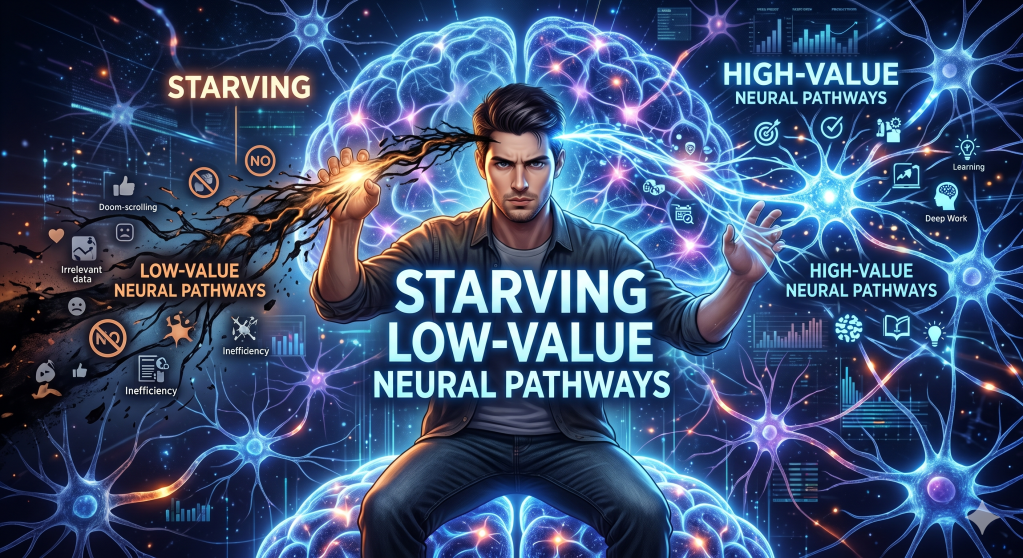
An exploration of neuroplasticity, attention, social media, and modern culture—and how starving low-value neural pathways can reshape behavior.
Human beings have always been shaped by their environments. The customs of a village, the demands of a profession, the expectations of a family, and the technologies of an era all influence how people think, feel, and behave. Yet for most of history, these influences operated at a relatively slow pace. Cultural changes unfolded over generations. Habits developed through repeated routines embedded within daily life.
The digital age altered that rhythm.
Over the past two decades, billions of people have entered environments specifically designed to capture and hold attention. Smartphones, social media platforms, recommendation algorithms, streaming services, online news feeds, and endless notifications transformed attention into one of the most valuable resources in the modern economy. At the same time, neuroscience increasingly revealed something important about the human brain: repeated patterns of attention are not merely experiences. They are forms of training.
Every thought rehearsed repeatedly, every habit reinforced consistently, and every emotional reaction practiced often enough can strengthen the neural pathways that support those behaviors. The brain is not a static machine. It is a living system that adapts to what it repeatedly does.
This understanding has profound implications for modern life.
Many discussions about self-improvement focus on building better habits, developing discipline, or creating healthier routines. These goals are important. But there is another side of the equation that receives less attention: learning how to stop feeding the mental patterns that no longer serve us.
Sometimes growth is not primarily about constructing something new. Sometimes it is about withdrawing reinforcement from what already exists.
The story of modern attention is therefore not only about what we choose to cultivate. It is also about what we choose to starve.
The Brain as an Adaptive System
One of the most significant discoveries in modern neuroscience is the concept of neuroplasticity.
For much of the twentieth century, many scientists believed that the adult brain was relatively fixed. While learning was possible, the underlying structure of the brain was assumed to remain largely stable after childhood.
Research eventually challenged that view.
Scientists found that the brain continuously reorganizes itself throughout life. Connections between neurons strengthen, weaken, and reorganize in response to experience. New skills create new patterns of activity. Frequently used networks become more efficient. Rarely used networks gradually lose influence.
This does not mean the brain can become anything we want it to become. Biology still imposes limits. Genetics still matter. Early development still matters.
However, experience matters far more than many people once believed.
The phrase often used to summarize this principle is simple: neurons that fire together wire together.
While the phrase oversimplifies a complex process, the underlying idea is sound. Repetition strengthens neural connections. Practice changes the brain.
What is often overlooked, however, is that the reverse process also occurs.
Neural pathways that receive less reinforcement tend to weaken over time. Skills deteriorate when neglected. Languages become harder to speak when unused. Habits fade when they are no longer practiced.
The brain is constantly reallocating resources toward what appears important based on repeated experience.
In effect, attention functions as a vote for future versions of ourselves.
Every time we repeatedly engage a pattern of thought or behavior, we signal that the pattern deserves continued investment.
Attention as Practice
Many people think of practice as something intentional.
Learning piano is practice. Studying mathematics is practice. Training for a marathon is practice.
Yet the brain does not always distinguish between deliberate practice and accidental repetition.
Repeated exposure is still repetition.
Every notification, every habit, every conversation, and every recurring experience is a form of practice.
This idea becomes especially important when considering modern digital environments.
A person who checks social media dozens of times per day is practicing attentional fragmentation.
A person who repeatedly seeks outrage-inducing content is practicing outrage.
A person who constantly compares their life to curated online portrayals is practicing social comparison.
A person who refreshes news feeds every few minutes is practicing vigilance.
Imagine someone who begins checking social media only during breaks at work. Over several years, those occasional checks gradually become reflexive. Moments of boredom trigger phone use automatically. Waiting in line becomes scrolling. A few spare seconds become an invitation to seek stimulation. What began as a tool slowly becomes a default response pattern. The change feels invisible because it happens one repetition at a time.
Most people would never consciously choose these activities as training programs. Yet from the brain’s perspective, training is occurring nonetheless.
The pathways associated with these behaviors receive repeated reinforcement.
Over time, what begins as occasional behavior can become a default tendency.
The individual may eventually experience the resulting mental state as part of their personality, when in reality it may be partially shaped by years of repeated environmental conditioning. Attention, in this sense, is not merely something we direct. It is something we rehearse.
The Rise of Attention Economies
Understanding modern neural training requires understanding the environments in which people now spend their time.
Historically, businesses competed for money.
Today, many businesses compete for attention.
The growth of advertising-supported digital platforms created powerful incentives to maximize user engagement. The longer people remain on a platform, the more opportunities exist to display advertisements, collect behavioral data, and generate revenue.
This does not necessarily require malicious intent. Many engineers and designers genuinely seek to create useful products.
Nevertheless, the economic incentives are clear.
Systems are often optimized to increase clicks, views, shares, comments, and time spent interacting.
Algorithms learn which content generates stronger emotional reactions. Content that evokes surprise, outrage, fear, excitement, curiosity, or validation often receives greater engagement.
As a result, individuals increasingly inhabit environments that continuously compete for psychological resources.
The challenge is not simply that these systems capture attention.
The deeper challenge is that repeated exposure trains patterns of attention that persist beyond the screen itself.
The brain gradually adapts to the environment in which it spends its time.
There is another implication that is easy to overlook. People often assume that attention follows importance—that we pay attention to things because they matter. But the relationship frequently works in the opposite direction as well. What we repeatedly attend to gradually begins to feel important, regardless of whether it truly is. Repetition can create significance. The subjects, conflicts, anxieties, and aspirations that occupy our attention most consistently often come to dominate our perception of reality.
This helps explain why attention is so consequential. It does not merely influence what we think about. It can influence what we come to value.
Why Negative Content Often Feels So Powerful
One of the most noticeable features of modern media is the prevalence of emotionally charged content.
This tendency is not entirely new.
Human beings evolved under conditions where paying attention to potential threats carried survival value. Missing a danger could be costly. Missing a pleasant opportunity was often less consequential.
Psychologists sometimes refer to this tendency as negativity bias.
Negative information often captures attention more quickly, generates stronger emotional reactions, and remains memorable for longer periods.
Digital platforms did not create this bias.
They inherited it.
Algorithms optimized for engagement frequently discover that emotionally activating content generates stronger responses than neutral information.
Consequently, users may find themselves repeatedly exposed to material that triggers anxiety, anger, fear, resentment, or outrage.
Each exposure may seem insignificant.
Thousands of exposures accumulated over years are not insignificant.
They become part of the brain’s training environment.
The Social Media Experiment No One Intended to Run
Social media introduced a historically unusual condition.
For most of human history, individuals compared themselves primarily to people within their immediate communities.
Today, people can compare themselves to millions of carefully curated representations of success, beauty, wealth, status, and achievement.
The psychological consequences are still being studied.
Research suggests that excessive social comparison can contribute to dissatisfaction, anxiety, lowered self-esteem, and distorted perceptions of normal life.
Importantly, these effects do not necessarily arise because people consciously believe everything they see online.
Knowing that an image is filtered does not eliminate its psychological influence.
Knowing that a lifestyle is curated does not completely prevent comparison.
The human brain responds to repeated exposure even when skepticism is present. Repeated encounters with idealized portrayals can gradually shape expectations, perceptions, and standards of comparison.
The pathways associated with comparison receive practice.
The pathways associated with contentment may receive less.
Habits, Reward Loops, and Reinforcement
Behavioral psychology provides another important piece of the puzzle.
Human behavior is strongly influenced by reinforcement.
Actions followed by rewarding outcomes tend to be repeated.
This principle helps explain why digital environments can become so compelling.
Likes, comments, notifications, messages, recommendations, and new content often arrive unpredictably.
Psychologists have long known that variable rewards can be especially effective at sustaining behavior.
Slot machines represent a classic example.
Digital technologies are obviously very different from gambling devices, but they often employ similar reinforcement dynamics.
The next refresh might reveal something interesting.
The next notification might contain something rewarding.
The next video might be even better.
The uncertainty itself becomes engaging.
Repeated participation strengthens the associated behavioral loops.
Eventually, many actions occur automatically, with little conscious deliberation.
Starving a Pathway
The phrase “starving low-value neural pathways” may sound dramatic, but the concept is relatively simple.
The term is meant metaphorically. “Starving” in this context does not mean eliminating a neural pathway entirely. It means reducing the reinforcement that keeps a pattern highly accessible, automatic, and influential in everyday behavior.
A neural pathway cannot remain dominant indefinitely without reinforcement.
If repeated attention strengthens a pattern, withdrawing attention can weaken it.
This principle appears throughout everyday life.
Unused skills fade.
Forgotten routines disappear.
Former habits lose strength.
Emotional reactions that are no longer rehearsed often become less automatic.
The process is rarely immediate.
People frequently expect psychological change to occur quickly. In reality, the brain tends to change gradually.
The pathway may still exist.
The impulse may still arise.
The difference is that repeated non-reinforcement reduces its influence over time.
Many therapeutic approaches utilize versions of this principle.
People learn to interrupt automatic reactions, challenge habitual thought patterns, or redirect attention toward more constructive alternatives.
The goal is not suppression.
The goal is reducing reinforcement.
The Difference Between Suppression and Starvation
This distinction matters.
Attempts to force thoughts away often produce paradoxical results.
Trying not to think about something can make it more mentally salient.
Psychologists have documented this phenomenon in numerous contexts.
Starvation operates differently.
Instead of fighting a thought, behavior, or impulse directly, a person simply stops feeding it.
Attention is withdrawn.
Repetition decreases.
The pathway receives fewer opportunities for activation.
Over time, alternative pathways gain relative strength.
This process is less dramatic than many self-help narratives suggest.
There is rarely a moment of transformation.
More often, there is a gradual shift in probabilities.
An old reaction becomes slightly less likely.
A healthier response becomes slightly more available.
The cumulative effect can be substantial.
Cultural Consequences of Collective Attention
The discussion becomes even more interesting when expanded beyond individuals.
Entire societies possess patterns of collective attention.
Media systems influence what populations discuss.
Algorithms influence which topics become visible.
Cultural norms influence which behaviors receive approval.
Large groups of people can simultaneously reinforce similar psychological tendencies.
This does not mean societies are programmed like machines.
Human behavior remains extraordinarily complex.
Nevertheless, attention shapes culture just as culture shapes attention.
When millions of people repeatedly engage with outrage-based content, outrage becomes more culturally prominent.
When millions repeatedly engage with status competition, status competition becomes more visible.
When millions repeatedly engage with fear-inducing narratives, collective perceptions of risk may shift.
The relationship is reciprocal.
Individual neural pathways and cultural environments continuously influence one another.
Reclaiming Agency in an Age of Constant Stimulation
Recognizing these dynamics does not require rejecting technology.
Modern technologies provide extraordinary benefits.
They enable communication across continents, access to knowledge, educational opportunities, creative expression, and countless practical conveniences.
The challenge is not technology itself.
The challenge is understanding that every environment trains something.
No environment is neutral.
Every platform encourages certain behaviors more than others.
Every information source shapes attention in particular ways.
Every routine reinforces some pathways while neglecting others.
Once this becomes visible, an important question emerges:
What kinds of mental patterns deserve reinforcement?
The answer will differ among individuals.
Some may prioritize curiosity.
Others may prioritize patience, creativity, focus, resilience, compassion, or deep learning.
Regardless of the specific goal, the underlying principle remains similar.
The brain becomes what it repeatedly practices.
Building better habits matters.
But reducing reinforcement of unhelpful habits matters as well.
Growth is often as much subtraction as addition.
The Future of Human Attention
The twenty-first century may ultimately be remembered as an era defined by competition for attention.
Artificial intelligence, personalized recommendation systems, immersive media, wearable technologies, and increasingly sophisticated digital platforms are likely to intensify this competition rather than reduce it.
As these systems become more capable, understanding the mechanics of attention may become increasingly important.
The central challenge is not merely technological.
It is psychological.
Human beings possess brains that continuously adapt to experience.
Every day, individuals cast countless votes for the kinds of minds they are becoming.
Most of those votes occur through ordinary actions that seem insignificant in isolation.
A notification opened.
A feed refreshed.
A video watched.
A conversation joined.
A habit repeated.
The cumulative effects of these experiences may ultimately shape far more than individual behavior. They may influence the character of entire cultures.
Understanding neuroplasticity reminds us that change is always occurring, whether intentionally or unintentionally.
The question is not whether our neural pathways are being strengthened.
The question is which pathways are receiving the reinforcement.
And perhaps equally important:
Which pathways are finally being allowed to fade.









