
Originally published in August 2025 and comprehensively updated and edited in June 2026.
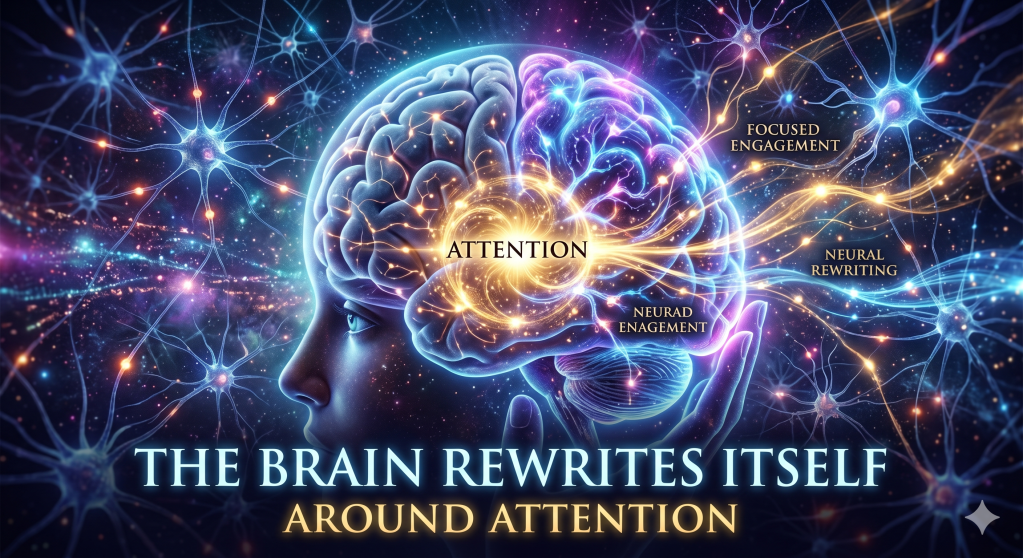
How neuroplasticity, attention, and digital technology reshape the brain, influencing habits, perception, cognition, and behavior over time.
Every swipe, click, notification, and recommendation seems insignificant in isolation. Yet the brain does not experience them in isolation. It experiences them as repetition.
Most people think of attention as something they use. They decide what to focus on, what to ignore, and what deserves their mental energy. But attention also works in the opposite direction. The things that repeatedly capture attention can gradually shape the mind itself.
This idea has become increasingly important in the digital age. Smartphones, social media platforms, streaming services, and algorithmic feeds have created environments that compete constantly for human attention. For the first time in history, billions of people live inside information systems specifically designed to attract, hold, and redirect focus throughout the day.
Much of the public conversation surrounding these technologies centers on distraction. People worry about screen time, shortened attention spans, and the habit of checking devices dozens of times each day. These concerns are understandable, but they may not fully capture what is happening beneath the surface.
The deeper question is what repeated patterns of attention do to the brain over time.
Modern neuroscience has shown that the brain is not a fixed machine. It is a living system that continuously changes in response to experience. Neural connections strengthen, weaken, and reorganize throughout life. Skills improve through repetition because the brain physically adapts to repeated use. Habits become easier because the pathways that support them grow increasingly efficient.
If attention is repeatedly directed toward particular kinds of experiences, those experiences can influence how the brain develops and functions. Over time, this process may shape not only behavior but perception, emotional responses, thinking patterns, and aspects of personality itself.
The story of the digital age is therefore not simply a story about technology. It is also a story about attention, neuroplasticity, habit formation, and the subtle ways environments shape human minds. Understanding this relationship helps explain many of the psychological and cultural changes that have emerged during the past two decades and offers insight into where society may be headed next.
The Discovery That Changed How We Think About the Brain
For much of the twentieth century, many scientists believed that the adult brain was largely fixed. Children learned rapidly because their brains were still developing, but adulthood was often viewed as a period of relative neurological stability.
That view turned out to be incomplete.
Research throughout the late twentieth and early twenty-first centuries demonstrated that the brain remains capable of significant change throughout life. This ability is known as neuroplasticity.
Neuroplasticity refers to the brain’s capacity to modify its structure and function in response to experience. New connections can form between neurons. Existing connections can become stronger or weaker. Networks that are used frequently tend to become more efficient, while those that are rarely used may gradually diminish.
This does not mean the brain can become anything at any time. Biology still imposes limits. However, it does mean that experience matters more than earlier generations often assumed.
Learning a musical instrument changes patterns of brain activity. Practicing a language strengthens relevant neural networks. Repeated physical training alters the brain regions involved in movement and coordination. Professional musicians, athletes, and other specialists often show measurable neurological adaptations related to their expertise.
The principle is straightforward: the brain tends to become better at whatever it repeatedly does.
While this idea is often discussed in the context of education or skill development, it applies equally to everyday habits. From the perspective of neuroplastic adaptation, repeated activity can influence neural pathways whether it arises from deliberate practice or everyday habit.
This observation becomes especially important when considering the modern attention environment.
Attention Is Not Just Awareness
Attention often feels passive. We experience it as simply noticing something.
In reality, attention is one of the brain’s most important resources.
At any given moment, the human brain receives far more information than it can consciously process. Attention acts as a filtering system, determining which signals receive priority and which fade into the background.
Psychologists sometimes describe attention as a spotlight. Whatever falls within the beam receives enhanced processing. Whatever remains outside it receives less.
This filtering process influences memory formation, learning, emotional responses, and decision-making. Information that receives sustained attention is more likely to be remembered. Experiences that capture attention repeatedly become increasingly familiar and cognitively accessible.
In practical terms, attention determines what the brain practices.
When someone spends years solving mathematical problems, the brain practices mathematical reasoning. When someone spends years playing a musical instrument, the brain practices musical perception and motor coordination.
Likewise, when attention becomes habitually focused on rapidly changing streams of fragmented information, the brain is repeatedly practicing a different set of cognitive behaviors.
The significance of this shift became more apparent as digital technologies evolved.
The Rise of the Attention Economy
Early internet users often interacted with relatively static websites. They visited pages intentionally, consumed information, and then left.
Over time, online platforms became increasingly sophisticated. Companies discovered that user attention could be transformed into advertising revenue. The longer people remained engaged, the more opportunities existed to display advertisements and collect data.
This economic incentive encouraged the development of systems designed to maximize engagement.
Notifications, recommendation algorithms, autoplay features, infinite scrolling, personalized feeds, and engagement metrics emerged as powerful tools for maintaining user attention. These innovations were not necessarily created with harmful intentions. Many were designed to increase convenience or improve user experience.
Yet they also created environments optimized to compete continuously for human attention.
Unlike previous forms of media, digital platforms could adapt in real time. Algorithms learned which content attracted engagement and delivered more of it. Every click, pause, comment, or share became information that could be used to predict future behavior.
As a result, attention increasingly became the central resource around which large portions of the digital economy were organized.
The consequences extended beyond technology companies. They influenced journalism, entertainment, marketing, education, and everyday social interaction.
Most importantly, they influenced the conditions under which millions of brains were learning and adapting.
The Brain Learns What It Repeatedly Experiences
One of the most important principles in neuroscience is often summarized by the phrase: “neurons that fire together wire together.”
Although the reality is more complex than the slogan suggests, the underlying idea remains useful. Repeated activation strengthens neural connections.
When certain patterns occur again and again, the brain becomes increasingly efficient at producing them.
This principle helps explain why habits become automatic. Initially, a new behavior requires conscious effort. Over time, repetition reduces the mental energy required to perform it.
The same process can influence patterns of attention.
If a person repeatedly switches between dozens of stimuli every few minutes, the brain practices rapid attentional shifting. If someone constantly monitors notifications, the brain becomes accustomed to frequent interruptions. If entertainment, information, and social feedback arrive in short bursts, the brain repeatedly experiences cycles of novelty and anticipation.
None of these experiences automatically produce negative outcomes. Human beings are adaptable, and many people successfully integrate digital technology into healthy lives.
However, repeated experiences can still shape cognitive tendencies.
The brain learns not only what to think about but also how to think.
Novelty, Reward, and Dopamine
One reason digital environments can be so compelling involves the brain’s reward systems.
Popular discussions often reduce dopamine to a “pleasure chemical,” but neuroscientists generally view it as more complicated than that. Dopamine is involved in motivation, learning, anticipation, and reward prediction.
Unexpected rewards can produce particularly strong responses.
This mechanism was useful throughout human evolution. Organisms that paid attention to potentially valuable opportunities often gained survival advantages. New sources of food, information, or social opportunity could be important.
Modern digital platforms frequently present users with unpredictable rewards.
A notification might contain exciting news. A message could arrive from a friend. A video might be entertaining. A social media post might receive positive feedback. Most interactions are relatively ordinary, but occasionally something highly rewarding appears.
Psychologists sometimes compare this pattern to variable reward schedules, which are known to encourage repeated engagement. Because the next reward is uncertain, individuals may feel motivated to keep checking.
Again, this does not mean technology functions exactly like an addictive substance. Such comparisons are often oversimplified. Human behavior is influenced by many factors.
Nevertheless, reward systems can reinforce habits of attention. The brain learns that checking, refreshing, and scrolling sometimes lead to rewarding outcomes. Repetition strengthens the behavioral loop.
Over months and years, these patterns can become deeply familiar.
Fragmented Attention and Cognitive Habits
The concern raised by many researchers is not simply that people spend time online. Rather, it is that certain forms of digital interaction encourage particular cognitive habits.
Many online experiences involve rapid transitions between topics. A user may move from a news article to a text message, from a video to an advertisement, from a social media post to an email, all within a few minutes.
This constant switching imposes cognitive costs.
Research in psychology has repeatedly shown that task switching can reduce efficiency and increase mental fatigue. The brain often requires time to reorient after an interruption. Frequent switching may create the subjective feeling of productivity while reducing the depth of engagement with any single task.
Over time, repeated exposure to fragmented information may encourage a preference for shorter, faster, and more immediately rewarding forms of content.
This does not mean people lose the ability to engage deeply. Many individuals still read books, pursue complex careers, and develop sophisticated expertise.
However, the surrounding environment increasingly rewards rapid engagement rather than sustained concentration. As a result, deep attention often requires more deliberate effort than it once did.
The challenge is not that focused thought has become impossible. The challenge is that distraction has become easier, more abundant, and more persistent than at any previous point in human history.
How Environments Shape Personality
People often think of personality as something stable and internal.
Certain personality traits do exhibit substantial stability over time. Yet psychological research also shows that behavior is influenced by context. Environments can encourage some tendencies while discouraging others.
Someone who spends years in a highly competitive environment may become more competitive. Someone immersed in a collaborative environment may become more cooperative. Social norms influence behavior, and repeated behavior can eventually influence identity.
The same principle may apply to attention.
Personality traits are influenced by genetics, development, and life experience, but attentional habits may still shape how those traits are expressed in daily life.
Imagine two individuals living in dramatically different information environments.
One spends large portions of each day engaging with long-form material, sustained conversations, and uninterrupted work. The other spends much of the day navigating rapidly changing digital feeds filled with notifications and constant novelty.
Their brains are repeatedly practicing different forms of attention.
Over time, these differences may influence how they process information, regulate emotions, evaluate experiences, and interact with the world.
The resulting psychological patterns may eventually feel natural and self-generated. Yet they may be partially shaped by years of environmental conditioning.
In this sense, technology does not merely provide tools. It can create conditions that influence the development of habits, preferences, and cognitive tendencies.
The Social Consequences of Attention Training
Changes in attention do not occur only at the individual level.
When millions of people experience similar attention environments, broader cultural effects can emerge.
News organizations compete for clicks and engagement. Entertainment increasingly favors content that captures attention quickly. Social media encourages constant visibility and frequent interaction. Public discourse often becomes shaped by what spreads most effectively through digital networks.
These incentives can influence what information becomes prominent and how people consume it.
Short-form content has obvious advantages. It is convenient, accessible, and easy to share. Yet a culture dominated by rapid information exchange may sometimes struggle with complexity. Many important issues do not fit neatly into a headline, a short video, or a brief social media post. Scientific research, economic policy, legal systems, and public health questions often require sustained attention to understand fully.
This creates a tension between the speed at which information travels and the time required to evaluate it carefully. Nuanced explanations may spread more slowly than emotionally engaging claims. Context can be lost as information moves through networks designed to maximize visibility rather than comprehension.
The result is not necessarily widespread misinformation or declining intelligence. Rather, it is an environment in which complexity often competes at a disadvantage. Public debates may become increasingly shaped by the content that captures attention most effectively rather than the content that best reflects reality. Outrage, novelty, and certainty frequently travel faster than nuance, ambiguity, or careful analysis.
These dynamics can also contribute to polarization. Individuals may encounter highly curated streams of information that reinforce existing interests and beliefs. At the same time, online platforms often place diverse audiences into the same digital spaces, where statements intended for one context are interpreted in another. Sociologists sometimes refer to this phenomenon as “context collapse.” Communication that once occurred within specific social groups becomes visible to everyone at once, often increasing misunderstanding and conflict.
None of these outcomes are inevitable. Digital technologies have also expanded access to knowledge, connected communities across great distances, and created opportunities for learning that previous generations could scarcely imagine. Yet the broader cultural effects of attention training remain an important subject of study because the habits encouraged at the individual level can accumulate into larger social patterns.
Attention as a Form of Self-Construction
One of the most profound implications of neuroplasticity is that attention is not merely a tool for interacting with the world.
It is also a mechanism through which the world interacts with us.
Every repeated focus strengthens some pathways while leaving others relatively undeveloped. Every habit of attention represents a small act of neural training. Every environment encourages certain patterns of thought while making others less likely.
This process is largely invisible because it unfolds gradually.
People rarely notice the formation of a habit while it is occurring. They notice only the result after the pattern has become familiar.
A person who repeatedly practices patience may become more patient. A person who repeatedly practices distraction may become more distractible. A person who repeatedly engages with complex ideas may become more comfortable navigating complexity.
Attention therefore functions as a form of self-construction.
The brain is constantly adapting to whatever receives repeated focus. In a very real sense, the experiences that capture attention help shape the mind that experiences them.
Conclusion
The modern world has created an unprecedented competition for human attention. Smartphones, social media platforms, recommendation algorithms, and digital media systems have transformed the informational environment in which billions of people live.
At the same time, neuroscience has revealed that the brain remains remarkably adaptable throughout life. Neuroplasticity allows experience to influence the structure and function of neural networks, making repeated patterns of thought and behavior increasingly efficient over time.
Taken together, these developments suggest a powerful insight: attention is not merely a way of observing reality. It is one of the mechanisms through which reality reshapes the brain itself.
The implications extend far beyond concerns about distraction or screen time. They raise broader questions about how environments influence perception, cognition, emotion, and identity. The habits of attention encouraged by a society may gradually become reflected in the minds of the people who inhabit it.
As technology continues to evolve, these questions are likely to become even more important. Artificial intelligence, augmented reality, personalized recommendation systems, and future forms of digital media will create new environments for human attention. The challenge will not simply be deciding what technologies to use, but understanding how those technologies train the patterns of attention through which experience is interpreted.
We often imagine that we become who we are through our choices. Neuroplasticity suggests a subtler possibility: we also become what we repeatedly attend to. Every habit of attention is, in some small way, a rehearsal for the person we are becoming.









