
Originally published in October 2025 and comprehensively updated/edited in June 2026.
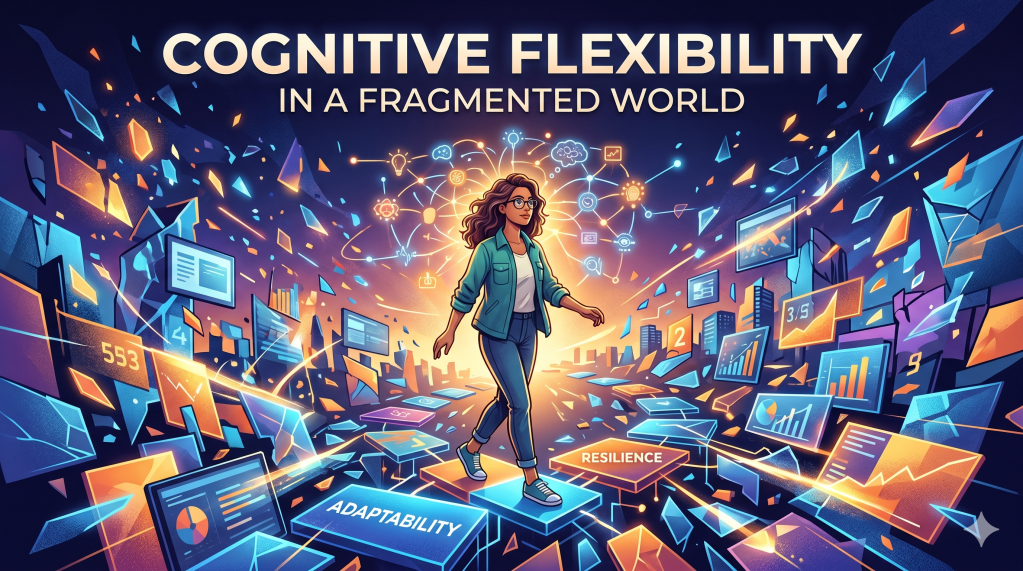
Cognitive flexibility — the brain’s ability to adapt, shift perspectives, and think through ambiguity — became a defining psychological challenge of the 2020s.
The world that emerged in the first half of the 2020s asked something unusual of the people living through it. Not just resilience — that word had already been worn smooth by overuse — but something more cognitively demanding: the ability to hold multiple, often contradictory realities at once. A pandemic had reshuffled daily life. Remote work dissolved the borders between professional and personal space. Artificial intelligence began to reshape whole industries faster than institutions could respond. Political and cultural polarization deepened, sorting people into increasingly separated information environments. And through all of it, the pace of change refused to slow down.
This is the context in which cognitive flexibility — the brain’s capacity to shift between different concepts, adapt to new information, and think about things from more than one angle — became not just a psychological asset, but something closer to a survival skill. The research had been building for decades, but the conditions of the mid-2020s made the concept newly urgent. What does it actually mean to be cognitively flexible? What happens to people when they’re not? And in a world that seems structurally designed to resist the very thing our brains need most, what can be done?
These are the questions this essay explores.
What Cognitive Flexibility Actually Means
The term sounds clinical, but the experience is familiar to anyone who has ever had to abandon a strategy mid-course when it stopped working, or who has listened to someone they disagreed with and genuinely updated their opinion. Cognitive flexibility, in its broadest definition, is the mental ability to switch gears — to stop applying a rule that no longer fits, adopt a new perspective, or engage productively with ambiguity.
Neuroscientists often break it into two overlapping capacities. The first is task-switching, which refers to the ability to move between different cognitive demands without getting stuck. The second is set-shifting, the ability to let go of a previously useful mental framework when the situation changes. Both rely heavily on the prefrontal cortex, the region of the brain most associated with executive function, planning, and impulse control. When researchers study cognitive flexibility in laboratory settings, they often use tasks that require people to follow one set of rules and then abruptly switch to a different set — measuring both the speed and accuracy of that transition.
What emerges from decades of this research is a fairly consistent picture: cognitive flexibility is not a fixed trait. It varies across individuals, yes, but it also varies within the same individual depending on stress levels, sleep, age, emotional state, and environment. It can be strengthened, and it can be degraded. That makes it both more interesting and more concerning than a simple personality characteristic.
The Brain Under Pressure
One of the most robust findings in this area is that stress impairs cognitive flexibility. Specifically, acute and chronic stress both affect the prefrontal cortex in ways that make it harder to shift mental gears. Stress floods the brain with glucocorticoids — a class of hormones that includes cortisol — and over time, elevated cortisol levels are associated with reduced gray matter density in prefrontal regions. This is not abstract neurochemistry. It translates directly into the kind of thinking patterns that became so visible during the social upheavals of the early 2020s: black-and-white reasoning, difficulty updating beliefs in the face of new evidence, and an increased tendency toward cognitive rigidity.
Amy Arnsten, a professor of neuroscience at Yale, has spent much of her career studying how stress weakens prefrontal function. Her research suggests that even moderate, everyday stress can temporarily shift cognitive processing away from the reflective, flexible thinking managed by the prefrontal cortex toward more automatic, habitual responses governed by deeper brain structures. In practical terms, this means that people under sustained pressure are neurologically less equipped to do the very thinking that pressure demands.
The implications for a society navigating prolonged uncertainty are hard to overstate.
A Fragmented Information Environment
Cognitive flexibility doesn’t exist in a vacuum. It develops and operates within environments, and the information environment of the 2020s was one that, in many ways, actively worked against it.
The business model that powers most digital media is built on engagement, and engagement, it turns out, is maximized not by presenting balanced, nuanced content, but by triggering emotional arousal. Fear, outrage, and moral indignation are particularly effective. Recommendation algorithms — the systems that decide what content people see next — learned to optimize for these emotional states because they keep users on platforms longer. The result was an information ecosystem that tended to surface the most extreme, emotionally charged versions of any given story, and to expose people primarily to content that confirmed what they already believed.
This is not a new critique, but the psychological consequences deserve careful examination. Eli Pariser coined the term “filter bubble” back in 2011 to describe the way algorithmic personalization creates isolated information environments. By the mid-2020s, those bubbles had thickened considerably. The concern from a cognitive flexibility standpoint isn’t merely that people were encountering less ideological diversity — it’s that they were being systematically habituated to a particular cognitive mode: one in which complex issues had clear villains and heroes, nuance was a sign of weakness or bad faith, and updating your position meant losing.
Research in social psychology has long identified what’s called belief perseverance — the tendency to maintain a belief even when the evidence supporting it has been refuted. Algorithms don’t create this tendency, but they provide it with a very favorable operating environment. When every piece of content you encounter has been preselected to match your existing worldview, the muscle of perspective-taking gets very little exercise.
Polarization as a Cognitive Phenomenon
Political polarization is often discussed in terms of policy disagreement or cultural conflict. But there’s a cognitive dimension to it that gets less attention. Research by political psychologists like Lilliana Mason has shown that in the United States, partisan identity increasingly functions less like a policy position and more like a social identity — something closer to being a fan of a sports team than holding a set of considered views. Identity-based reasoning, as opposed to evidence-based reasoning, is by definition less flexible. When a belief is tied to who you are rather than what you think, revising it feels threatening in a way that goes beyond the intellectual.
Psychologist Jonathan Haidt’s work on moral foundations theory adds another layer. Haidt argues that people across the political spectrum are reasoning from genuinely different sets of moral intuitions, not just different policy preferences. This means that what looks like irrationality from one perspective is often internally coherent reasoning from another value system. Understanding that doesn’t resolve the disagreement, but it does reframe it — and that reframing is itself an act of cognitive flexibility.
The difficulty is that this kind of perspective-taking requires exactly the mental space and psychological security that a high-stress, high-stakes information environment tends to erode.
Technology and the Attention Economy
To understand why cognitive flexibility became so culturally significant in the 2020s, it helps to look at what was happening to attention itself.
The smartphone, now more than a decade old by this period, had become the dominant interface through which most people in wealthy countries managed their time, relationships, work, and entertainment. The average adult in the United States was spending somewhere between seven and ten hours per day looking at screens of various kinds. More consequentially, that screen time was heavily fragmented — characterized by rapid context-switching, short-form content, and constant notification interruption.
There’s an irony here worth noting. On its surface, this kind of rapid information-switching might look like cognitive flexibility — you’re moving between tasks, jumping between topics, processing diverse inputs. But researchers make an important distinction between reactive context-switching, which is externally driven and often stressful, and deliberate cognitive flexibility, which involves choosing to adopt a new perspective or apply a new rule. The former, practiced relentlessly, may actually undermine the latter. A brain that is perpetually interrupted becomes habituated to shallow processing — good at skimming, poor at sustained engagement with complexity.
Adam Gazzaley, a neuroscientist at UC San Francisco, and Larry Rosen, a psychologist who studies technology’s effects on cognition, documented many of these patterns in their 2016 book The Distracted Mind — and the trends they identified only intensified in the years that followed. Their central argument was that the human brain’s information-foraging instincts, useful in the evolutionary context of physical environments, are being exploited and over-triggered by digital environments designed to maximize engagement. The result is a kind of cognitive fragmentation that makes deep, flexible thinking harder.
The Deep Work Problem
The writer and computer scientist Cal Newport popularized the term “deep work” to describe the kind of focused, cognitively demanding effort that produces complex output — the thinking that requires holding multiple variables in mind simultaneously, making unexpected connections, tolerating ambiguity, and revising your understanding as you go. This is, essentially, a description of cognitive flexibility in action.
Newport’s argument, developed through the late 2010s and extending into the 2020s, was that the conditions for deep work were becoming rarer in modern professional life. Open-plan offices, always-on communication tools, and the expectation of constant availability had created work environments that were structurally hostile to sustained concentration. The shift to remote and hybrid work created some new possibilities for focus, but it also collapsed the boundaries between work and home in ways that introduced new cognitive costs.
What this points to is a collective action problem. Cognitive flexibility requires practice, and the kind of practice it requires — sustained attention, exposure to unfamiliar ideas, deliberate perspective-taking — runs against the grain of many incentive structures built into contemporary digital life. Individuals can work against this, but it is harder than it should be.
Creativity, Ambiguity, and the Flexible Mind
There’s a positive dimension to this story that deserves equal attention.
Cognitive flexibility is consistently associated with creativity. The connection is intuitive: people who can move easily between different ways of framing a problem are better positioned to find solutions that aren’t obvious from any single frame. Psychologists use the term cognitive inhibition to describe the ability to suppress dominant, obvious responses in order to consider less familiar ones — and this capacity is closely related to both flexibility and creative output.
Researcher Sarnoff Mednick proposed in the 1960s that creative insight depends on the ability to form associations between concepts that are not obviously related — what he called “remote associations.” More recent neuroimaging research has added texture to this picture. Studies using functional MRI have shown that highly creative individuals tend to have stronger functional connectivity between brain networks that don’t typically work together at the same time: the default mode network, associated with imagination and spontaneous thought, and the executive control network, associated with focused attention and evaluation. In flexible thinkers, these networks communicate more effectively — which may be why they can both generate novel ideas and critically evaluate them.
This neurological profile helps explain why creative people often seem comfortable with ambiguity in a way that others are not. Tolerating the discomfort of not-knowing — what the poet John Keats famously called “negative capability” — appears to be a feature of cognitively flexible minds, not merely a personality quirk. The psychologist Mihaly Csikszentmihalyi spent decades studying creative people across disciplines and consistently found that the ability to hold apparent contradictions without forcing premature resolution was a hallmark of exceptional creative thinkers.
Education and the Flexibility Gap
Schools have long been criticized for teaching compliance over curiosity, but the stakes of this critique sharpened as the economy increasingly rewarded adaptability. By the 2020s, organizations like the World Economic Forum were consistently ranking cognitive flexibility, creativity, and complex reasoning among the most valuable skills in the labor market — precisely because they are difficult to automate.
Yet educational systems in many countries remained oriented toward the reproduction of established knowledge rather than the cultivation of flexible thinking. Standardized testing, rigid curricula, and the pressure to cover content quickly all tend to frame uncertainty as a problem to be eliminated rather than a condition to be navigated. That framing is the opposite of what cognitive flexibility requires. The broader concern — and it extends well beyond schools — is that institutions built during more stable periods had embedded assumptions about what learning and work should look like that were increasingly out of step with the demands of rapid change.
Adaptability in a Time of Rapid Change
The labor market disruptions of the 2020s put pressure on individuals and institutions in ways that made cognitive flexibility a practical economic matter, not just an abstract psychological virtue.
In stable environments, cognitive rigidity can appear as conviction. In rapidly changing environments, it increasingly becomes a liability.
Automation, accelerated by advances in machine learning and AI, was displacing routine cognitive work — the kind of tasks that could be described in explicit rules and applied systematically. Customer service, basic legal research, financial analysis, content moderation, radiology image reading: all of these were affected to varying degrees. What remained less susceptible to automation was work that required context-sensitivity, judgment under ambiguity, and the ability to navigate situations that hadn’t been encountered before. These are, again, descriptions of cognitive flexibility.
The economic argument points toward something deeper than job skills. Adam Grant, in Think Again (2021), drew a distinction between people who update their thinking readily and those who treat changing their mind as a kind of personal failure. In a world of rapid technological change, the willingness to revise your understanding — to let go of expertise that is no longer relevant and learn something new — may matter as much as the original effort to acquire it. Effort gets you somewhere. Adaptability determines whether you can navigate once you arrive.
The Social Dimension: Trust, Dialogue, and Epistemic Humility
Cognitive flexibility is typically studied as an individual capacity, but it has an irreducibly social dimension. The willingness to genuinely consider a perspective that differs from your own — to hold it as possibly valid rather than as a threat to be defeated — requires a baseline of interpersonal trust that was visibly eroding in many societies during this period.
Research in social psychology consistently shows that trust facilitates the kind of open information-sharing that allows groups to correct errors and update beliefs collectively. Low-trust environments, by contrast, tend to produce defensive reasoning — people share information selectively, interpret ambiguous signals as hostile, and resist updating their positions because doing so feels like ceding ground to an adversary.
The philosopher Miranda Fricker introduced the concept of epistemic injustice to describe situations in which someone is wronged specifically in their capacity as a knower — their testimony is discounted, their perspective is excluded. One of the features of the fractured information environment of the 2020s was a widespread sense, across very different communities, that their knowledge and experience were being systematically disrespected by mainstream institutions. This sense of epistemic grievance, regardless of its specific content, tends to produce exactly the kind of defensive, closed reasoning that cognitive flexibility requires escaping.
This doesn’t mean all claims of epistemic injustice are equally valid. But it does suggest that the social preconditions for collective cognitive flexibility — mutual respect, good-faith engagement, some shared epistemic ground — were being degraded by the same structural forces that were degrading individual cognitive flexibility.
What Research Suggests About Building Flexibility
If cognitive flexibility can be degraded, it can also be cultivated. The research literature offers several directions, though it’s worth noting that most interventions have been studied in controlled settings with specific populations, and translating them to real-world behavior change is rarely straightforward.
Mindfulness-based practices have accumulated a substantial evidence base for improving cognitive flexibility. A 2019 meta-analysis published in Psychological Bulletin found that mindfulness training was associated with improvements in a range of executive function measures, including cognitive flexibility and working memory. The proposed mechanism is that mindfulness practice strengthens the capacity for metacognition — awareness of your own thought processes — which in turn makes it easier to notice when you’re caught in a rigid pattern of thinking and to deliberately shift perspective.
Physical exercise has also shown consistent associations with improved executive function, including flexibility. Aerobic exercise in particular appears to support neuroplasticity in prefrontal regions, partly through the release of brain-derived neurotrophic factor (BDNF), a protein that supports the growth and maintenance of neurons. The effect is not enormous — exercise is not a cognitive supercharger — but it is real and well-replicated.
Exposure to diverse perspectives, when the exposure is genuinely engaging rather than superficial, appears to support flexible thinking by providing more varied mental models to work from. Experimental research by social psychologist Carmit Tadmor has found that people who have lived abroad and genuinely engaged with a different culture tend to show greater creative flexibility than those who haven’t — and that the key factor is psychological integration of the experience, not mere exposure. Diversity, in other words, builds cognitive flexibility only when it is actually processed, not just encountered.
Sleep, perhaps unsurprisingly given its role in memory consolidation and emotional regulation, is also closely linked to flexible thinking. Sleep deprivation consistently impairs prefrontal function, and the REM stages of sleep appear particularly important for the kind of associative thinking that underlies creative problem-solving.
Looking Forward
The tensions explored in this essay — between the cognitive demands of a rapidly changing world and the social and technological forces working against the mental capacities those demands require — were not resolved by the mid-2020s. If anything, they intensified as artificial intelligence accelerated into domains that had previously been considered the exclusive territory of human judgment.
What the research collectively suggests is that cognitive flexibility is not a luxury or a personality trait of the naturally talented. It is a cultivable capacity, distributed across the population, that depends heavily on conditions: the quality of attention the environment permits, the degree of psychological safety available for genuine inquiry, the breadth of perspectives a person is genuinely exposed to, and the level of chronic stress they are navigating.
The fragmented world of the 2020s did not make cognitive flexibility impossible, but it often made it unnecessarily difficult. People adapted, learned new skills, revised their beliefs, built new social connections across old divides. But the structural forces driving that difficulty — algorithmic amplification of outrage, economic insecurity, the erosion of shared epistemic ground — demanded responses at a level beyond individual self-improvement.
Understanding the neuroscience and psychology of cognitive flexibility matters not because it provides easy answers, but because it reframes the problem. The cognitive rigidities that manifested so visibly in public life during this period were not simply the product of ignorance or bad faith. They were, in large part, predictable responses of human brains operating under conditions of sustained stress, social fragmentation, and information overload. That framing neither excuses the consequences nor eliminates the responsibility to do better — but it does open different possibilities for how to think about getting there.









