
Originally published in December 2025 and comprehensively updated/edited in June 2026.
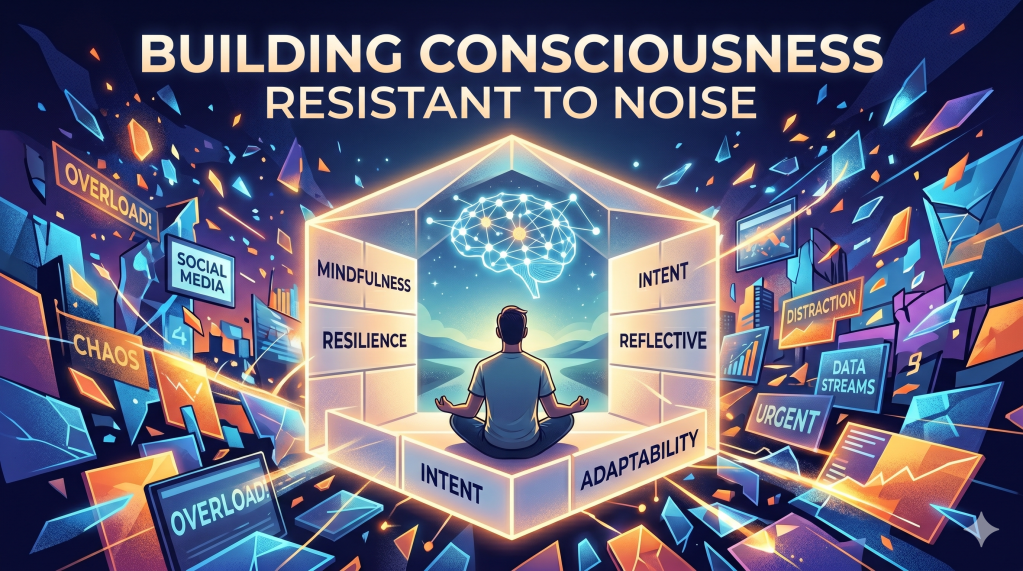
How modern information environments exploit human cognition — and the psychological, neurological, and behavioral practices that build genuine mental resilience.
Every era has had its forms of noise. Ours may be the first designed by machines that learn what captures attention and then become better at capturing it tomorrow. Notifications, outrage cycles, algorithmic feeds, breaking news that breaks again differently an hour later — the noise is not incidental. It is structural. And over the past several years, that structure has grown more sophisticated, more pervasive, and more difficult to simply walk away from.
The phrase “building consciousness resistant to noise” might sound abstract at first — perhaps like something from a wellness retreat brochure or a philosophy seminar. But it describes something concrete and urgent: the deliberate cultivation of an inner life that can sustain attention, tolerate ambiguity, and hold coherent values even when the surrounding environment is doing everything it can to fragment all three. This is not a new human challenge. People have always had to think clearly under pressure, hold their own against propaganda, resist the pull of crowds. What is new is the scale, the speed, and the precision with which modern information environments can exploit the specific vulnerabilities of human cognition.
This essay examines why those vulnerabilities exist, how contemporary conditions exploit them, what the psychological and neurological consequences look like, and what it means to cultivate a mind capable of remaining coherent amid noise.
The Architecture of Distraction
How the Environment Was Redesigned Around Attention
To understand the problem, it helps to understand how thoroughly the environment has changed in a short period of time. As recently as the early 2000s, the average person’s information diet was constrained by the relatively slow pace of print and broadcast media. News cycles ran on 24-hour loops. Social interaction, for most people, happened face to face or over the telephone. The friction built into communication — the time it took to write a letter, make a call, sit down with a newspaper — imposed a kind of natural pacing on how much information could reach any one person in a day.
That friction is gone. The smartphone, social media, and algorithmically curated content feeds have together created an environment in which information is essentially unlimited and always proximate. More importantly, that information is no longer neutral. It is selected, ranked, and delivered according to what keeps you engaged — not what is accurate, not what is important, not what is conducive to your understanding of the world.
The business model of attention-based platforms depends on maximizing time spent. The most reliable way to do that, as internal research at multiple major companies has confirmed, is to surface content that triggers strong emotional responses — outrage, fear, and moral indignation above all. These emotions are cognitively consuming. They narrow attention, accelerate judgment, and make careful thinking genuinely difficult. The system is not broken. It is working exactly as designed. The problem is that what it was designed to do and what is good for human cognition are not the same thing.
Attention as a Limited Resource
Cognitive science has long understood that attention is not infinite. The concept of cognitive load — developed by educational psychologist John Sweller in the 1980s and refined extensively since — describes the idea that working memory, the mental space where active thinking happens, has a finite capacity. When that capacity is overwhelmed, performance degrades. Errors increase. Complex reasoning becomes difficult. The ability to integrate new information with existing knowledge breaks down.
For decades, this insight was primarily applied in educational settings, where instructors learned to structure lessons in ways that didn’t overload students. But the same principles apply to anyone trying to think carefully in a high-noise environment. When incoming information is voluminous, emotionally activating, and frequently contradictory, cognitive load increases. The mental overhead required just to process what is happening leaves less room for deeper analysis.
Research published in journals like Psychological Science and Computers in Human Behavior has documented a measurable decline in average sustained attention performance over the past two decades. These findings are sometimes overstated in popular media — the claim that human attention spans are now shorter than a goldfish’s is a myth, for instance — but the underlying trend is real. People are more easily distracted, more prone to task-switching, and less practiced at sustained concentration than they were before the smartphone era. The brain is, in a meaningful sense, adapting to its environment. The question is whether that adaptation serves us.
The Neuroscience of Information Overload
What Happens in the Brain Under Noise
The human brain is not a passive receiver. It is an active prediction machine, constantly generating models of the world and updating them based on incoming data. This architecture makes us remarkably flexible and adaptive — but it also makes us exploitable in specific ways.
When the brain encounters information that is surprising, threatening, or socially relevant, it triggers a response involving the amygdala — a small, almond-shaped structure deep in the brain that plays a central role in emotional processing and threat detection. The amygdala does not distinguish well between a physical threat and a symbolic one. A news alert about a distant crisis and the sight of an approaching predator both activate similar circuitry, flooding the body with stress hormones and shifting cognitive resources toward immediate, reactive processing.
This is useful when the threat is real and requires action. It is less useful when the “threat” is a political controversy that you cannot personally influence and that will be superseded by a different controversy by the following morning. But the amygdala does not know that. It responds to the signal it receives.
Neuroscientist and author Lisa Feldman Barrett, whose work on the theory of constructed emotion has reshaped how psychologists think about feeling and perception, has noted that the brain allocates metabolic resources based on what it predicts will be needed. Chronic exposure to high-arousal content essentially trains the brain to anticipate emotional intensity. Over time, this can make the neutral, quiet states required for reflective thought feel uncomfortable or even threatening — a phenomenon that may partly explain why so many people find silence or boredom more distressing than they once did.
The prefrontal cortex, the part of the brain most associated with executive function, long-term planning, and complex reasoning, operates most effectively when the amygdala is not in overdrive. The relationship between these two regions is sometimes described as a kind of ongoing negotiation. When stress is high and arousal is elevated, the prefrontal cortex loses ground. Impulsive responses become more likely. Nuanced thinking becomes harder. The capacity to hold contradictory ideas in mind simultaneously — which is essential to genuine intellectual engagement — diminishes.
The Dopamine Loop and Compulsive Checking
Neurotransmitter systems also play a significant role in how modern information environments affect the mind. Dopamine, commonly associated with pleasure, is more precisely understood as a signal related to anticipation and reward prediction. The dopamine system is activated not just by receiving a reward, but by the possibility that a reward might be coming — and it responds especially strongly to variable, unpredictable rewards.
Slot machines operate on this principle. So do social media feeds. Each time you scroll through a feed or check a notification, there is a small probability of finding something emotionally rewarding — a flattering comment, an interesting piece of news, a moment of genuine connection. That unpredictability makes the behavior compulsive in ways that predictable rewards do not. You keep checking because you don’t know what you’ll find.
This is not a metaphor. The same neural circuitry implicated in compulsive gambling and substance use is engaged, to a lesser degree, by habitual social media use. Psychologist B.J. Fogg at Stanford has studied how technology is intentionally designed to exploit these systems, and his work has influenced both the design of persuasive technology and, more recently, efforts to push back against it. The point is not that social media is equivalent to addiction — the comparison is frequently overstated — but that these platforms are architecturally designed to create habitual engagement in ways that bypass deliberate choice.
Social Dynamics and the Erosion of Epistemic Independence
The Psychology of Group Belief
Human beings are deeply social creatures. This is not merely a cultural observation — it is a fact rooted in evolutionary history. For most of human existence, survival depended on group membership. Being cast out of one’s community was, in a very real sense, a death sentence. As a result, the human brain evolved to be exquisitely sensitive to social signals: what do the people around me believe? What are they doing? What will maintain my standing among them?
This sensitivity served early humans well. It also creates specific vulnerabilities in a modern information environment that can simulate social pressure at enormous scale. When you see that millions of people are outraged about something, the socially adaptive response — the one that would have kept your ancestors safe — is to calibrate your own position accordingly. This tendency is what psychologists call conformity, and it operates largely below the level of conscious awareness.
What has changed in the current environment is the ability to artificially inflate the apparent consensus around any given position. Algorithmic amplification can make a fringe view appear mainstream by repeatedly surfacing it. Coordinated engagement campaigns can manufacture the appearance of widespread agreement. The cues your social cognition is using to calibrate belief are no longer reliable reflections of genuine community consensus — they are, in many cases, outputs of optimization systems designed to maximize engagement.
Psychologist Jonathan Haidt, whose work on moral psychology has been widely cited in discussions of political polarization, has argued that social media platforms have fundamentally changed the incentive structure of public discourse. In his framework, the competitive dynamics of likes, shares, and follower counts reward the most emotionally intense expression of in-group identity, rather than the most accurate or constructive. Over time, this creates pressure toward positions that are more extreme, more tribal, and less tethered to evidence.
Whether or not one accepts every element of Haidt’s analysis, the underlying psychological mechanisms he describes — motivated reasoning, in-group favoritism, moral licensing — are well-documented phenomena that do not require any particular political context to operate.
Filter Bubbles and Echo Chambers
The “filter bubble” concept — the idea that algorithmic personalization creates informational environments so tailored to individual preferences that people lose exposure to contradictory perspectives — has been both influential and contested. Some researchers find that the actual segregation of content is less severe than popular accounts suggest. Others argue that self-selection is more powerful than algorithmic sorting anyway: people seek out sources that confirm existing beliefs, a tendency known as confirmation bias that predates social media by centuries. The internet does not create that tendency; it gives it an unprecedented toolkit.
The practical consequence is a world in which many people’s picture of reality is built from an informational foundation that is systematically skewed — not necessarily by lies, but by selective emphasis, missing context, and the erosion of any shared factual baseline from which disagreements can be productively engaged.
The Synthetic Layer
A newer and more fundamental challenge has emerged alongside these dynamics: generative AI. Information no longer needs to be written, filmed, or recorded by a human being to achieve scale. Text, images, audio, and video can now be produced in volumes that would have been impossible only a few years ago, at a cost approaching zero, and with enough surface plausibility to pass casual inspection. The earlier problem was filtering an overwhelming quantity of human-generated content. The current problem is that the boundary between content generated from lived experience and content generated from a statistical prediction has become largely invisible.
This does not mean most AI-generated content is intentionally deceptive. Much of it is not. But the aggregate effect on information environments is significant. When synthetic content floods search results, social feeds, and comment sections, the cognitive overhead required to assess provenance — to ask not just “is this true?” but “did this originate from reality at all?” — increases substantially. The brain’s existing heuristics for evaluating credibility were not built for this. Building consciousness resistant to noise now includes developing habits of epistemic caution that previous generations simply did not need.
What Resistance Actually Looks Like
The Cognitive Skills That Buffer Against Noise
Building consciousness resistant to noise is not primarily a matter of willpower or discipline. It is a matter of developing specific cognitive skills that create a kind of structural resistance to exploitation. These skills are trainable, though they require deliberate effort and practice.
The first and perhaps most fundamental is what psychologists call metacognition — the ability to observe your own thinking, notice when it is being driven by emotion or social pressure rather than evidence, and adjust accordingly. Metacognition is not the same as being unemotional or detached. It is the capacity to hold awareness of your own mental state while still engaging with content. Research by psychologist Keith Stanovich, whose work on “dysrationalia” — the failure to think rationally despite adequate intelligence — has been influential in this area, suggests that metacognitive skill is at least partially independent of raw intelligence. Smart people can be just as susceptible to motivated reasoning and cognitive bias as anyone else, if they lack the habit of examining their own thought processes.
The second skill is tolerance for uncertainty. One of the most reliable features of low-quality information environments is the pressure they create toward certainty. Algorithmic systems reward confident, emotionally clear expression. Nuance and ambiguity are punished with disengagement. The result is that sustained exposure to these environments can create a kind of psychological intolerance for not-knowing — an uncomfortable urgency to have a firm position on everything, regardless of whether the evidence supports one.
The capacity to sit with uncertainty — to say “I don’t know enough to have a strong opinion about this yet” — is not intellectual weakness. Psychologists who study actively open-minded thinking have found it to be one of the strongest predictors of accurate belief formation. It is also, in a high-noise environment, an act of genuine resistance.
Attention as a Practice
Sustained attention is a skill that degrades without practice and improves with it. The research on this is fairly consistent. Mindfulness-based practices, in particular, have been studied extensively enough to move from the margins of psychology into mainstream clinical and organizational contexts. Meta-analyses published in journals including Psychological Bulletin and JAMA Internal Medicine have found that regular mindfulness practice produces measurable improvements in attentional control, working memory capacity, and emotional regulation.
None of this requires any particular spiritual framework. At its core, attention training is simply the repeated practice of noticing when the mind has wandered and bringing it back to a chosen point of focus. Done consistently, this practice appears to strengthen the neural circuits associated with executive function, creating something like improved cognitive infrastructure.
Long-form reading serves a similar purpose, and its decline in recent years has been both documented and mourned by literacy researchers. Literary scholar N. Katherine Hayles distinguishes between “hyper attention” — the rapid, stimulus-seeking mode of processing dominant in digital environments — and “deep attention,” the sustained, single-focus mode required for reading a long novel or working through a complex argument. Both modes are valuable. The concern is not that hyper attention exists, but that the current environment so overwhelmingly rewards it that deep attention is becoming genuinely rare.
Regular reading of long-form text is, among other things, a form of deep attention training. It is also one of the primary ways that human beings have historically transmitted complex knowledge, contextual understanding, and nuanced argument across time and between minds. The erosion of this practice has consequences that extend beyond individual cognition.
Reconstructing a Stable Inner Life
Beyond cognitive skills, building consciousness resistant to noise involves something harder to measure but arguably more important: the cultivation of a coherent inner life — a set of values, commitments, and self-understandings that do not shift with every change in the social weather.
Psychologists who study identity and meaning — including Erik Erikson, whose developmental theory still provides a useful framework here, and more recently researchers working within self-determination theory — have found that psychological stability and wellbeing are strongly associated with what they call autonomous motivation: acting from genuinely held values rather than external pressure or social reward. People who know what they care about, and why, are less susceptible to the kind of value disruption that high-noise environments can produce.
This is partly why practices that encourage self-reflection — journaling, therapy, sustained creative work, meaningful conversation — tend to produce measurable benefits for cognitive and emotional resilience. These practices create occasions for the kind of slow, deliberate self-examination that noisy environments foreclose. They help people develop what might be called an epistemic home base — a stable set of commitments from which new information can be evaluated, rather than a perpetually reactive surface on which every new claim makes an equal impression.
There is also evidence that physical factors matter more than many people expect. Sleep is perhaps the most significant and most frequently neglected. The research on sleep deprivation and cognitive function is unambiguous: even mild, chronic sleep restriction produces measurable impairments in attention, working memory, emotional regulation, and decision-making. A person who is consistently underslept is cognitively compromised in exactly the ways that make them most vulnerable to manipulation and noise. Exercise, social connection, and time in natural environments have all been associated with improved cognitive function and emotional regulation as well — not as luxuries, but as foundations.
The Broader Stakes
Why This Matters Beyond the Individual
The stakes of this conversation are not only personal. Democratic systems depend, at least in principle, on the capacity of citizens to reason about collective problems and make considered judgments. If the cognitive infrastructure required for that kind of reasoning is systematically degraded — by sleep deprivation, by chronic stress, by information environments that reward reaction over reflection — the consequences extend well beyond individual wellbeing.
Political scientists and sociologists have documented a range of ways in which high-noise, high-polarization information environments undermine deliberative capacity at the collective level. Shared factual baselines erode. The perceived social cost of holding nuanced or cross-cutting positions increases. Coordination around complex problems becomes harder as the capacity for trust across social boundaries diminishes.
None of this is inevitable. Humans have navigated high-noise, high-stress information environments before — during wars, economic crises, periods of rapid social change — and emerged with their reasoning capacities intact, and sometimes sharpened. The difference today is the unprecedented scale and sophistication of the systems designed to capture and monetize attention, combined with the relative novelty of the environment and the limited time that individuals, institutions, and regulatory frameworks have had to adapt to it.
The Longer Arc
The period from roughly 2016 through the mid-2020s will likely be understood, in retrospect, as a pivotal transitional phase in how human cognition interacts with information technology. The social and psychological effects of social media, algorithmic curation, and smartphone ubiquity are still being mapped in real time. The research literature is substantial but young. The full consequences of raising a generation inside these environments from early childhood remain to be seen.
What is already clear is that the people who navigate this transition most successfully — who manage to think clearly, form accurate beliefs, maintain stable values, and act constructively even within high-noise environments — are not doing so by accident. They are, whether deliberately or not, engaging in practices that build cognitive resilience: reading deeply, managing their attention, cultivating genuine social relationships, maintaining physical health, and developing the metacognitive habits that allow them to observe and regulate their own mental processes.
These are not exotic or esoteric practices. Most of them are ancient. The challenge of the present moment is not discovering them — it is recognizing that they require deliberate cultivation in an environment that has made them genuinely difficult to maintain, and committing to that cultivation anyway.
Building consciousness resistant to noise is, ultimately, the project of remaining a coherent, self-directed person in an environment that has enormous economic incentive to fragment your attention and override your judgment. It is not a project that finishes. It is a practice, a set of daily choices, and — perhaps most importantly — an act of taking seriously the idea that how you think matters as much as what you think.
The noise is not going away. The question is whether you are.









