
Originally published in November 2025 and comprehensively updated/edited in June 2026.
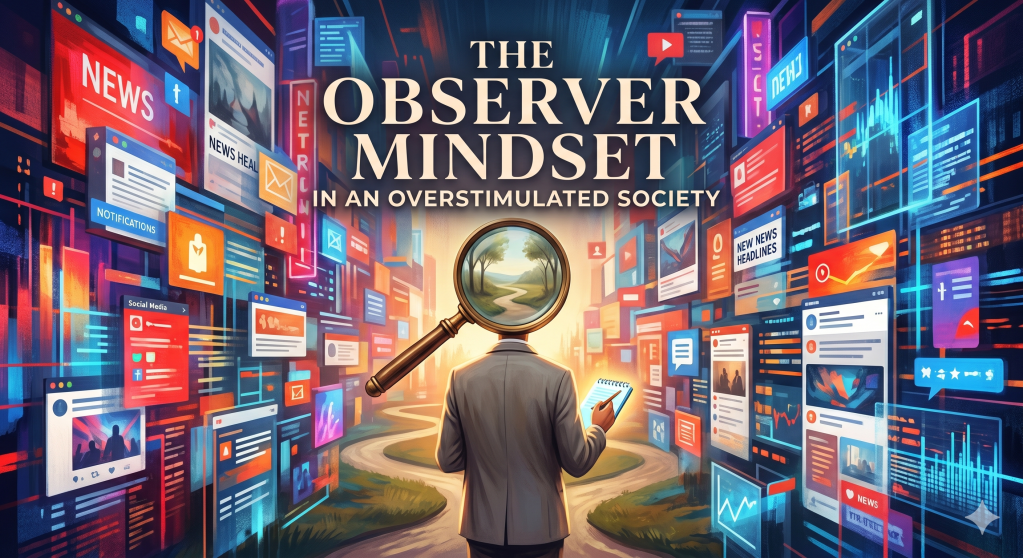
The observer mindset — the ability to watch your own thoughts and reactions with clarity — has become harder and more necessary in an era of algorithmic distraction and chronic overstimulation.
There is a particular kind of exhaustion that has become one of the defining experiences of modern life. It is not the exhaustion of physical labor or even the familiar tiredness that follows a long day at work. It is something more diffuse — a fatigue of the attention, a wearing-down of the mind’s ability to rest inside itself. Millions of people describe feeling simultaneously overstimulated and bored, perpetually connected yet oddly hollow. They scroll not because they are enjoying it, but because stopping feels worse.
This is the psychological atmosphere of our current era. It did not arrive all at once. It built gradually, the product of technological acceleration, cultural pressures, and neurological patterns that most people never consciously chose. Understanding it requires stepping back far enough to see the whole picture — and that act of stepping back, of observing rather than simply reacting, is precisely what this article is about.
The observer mindset is not a trend or a productivity hack. It is a psychological orientation: the capacity to watch your own thoughts, reactions, and environment with some degree of distance and clarity. In a society engineered to capture and hold attention at all costs, developing that capacity has become genuinely difficult — and, for that reason, increasingly important.
The Architecture of Distraction
How the Attention Economy Rewired Daily Life
To understand why the observer mindset matters now, it helps to understand what it is working against. The concept of the “attention economy” — the idea that human attention is a scarce resource that technology companies compete to capture — was articulated by economists and media theorists as far back as the 1970s, but it took on urgent new meaning with the maturation of smartphone technology and social media platforms in the 2010s.
The business model of most major platforms is simple in structure: the longer a user stays engaged, the more advertising revenue the platform generates. This created powerful financial incentives to design products that exploit the brain’s reward systems as efficiently as possible. The result was a generation of apps built around variable-ratio reinforcement — the same psychological mechanism that makes slot machines addictive. Unlike a slot machine that dispenses a reward at predictable intervals, variable-ratio reinforcement delivers rewards unpredictably. You might pull the lever ten times and get nothing, then twice and hit a jackpot. This unpredictability is precisely what makes the behavior so difficult to stop.
Every swipe downward on a social media feed is, neurologically speaking, a pull of that lever. Sometimes the next post is interesting. Sometimes it is moving. Often it is neither. But the possibility of a reward keeps the behavior going. Dopamine, the neurotransmitter most closely associated with the anticipation of reward, is released not at the moment of finding something satisfying, but during the search itself. The brain learns to crave the searching, not the finding. This is a subtle but critical distinction: the technology is not just capturing attention, it is restructuring the relationship between effort and reward in ways that can persist long after the phone is put down.
The Cognitive Costs of Constant Connectivity
Neuroscientists have spent the past two decades documenting what this kind of environment does to the brain. Attention, it turns out, is not a fixed resource — it behaves more like a muscle, capable of being trained, strengthened, or depleted depending on how it is used. Research on what psychologists call “directed attention fatigue” suggests that sustained focus on any single task draws down a finite mental reserve. Rest and genuine disengagement allow that reserve to replenish.
The problem with an environment of constant low-level stimulation is that it prevents the kind of mental idling that allows recovery. When the mind wanders during true rest — staring at the ceiling, walking without a podcast, sitting in a waiting room without reaching for a phone — it engages the default mode network, a set of brain regions associated with memory consolidation, creative thinking, and the development of self-narrative. Chronic overstimulation crowds out these processes: the mental activity by which people make sense of their experiences and maintain a coherent sense of who they are.
Research following the mass adoption of smartphones found associations between heavy social media use and measurable declines in sustained attention and attentional control — the ability to deliberately direct focus rather than have it captured by whatever is most stimulating nearby. These were associations rather than direct causations, and the picture is complicated by the fact that heavy use also correlates with pre-existing anxiety and social isolation. But the bidirectional nature of the relationship — overstimulation worsening anxiety, anxiety increasing compulsive phone use — is itself the point. The cycle is self-reinforcing.
The Psychological Landscape of Overstimulation
Anxiety, Identity, and the Comparison Machine
The cognitive effects of overstimulation are paired with distinct psychological consequences. Social comparison — measuring oneself against others — is not new. It is a basic feature of human social cognition, described by psychologist Leon Festinger in his social comparison theory as far back as 1954. What is new is the scale and frequency at which it now occurs.
A person in a pre-digital era might meaningfully compare themselves to a few dozen people in their immediate community. The comparison points were real, observable, and embedded in context. A neighbor’s apparent wealth or success came with visible texture — you knew them, you saw the whole picture, you understood something about the trade-offs they had made. Social media replaced this with comparison against a virtually unlimited pool of curated, filtered, and strategically presented versions of other people’s lives. The comparison points became simultaneously more numerous and less real.
The psychological research on this is fairly consistent. Upward social comparison — comparing oneself to people who appear to be doing better — is reliably associated with decreased life satisfaction, increased anxiety, and lowered self-esteem when it occurs in a context where the comparison feels relevant to one’s own possibilities. The difficulty with social media is that it is designed to make almost every comparison feel relevant. Algorithms surface content that triggers engagement, and content that triggers envy reliably produces engagement. A post about someone’s stunning vacation or thriving career reaches millions of people, each of whom is invited to experience it as a mirror held up to their own life.
This is not a story about vanity or shallowness. It is a story about the mismatch between a biological and psychological system evolved for small-group living and an information environment that has no precedent in human history. The brain did not develop calibrations for processing this volume of social information. It applies the same heuristics it would use to interpret the status of a rival in a tribe of fifty people — with emotionally significant results.
Emotional Reactivity and the Loss of Reflection Time
One of the more underappreciated consequences of an overstimulated information environment is what might be called the compression of reflection time. For most of human history, events arrived at a pace that allowed for processing. News traveled slowly. Even in the early decades of mass media, a newspaper was delivered once a day, television news ran for thirty minutes in the evening, and the day contained long stretches of time with no external information arriving at all.
That architecture permitted a particular kind of psychological activity: sitting with a piece of information long enough to develop a considered response to it. Strong emotions — anger, grief, fear, excitement — are known to follow a fairly predictable physiological arc. They peak and then naturally diminish if they are not continuously fed. The process of calming down, revisiting, and forming a more considered view is not a sign of moral weakness or indifference. It is how the prefrontal cortex, the part of the brain most responsible for deliberate reasoning and impulse control, reasserts influence over the more reactive limbic system.
Contemporary media and social platforms actively compress this processing time. Outrage-inducing content is algorithmically prioritized because outrage is one of the most reliable drivers of engagement. The social norm of responding immediately — to news, to events, to what other people have said — means that the considered response frequently never forms. People react to their reactions, forming and expressing opinions before the emotional peak has passed and before they have had time to consider context, alternative interpretations, or their own prior assumptions.
The observer mindset sits in direct opposition to this dynamic. It is not about achieving emotional detachment — that is a misreading of what the concept involves. It is about developing enough of a gap between stimulus and response to allow something other than pure reflex to operate. Viktor Frankl, writing from an entirely different context, expressed something similar: that between stimulus and response there is a space, and in that space lies the capacity for choice. The challenge in an overstimulated society is that the environment has been deliberately engineered to close that space.
What the Observer Mindset Actually Is
Distance Without Detachment
The observer mindset is sometimes confused with emotional suppression, intellectual detachment, or a kind of world-weary cynicism. None of these is what the concept means. Emotional suppression — actively pushing feelings away or refusing to acknowledge them — is associated in the psychological literature with increased emotional reactivity over time, not decreased. Detachment suggests an absence of engagement that is neither possible nor desirable for most people. And cynicism, while sometimes masquerading as clarity, tends to be its own form of reactivity — a pre-formed conclusion that forecloses genuine observation.
The observer mindset is better understood as metacognitive awareness: the capacity to notice your own mental and emotional processes without being entirely consumed by them. Psychologists sometimes describe this as the ability to “take the perspective of a fair witness to oneself” — applying the same standards of honest evaluation to your own states and behaviors that you would apply to anyone else’s. This does not mean being harsh with yourself. It means being clear-eyed.
Consider something that happens to almost everyone: you pick up your phone to check a message and twenty minutes later find yourself watching videos you never intended to watch, on a topic you weren’t thinking about when the day began. The observer mindset is not the resolution of that situation — it is the moment you notice the drift while it is still happening, rather than only after it’s done. That gap of awareness, however brief, is where deliberate choice becomes possible again.
More broadly, the mindset might look like registering a strong emotional reaction to a piece of news and pausing long enough to ask what you actually know versus what you are assuming. Or recognizing that a particular pattern of restlessness tends to arrive at the same time each day, and having enough internal perspective to respond to it rather than simply be moved by it.
Mindfulness-based therapeutic approaches, which have been studied extensively over the past thirty years, are built around this capacity. The research on mindfulness-based cognitive therapy and mindfulness-based stress reduction is substantial and generally supportive, though the field is not without methodological criticisms. What the more rigorous studies suggest is that practices that train metacognitive awareness — the ability to observe one’s own thoughts as thoughts rather than as unquestionable reality — can reduce rumination, decrease anxiety sensitivity, and improve what researchers call “cognitive flexibility”: the ability to shift between different ways of thinking about a situation.
The Neuroscience of Stepping Back
There is a neurological basis for what happens when a person practices this kind of metacognitive awareness. The regions of the brain most associated with self-referential thinking, emotional regulation, and perspective-taking — including parts of the medial prefrontal cortex and anterior cingulate cortex — show increased activity and altered connectivity in people who regularly practice attentional training. Importantly, these are also the regions that tend to be underactivated in states of high anxiety or emotional dysregulation.
This is not to suggest that the observer mindset is a neurological fix-all or that it can be reduced to brain scan data. The connection between specific mental habits and specific neural patterns is real but complicated, and the popular science of neuroplasticity has frequently overstated the ease and speed of change. What can be said more carefully is that the brain is demonstrably not a static organ, that attentional habits influence how it operates, and that the skills involved in observing one’s own mental states are trainable rather than fixed.
The relevance of this to an overstimulated society is straightforward: if the environment is actively training one set of attentional habits — rapid switching, reactive engagement, shallow processing — then developing the counter-capacity requires intentional practice. It does not happen by default.
Society, Culture, and the Pressure to React
The Social Cost of Reflection
There is a cultural dimension to this that goes beyond individual psychology. In a media environment that rewards speed of response, public thoughtfulness carries a social cost. The person who takes time before forming an opinion can appear indifferent or evasive in a context where strong, immediate reactions signal engagement and commitment. The person who revises their view in light of new information can be accused of inconsistency. The person who expresses uncertainty is often treated as less credible than the person who expresses certainty, regardless of which is more epistemically warranted.
This creates a social ecology that selects against the observer mindset at the collective level even as many individuals privately recognize its value. The culture of instantaneous response is not merely a personal habit but a structural feature of how contemporary discourse operates — and the pressures it exerts are not evenly distributed. People in public roles face them acutely.
There are also generational dimensions. Young people who came of age entirely within the smartphone era have no pre-digital baseline to compare their attention against. For them, the current pace is simply how the world has always worked, which makes the observer mindset simultaneously more important and more conceptually unfamiliar.
Solitude, Silence, and the Conditions for Observation
The observer mindset requires conditions in which it can operate. Chief among these is some degree of solitude — not the loneliness of social isolation, but the deliberate, chosen experience of being alone with one’s own thoughts. Psychologist Ester Buchholz, in her research on solitude, distinguished between isolation (unwanted aloneness) and what she called “alonetime” — the experience of solitude that serves developmental and restorative functions. Buchholz argued that Western culture systematically undervalues this kind of alonetime, treating busyness and social engagement as the default conditions of a healthy life.
That tendency has intensified considerably in the social media era. The smartphone has functionally eliminated the experience of unoccupied time for many people. Every moment of waiting — at a bus stop, in a checkout line, in the first minutes of waking — is now, for most people, immediately filled with external input. This is a historically novel situation. Unoccupied time was previously a common, unremarkable feature of daily life. Now it requires active creation.
The implications for the observer mindset are significant. If observation requires some degree of internal quiet — some gap between the arriving stimulus and the conditioned response — then an environment that fills every potential gap with external stimulation is an environment that makes observation structurally harder. The difficulty is not personal weakness or lack of willpower. It is environmental design.
Cultivating the Observer Mindset in Practice
What This Looks Like Day to Day
There is a risk, in discussing the observer mindset, of making it sound like an aspirational state available only to people with the luxury of time and tranquility. The skills involved are applicable in ordinary circumstances and do not require extended retreat from ordinary life.
What they do require is some intentionality about the conditions of attention. This might mean designating stretches of the day as genuinely screen-free — not as a short-term digital detox, but as a regular practice of allowing the mind to operate without external management. It might mean treating one’s own mental states with something like the curiosity you would extend to any interesting phenomenon: when anxiety arises, noting its presence rather than immediately acting to relieve or suppress it.
The research on expressive writing is relevant here. Studies by psychologist James Pennebaker consistently found that translating emotional experiences into language — even privately, without any audience — reduces physiological stress markers over time. The mechanism appears to involve giving narrative structure to otherwise formless emotional experiences. That structuring is itself a form of observation: taking what is raw and reactive and making it clear enough to see.
The Difference Between Observation and Rumination
One important distinction to draw is between the observer mindset and rumination. Rumination — the repetitive, passive dwelling on distressing thoughts or experiences — is associated in the clinical literature with increased risk of depression and is essentially the opposite of what the observer mindset involves. Where rumination is passive and repetitive, observation is active and curious. Where rumination tends to generate increasingly negative self-focused thinking, observation maintains a degree of perspective that prevents any single thought or experience from dominating the entire mental landscape.
The difference is not always obvious from the inside, which is one of the reasons that developing the observer mindset benefits from some external framework — whether through therapy, structured mindfulness practice, or even the kind of honest intellectual engagement with one’s own patterns that good writing and reading can facilitate.
The Larger Significance
Why This Matters Beyond the Individual
The observer mindset is ultimately not only a personal practice but a social capacity. Healthy collective decision-making — whether in families, organizations, or democratic societies — depends on the ability of people to pause, consider, revise, and engage with perspectives that differ from their own. These capacities are not separable from the individual attentional habits that produce them. A culture of chronic reactivity, in which strong immediate responses are rewarded and deliberate consideration is penalized, produces those effects at the collective level as well as the individual one.
The same dynamics that make the observer mindset difficult for individuals — the compression of reflection time, the algorithmic reward of outrage, the social cost of expressed uncertainty — also shape the character of public discourse. This is not a claim about any particular political moment or ideological direction. It is an observation about the structural conditions that make certain kinds of collective reasoning more or less available to a society.
Historically, each major shift in information technology has transformed the conditions of attention and the character of public life. The printing press, the telegraph, radio, television — each changed not just what information was available, but how it arrived, at what pace, and what cognitive demands it placed on its recipients. The current shift is distinguished by its speed, its personalization, its pervasiveness, and the deliberate optimization of its design for engagement over reflection. Whether the cultural adaptations that follow will restore some of the capacity for deliberate observation, or whether new technologies will simply create new varieties of the same basic problem, is genuinely uncertain.
What is less uncertain is that the capacity for observation — for watching one’s own mind with some degree of honesty and perspective — remains one of the more distinctively valuable things a human being can develop. It does not resolve the structural conditions that make it difficult. It does not remove the anxiety of living in a period of rapid and disorienting change. But it does create the conditions for a different kind of engagement with those realities: one that is more deliberate, more curious, and more genuinely responsive to what is actually happening, rather than simply to what has been engineered to feel urgent.
That is not a small thing. In an era that has made reactivity the default, the capacity to simply pause and look — at the world, at one’s own responses to it, at the space between the two — may be among the more quietly radical acts available to an ordinary person.









