
The hidden difference between suppression and regulation — and why it matters more than most people realize.
The Version of Control That Was Costing Me Everything
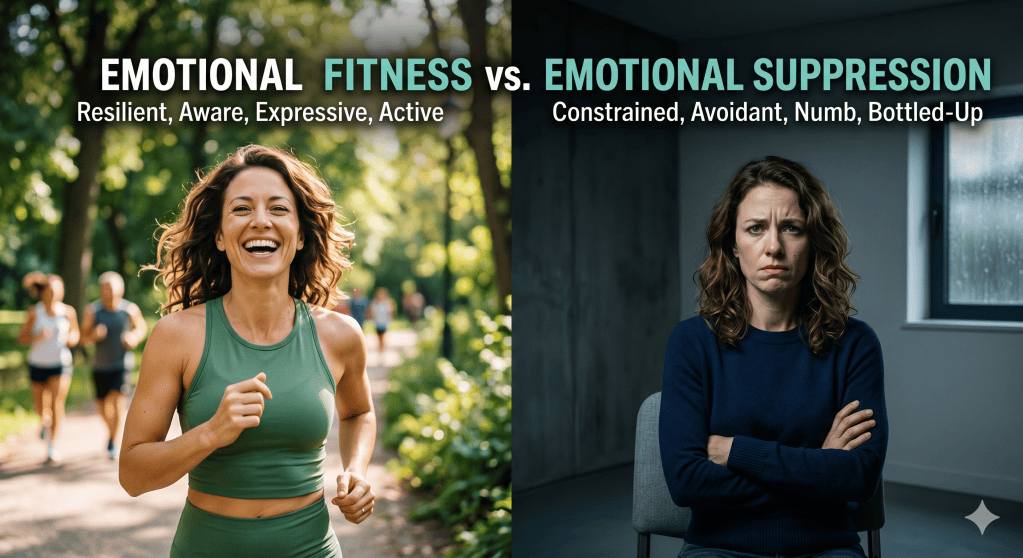
For years I believed emotional control meant never visibly reacting. I became genuinely skilled at appearing calm — measured tone, steady eye contact, composed in rooms where others unraveled. What I did not understand was the difference between performance and regulation. Beneath the surface, unresolved stress was accumulating the way sediment does: slowly, invisibly, until the riverbed changes shape entirely. It showed up in my sleep first. Then in my decision-making. Then in the quality of my closest relationships. I was not regulated. I was suppressed. And suppression, I eventually learned, is not a strategy. It is a delay.
This essay is about the difference — and what it actually takes to move from one to the other.
What Emotional Suppression Actually Does to the System
Suppression feels like control because it produces a temporary result: the emotion disappears from the surface. The problem is that emotions are not surface events. They are systemic — chemical, neurological, somatic. They run through the body like electricity through wire.
When you suppress an emotional state, you do not delete it. You compress it. You drive it inward, where it continues running in the background like a process you forgot to close. It consumes resources. It degrades performance. It distorts your perception of incoming data, because every unresolved signal functions as a filter through which you interpret your present reality.
This is the software analogy that matters: suppression is not closing a program. It is minimizing it. The program is still running. It is still consuming RAM. And eventually, when the system gets overloaded, everything crashes — often at the worst possible time, in response to something that should have been minor.
Chronic suppression carries documented downstream effects: elevated cortisol, cardiovascular strain, impaired immune response, decision fatigue, and relational disconnection. Research also suggests you cannot suppress selectively — when you close the channel for difficult emotions, you reduce bandwidth across the emotional register. Joy flattens alongside grief.
The body keeps the score. In many ways, that is far more than a metaphor.
The Emotional Fitness Framework: Treating Your Inner State Like Software
Software engineers do not panic when code breaks. They debug. They locate the fault, understand the logic error, patch it, and run the system again.
Emotional fitness asks you to develop the same relationship with your internal state.
This means four things:
1. Real-time monitoring — not post-crash forensics 2. Active processing — not passive suppression 3. Psychological boundary-setting — not reactive eruption 4. Iterative recalibration — not permanent override
Each of these is a trainable skill. Not a personality trait. Not a gift. A skill — built through structured, repeatable practice.
Pillar One: Somatic Tracking — Reading the Body Before the Mind Narrates
The mind is a story-making machine. Given any emotional signal, it will immediately begin constructing a narrative: I am angry because he said that. I am anxious because of the meeting. I am sad because of the situation. These narratives arrive fast and feel true. They are often incomplete, or anchored to the wrong cause entirely.
Somatic tracking is the practice of going underneath the story to the raw signal in the body before the narrative hardens.
This is not mystical. It is neurological. The body processes threat signals milliseconds before the conscious mind registers them. Emotional data — tightness in the chest, heat in the face, a constriction in the throat, heaviness in the limbs — is available to you before you have words for it. Learn to read that data in real time, and you gain critical seconds of response window that most people never access.
The practice: When you notice an emotional shift, pause. Before you think, feel. Where is this in the body? What is its texture — tight, hot, diffuse, heavy, buzzing? You are not trying to change it yet. You are simply reading the data accurately.
This is the difference between a pilot who trusts the instruments and one who flies blind. Somatic tracking gives you instruments.
Pillar Two: Breathwork — Direct Access to the Nervous System
Strip away the branding around breathwork and what remains is this: breath is the only autonomic function you can consciously control, and controlling it gives you direct access to the autonomic nervous system itself.
Your nervous system responds to signals — and breath is among the most immediate ones you can send. Slow, extended exhalation activates the parasympathetic branch. You have a lever. Most people never learned to use it deliberately.
For acute spikes: The physiological sigh — a double inhale through the nose followed by a long exhale through the mouth — is currently the fastest-studied method for reducing acute physiological arousal. Research from Stanford’s Huberman Lab suggests even a single cycle begins to shift state. Three cycles functions as a protocol.
For accumulated stress: Box breathing (four counts in, hold, out, hold) supports heart rate variability coherence — a state associated with clearer perception and more stable emotional access. It is worth doing before a difficult conversation, not only after one.
For reset after suppression: Extended exhale breathing (inhale for four, exhale for eight) down-regulates the stress response and creates the physiological conditions for compressed material to surface, be felt, and complete its cycle without flooding.
The point is not to master one technique. It is to hold a working vocabulary of techniques and know which one the situation calls for.
Pillar Three: Clearing Mental Noise — The Cognitive Layer
Beneath emotional turbulence, there is almost always a layer of cognitive noise: recursive thinking, worst-case projections, self-critical loops, unresolved narratives that the mind keeps reopening because they were never given a proper close.
The write-to-release method: When a thought pattern is recurring, write it out in full — not as a journal entry, but as a data dump. Get it out of the loop and onto the page. Then finish the thought. Do not stop at the anxiety. Follow it to its logical conclusion: if the worst happened, what would you do? Answer honestly. The loop often runs because the mind is trying to solve a problem you have not let it finish solving.
Processing toward completion: For many people, emotional loops feel stuck because the original experience was interrupted before it could complete its arc — the emotion began to move, and then was stopped. For many people, one of the most effective paths toward resolution is intentional completion: allowing the arc to finish through movement, breath, writing, or speaking it aloud in a safe context. This idea has roots in somatic therapy and experiential psychology, though individual responses vary, and working with a trained therapist is often the most effective route for deeply held material.
Cognitive defusion: A technique from Acceptance and Commitment Therapy that creates useful distance between you and your thoughts. Instead of I am overwhelmed, the practice trains you toward: I notice I am having the thought that I am overwhelmed. You are still registering the signal. You are simply not fusing your identity with it — which preserves your capacity to respond rather than react.
Pillar Four: Psychological Boundary Architecture — The Stability Layer
This is where emotional fitness moves from regulation into something more like durable composure.
Your psychological boundary architecture is the threshold at which external stimuli are permitted to penetrate and destabilize your internal state. Everyone has one. Most people’s is entirely unconscious — managed by circumstance, by the mood in the room, by what the news says, by whether traffic was bad.
Developing this layer means building the conscious capacity to decide what gets in. This is not indifference. It is not dissociation. It is not the suppression of empathy. It is the opposite: you can be fully present to what is happening, fully feeling what is real, without being destabilized — because you are standing inside a structure you built and actively maintain.
The ownership check: Before entering a meeting, difficult conversation, or charged social environment, ask yourself one question: What belongs to me, and what belongs to the room? This simple distinction — practiced as a brief pause rather than an extended analysis — helps prevent the unconscious adoption of other people’s emotional states. You are not trying to wall yourself off. You are arriving with enough self-awareness to know where you end and the collective mood begins. Done consistently, this habit builds boundary awareness that reactive experience rarely teaches.
The morning architecture practice: How your nervous system begins the day shapes its baseline reactivity for the hours that follow. A short morning practice that includes breath, movement, and a somatic check-in is not a luxury. It is infrastructure. You are setting the initial conditions of the system before the world begins sending inputs.
The input audit: What is consistently entering your awareness — socially, digitally, relationally — that you have not consciously chosen? Emotional fitness requires the same deliberate curation you would apply to diet. Some inputs nourish. Many simply raise baseline arousal without your awareness.
The return-to-baseline skill: The most important skill in emotional fitness is not the ability to stay regulated. It is the ability to return to regulation quickly after disruption. Everyone gets disrupted. The variable is recovery time. High performers across every domain share this: fast recovery. Every practice in this framework is, in one form or another, return-to-baseline technology.
Emotional Fitness Is Not Emotional Perfection
Even elite athletes get injured. Even trained runners cramp. Even the physically fittest people have days where the body refuses.
Emotional fitness is not the engineering of a life without grief, rage, fear, or despair. Those are not bugs in the system. They are features — biological signals carrying information you need.
The goal is not a life without emotional weather. The goal is a nervous system that can function in any weather — that moves through storms without losing structural integrity, that processes difficult experience without creating chronic residue, that can be shaken and still find its way back to ground.
Suppression promises you no storms. It delivers instead a pressure system that builds underground until it breaks through without warning.
Emotional fitness promises something more honest and more durable: the capacity to meet whatever comes, feel it fully, process it cleanly, and return — faster each time — to command of your own interior.
The Practice Is the Point
None of this is theoretical. All of it is trainable. And like physical fitness, it responds directly to the consistency and quality of practice.
You do not become emotionally fit by reading about emotional fitness. You become emotionally fit by doing the breath practice when you do not want to, by tracking the somatic signal before you default to the story, by clearing the mental noise before it accumulates weight, by returning to your baseline each morning with intention.
The person who has done this work is recognizably different — not because they feel less, but because they are not afraid of what they feel. They move through the emotional landscape with the quiet authority of someone who knows the terrain.
That is the destination. The path there is the practice itself.









