
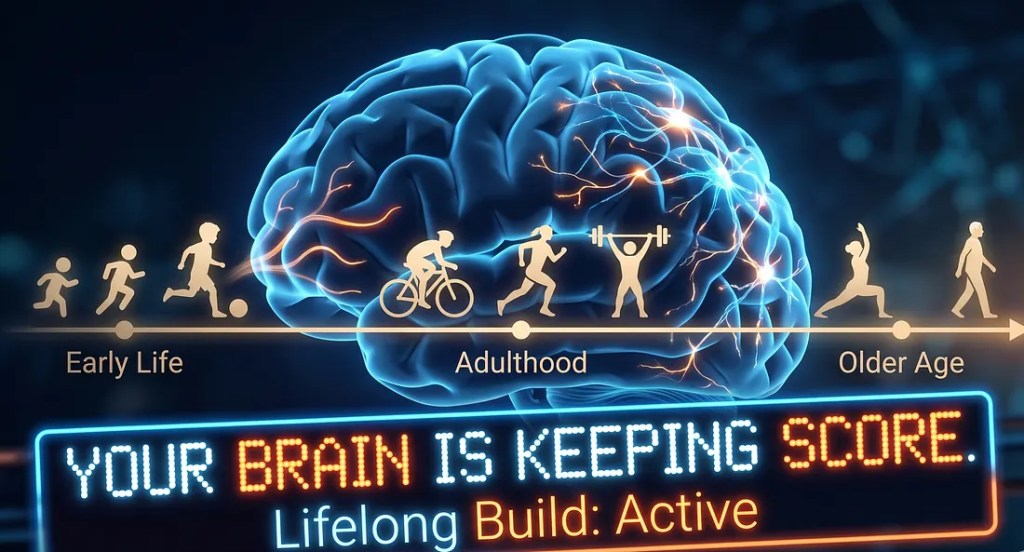
The new science of “exercise memory” and why brain health isn’t something you fix. It’s something you build — across a lifetime.
For most of modern medicine’s history, we treated the brain the way we treated a car engine: ignore it until something goes wrong, then try to fix it. Anxiety? Here’s a prescription. Memory trouble after sixty? We’ll refer you to a specialist. Cognitive decline? A tragic but largely inevitable outcome of aging.
That model is quietly collapsing.
In its place, a different framework is emerging — one that treats brain health not as a series of crises to manage, but as a continuous arc to tend. Researchers are calling it the lifespan brain health lens. And if the data is right, the choices you make in your twenties are laying molecular groundwork that either protects or endangers the mind you’ll have at seventy.
At the center of this shift is a surprisingly poetic idea: the brain remembers exercise. Not the way you remember a workout because you’re sore the next day. At the molecular level. In ways that appear — at least in emerging research — to accumulate, compound, and persist long after any individual session ends.
The End of Episodic Brain Care
Ask most people when they started thinking seriously about their brain health, and they’ll name a moment: a panic attack that came out of nowhere, a parent’s Alzheimer’s diagnosis, a year of crushing burnout that left them feeling hollowed out. Brain health, culturally speaking, has been reactive. You address the brain when the brain becomes a problem.
But the data on how cognitive decline actually unfolds tells a different story. Neurodegeneration doesn’t announce itself — it accretes quietly over years, sometimes decades, before symptoms surface. Research suggests Alzheimer’s-related changes may begin years or even decades before symptoms become apparent. The white matter changes that predict cognitive fragility in later life often originate in midlife, or earlier.
This means that treating brain health as a series of discrete episodes — a round of therapy here, a meditation app there — misses the architecture of the problem entirely.
What’s beginning to replace the episodic model is something closer to a lifespan framework: the recognition that the brain moves through distinct biological eras, each with its own vulnerabilities and opportunities, and that brain health is less about intervention at crisis points and more about what you do during the long, quiet stretches in between.
Life in Eras: How the Brain Ages in Stages
The lifespan brain health model draws a rough map of these eras, and the map is more dynamic than most people expect.
Extended adolescence and the still-forming brain. The prefrontal cortex — the seat of judgment, impulse control, and long-range planning — doesn’t fully mature until the mid-twenties. This era is marked by extraordinary neuroplasticity but also heightened vulnerability: stress during this period shapes the stress-response architecture that will govern the body and brain for decades. Early physical activity habits laid down here appear to have disproportionate protective effects, likely because they coincide with critical windows of synaptic pruning and circuit formation.
The midlife crucible. The thirties and forties are when most people are least focused on brain health — and most exposed to the forces that quietly erode it. Chronic stress, disrupted sleep, sedentary work, metabolic shifts. This era is increasingly recognized as a critical inflection point: not the time when decline happens, but the time when its trajectory gets set. Research on midlife cardiovascular health, for instance, shows strong predictive power for late-life cognitive outcomes — the brain health you’ll have at seventy is being shaped, in part, right now.
Later-life cognitive resilience. The questions that dominate later-life brain health research have shifted. The goal is no longer simply to avoid catastrophic cognitive decline — it’s to understand what enables some people to remain cognitively vital well into their eighties and nineties while others don’t. The concept of cognitive reserve — the brain’s accumulated capacity to tolerate damage before symptoms appear — turns out to be one of the most powerful predictors of late-life outcomes. And crucially, reserve is built over a lifetime, not conjured in old age.
The Neuroscience of Exercise Memory
Here is where things get genuinely strange and wonderful.
We have known for decades that exercise is good for the brain. It improves mood, reduces anxiety, sharpens focus, and appears to protect against dementia. What we didn’t fully understand until recently is how — at the molecular level — that protection actually works. And what the emerging picture suggests is that the brain doesn’t just benefit from exercise in the moment. It remembers it.
The metaphor, it turns out, has real molecular backing — even if the full picture is still being assembled. Researchers studying a class of molecules called myokines — proteins released by contracting muscles during exercise — have found that these molecules cross the blood-brain barrier and trigger changes in gene expression within the brain itself. Among the most studied is BDNF (brain-derived neurotrophic factor), often described as “fertilizer for neurons.” Exercise causes its release. BDNF promotes neurogenesis in the hippocampus — the brain region most critical for memory and learning, and one of the first areas damaged in Alzheimer’s disease.
But here’s the part that reframes everything.
The Brain’s Molecular Record
The effects of exercise on the brain appear to be epigenetically encoded. The brain doesn’t simply benefit from each workout and then return to baseline. It retains a kind of molecular record of physical activity over time — chemical marks on DNA that alter gene expression, structural changes in regions like the hippocampus, a recalibrated inflammatory response that persists well beyond any single session.
Animal studies have suggested something even more striking: that exercise early in life appears to create lasting neuroprotective changes that buffer against cognitive insults later, even after exercise ceases. The brain, it turns out, may carry something like an exercise credit history. Past deposits appear to earn interest. Researchers are still debating how durable these effects are in humans and how much of the evidence from animal models ultimately translates to lifelong cognitive protection — but the directional signal is consistent enough to have reshaped how the field thinks about timing and accumulation.
More recent work is exploring lactate — long dismissed as a mere metabolic waste product of exercise — as another potential messenger between muscle and brain. High-intensity exercise floods the bloodstream with lactate. Neurons, it turns out, can use lactate as fuel, and there’s evidence that it may also trigger protective signaling cascades within brain cells. Lactate may be one of several biochemical messengers contributing to the cognitive and emotional effects of exercise — a field of inquiry that is still being mapped.
What “Cognitive Reserve” Actually Means (and How You Build It)
The concept that ties the lifespan lens and exercise memory together is cognitive reserve — and it’s worth spending a moment with, because it’s one of the most consequential ideas in neuroscience that almost no one outside the field has heard of.
Cognitive reserve refers to the brain’s resilience: its ability to sustain function despite pathology. Autopsies have repeatedly revealed something startling: some people whose brains show extensive Alzheimer’s pathology — plaques, tangles, the full architectural signature of the disease — never showed symptoms during their lifetimes. Their brains had enough redundancy, enough alternative circuitry, enough raw capacity, that damage could accrue before it overwhelmed function.
Reserve is built through a combination of factors: education, cognitive engagement, social connection, sleep quality, cardiovascular health — and physical exercise, which appears to contribute through multiple mechanisms simultaneously: reducing vascular risk, promoting neurogenesis, attenuating neuroinflammation, and encouraging the formation of the denser, more redundant neural networks that characterize resilient brains.
The uncomfortable implication is that cognitive reserve is largely accumulated before the period when most people start worrying about cognitive decline. You can’t build the scaffolding while the building is already on fire.
The Practical Reckoning
None of this is meant to induce paralysis or shame. The evidence doesn’t say that if you were sedentary in your twenties your brain is forfeit. Neuroplasticity doesn’t expire; the brain retains meaningful capacity for positive change at every age. Starting exercise in midlife produces measurable cognitive benefits. So does starting in late life.
But what the lifespan brain health framework does demand is a shift in how we think about mental and cognitive wellness — away from reactive, episodic intervention and toward something more like stewardship.
Consider two forty-five-year-olds. Neither has memory problems. Neither would score poorly on a cognitive screen. One has spent two decades reasonably active, sleeping adequately, managing cardiovascular risk factors. The other hasn’t. The differences in their future cognitive trajectories may already be emerging — quietly, molecularly — long before either notices a single symptom. That’s what the lifespan lens makes visible that the episodic model misses entirely.
A few things that shift under this lens:
Physical exercise is brain medicine. Not a lifestyle bonus. Not something to add when things are going well. The evidence base is now robust enough that any honest accounting of long-term brain health puts exercise among the most consistently supported interventions available — one of the most powerful influences on long-term brain health that most people still treat as optional.
Midlife is the leverage point. The forties are not too late. They may be the most important decade for setting late-life cognitive trajectory, precisely because they represent the last window before cumulative vascular and inflammatory damage becomes structural.
Sleep, stress, and inflammation are not separate issues. They are part of the same system. Chronic stress elevates cortisol, which damages the hippocampus. Poor sleep impairs the brain’s glymphatic system — its overnight cleaning mechanism for flushing out toxic proteins. Chronic inflammation accelerates neurodegeneration. These aren’t parallel concerns; they’re interconnected inputs into the same biological calculus.
Your brain is already keeping score. Every workout is a deposit. Every chronic stressor is a withdrawal. Every good night of sleep is a moment of maintenance. The brain is not waiting for your crisis to start accounting.
The Invitation
There is something both sobering and oddly liberating in this picture.
Sobering because the timeframe matters. The science suggests that the most powerful window for shaping late-life brain health isn’t in your seventies — it’s across the full stretch of adult life, with special weight on the years most people spend thinking about almost anything else.
Liberating because the intervention isn’t exotic. You don’t need a clinic or a drug trial or a genomic workup. The single most evidence-backed thing you can do for your long-term brain health is something humans have done for hundreds of thousands of years: move your body, consistently, over a lifetime.
The brain, it turns out, is a faithful record-keeper. Every run, every swim, every walk taken instead of a drive — they don’t disappear when you towel off. They leave traces. A slowly accumulating case for your own cognitive future.
The question the science is now pressing us to ask isn’t “what should I do if my brain starts to fail?” It’s the one we should have been asking all along:
What kind of brain am I building?
The research referenced in this piece draws on emerging work in exercise neuroscience, epigenetics, and cognitive aging. As with any rapidly developing field, the picture continues to evolve — but the directional signal has been consistent enough, across enough studies, that the broad strokes deserve to be part of everyday conversation about health.









