
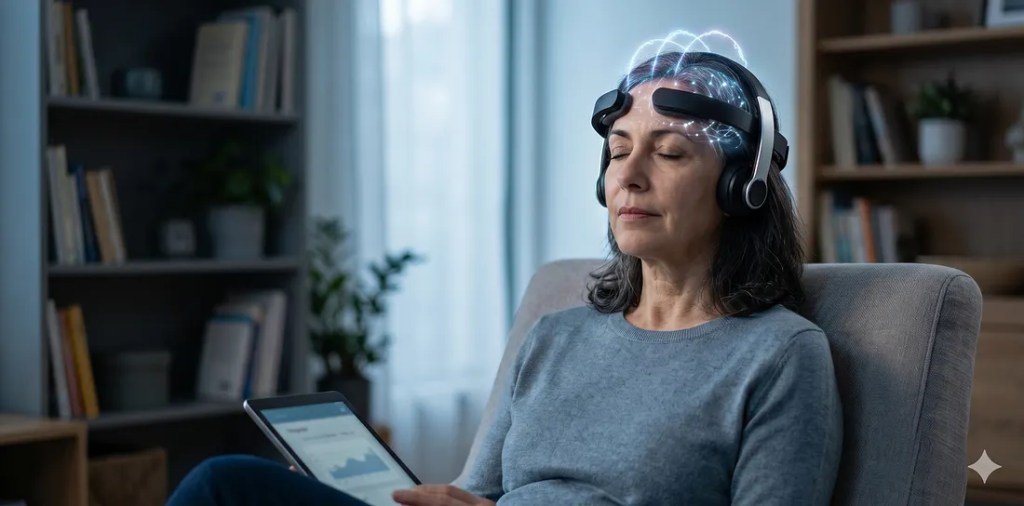
The brain speaks in electricity. For the first time, medicine is talking back — without drugs.
There is a quiet revolution happening in mental health care, and it doesn’t come in a pill bottle. It comes in a headset. It hums rather than dissolves. It speaks the brain’s own language — electrical current and magnetic pulses — rather than flooding the bloodstream with chemistry that the brain must then interpret.
“Electric medicine” is the informal name gathering steam around a cluster of technologies that modulate the nervous system without cutting into it, without sedation, and increasingly, without a trip to the clinic. As searches for transcranial magnetic stimulation (TMS) and its rapid-acting cousin SAINT therapy trend across health forums and social platforms, it’s worth asking: what exactly are these treatments, who are they for, and does the science actually hold up?
The Idea Behind the Current
The brain is, at its most fundamental level, an electrical organ. Neurons communicate using tiny electrical signals generated by the movement of charged particles across cell membranes, passing information through networks spanning billions of cells. Mood, memory, and motivation all emerge from electrochemical communication.
Depression, at least in part, disrupts these communication networks. Many studies have found reduced activity in the left dorsolateral prefrontal cortex — a region involved in emotional regulation, planning, and executive function — among people with major depressive disorder, though depression remains a highly heterogeneous condition and no single brain signature applies universally. For decades, neuromodulation researchers have pursued a simple question: what if you could turn the volume back up?
Transcranial direct current stimulation (tDCS) does this with a gentle, steady flow of direct electrical current — so mild it produces little more than a tingling or warmth at the scalp. Transcranial magnetic stimulation (TMS) uses rapidly changing magnetic fields to induce electrical currents deeper in cortical tissue, producing actual neuron firing. Both approaches aim to shift the excitability of targeted brain regions, triggering a cascade of neuroplastic change that, over sessions, can recalibrate the dysfunctional circuitry underlying depression.
The analogy that researchers often reach for is physical therapy — repeated, targeted stimulation that gradually restores function. Unlike antidepressants, which alter neurotransmitter levels throughout the body and often take weeks to reach full effect, neuromodulation acts directly on targeted neural circuits, seeking to modify the activity of specific brain networks.
The Headset in Your Medicine Cabinet
For years, TMS and tDCS existed almost entirely in clinical settings — expensive, time-consuming, and geographically inaccessible to most people who might benefit. That began to change on December 11, 2025, when the FDA granted approval to Flow Neuroscience’s FL-100, making it the first at-home, prescription neuromodulation device cleared in the United States for treating major depressive disorder.
The device is a headset. It delivers low-intensity direct electrical current through scalp electrodes to the prefrontal cortex, the same region targeted in clinical settings, and it pairs with a companion app that guides each session and monitors adherence. The recommended protocol calls for five 30-minute sessions per week for the first three weeks, tapering to up to three sessions weekly afterward — all from home.
The approval came on the strength of the Empower Phase 2 trial, published in *Nature Medicine* in October 2024, which enrolled 174 participants with moderate to severe depression. The results were notable: roughly 58% of those using the active device achieved remission of their depression after ten weeks, compared to a significantly lower rate in the sham group. For context, standard antidepressant medications typically produce remission in around 30–40% of patients after an initial treatment trial — which makes 58% a genuinely meaningful number, though replication in larger trials will be essential before drawing firm conclusions. Side effects were mild — some skin redness and itching where the electrodes contact the scalp — and no serious safety concerns emerged.
One challenge in neuromodulation research is separating true biological effects from expectation effects. Because participants often feel sensations during active stimulation — that characteristic tingling or warmth — maintaining a convincing sham condition is technically difficult. This is one reason scientists place particular weight on replication across large, independent trials, and why the field’s advocates are careful not to over-claim on any single study.
The FL-100 is expected to reach U.S. patients in mid-2026, priced between $500 and $800, with Flow Neuroscience already in conversations with insurers about coverage. The device has already been used by more than 55,000 people across Europe, the United Kingdom, Switzerland, and Hong Kong, where it is prescribed within parts of the public health system. Whether at-home neuromodulation ultimately delivers on its promise at scale remains to be seen, but the FDA clearance marks a significant milestone — the first time regulators have authorized a home-use brain stimulation device for a major psychiatric indication in the United States.
“We’re really about the democratization of access,” Flow CEO Erin Lee said at the time of approval, noting that many patients cannot reach or afford in-office procedures. “We can put it in any home in the United States.”
Yet if Flow represents accessibility, another approach is pushing the limits of speed. At Stanford, researchers have developed a protocol that compresses weeks of treatment into five days — with results that have surprised even longtime skeptics.
SAINT: The Five-Day Treatment
While the Flow headset represents the democratization end of the spectrum, SAINT therapy represents the cutting edge of precision and speed — a protocol so different from conventional TMS that it might as well be a different treatment altogether.
SAINT stands for Stanford Accelerated Intelligent Neuromodulation Therapy. It was developed in the brain stimulation laboratory of Dr. Nolan Williams at Stanford University and represents a convergence of three ideas: higher doses of stimulation, a compressed treatment schedule, and personalized brain targeting guided by functional MRI.
In conventional TMS, patients typically come to a clinic three to five times per week for four to six weeks, accumulating sessions gradually. SAINT compresses that timeline radically — patients receive ten sessions per day for five consecutive days, totaling fifty sessions in a single week. Each session uses intermittent theta-burst stimulation, a pattern designed to mimic the natural brain rhythms involved in synaptic plasticity and learning.
But the most distinctive feature is the individualization. Before treatment begins, each patient undergoes functional MRI scanning that maps the connectivity of their specific brain — identifying, with precision, the subregion of the dorsolateral prefrontal cortex that is most tightly linked to the subgenual anterior cingulate cortex, a structure heavily implicated in depression. No two people’s optimal stimulation target is exactly the same. SAINT treats the individual’s brain, not the average brain from a textbook diagram.
The clinical results have drawn sustained attention. Early trials reported remission rates approaching 79% in patients with severe treatment-resistant depression — people who had typically failed multiple rounds of antidepressants and other interventions. Those numbers are striking, though they come from relatively small samples, and researchers note that durability of response varies; some patients require booster treatments to maintain their gains. Larger, more heterogeneous trials are ongoing. The FDA granted clearance to Magnus Medical to commercialize the protocol in 2022, making SAINT the first rapid-acting neuromodulation commercially available in the United States.
In March 2026, the University of Arkansas for Medical Sciences celebrated the one-year anniversary of a patient’s remission — a woman named Sandy Rasmussen who had lived with major depression for more than sixty years, surviving multiple suicide attempts and exhausting seemingly every available treatment. She completed SAINT in five days. “I started seeing results from the treatment by that first weekend,” she said. “Almost everybody says that I act much happier. I get out of the house a lot more, and I can deal with things a lot better. I feel like I have control over my life now.”
Rasmussen’s experience is not unique, though researchers caution that individual outcomes vary considerably. It is precisely these cases — patients who exhausted every available option and still found relief — that keep rigorous scientists returning to SAINT despite the field’s broader history of overpromising.
What Makes This Moment Different
Non-invasive brain stimulation has been studied for decades, with a checkered history of exciting early results that failed to replicate cleanly in larger trials. The field has earned some of its skeptical reputation honestly. So why does this moment feel different?
For decades, neuromodulation occupied the fringes of psychiatry — promising enough to attract research funding, but not mature enough to reshape clinical practice. The convergence of neuroimaging, precision targeting, accelerated stimulation protocols, and now home-use devices has changed that equation. For the first time, brain stimulation is moving simultaneously toward greater personalization and greater accessibility — a combination the field has never before achieved at once.
Several reasons converge to explain the shift. First, the science has matured. The combination of neuroimaging-guided targeting with optimized stimulation parameters has moved the field beyond the early “one size fits all” approach. Second, regulatory agencies are now granting clearances based on rigorous randomized controlled trial data — not just feasibility studies. Third, the unmet need is acute and growing. More than 20 million Americans live with depression, a number that has grown by roughly 60% over the past decade. Approximately one in three people with depression does not respond adequately to antidepressant medications, and many more stop taking them due to side effects including sexual dysfunction, weight gain, and emotional blunting.
That gap — between the scale of depression and the adequacy of existing treatments — is exactly where electric medicine is trying to plant itself. Not as a replacement for pharmaceuticals across the board, but as an alternative for the millions whom those pharmaceuticals fail, and as a complement for the many more who want a non-systemic option.
The home-use approval is particularly significant because geography and cost have long rationed access to neuromodulation. In-office TMS protocols can cost several thousand dollars out-of-pocket and require a facility within reasonable driving distance. At $500–$800 for a home device — assuming eventual insurance coverage materializes — the calculus changes considerably.
The Caveats Worth Keeping
Honest enthusiasm about electric medicine requires acknowledging what remains uncertain. The tDCS literature is genuinely mixed — some trials show robust antidepressant effects, others find little separation from sham. Replication has been a problem, and effect sizes in some studies are modest. The 58% remission figure for Flow’s device is impressive, but it comes from a single Phase 2 trial of 174 participants; larger Phase 3 replication will matter.
SAINT’s early results are dramatic enough that skeptics have raised questions about whether the effect sizes are too large to be real, or whether they will hold in more heterogeneous patient populations. Long-term durability of response is still being studied, and continuation protocols are an active area of research.
There is also the question of consumer access and misuse. FDA clearance covers prescription use under medical supervision. The broader market for consumer tDCS devices — sold without prescription for “focus” or “mood enhancement” — operates in murkier territory, with parameters, electrode placement, and currents that vary widely from what clinical research uses. People curious about brain stimulation should be careful not to conflate cleared medical devices with consumer wellness gadgets.
A New Vocabulary for Mental Health
What makes this moment worth watching, beyond the clinical results themselves, is what it suggests about how we conceptualize mental illness and its treatment. The serotonin hypothesis of depression — always oversimplified even at its most popular — has been quietly receding from center stage. What is filling the space is a more circuit-based understanding: depression as a disorder of connectivity and network function, which responds to interventions that operate at the level of those networks.
Electric medicine is not anti-medication. Most neuromodulation studies allow adjunctive antidepressant use, and the FL-100 was cleared for use both alone and alongside medication. But it opens a genuinely new treatment category — one that acts through the brain’s native signaling mechanisms rather than through systemic chemistry.
For the millions of people who have tried the pills and found them wanting — found that the side effects aren’t worth the partial relief, or that the depression keeps finding ways around the chemistry — the idea of a treatment that speaks the brain’s own language carries something more than clinical promise.
It carries the feeling of being finally understood — not as a chemical imbalance to be corrected, but as a network that can be rewired.
If you or someone you know is struggling with depression, speak with a licensed healthcare provider about whether neuromodulation treatments may be appropriate. The FL-100 by Flow Neuroscience is expected to be available by prescription in the U.S. in mid-2026. SAINT therapy is available at select clinical sites now.









