
Some People Miss Your Availability More Than They Miss You
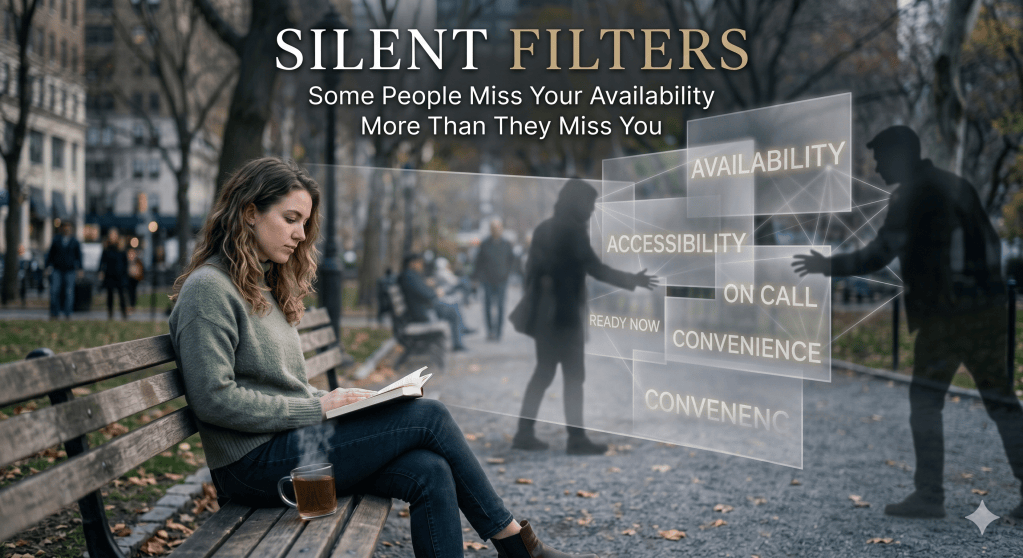
The people who truly value you adapt to your boundaries. The people who only valued access slowly disappear.
I didn’t notice the silence at first.
No dramatic endings.
No confrontations.
No final conversations heavy with closure.
Just… less.
Fewer messages.
Fewer check-ins.
Fewer people reaching for me with the urgency they once had.
At first, I interpreted it as loss.
I wondered if I had become too distant.
Too difficult to reach.
Too changed.
But over time, a different pattern emerged:
The more unavailable I became to emotional extraction,
the more certain connections quietly dissolved.
That realization hurt more than I expected.
Because part of me still wanted to believe the relationships were built on something deeper than accessibility.
That people loved me.
Not my responsiveness.
Not my emotional labor.
Not my constant willingness to hold space for everyone else while quietly abandoning myself.
But once the automatic access disappeared,
so did many of the connections that depended on it.
That’s the thing no one tells you about boundaries:
They are also filters.
Not loud filters.
Silent ones.
You don’t always discover who values you by who arrives during your hardest moments.
Sometimes you discover it by who remains
when you stop over-functioning.
When you stop:
- initiating every conversation
- fixing every emotional disruption
- replying immediately
- making yourself endlessly accessible
something becomes visible that was impossible to see before.
Effort imbalance.
Some people were connected to you through mutual care.
Others were connected to the convenience of your availability.
And the moment availability changes, the difference becomes undeniable.
I remember noticing how certain people only appeared when they needed something emotionally stabilizing.
Reassurance.
Attention.
Validation.
Comfort.
There was always a reason to reach out when they felt uncertain.
But when I became quieter —
when I stopped carrying the emotional momentum of the relationship —
everything slowed.
Not because the connection was deep and wounded.
Because it had been one-sided for longer than I wanted to admit.
That realization can make you cynical if you let it.
It’s tempting to look back at every relationship and reduce it to utility.
But that isn’t the truth either.
Some people genuinely care about you.
They simply became accustomed to a version of you that never required reciprocity.
When you consistently over-give,
you accidentally remove the necessity for balance.
People stop checking whether you’re okay because you trained them to expect endurance.
And endurance is a dangerous identity.
Because eventually, people stop seeing your effort as effort.
They see it as your nature.
That’s why changing feels disruptive even when you change quietly.
You are altering the emotional architecture people unconsciously relied on.
The interesting part is what happens next.
Because healthy connections don’t collapse under boundaries.
They recalibrate.
The people who genuinely value you begin adjusting naturally.
They:
- respect delays in response
- stop expecting immediate emotional access
- ask instead of assume
- notice your absence without demanding explanations
There’s patience in real care.
There’s adaptability in mutual respect.
And then there are the others.
The ones who slowly disappear when your availability is no longer unconditional.
At first, it can feel personal.
Like rejection.
Like abandonment.
But eventually, you see it more clearly:
Some relationships survive through constant access.
Without it, there’s nothing substantial holding them together.
That isn’t failure.
That’s revelation.
Not every disappearing connection is a tragedy.
Some are expired dynamics finally losing artificial support.
And strangely, the silence that follows can feel cleaner than the noise that came before it.
Because once you stop managing everyone’s emotional comfort,
you finally have enough distance to hear your own internal voice again.
Your own exhaustion.
Your own preferences.
Your own limits.
For years, I confused being needed with being valued.
I thought constant demand meant importance.
But urgency is not love.
Dependency is not connection.
And accessibility is not intimacy.
Real connection survives pauses.
It survives slower replies.
Distance.
Change.
Evolution.
It doesn’t require permanent access to remain real.
That’s the hidden gift of silent filters:
They remove the illusion that every connection was equally deep.
And while that can feel painful at first,
it also creates space.
Space for relationships that are mutual instead of consumptive.
Space for people who can meet you outside the role of caretaker, stabilizer, rescuer, or emotional infrastructure.
Because the right people don’t just enjoy your presence when it’s convenient.
They adjust when your boundaries evolve.
And sometimes the clearest form of love
is not who demands access —
but who remains gentle
after access is no longer guaranteed.









