
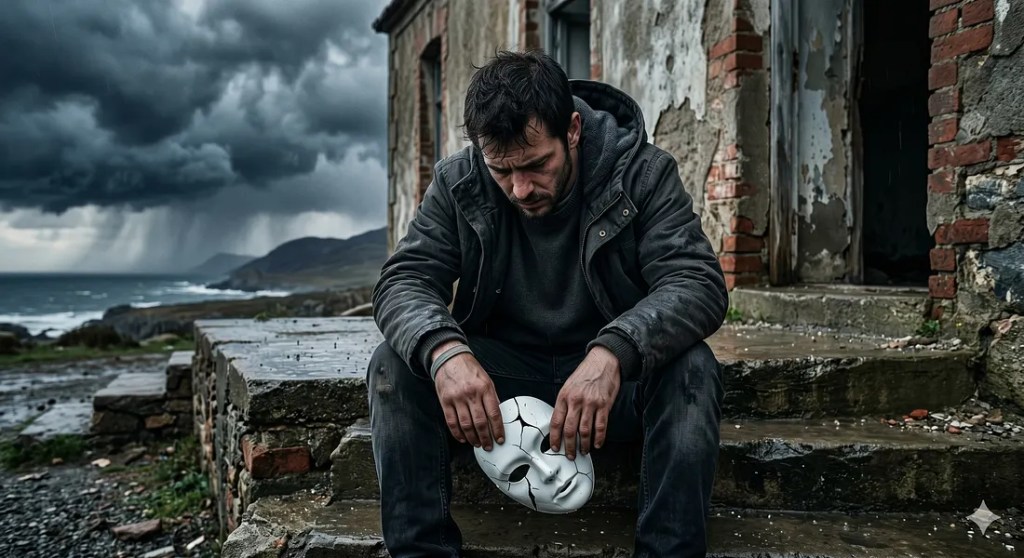
The dominant cultural story about trauma is a story about damage. About what gets broken, lost, or permanently diminished. That story is not wrong — but it is incomplete.
A growing body of research documents something more complex: under specific conditions, and with adequate support, profound distress can function as a radical disruptor of rigid cognitive habit. Not a gift. Not a silver lining. Something harder to name than either of those — a forced architectural renovation of the mind, undertaken not by choice but by necessity, whose results are neither guaranteed nor uniformly good, but which can, in certain people under certain conditions, produce structures of thought that calmer developmental paths never required them to build.
This is the science of post-traumatic growth — a field whose foundational framework was established by psychologists Richard Tedeschi and Lawrence Calhoun, who in 1995 and 1996 began documenting the phenomenon systematically and gave it its name.
I. Disequilibrium
Stability is a conserving force. When life is predictable, the mind has no particular incentive to update its operating assumptions. Existing cognitive pathways handle incoming experience adequately. Habits of thought — about self, world, future, meaning — remain undisturbed precisely because they don’t need to be disturbed. Stability rarely demands architectural change.
Researcher Tobi Zausner’s 1998 study, When Walls Become Doorways: Creativity, Chaos Theory, and Physical Illness, examined what happens when that stability is violently removed. Drawing on chaos theory and the biographies of twenty-one visual artists — among them Goya, Kahlo, and O’Keeffe — Zausner argued that disequilibrium may do something stability structurally cannot: it dissolves entrenched mental habits and rigid cognitive pathways. The disruption is not instructive in any neat sense. It does not hand the person a new framework. It dismantles the old one — and in doing so, creates the precondition for something different to emerge.
The key word is precondition. Disequilibrium does not produce growth automatically, or reliably, or without cost. The dismantling is real and the suffering is real. What disequilibrium produces is an opening — a state of forced cognitive fluidity that ordinary stability rarely demands. Whether anything meaningful grows through that opening depends on what happens next.
II. Cognitive Restructuring
The forced fluidity that trauma produces does not resolve into chaos — at least, not always, and not for everyone. With sufficient integrative support, it tends to reorganize into new, more complex structures of thought: frameworks capable of holding contradiction, tolerating ambiguity, and generating meaning across previously unconnected domains.
Consider what it takes for a person to reconstruct trust after a serious betrayal — by an institution, a partner, or a belief system they organized their life around. The prior cognitive model, the one that assigned reliability to certain sources of safety, has failed catastrophically. Rebuilding is not a matter of patching the old framework. It requires constructing a new one that can accommodate the fact of the betrayal while still allowing for conditional openness. That is not a simple cognitive operation. It demands holding contradiction, tolerating irreducible uncertainty, and generating meaning in the absence of prior guarantees. The research on post-traumatic growth suggests that this kind of forced reconstruction — when it succeeds — leaves certain individuals with a structural familiarity with complexity that they did not have before and that easier circumstances would not have required.
This is not an argument that trauma produces better thinkers. It is an observation about a specific mechanism. Extreme adversity, when survived and integrated, can demand a kind of cognitive flexibility that ordinary development simply does not require. The distinction between trauma and integration is essential here. Unprocessed, unsupported trauma tends to narrow cognition — hypervigilance, avoidance, the foreclosure of ambiguity in the service of survival. What the post-traumatic growth literature documents is not the effects of suffering per se, but the effects of suffering that has been survived and metabolized. Integration is the active ingredient. Trauma is the condition that made it necessary.
It is also worth naming what integration does not erase. The same adaptations that foster synthesis can carry substantial costs. Hypervigilance may sharpen perception while exhausting the nervous system. Pattern recognition can become overinterpretation. The ability to imagine multiple futures can coexist with difficulty inhabiting the present. Post-traumatic growth does not replace injury; it develops alongside it.
Put plainly: trauma is not a curriculum. Integration is.
III. Internal World-Building
A related body of research approaches this question from a different angle — developmental rather than neurological, longitudinal rather than acute.
Researchers have long observed an overrepresentation of early parental loss among certain highly creative populations. One of the most cited empirical treatments of this pattern is J. Marvin Eisenstadt’s 1978 study in American Psychologist, which documented elevated rates of early orphanhood among eminent individuals across history. More recently, a 2023 study published in Scientific Reports found that adults who had experienced childhood parental loss showed measurable differences in dopamine pathway activity, associated with greater openness to experience and creative flexibility. The relationship is correlational rather than causal, but it raises an intriguing question: what kinds of cognitive adaptations emerge when meaning must be generated in the absence of stability?
One hypothesis is that early adversity compels a form of premature cognitive independence in the developing brain. When the external world becomes unsafe or unavailable as a source of stability, the developing mind turns inward — not as an aesthetic project, not as a choice, but as a structural necessity. It builds an internal world capacious enough to live in.
That internal architecture — constructed under duress, furnished with meaning synthesized from loss and absence — appears to become, in some individuals, the creative infrastructure of adulthood. The brain forced from early on to generate meaning from scarcity may retain aspects of that generative range into adulthood. What was built as a survival mechanism becomes, years later, a way of seeing.
The implication is not that early loss produces artists. Most people who experience early loss do not become artists, and most artists did not lose a parent young. The claim is narrower and more interesting: that the internal architecture built to survive such loss may, under the right conditions — with the right support, the right integration, the right time — become the most original thing a person ever makes.
The Frame That Holds All Three
What Zausner’s disequilibrium, Tedeschi and Calhoun’s post-traumatic growth framework, and the research on early loss and creativity share is a common underlying logic: that the mind, pushed beyond the limits of its existing structure, can — not inevitably, not automatically, but under specific conditions — build something new in place of what broke.
This is not consolation. It does not make trauma survivable or suffering meaningful in any simple sense. The cost remains real, and for many people, the rebuilding never happens, or happens only partially, or produces structures that are more defensive than generative.
But the science suggests that the human mind has capacities that ordinary stability does not call upon — capacities for complexity, synthesis, and meaning-making that disequilibrium, at its most devastating, can be the thing that finally demands them.
The wound is not the growth. The work of surviving the wound is.









