
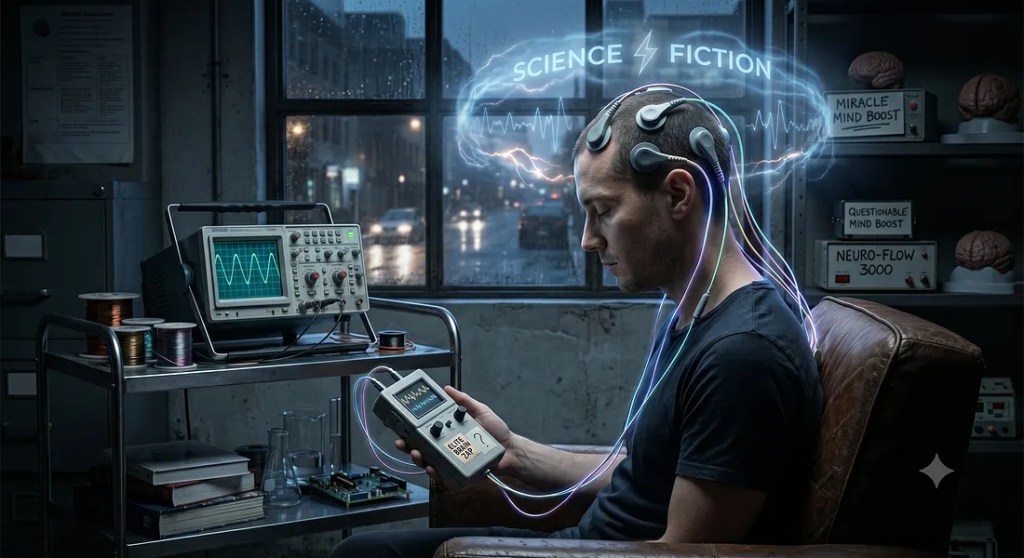
The rise of “electric medicine” is real, promising, and already overrun with charlatans. Here’s how to tell the difference.
There’s a headset on the market right now that psychiatrists can prescribe for major depression — and patients can use from their living rooms. It received FDA clearance in December 2025. It requires no pills, no clinic visits, no electrodes in your skull. You wear it at home, for thirty minutes a session, paired with a smartphone app that tracks your symptoms week by week.
This is not a scene from a speculative novel. It’s 2026, and a quiet revolution in how we treat the brain — and the body — is arriving faster than most people realize. Interest in terms like “brain stimulation,” “vagus nerve stimulation,” and “TMS therapy” has grown sharply in recent months, driven by a potent mix of genuine medical breakthroughs, Silicon Valley biohacker culture, and a population that is, understandably, exhausted by the limitations of psychiatric medication. People are paying attention. The question is whether they’re paying attention to the right things.
What “Electric Medicine” Actually Means
Neuromodulation — the broad term for therapies that alter nerve activity through targeted delivery of electrical, magnetic, or ultrasound-based stimulation — is not new. Electroconvulsive therapy (ECT), long stigmatized by its portrayal in One Flew Over the Cuckoo’s Nest, has been used since the 1930s and remains one of the most effective treatments for severe, treatment-resistant depression. Deep brain stimulation (DBS), in which electrodes are surgically implanted into specific brain regions, has been a lifeline for Parkinson’s patients since the late 1980s.
What is new — and what is driving the current surge in public interest — is the arrival of non-invasive neuromodulation at clinical and consumer scale. These are technologies that work from the outside: no surgery, no anesthesia, no hospital stay. They include:
- Transcranial Magnetic Stimulation (TMS): A device held near the skull generates magnetic pulses that induce electrical currents in targeted cortical regions. FDA-cleared for depression since 2008, it’s now used for OCD and anxious depression as well.
- Transcranial Direct Current Stimulation (tDCS): Mild electrical current is passed through electrodes placed on the scalp, nudging neurons toward excitation or inhibition. Widely studied; increasingly available as consumer hardware.
- Vagus Nerve Stimulation (VNS): Electrical pulses delivered to the vagus nerve — either through an implant, a neck patch, or an ear clip — modulate a vast signaling highway connecting the brain to nearly every major organ. FDA-approved for epilepsy, depression, and, most recently, in a non-invasive form for headache and inflammation.
- Focused Ultrasound: Acoustic energy precisely targeted at deep brain structures, capable of temporarily disrupting or stimulating activity without a scalpel. Clinical trials are ongoing for tremor, Parkinson’s, and even Alzheimer’s.
The common thread: instead of flooding the entire bloodstream with a chemical that crosses the blood-brain barrier and binds imprecisely to receptors across the nervous system, these technologies aim to adjust specific circuits, in specific places, with something closer to surgical precision. It’s the difference between watering one plant and flooding the entire garden.
Why People Are Searching for This
The pharmaceutical model of mental health treatment has saved millions of lives. It has also let down millions more.
Roughly one-third of people with major depressive disorder don’t respond adequately to antidepressants — a clinical reality that hasn’t meaningfully improved in decades, despite an enormous investment in drug development. Antidepressants take weeks to work, carry side effects ranging from tolerable to devastating, and for some patients, simply don’t work at all. Anti-anxiety medications like benzodiazepines risk dependence. Antipsychotics can cause metabolic changes and movement disorders. For a significant portion of patients, the medicine helps — but at a cost.
Add to this the broader cultural moment: a population more aware of and willing to discuss mental health than any prior generation, a wellness industry worth hundreds of billions of dollars actively marketing “brain optimization,” and a post-pandemic surge in depression and anxiety that has overwhelmed traditional psychiatric care. People are looking for something. Electric medicine, with its futuristic sheen and its genuine clinical credentials, has arrived at exactly the right moment.
The arrival of prescription-grade, at-home neuromodulation devices marks a watershed in that shift. In December 2025, the FDA approved the first such device for home depression treatment: Flow Neuroscience’s FL-100, a tDCS headset indicated for moderate-to-severe major depressive disorder. It won’t necessarily remain alone — the regulatory pathway is now established, and other devices are under development. The searches that followed the approval were not subtle. People wanted to know: Does it work? Is it safe? And, critically — is it the same as the tDCS headset selling for $299 on the wellness site they’d been browsing?
It is not.
Consider what happened to a woman I’ll call Maria — a composite drawn from accounts that appear regularly in patient forums and clinical case reports, because versions of this story happen often enough to be representative. After two antidepressants failed her, she spent $350 on a consumer neurostimulation headset she found through a wellness influencer’s affiliate link. She used it faithfully for three months. Nothing changed. Frustrated, she concluded that “brain stimulation doesn’t work for me” and told her psychiatrist as much — which nearly deterred her from trying clinic-based TMS, a categorically different and rigorously validated treatment, for another eighteen months. She eventually did try it. It helped. The delay cost her a year and a half.
The Line That Matters Most
Here is where the promise of electric medicine collides with its most significant danger.
The regulated medical device market and the consumer “neurostimulation” wellness market are not the same thing. They are not even close to the same thing. But they look alike, they use similar language, and they are sold on the same internet.
An FDA-cleared TMS device has undergone rigorous clinical trials demonstrating safety and efficacy for a specific indication. Its parameters — pulse frequency, intensity, coil placement, session duration — have been validated by research. It is prescribed by a licensed clinician who has assessed whether a given patient is an appropriate candidate (people with metal implants in their skulls, for instance, cannot use it safely). It is monitored.
A consumer tDCS headset purchased from a biohacking website has, in most cases, done none of these things. The FDA does not approve these devices as medical treatments. Some are classified as “general wellness” products, a regulatory category that permits vague claims about things like “focus” and “relaxation” without the burden of clinical proof. Others exist in a grey zone that the FDA has struggled to police effectively. The electrodes may be placed imprecisely. The current parameters may be inconsistent. And the buyer, interpreting the device’s existence on a reputable e-commerce platform as implicit validation, may assume a safety profile that simply hasn’t been established.
Clinicians are sounding alarms — not to discourage the field, but to protect patients who are making consequential decisions based on marketing copy. Depression is a serious illness. Substituting an unvalidated gadget for evidence-based care can mean months lost, symptoms worsening, and a person concluding — wrongly — that “brain stimulation didn’t work” before they ever tried the real thing.
The questions that cut through the noise are not complicated:
- Has this device received FDA clearance or approval for the specific condition I have? (Not “FDA registered,” not “FDA compliant” — cleared or approved.)
- Is it available by prescription, reviewed by a clinician?
- What peer-reviewed clinical evidence exists for this exact device and indication?
If the answers are no, unclear, and none — it’s a wellness gadget, not a medical treatment. That doesn’t mean it’s dangerous. It means you don’t actually know.
The Legitimate Frontier
None of this should obscure how genuinely extraordinary the science is.
Vagus nerve stimulation, once requiring a surgically implanted pulse generator, can now be delivered through a small device worn on the ear or pressed against the neck. Research suggests non-invasive VNS may have applications in reducing inflammation in autoimmune conditions, accelerating recovery from stroke, and modulating the hyperactive threat responses seen in PTSD. A pivotal trial published in The Lancet showed that VNS paired with rehabilitation significantly improved upper limb motor recovery in chronic stroke patients — a finding that helped win FDA approval for VNS as a stroke therapy.
Focused ultrasound, still largely confined to research and specialized clinical settings, can now reach targets deep in the brain — the thalamus, the subthalamic nucleus, the amygdala — without breaking the skin. Early-phase trials are exploring whether it can suppress the seizure foci in epilepsy, disrupt the pathological circuits in OCD, and even temporarily open the blood-brain barrier to allow targeted drug delivery directly to tumors.
And the convergence of neuromodulation with AI-driven biomarkers may produce something even more transformative: closed-loop systems that read neural signals in real time and adjust stimulation dynamically, not to a preset protocol, but to the actual state of the patient’s brain in the moment. This is not a speculative ambition. It is the active goal of several well-funded research programs and has already been demonstrated in limited clinical contexts.
The brain has long been medicine’s most resistant territory — one of the organs whose dysfunction causes immense suffering and has resisted many of medicine’s cleanest solutions. These technologies represent a genuine shift in how we might approach it: not through chemistry alone, but through the electrical language the brain already speaks.
How to Be an Informed Patient
If you’re drawn to this field — as a patient, a caregiver, or simply a curious person — there are a few principles worth holding onto.
Skepticism and enthusiasm are not mutually exclusive. The science here is real and exciting. That makes it a perfect target for exploitation. Both things are true simultaneously.
Regulatory status is a floor, not a ceiling. FDA clearance means a device is reasonably safe and effective for a specific use. It doesn’t mean it’s right for you, that all uses are validated, or that a clinician’s oversight is unnecessary.
“Biohacking” is a vibe, not a methodology. Some self-experimenters in this space are rigorous, thoughtful, and generating genuinely interesting data. Many are not. The absence of side effects is not evidence of efficacy. A YouTube testimonial is not a clinical trial.
Access to good care matters. One of the most frustrating aspects of this moment is that the legitimate treatments — clinic-based TMS, FDA-cleared VNS devices, ECT — remain inaccessible to many people due to cost, geography, and coverage gaps. The wellness market fills that void not because it’s better but because it’s available. That’s a healthcare system problem, not a technology problem.
The electricity running through your nervous system right now — the signals firing between neurons, the currents that make your heart beat and your lungs expand — is not metaphor. It is physics. The idea that we might learn to speak that language, to intervene in disease by directly addressing the circuitry rather than the chemistry, is one of the most compelling ideas in modern medicine.
It is also, right now, an idea that both scientists and marketers are racing to bring into the world.
Not all of them are equally trustworthy.
If you’re considering any form of neuromodulation therapy, speak with a board-certified psychiatrist or neurologist before purchasing any device. The Clinical TMS Society and the American Academy of Neurology maintain resources for finding qualified clinicians and understanding the evidence base for specific treatments.









