
Why Choosing Yourself Still Feels Wrong After Years of Self-Abandonment
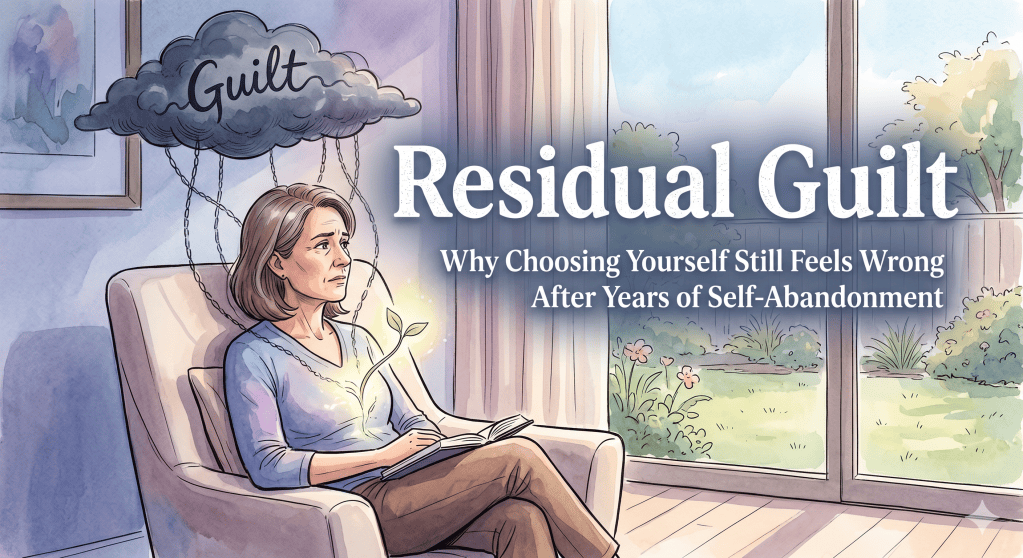
The strange part about healing is that sometimes your nervous system experiences self-respect as danger.
After years of abandoning yourself for others, choosing yourself can feel emotionally incorrect — even when it’s necessary.
I thought boundaries would feel empowering immediately.
Clean.
Certain.
Liberating.
I thought the moment I stopped overextending myself, some internal alarm would finally go quiet.
Instead, something unexpected happened.
I felt guilty.
Not because I was harming anyone.
Not because I was cruel.
But because I was no longer functioning in the role my nervous system had spent years rehearsing:
Caretaker.
Stabilizer.
Emotional responder.
The one who absorbs discomfort before it reaches anyone else.
When you spend enough time abandoning yourself for the comfort of others, self-sacrifice stops feeling like a behavior.
It starts feeling like morality.
That’s why healing can feel emotionally disorienting at first.
Your mind may understand the change long before your body trusts it.
You say “no” to something exhausting —
and instead of relief, you feel anxiety.
You stop explaining yourself —
and suddenly feel cold.
You choose rest over availability —
and your nervous system reacts as if you’ve done something dangerous.
Because in a strange way, you have.
You’ve interrupted a survival pattern.
Most people think guilt is proof that something is wrong.
But residual guilt often appears when something old is losing control over you.
I didn’t understand this immediately.
I assumed every uncomfortable feeling meant I was becoming selfish.
Every delayed response felt rude.
Every boundary felt excessive.
Every act of self-protection carried a quiet emotional aftertaste, like I had violated some invisible contract.
And in a way, I had.
But the contract was never healthy to begin with.
It was built on the belief that my value increased in proportion to my usefulness.
That being needed meant being loved.
That accessibility was kindness.
That exhaustion was evidence of care.
The problem with survival identities is that they don’t disappear the moment you outgrow them.
They echo.
Even after your behavior changes, your nervous system keeps anticipating the old consequences:
- rejection
- disappointment
- emotional withdrawal
- conflict
- abandonment
So when you finally choose yourself, your body doesn’t always register freedom first.
Sometimes it registers threat.
That realization changed the way I interpreted guilt.
I stopped seeing it as moral evidence.
And started seeing it as emotional residue.
Residual guilt is what remains after years of self-erasure.
It’s the psychological soreness that appears when you begin using parts of yourself that were neglected for survival.
And the hardest part?
It can make unhealthy dynamics feel emotionally safer than healthy ones.
Over-functioning feels familiar.
Over-explaining feels familiar.
Immediate responsiveness feels familiar.
But calm boundaries?
Mutual responsibility?
Rest without apology?
For many people, those things feel deeply unfamiliar at first.
And unfamiliarity is often mistaken for wrongness.
I remember moments where I almost reversed my own growth just to escape the discomfort.
Moments where apologizing would have been easier than maintaining the boundary.
Moments where abandoning myself again felt tempting simply because it restored emotional predictability.
That’s how powerful old conditioning can be.
Because healing is not just behavioral.
It’s neurological.
You are teaching your system that:
- rest is safe
- saying “no” is survivable
- disappointing others is not fatal
- your needs do not require justification to exist
And repetition matters.
Every time you maintain a boundary without collapsing into self-erasure, you send your nervous system a new message:
I can protect myself and remain safe.
Eventually, the guilt changes.
It softens.
What once felt emotionally “wrong” starts feeling neutral.
Then natural.
Then necessary.
You stop panicking when someone is disappointed in you.
You stop interpreting every emotional reaction as your responsibility to fix.
You stop treating your own limits like betrayals.
And slowly, something quieter replaces the guilt:
Self-trust.
Not loud confidence.
Not superiority.
Just the calm understanding that your existence does not need to be earned through constant emotional labor.
That realization changes everything.
Because once you stop measuring your worth through usefulness, you begin asking entirely different questions:
- Do I even enjoy this connection?
- Do I feel safe here?
- Do I feel respected without performing?
- Am I loved — or merely relied upon?
Those questions can rearrange your entire life.
And perhaps that’s why healing feels so emotionally complex.
You are not simply learning new behaviors.
You are grieving an identity that once kept you connected, needed, and emotionally necessary.
Even if it was destroying you quietly.
Residual guilt is not proof you should return to self-abandonment.
It’s evidence that your internal system is adjusting to a new reality —
one where your needs matter too.
And eventually, your nervous system learns something it never fully believed before:
You do not have to disappear
in order to be loved.









