
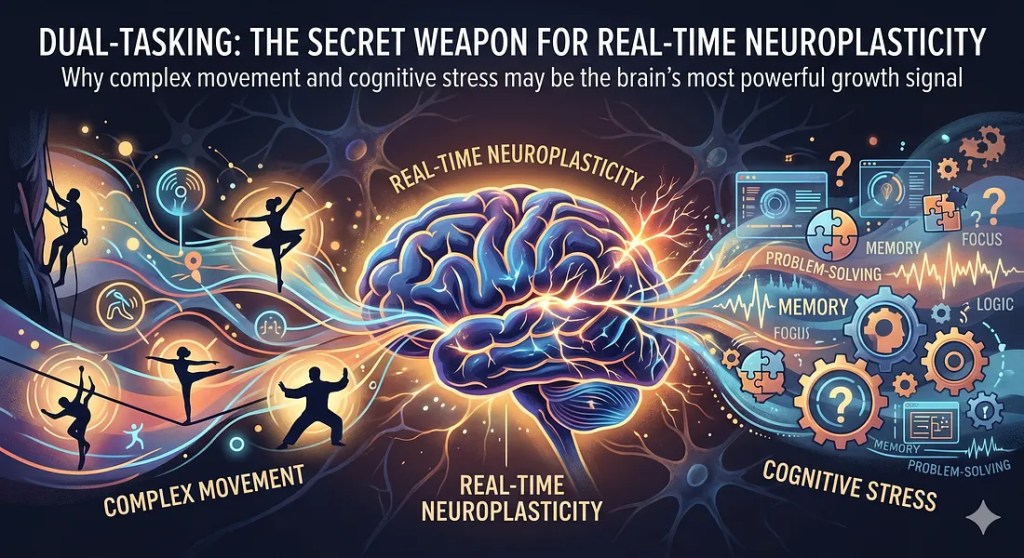
Why complex movement and cognitive stress may be the brain’s most powerful growth signal
For decades, the fitness industry sold us a clean and simple equation: move your body, burn calories, get healthy. Exercise was a physical event. The brain, we assumed, was just along for the ride.
That assumption is being quietly dismantled.
A growing body of research — including research from Stanford and the Parkinson’s Foundation — has put a striking protocol under the microscope: Dual-Tasking. It’s the practice of forcing the brain to manage complex cognitive demands at the exact moment the body is engaged in intense physical movement. And what it reveals about the nature of neuroplasticity challenges nearly everything we thought we knew about how the brain actually changes.
The Brain Doesn’t Care That You’re “Working Out”
Standard exercise does something good for the brain. That much has been established. Aerobic activity increases cerebral blood flow, nudges up BDNF (brain-derived neurotrophic factor), and correlates with modest improvements in mood and memory. For decades, this was the headline: cardio is good for your brain. Go for a run. Take the stairs.
But here’s the problem with that story: the brain is exquisitely sensitive to the nature of what it’s being asked to do — not just whether the body is moving.
When you jog at a comfortable pace, your motor cortex runs the movement largely on autopilot. Your working memory is free to wander. Your prefrontal cortex — the seat of executive function, planning, and complex thought — is essentially on standby. The brain is present, but it isn’t particularly challenged.
Dual-Tasking breaks that dynamic entirely.
The protocol asks you to perform a cognitively demanding task simultaneously with physically demanding movement. Count backward from 100 in a foreign language while performing complex footwork drills. Solve a verbal reasoning problem while sprinting intervals. Recite sequences while executing a demanding athletic movement pattern you haven’t yet mastered.
What happens next, at the neurological level, is a fundamentally different adaptive challenge.
An Agitated, High-Demand State — By Design
Researchers describe what Dual-Tasking induces as an “agitated, high-demand state” in the brain — and that phrase is worth sitting with, because it sounds alarming and yet it’s precisely the point.
The brain is not a muscle in the literal sense, but it shares one critical property with muscle tissue: it adapts under load. Load that is insufficient produces no meaningful adaptation. Load that is excessive produces injury or shutdown. But load that sits just above the current threshold of competency — load that is hard but manageable — forces structural change.
Standard exercise rarely hits that threshold for the brain. Dual-Tasking is specifically engineered to.
When you are simultaneously processing intense physical coordination and a demanding cognitive task, researchers believe something qualitatively different begins to unfold.
Rather than the partial neuromodulator response triggered by exercise or cognition alone, the evidence suggests these conditions may increase activity across systems associated with dopamine and noradrenaline — the networks tied to attention, learning, and adaptive response. Researchers suspect this combined activation may create a uniquely potent environment for neural adaptation, one that signals novelty and urgency in a way that neither demand achieves in isolation.
Under those conditions, the brain appears to enter a heightened state of synaptic adaptation — more receptive to structural change, more likely to respond to the demands that unfamiliar tasks place on it.
What this may represent is a more accelerated form of neuroplastic adaptation — not the slow accumulation that comes from months of repetitive habit, but something closer to the rapid reorganization the brain undertakes when it encounters a genuinely new problem it hasn’t yet learned to solve.
The Gray Matter You Can Actually Grow
A comprehensive clinical review tracking mind-body physical practices adds another dimension to this picture — and it’s one that reframes physical training entirely.
The data suggests that combining structured physical movement with deep mental engagement doesn’t just improve performance. It may actually support increases in gray matter volume in the hippocampus and prefrontal cortex — two of the most consequential regions in the human brain.
The hippocampus governs memory consolidation and spatial navigation. It is one of the first structures to deteriorate with age and stress, and one of the primary targets of neurodegeneration in conditions like Alzheimer’s. The prefrontal cortex governs executive function: decision-making, impulse regulation, planning, social cognition.
These are not peripheral structures. These are the organs of your cognitive life.
The mechanism behind this under Dual-Tasking conditions appears to follow the same principle that governs all deep learning: novelty plus difficulty. The activity must be genuinely hard to master. It must demand the integration of systems that don’t normally work together. It must resist automaticity — the moment a task becomes routine, the brain stops adapting around it.
This is why “learning a complex movement pattern while counting backward in a foreign language” isn’t an absurd example. It’s a precise prescription. The cognitive system must be forced to route information through unfamiliar pathways. The motor system must be executing something it hasn’t yet internalized. The discomfort you feel doing this is not incidental — it is the mechanism.
Rewriting the Grammar of Neural Communication
There’s a phrase from the clinical literature that deserves to be read slowly: Dual-Tasking changes the literal “grammar” of how neural networks communicate.
Neural networks — like all networks — develop preferred pathways over time. Signals travel the routes they’ve always traveled. Habits form. Defaults solidify. This is efficient, and for most of the brain’s operations, it’s exactly what you want.
But efficiency, taken to its logical extreme, is rigidity. A brain that only runs practiced routines is a brain that stops adapting. And a brain that stops adapting is one that begins, gradually, to decline.
The reason Dual-Tasking is showing clinical promise in conditions like Parkinson’s disease — where motor-cognitive integration breaks down — is precisely because it pressures the brain to move beyond default routing. It may help recruit and strengthen alternative neural pathways that more familiar, automated activity simply doesn’t reach.
This has implications well beyond the clinic. For anyone interested in peak cognitive performance, resilience against age-related decline, or simply a more capable, adaptable mind — the principle is the same: you have to break the grammar before you can write a new one.
Not Calorie Burning. Cognitive Installation.
The reframe this research demands is significant enough that it’s worth stating plainly.
Physical movement is not primarily a calorie-burning event. At the level of neural biology, movement is a cognitive software installation — provided it’s demanding, novel, and mentally integrated enough to trigger the brain’s adaptation response.
A ten-mile run that your body has done a hundred times, at the same pace, on the same route, is a very good cardiovascular maintenance event. It is not driving meaningful cognitive adaptation. Your motor system has already automated it. Your prefrontal cortex is somewhere else entirely.
A forty-five-minute Dual-Tasking session — complex movement patterns you’re still learning, paired with demanding cognitive loads you haven’t internalized — is something else. It is a full-system renovation in progress. Memory systems associated with the hippocampus appear to be more actively involved. The prefrontal cortex is online and working. The conditions for synaptic adaptation appear to be present.
The body is the vehicle. The brain is the destination.
What This Looks Like in Practice
Dual-Tasking doesn’t require specialized equipment or a neuroscience lab. It requires designing training sessions around the core principle: the cognitive load and the physical load must both be genuinely difficult, and neither can be on autopilot.
Some practical translations of this principle:
- Learn a new, technically complex movement pattern (a martial arts sequence, an unfamiliar dance form, an Olympic lifting variation you’ve never performed) while simultaneously solving verbal or arithmetic problems spoken aloud.
- Perform agility ladder or footwork drills that require active attention — while maintaining a complex counting or language task in working memory.
- Engage in sports or movement practices that are inherently dual-task by design: improvisational partner dance, martial arts sparring, basketball, tennis — activities where the cognitive and physical demands are inseparable and neither can be automated.
The key criterion is honest difficulty. The moment either task becomes easy enough to run in the background, the adaptation signal weakens. You have to stay at the edge of your competency in both domains simultaneously.
That’s uncomfortable. It’s supposed to be.
The Deeper Implication
We are living in an era of cognitive overload and physical convenience — a combination that may be quietly devastating for long-term brain health. We think a great deal while sitting still, and we move our bodies in predictable, unchallenging loops. Neither the mind nor the body is being asked to do something genuinely new.
Dual-Tasking is an antidote to both problems at once.
It asks the most fundamental question you can ask of any training practice: is the brain actually being changed by this? Not stimulated. Not maintained. Changed.
The answer, the research increasingly suggests, depends on whether you are willing to be genuinely bad at something hard — physically and mentally, at the same time — and keep going anyway.
The brain builds itself in the places where it struggles most. Give it two places to struggle at once.
The science of neuroplasticity is evolving rapidly. If you’re working with a specific condition or recovery protocol, consult a qualified clinician before redesigning your training around these principles.









