New neuroscience reveals that social craving activates the same brain circuits as hunger. What the MIT isolation study tells us about social reward sensitivity and attention.
There is a peculiar assumption buried in the modern obsession with social connectivity: that the desire for an audience is, at its core, a personality trait. A quirk of temperament. Something some people simply have more of than others. The introvert-extrovert spectrum gets invoked. Cultural upbringing gets cited. Social media gets blamed. But the conversation rarely goes deeper than that — rarely reaches into the architecture of the brain itself, where something far more mechanical is happening.
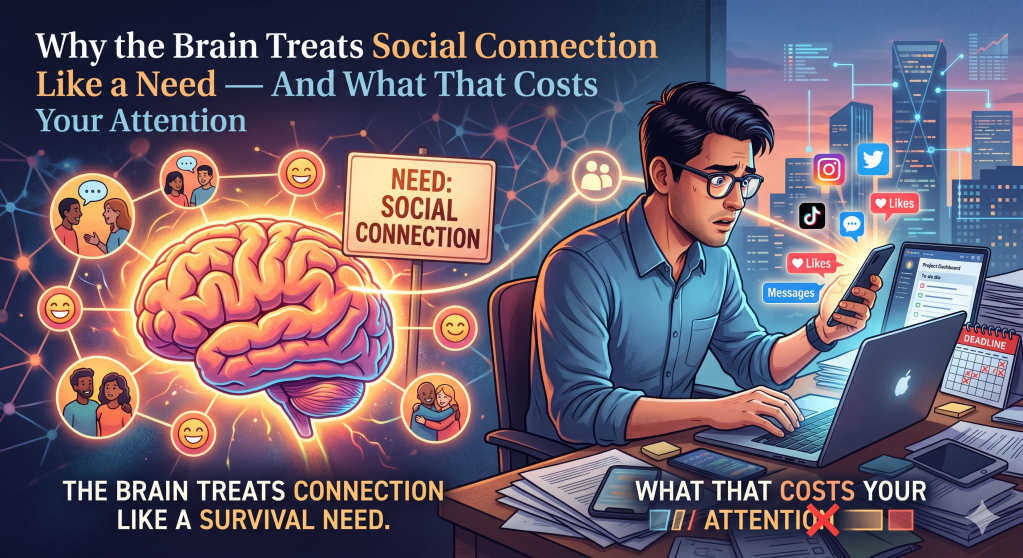
What neuroscience has been quietly uncovering over the past two decades is not a personality story. It is a chemistry story. For a significant portion of the population, the crowd is not just emotionally satisfying. The brain treats social connection as a genuine biological need — one processed through the same reward circuitry that governs hunger, motivation, and the drive to seek out anything the brain has learned to value. When that input is removed, the brain does not simply feel lonely. It signals an absence, and it wants it filled.
That distinction — between preference and reward sensitivity, between enjoyment and biological orientation — is the central question worth examining here. Because how a person’s brain responds to social deprivation turns out to reveal a great deal about how that brain is structured, what it prioritizes, and what it is capable of when left alone.
The MIT Study That Reframed the Entire Conversation
In 2020, a research team at MIT led by neuroscientist Livia Tomova published findings that sent a quiet but significant shockwave through the behavioral sciences. The study, conducted at the McGovern Institute for Brain Research, was not especially large in terms of sample size. But its methodology was precise, its controls were rigorous, and its conclusions were striking enough to demand serious attention.
What the Researchers Actually Did
The design was straightforward, which is part of what makes the results so hard to dismiss. Participants — healthy, socially connected adults — were subjected to two separate ten-hour interventions, each conducted on different days. In the first condition, subjects fasted completely: no food, no caloric intake of any kind for the full duration. In the second condition, subjects underwent total social isolation: no human contact, no phone, no digital communication, no social media, no interaction of any kind for the same ten-hour window.
After each intervention, participants were placed inside an fMRI scanner — a machine that measures blood flow in the brain as a proxy for neural activity — and shown a series of images. After the fasting condition, they were shown images of food. After the isolation condition, they were shown images of people engaged in social activity.
The brain scans were then compared. What the researchers were looking for was whether social deprivation produced measurable craving responses in the brain — and if so, whether those responses resembled what the brain does when it is physically starving.
The Region That Matters: The SN/VTA
To understand why the findings were significant, it helps to understand the specific brain region Tomova’s team was monitoring. The Substantia Nigra and Ventral Tegmental Area — typically referred to together as the SN/VTA — is a compact cluster of neurons located in the midbrain, sitting roughly at the base of the brain near the brainstem. It is, in the most fundamental terms, the engine of the human dopamine system.
Dopamine is frequently mischaracterized in popular media as the “pleasure chemical,” but that framing is imprecise. What dopamine actually does, in the context of the SN/VTA, is signal salience — it tells other parts of the brain that something matters, that something is worth pursuing, that a reward is available and action should be taken to obtain it. The SN/VTA fires when a person encounters food while hungry, substances of abuse, sexual opportunity, or any high-value reward that the brain has learned to associate with survival or well-being.
Crucially, the SN/VTA is the same region that lights up during addiction. When a person addicted to cocaine sees drug paraphernalia, the SN/VTA activates and triggers the downstream cascade of craving, attention narrowing, and compulsive seeking. When a smoker craves a cigarette, the same architecture is at work. The SN/VTA does not distinguish between categories of reward. It responds to what the brain has learned to need.
The Overlap That Changes Everything
Here is what Tomova’s team found: after ten hours of social isolation, the SN/VTA activated in response to images of social connection in a pattern that was statistically indistinguishable from its activation in response to food images after ten hours of fasting.
The neural signature of social craving closely resembled the neural signature of hunger.
This was not a metaphor. It was not a loose analogy. It was a direct functional overlap in the same midbrain dopaminergic region, producing the same kind of craving response, triggered by the same kind of deprivation. The brain, it turns out, codes social connection using some of the same circuitry it uses to track survival needs. For individuals in whom this system is particularly active, the crowd is not a preference. It is processed, at the level of brain chemistry, more like a need than a nicety.
The researchers were careful to note important limitations. The study captured acute responses to short-term isolation, not long-term social behavior. Individual variation was present, meaning not everyone showed the same degree of SN/VTA activation. And correlation between brain activity and subjective craving experience, while strong in many participants, is not a perfect equivalence. The science points toward a mechanism. It does not claim to fully explain the full spectrum of human social motivation.
But the mechanism it points toward is real, and its implications reach well beyond the laboratory.
The External Reward Model: What Happens When the Crowd Becomes the Engine
Understanding the neurological basis of social craving opens a more practical question: what does it actually do to a person’s cognitive life when social stimulation becomes a primary source of reward?
How a High Social Reward Orientation Shapes Attention
The prefrontal cortex — the region responsible for executive function, long-term planning, abstract reasoning, and sustained attention — does not operate in isolation. It is in constant conversation with the dopaminergic circuits that run through the striatum and the limbic system. When those reward systems are not constantly seeking immediate reinforcement, the prefrontal cortex is generally better able to sustain focus on complex, deferred, and abstract tasks. It can sustain effort toward goals that do not produce immediate reward.
For a brain with a strong external social reward orientation, the calculus shifts. The brain begins to prioritize behaviors that produce rapid dopamine activation. In a social context, those behaviors include checking for social feedback — likes, responses, reactions, acknowledgment, approval — engaging in group-reinforcing communication, monitoring social standing, and avoiding behaviors that might result in social rejection or exclusion. These are all fast-acting social inputs that engage the SN/VTA and satisfy the signal, at least momentarily.
The problem is that the prefrontal cortex cannot do two things simultaneously at full capacity. Sustained creative or analytical work requires the kind of extended, low-distraction focus that is fundamentally incompatible with the constant micro-interruption of social monitoring. A brain that is persistently attuned to social feedback — scanning for its next external cue — is a brain that is not fully available for deep, independent execution.
This is not a moral failing. It is not a weakness of character. It is the predictable output of a brain running a particular kind of software. But the consequences are real. Research on attention and cognitive performance consistently shows that task-switching — moving attention between a demanding task and a social monitoring behavior — does not merely divide attention. It degrades the quality of both tasks and increases the metabolic cost of both. The brain does not multitask; it alternates, and alternation is expensive.
The Algorithm Trap
Social media platforms were not designed with any understanding of the SN/VTA, but they were designed — through iterative behavioral testing — to exploit exactly what the SN/VTA responds to. Variable reward schedules, the same mechanism that makes slot machines compelling, are built into the architecture of every major social platform. Notifications arrive unpredictably. Social feedback — a like, a comment, a share — comes in irregular intervals that are more reinforcing, neurologically, than regular ones. The scroll is infinite, meaning the search for the next social signal never has a natural stopping point.
For someone whose dopamine system is strongly calibrated to external social input, this environment is not simply distracting. It is a highly efficient delivery system for the social rewards the brain has learned to seek. The platform delivers the SN/VTA activation that isolation was threatening to deprive. And because the rewards are variable and unpredictable, the craving — rather than being satisfied — is maintained in a state of heightened sensitivity.
Behavioral economist B.J. Fogg, who spent years studying the mechanics of persuasive technology at Stanford, has described the intentional use of these mechanisms in platform design. The result, as researchers like Jean Twenge have documented through longitudinal survey data, has been a measurable shift in how young people in particular relate to solitude, boredom, and unstructured time — states that once served as the incubation environment for creative and intellectual development.
This is not a claim that social media produces clinical addiction in most users. The literature on this question is genuinely contested, and the term “addiction” applied to social media behavior is disputed among researchers. But the neurological overlap between social craving and other forms of reward-seeking that Tomova’s work identified suggests that for individuals with a highly externally-calibrated social reward system, the behavioral patterns we associate with compulsive use are the predictable output of a brain doing exactly what its chemistry is telling it to do.
The Cost of Perpetual Social Orientation
There is a subtler consequence that tends to get less attention. When a brain is chronically organized around external social input as its primary dopamine source, it loses practice at something important: generating motivation and meaning from internal states.
Intrinsic motivation — the capacity to pursue a goal, solve a problem, or create something because the process itself is rewarding, independent of external recognition — is not purely volitional. It has a neurological substrate. Research on what psychologist Mihaly Csikszentmihalyi called “flow” — the state of deep, absorbing engagement with a challenging task — suggests that the flow state is associated with a distinctive pattern of brain activity in which the default mode network quiets and sustained, focused processing takes over. That state is neurologically incompatible with social monitoring. It requires a certain willingness to be temporarily invisible.
For a brain that has been consistently rewarded by social input and intermittently punished (via dopamine dip) by its absence, tolerating that invisibility is genuinely difficult. Not because the person lacks discipline, but because the brain has been shaped — by experience, by platform design, and possibly by underlying neurological predisposition — to treat social disconnection as a threat signal. The absence of external dopamine input registers as an alarm rather than an opportunity.
The result, over time, may be a reduced tolerance for prolonged periods of self-directed work in some individuals. Not an inability — the prefrontal cortex retains its hardware — but a kind of atrophy, a stiffness in the cognitive muscles that sustain independent effort. The individual may find themselves increasingly reliant on external structure, external deadlines, external audiences, and external validation not because they have chosen that reliance but because the reward architecture of their daily life has continuously reinforced it.
It is worth pausing here to acknowledge something the neuroscience does not dispute: a highly active social reward system is not simply a liability. Many of the traits that make someone strongly oriented toward social input — sensitivity to others’ emotional states, attentiveness to group dynamics, skill at reading a room — are the same traits that underpin effective leadership, persuasion, teaching, coalition-building, and entrepreneurship. The socially attuned brain often excels precisely in the environments where those capacities matter most. The research is not arguing that high social reward sensitivity is a flaw to be corrected. It is suggesting that any strong orientation — toward any particular reward source — comes with trade-offs in attentional bandwidth, and that those trade-offs are worth understanding clearly.
Recognizing the Calibration and the Question of What to Do With It
The point here is not that social engagement is pathological, or that the desire for connection represents some kind of neurological deficiency. Human beings are social animals. The SN/VTA’s response to social cues is not a malfunction — it is the system working as designed. Social connection is genuinely important to well-being, and the research on social isolation’s long-term health consequences is extensive and sobering.
The more precise question is one of calibration and source. A brain with reward-system flexibility — one that does not require continuous external social input to maintain its baseline function — has far more range. It can engage deeply with the crowd when engagement is appropriate and useful. It can step back from the crowd when independent work requires it. It is not at the mercy of either state.
The research suggests that this kind of reward-system flexibility is not fixed. Neuroplasticity, the brain’s capacity to reorganize its patterns of activation through repeated experience, means that the reward architecture is not permanent. A brain strongly calibrated toward external social input can, with deliberate practice in tolerating and even enjoying solitude, gradually shift that calibration. The discomfort of social disconnection — the craving that Tomova’s team measured in the SN/VTA — tends to diminish with repeated, voluntary exposure to productive solitude, much as other craving responses diminish when the anticipated reward repeatedly fails to appear.
This is supported by a body of research on attention restoration, solitude, and cognitive renewal that spans several decades and multiple disciplines. Studies by psychologists Ester Buchholz and Christopher Long, among others, have documented that voluntary solitude — as distinct from loneliness or involuntary isolation — is associated with creativity, self-knowledge, and emotional regulation in ways that social stimulation cannot replicate. The capacity to be alone, productively and without distress, appears to be a learnable and developable cognitive skill, not simply a temperamental endowment.
The Broader Picture
What Tomova’s 2020 MIT study ultimately contributes to this conversation is a neurological frame that replaces the vague language of personality and preference with something more precise. The crowd-seeking profile is not simply an expression of who someone is. For a significant subset of the population, it reflects how the brain has been calibrated — its reward circuitry shaped by experience, environment, and possibly underlying neurological predisposition to weight social input heavily in its calculations.
That framing matters because it changes the nature of the conversation about social behavior, attention, productivity, and autonomy. If the issue is merely temperamental, the prescription is accommodation: arrange your environment to suit your social needs and find ways to work within those constraints. If the issue is one of reward calibration, the options expand: the brain can be recalibrated, but only through the deliberate and repeated experience of what it currently finds aversive.
Stepping away from the crowd, in this context, is not a rejection of social life. It is not misanthropy, not a retreat from the world. It is something closer to a deliberate process of teaching the brain to draw on a wider range of reward sources — to find motivation in internal states as well as external ones, to function across a broader spectrum of social conditions rather than only within a narrow band.
Whether that recalibration is worth pursuing is a question each person has to answer for themselves, based on what they are trying to build, what kind of work they are trying to do, and how much of their cognitive bandwidth is currently occupied by an attentional pattern they may not have consciously chosen.
But the first step — the one Tomova’s research makes possible in a way that intuition alone cannot — is simply recognizing what is actually happening in the brain when the crowd feels necessary. Not a personality. Not a preference. A craving signal, mediated by the same midbrain circuits that make food feel urgent when you are starving.
Understanding that mechanism does not make the signal disappear. But it does make it visible. And visibility, as anyone who has ever successfully changed a deeply ingrained habit knows, is where the work begins.
Selected References
Tomova, L., Wang, K. L., Thompson, W., Matthews, G. A., Takahashi, A., Tye, K. M., & Saxe, R. (2020). Acute social isolation evokes midbrain craving responses similar to hunger. Nature Neuroscience, 23, 1597–1605.
Csikszentmihalyi, M. (1990). Flow: The Psychology of Optimal Experience. Harper & Row.
Buchholz, E. S. (1997). The Call of Solitude: Alonetime in a World of Attachment. Simon & Schuster.
Long, C. R., & Averill, J. R. (2003). Solitude: An exploration of benefits of being alone. Journal for the Theory of Social Behaviour, 33(1), 21–44.
Fogg, B. J. (2003). Persuasive Technology: Using Computers to Change What We Think and Do. Morgan Kaufmann.
Twenge, J. M. (2017). iGen: Why Today’s Super-Connected Kids Are Growing Up Less Rebellious, More Tolerant, Less Happy — and Completely Unprepared for Adulthood. Atria Books.