
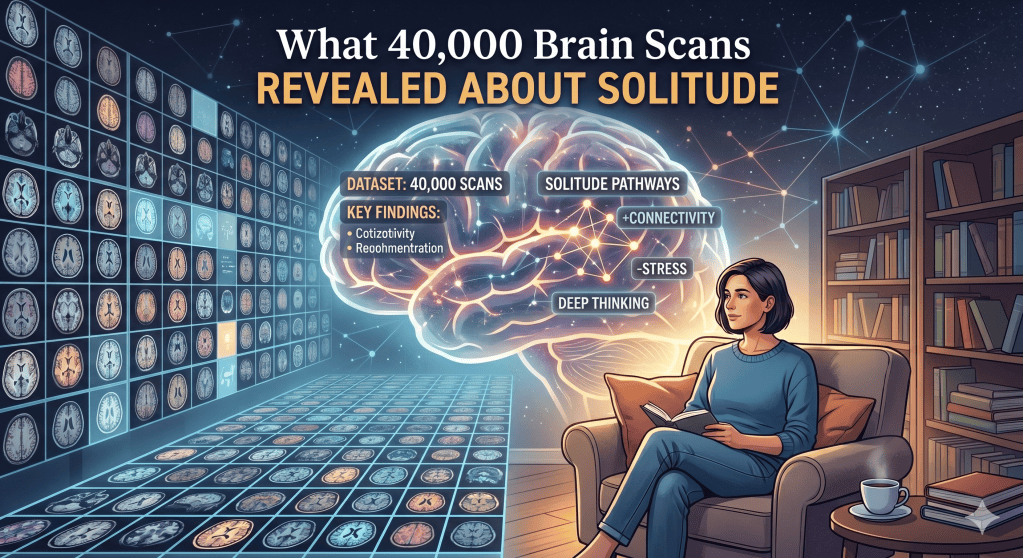
A massive neuroscience study suggests that loneliness and chosen solitude may shape the brain in very different ways.
There is a specific kind of quiet that most people find unbearable. Not the quiet of a peaceful morning or a walk through an empty park, but the deep, pressing silence that settles in when the social world has gone still and the mind is left entirely to itself. For many people, that silence fills immediately with noise — an internal chatter of unfinished thoughts, social replays, and low-grade anxiety that makes genuine solitude feel less like rest and more like confinement.
And yet, for a smaller and very different group of people, that same silence is not a problem to be solved. It is the condition they deliberately seek out. It is the state in which they do their best work.
What separates these two experiences is not personality, willpower, or some vague notion of introversion. According to a growing body of neuroscience research — including one of the largest brain-imaging studies ever conducted — the difference may be structural. It appears to live in the architecture of the brain itself, in a network of regions that activates automatically whenever we stop engaging with the outside world and turn inward.
That network is called the Default Mode Network. Understanding what it does, how it behaves under different conditions, and how it can be shaped over time may be one of the most practically useful things a person can learn about their own mind.
The Network That Never Truly Turns Off
The Default Mode Network, or DMN, was something of an accidental discovery. Neuroscientists studying brain activity in the late 1990s noticed something strange: certain regions of the brain were actually more active when subjects were doing nothing — lying still in a scanner with no assigned task — than when they were engaged in focused mental work. The pattern was so consistent that researchers eventually concluded it represented a distinct functional system, one that the brain defaults to when external demands fall away.
The DMN is not a single brain region but a coordinated set of them: the medial prefrontal cortex, the posterior cingulate cortex, the angular gyrus, and several others. Together, they handle a specific cluster of mental activities. When the DMN runs, the brain is doing things like rehearsing past social interactions, imagining future scenarios, thinking about other people’s perspectives, constructing a sense of personal identity, and generating spontaneous creative associations. In everyday terms, the DMN is the network responsible for your inner monologue, your daydreams, your social rumination, and your sense of self.
It is, in other words, the network that most people experience as “their thoughts.”
When the DMN runs well, it supports reflection, creativity, and a coherent self-narrative. When it runs poorly, it generates the kind of circular, repetitive thinking that most people associate with stress, loneliness, and anxiety.
What 40,000 Brain Scans Suggested
In 2023, researchers analyzing data from the UK Biobank — a massive long-term health study with biological and medical data on hundreds of thousands of UK residents — published findings drawn from structural MRI scans of roughly 40,000 individuals. At roughly 40,000 scans, the study was orders of magnitude larger than most neuroimaging research, making subtle structural patterns easier to detect.
What the researchers found was a meaningful divergence between two groups who, on the surface, might seem similar: those who were chronically lonely — people who wanted more social connection than they had — and those the researchers called “social loners,” people who genuinely preferred spending significant time alone.
The two groups showed measurably different structural patterns in the regions associated with the Default Mode Network. Because the study is correlational, it cannot tell us whether those differences caused the different experiences of solitude, resulted from them, or reflect some combination of both. What it does suggest is that a long-term relationship with solitude — chosen or unchosen — may leave a structural signature in the brain, and that the signatures look quite different depending on which kind of solitude a person has been living with.
The Lonely Brain: When the DMN Runs Loud
For individuals who reported chronic loneliness, the UK Biobank data revealed a consistent structural pattern: the brain regions associated with the Default Mode Network showed increased grey matter volume compared to people who were more socially satisfied.
“More grey matter” might sound like a good thing, but in neuroscience bigger does not always mean better. The enlargement appeared to reflect something more like overuse. Deprived of external social input, the lonely brain compensates by generating more of its own — more social simulation, more replay of past interactions, more projection into imagined futures. The internal world becomes louder and harder to quiet.
Most lonely people would recognize the result: conversations replayed long after they’ve ended, hyperawareness of social cues, mental rehearsal of things you should have said. The brain is not malfunctioning — it is maintaining social readiness in the absence of social contact, which is exactly what it evolved to do. But it comes at a cost. Chronic DMN hyperactivation is associated with anxiety, rumination, and difficulty concentrating. And the same mechanism meant to help often makes things worse: the more vividly you simulate the social world you’re missing, the more acutely you feel its absence.
The Voluntary Loner: A Different Pattern
The picture looked quite different for people who described themselves as preferring solitude — those who chose to spend time alone and found it satisfying rather than distressing.
Rather than the DMN expansion seen in chronically lonely individuals, voluntary loners showed patterns suggesting a different relationship between their Default Mode Network and what neuroscientists call the Task-Positive Network, or TPN. These two networks are, in a sense, the brain’s two primary operational modes, and they are functionally antagonistic — when one is active, the other tends to quiet down.
The Task-Positive Network handles focused, goal-directed thinking. It activates when you are concentrating on a specific problem, learning something new, or engaging in analytical reasoning. It is largely incompatible with the wandering, associative quality of DMN activity. The two systems compete for metabolic resources, and the brain makes an ongoing choice about where to direct its energy.
The Biobank data suggests that long-term comfort with solitude may be reflected in brain structure. One possible interpretation is that these individuals develop a different relationship between internally directed thought and goal-directed attention, allowing them to engage more readily in focused cognitive work when alone. This is not simply a personality trait they were born with, though temperament certainly plays a role. It is also, at least in part, a learned and reinforced tendency that the brain, given enough repetition, may begin to encode structurally.
Why the Brain Treats Silence as Either Threat or Tool
Understanding why these two patterns diverge requires a brief detour into the brain’s threat-detection systems — specifically, the amygdala.
The amygdala processes incoming information and flags potential threats, triggering stress responses that prepare the body to react. Most people associate it with physical danger, but it is equally attuned to social threats: rejection, exclusion, the sense of being unwanted. For chronically lonely individuals, prolonged social isolation can activate amygdala responses in a way that resembles other forms of threat detection. The brain interprets the absence of social connection as a danger signal — and not without evolutionary reason, since for most of human history, social exclusion was genuinely life-threatening. This keeps the nervous system in a low-grade state of vigilance, which in turn keeps the DMN running its social-monitoring routines.
For voluntary loners, this coding appears to be different. Chosen solitude does not seem to trigger the same amygdala response. When isolation is self-initiated and purposeful, the brain’s threat-detection system does not interpret it as exclusion. The amygdala stays quieter, and when that happens, the DMN can also quiet — because the urgent need to maintain social readiness has been removed. The nervous system, no longer on alert, can allow cognitive resources to shift toward higher-order executive functions: planning, problem-solving, creative synthesis, sustained concentration.
This distinction — between solitude as threat and solitude as tool — is not merely philosophical. It appears to have a neurological substrate.
What the TPN Makes Possible
Once the DMN steps back, the TPN can operate without constant competition for metabolic resources. And what that enables is a qualitatively different kind of thinking than most people experience in their ordinary, socially embedded daily lives.
In standard social environments, cognitive bandwidth is continuously split. A portion of attention is always tracking the social dynamics of the room — reading expressions, monitoring tone, anticipating responses. Even in professional settings focused ostensibly on work, this background social processing persists. It is largely automatic and largely invisible, but it is not free. It costs attention, and attention is a finite resource.
In a state of genuine, voluntary solitude, that social processing largely disappears. The full cognitive apparatus can turn toward the task at hand. Complex information can be held in working memory for longer without being displaced by social distraction. Creative connections that require sustained, nonlinear thinking become more accessible — not because inspiration strikes from nowhere, but because the mind finally has the bandwidth to follow a thread all the way to its end.
Building the Capacity: Solitude as Practice
One of the more practically significant implications of the UK Biobank findings is the suggestion that the brain’s relationship to solitude is not entirely fixed. The structural differences observed between lonely individuals and voluntary loners are at least partly attributable to repeated patterns of behavior and experience — which means they are, to some degree, trainable.
The brain is structurally plastic throughout adult life. The pathways you use regularly become more efficient. The states you enter repeatedly become easier to access. If most of your time alone has been spent in anxious rumination or passive consumption of social media — which neurologically mimics the social stimulation the lonely brain craves — you have been reinforcing the very DMN patterns that make productive solitude difficult.
Conversely, deliberately spending time in purposeful solitude — engaged in focused work, deep reading, or sustained creative practice — may gradually train the brain toward the TPN-dominant mode. The transitions become smoother. The experience of being alone shifts, over time, from uncomfortable to ordinary to genuinely restorative.
There is also a useful distinction between different qualities of solitude. Physical solitude — being in a room by yourself — is not enough if the mental environment remains crowded. Checking social media or passively consuming entertainment keeps the DMN’s social-monitoring functions running even in the absence of actual social contact. The kind of solitude that appears to produce meaningful change is what might be called active solitude: time alone directed toward something internally generated — a problem, a craft, a line of thinking — rather than toward external social signals.
The Broader Significance
What the neuroscience of the Default Mode Network ultimately reveals is that solitude, like most things that matter, is less about external circumstances than about the internal orientation brought to them. Two people can sit alone in identical rooms and have entirely different neurological experiences — one trapped in an anxious simulation of the social world, the other navigating a productive, self-directed interior landscape.
We live in a cultural moment deeply uncomfortable with solitude. Social technology has made continuous connection not just possible but default, and the pressure to be constantly available has subtly reshaped what people expect from their own interior lives. Time alone is increasingly treated as something to be filled rather than inhabited.
The Biobank data suggests this matters neurologically. The brain shaped by constant social stimulation and the brain shaped by practiced, purposeful solitude show different structural emphases — different default operational modes, different capacities for the kind of self-generated cognitive work that tends to produce original thought and creative depth. None of this argues against connection or community. Those needs are real and neurologically grounded. But the evidence does suggest that the relationship between solitude and psychological health is more nuanced than the mythology of constant connectivity would have us believe.
The ability to be alone without becoming lonely may be one of the most undervalued cognitive skills of modern life. It is not a personality trait but a capacity — one that can be strengthened through practice. The Default Mode Network does not have to dominate attention. With time, the mind can learn a different relationship to silence, and in that silence discover a depth of thought that constant connection rarely allows.
Selected References
Tomova, L., Wang, K. L., Thompson, W., Matthews, G. A., Takahashi, A., Tye, K. M., & Saxe, R. (2020). Acute social isolation evokes midbrain craving responses similar to hunger. Nature Neuroscience, 23, 1597–1605.
Buchholz, E. S. (1997). The Call of Solitude: Alonetime in a World of Attachment. Simon & Schuster.
Long, C. R., & Averill, J. R. (2003). Solitude: An exploration of benefits of being alone. Journal for the Theory of Social Behaviour, 33(1), 21–44.
Csikszentmihalyi, M. (1990). Flow: The Psychology of Optimal Experience. Harper & Row.