
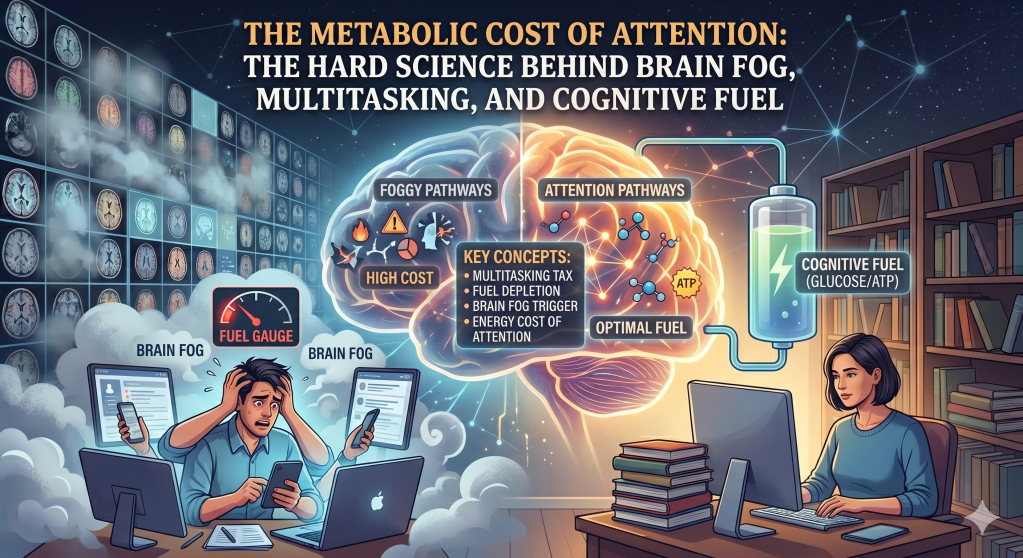
Why does multitasking leave you mentally exhausted? The science of glucose, glutamate, and ATP reveals the real biological cost of attention and brain fog.
We tend to talk about focus the way we talk about motivation — as something you either have or you don’t. If you can’t concentrate, the assumption is that you’re distracted, undisciplined, or maybe just not that interested in what’s in front of you. Productivity culture has built an entire industry on this idea: new apps, journaling systems, time-blocking templates, all designed to fix what is framed as a psychological problem.
But that framing misses something fundamental. Attention is not a habit. It is not a mindset. At its core, attention is a biological process — a physical operation running on a measurable, exhaustible supply of chemical fuel. When your focus collapses after a long day of meetings, context-switching, and inbox management, your brain isn’t failing you emotionally. It is failing you chemically. The tank is empty.
Understanding why that happens — and what’s actually being depleted — changes how you think about productivity, diet, rest, and the design of a demanding workday. This article pulls back the curtain on the metabolic cost of attention: what brain fog actually is at the cellular level, why multitasking is so physically punishing, and how the brain’s energy demands shape — in ways most people never consider — what we eat, how we rest, and how well we actually think.
Attention is not merely psychological. It is metabolic.
The Brain Runs on a Strict Energy Budget
Before getting into what goes wrong, it helps to understand the baseline. The human brain is, by any metabolic measure, extraordinarily expensive to run.
Though it accounts for only about 2% of your total body weight, the brain consumes roughly 20% of the body’s resting energy — almost entirely in the form of glucose, the simple sugar that circulates in your bloodstream after you eat carbohydrates. As Marcus Raichle and Debra Gusnard documented in their landmark 2002 research published in PNAS, this energy demand is not optional or variable based on how hard you’re thinking. The brain’s baseline energy consumption is enormous even when you’re doing nothing in particular — staring out a window, drifting between thoughts, waiting for a meeting to start. The moment you engage in concentrated cognitive work, that demand climbs further.
This biological reality is what makes attention such a finite resource. You cannot “decide” to have more of it the way you might decide to work an extra hour. Sustained attention requires fuel, and that fuel comes from a supply that can be replenished only through rest and nutrition — not through ambition or effort.
The brain’s preferred fuel is glucose, and its preferred method of delivery is fast and direct. When you eat carbohydrates, your digestive system breaks them down into glucose, which enters the bloodstream and crosses the blood-brain barrier relatively quickly. The prefrontal cortex — the region behind your forehead responsible for planning, decision-making, working memory, and executive control — is particularly hungry for this supply. It is the most metabolically demanding piece of real estate in your skull, and research on hypoglycemia — the clinical state of low blood sugar — consistently identifies the prefrontal cortex and hippocampus as among the most vulnerable regions when glucose availability drops significantly.
This is where things get interesting, and where the popular conversation about “brain fog” and “burnout” starts to acquire a biological foundation that most people have never been given.
What Actually Happens When You Multitask
The word “multitasking” is itself a kind of myth. Human beings do not truly perform two cognitively demanding tasks simultaneously. What the brain actually does is switch — rapidly and repeatedly — between tasks, toggling its executive control from one context to another. It feels like doing two things at once. Neurologically, it is doing one thing at a time, very quickly, over and over again.
And every single switch costs something.
Psychologists Joshua Rubinstein, David Meyer, and Jeffrey Evans at the University of Michigan documented this phenomenon rigorously in a 2001 study published in the Journal of Experimental Psychology. Their research defined what they called the “switch cost” — the measurable loss of time and cognitive efficiency that occurs every time a person transitions from one task to another. Even when the tasks were relatively simple and the switches were voluntary, participants consistently lost time during each transition. The more complex the tasks, the higher the cost.
What Rubinstein and his colleagues were measuring in terms of time, however, represents something more fundamental at the level of biology. Each switch requires the brain to disengage the neural control settings for the previous task and reconfigure them for the new one. Think of it like rebooting a computer program: even if the reboot takes only a fraction of a second, every reboot burns through system resources. Do it often enough, and performance begins to degrade.
The metabolic implications appear consistent with what we know about the energetic demands of executive control. Every time you abandon a task mid-stream to check a notification, scan a dashboard, or respond to a message, your prefrontal cortex burns a disproportionate amount of glucose and ATP — adenosine triphosphate, the cellular energy molecule that powers virtually every biological process in the body — just to execute that cognitive reset. The act of maintaining a circuit is metabolically cheap. The act of tearing it down and building a new one is expensive.
This is the physics behind why two hours of switching between browser tabs can leave you feeling more depleted than a three-hour stretch of focused writing. In the first scenario, you are burning fuel inefficiently — idling at a red light, accelerating, braking, over and over. In the second, you are cruising at highway speed, burning fuel steadily and productively. The total distance traveled is roughly the same, but the fuel consumed is not.
The Three Biological Mechanisms of Cognitive Fatigue
Cognitive fatigue is not one thing. It is the cumulative output of three distinct biological processes, each operating at a different level of the brain’s chemistry. Understanding them individually makes it easier to understand why they compound so quickly under the conditions of a modern workday.
Glucose Depletion and the Brain’s Fuel Crisis
As established, the brain runs on glucose. Under conditions of deep, sustained focus — the kind where you lose track of time and produce large amounts of work in a single uninterrupted session — glucose consumption is high, but it is also structured and efficient. The neural circuits engaged in the task run steadily, burning fuel at a stable rate.
Multitasking disrupts this efficiency dramatically. When attention fragments across multiple contexts, the prefrontal cortex must repeatedly reset — and each reset requires a surge of metabolic activity to fire new action potentials and reconfigure the neural network. This is why intense task-switching doesn’t just feel more tiring than focused work; the metabolic evidence suggests it genuinely is.
The sensation most people recognize as “hitting a wall” — that sudden, heavy, almost physical inability to form a coherent thought — likely reflects a combination of factors: changes in local energy availability within highly active neural circuits, shifting neuromodulator levels, and what some researchers describe as the brain performing an implicit cost-benefit calculation, deciding that continued effortful output is no longer worth the metabolic expenditure. The exact mechanisms are still being investigated, and cognitive fatigue research is more contested than popular accounts suggest. But the underlying principle holds: sustained, fragmented attention is expensive in ways that accumulate over hours.
ATP Exhaustion at the Cellular Level
Glucose itself is not the final energy currency the brain uses. Inside neurons, glucose is metabolized through a series of biochemical reactions into adenosine triphosphate — ATP — the actual molecule that powers cellular work. When a neuron fires, when a neurotransmitter is released, when the ion pumps that maintain the electrical gradient of a nerve cell are reset — all of it runs on ATP.
Periods of sustained neural activity increase ATP demand and contribute to the accumulation of fatigue-related metabolic signals. As neural firing rates climb and the brain’s energy turnover accelerates, a byproduct accumulates: adenosine, the base molecule at the core of ATP.
This is not incidental chemistry. Adenosine is a recognized neurological signal. As it builds up in brain tissue, it binds to receptors in the brain that trigger an increasing sense of fatigue. Caffeine, incidentally, works by blocking those same receptors — it doesn’t restore your ATP supply, it just mutes the signal telling you the supply is low. Eventually, when you come off caffeine, the accumulated adenosine floods back in, and the fatigue hits harder.
The brain’s response to rising adenosine is to enter an energy-conservation mode — slowing cognitive processing, reducing the intensity of neural firing, and generating a powerful drive toward rest. This is not weakness. It is the nervous system’s rational response to a cellular energy deficit.
Glutamate Saturation: The Chemical Brake
The third mechanism is the most recently documented and perhaps the most important for understanding why pushing through cognitive fatigue can feel not just unpleasant, but physically impossible.
In 2022, a team of researchers led by Antonius Wiehler at the Paris Brain Institute published a study in Current Biology that gave brain fog a concrete structural explanation. Using magnetic resonance spectroscopy — a neuroimaging technique that can measure the chemical composition of specific brain regions in living people — they tracked what happened in the lateral prefrontal cortex during six hours of demanding cognitive work.
What they found was striking. Participants who spent the day performing high-demand tasks showed, by the end, an 8% higher concentration of glutamate in their lateral prefrontal cortex compared to a control group that had spent the same time on low-effort tasks. Glutamate is the brain’s primary excitatory neurotransmitter — the chemical signal that tells neurons to fire. Under normal conditions, it is cleared efficiently from the synaptic cleft (the gap between neurons) by surrounding glial cells. But under conditions of intense, repeated neural activation — exactly the kind produced by hours of task-switching or concentrated cognitive labor — glutamate accumulates faster than it can be cleared.
At elevated concentrations, glutamate begins to disrupt normal neural transmission. Communication between neurons becomes less reliable. The metabolic cost of producing further cognitive output rises. And the brain, in what the researchers described as a protective response, activates a biological mechanism to force disengagement: a wave of lethargy, reduced motivation, and a powerful pull toward low-effort, low-stimulation activity.
In at least some forms of cognitive fatigue, brain fog may be quite literally in your head — a physical accumulation of metabolic waste in the very region responsible for executive function, rational planning, and effortful thought.
The glial cells that clear glutamate do their work during rest. Sleep, in particular, is when the brain’s waste-clearance system — the glymphatic system — is most active, flushing metabolic byproducts and resetting the neurochemical environment for the following day. Attempting to override this process through stimulants or sheer willpower doesn’t remove the glutamate. It just delays the shutdown.
The Startup Cost Problem: Why Flow State Is Metabolically Efficient
There is a reason elite performers in cognitively demanding fields — writers, programmers, researchers, surgeons, composers — tend to be almost fanatical about protecting their uninterrupted work time. It is not merely a preference. It reflects, whether they know it or not, a basic principle of neural economics.
When the brain successfully enters a state of deep, uninterrupted focus — what the psychologist Mihaly Csikszentmihalyi famously called “flow” — the metabolic dynamics shift. The circuits needed for the task are active and running. The startup cost has been paid. Maintaining that state, even at high intensity, is far cheaper than repeatedly tearing it down and rebuilding it.
The switch cost research by Rubinstein and colleagues illustrates this in practical terms. Every interruption doesn’t just cost you the time of the interruption itself. It costs you the time — and fuel — needed to reconfigure your neural control settings and re-enter the task context afterward. For complex intellectual work, that re-entry period can take anywhere from fifteen minutes to over half an hour. Multiply that by a day of fragmented attention, and you begin to understand why people who are technically “at work” for eight hours often feel they accomplished four hours’ worth of substantive output.
The common response to this feeling is to push harder — to extend the workday, add another caffeine intake, fight through the fatigue. But the biological reality is that this response is working against the mechanism, not with it. The glutamate has already accumulated. Metabolic fatigue signals are already accumulating. The adenosine is already binding. Pushing through does not clear the metabolic waste; it adds to it.
What Your Brain Is Asking For When It Craves Carbohydrates
There is a pattern that most people who do intense cognitive work will recognize: after a few hours of concentrated effort, the craving for something sweet or starchy becomes almost impossible to ignore. A banana. A piece of bread. A handful of crackers. The brain is not being irrational. It is responding to a genuine metabolic signal.
Carbohydrates are the fastest available pathway to restoring circulating blood glucose. The body breaks them down quickly, glucose enters the bloodstream within minutes, and the brain’s immediate energy supply is replenished. Under typical physiological conditions, glucose is the brain’s primary fuel — and this is worth understanding in an era when nutritional discourse has frequently cast carbohydrates as the enemy of health and performance. For the purposes of fueling high-intensity cognitive work, they are not the enemy. They are the brain’s primary fuel source under normal metabolic conditions.
When carbohydrate intake is severely restricted, the body must find alternative routes. Gluconeogenesis converts amino acids from protein into glucose through a slow, metabolically expensive process in the liver — functional, but not well-suited to meeting the rapid energy demands of a brain in deep focus. Ketosis, the other route, involves adapting to ketone bodies derived from fat. The research on cognition in ketosis is genuinely mixed: some functions appear to operate adequately once adapted, while others seem to fare better with glucose available. The transition period itself carries a real cost — the “keto fog” many people experience in the early weeks is a recognized phenomenon.
The honest summary is that individual variation matters, the literature is more nuanced than most popular accounts acknowledge, and the right nutritional approach for any given person depends on factors this article can’t resolve. What the biology does suggest is that dismissing the carbohydrate craving that follows intense cognitive work as mere weakness or lack of discipline misreads what the signal means.
Respecting the Hardware
There is a tendency in productivity culture to treat the mind as essentially unlimited — a resource that responds to better habits, stronger routines, and firmer willpower. The science of cognitive metabolism tells a different story. The mind is powerful, but it runs on a physical substrate that has real operational limits and real maintenance requirements.
Attention is expensive. Task-switching is wasteful. Glutamate accumulates, ATP depletes, and glucose gets consumed faster than most people realize. These are not abstract processes. They are the biological foundation of every hour of focused work you have ever done — and every hour of brain fog you have ever suffered through.
Understanding this doesn’t mean lowering your ambitions. It means building a more accurate model of how your mind actually functions. Deep, uninterrupted work is not a luxury for people with less demanding schedules. It is the metabolically efficient mode in which the brain produces its best output with the least waste. Protecting that kind of time — blocking out the notifications, closing the unnecessary tabs, treating interruptions as the fuel expenditures they actually are — is not a productivity hack. It is basic hardware maintenance.
Rest is not the absence of work. It is when the glial cells clear the glutamate, when the ATP reserves are rebuilt, when the glymphatic system washes out the accumulated metabolic waste and resets the neurochemical environment for the next session. Sleep, specifically, is the most powerful cognitive-performance tool available to a person — and it works not through inspiration or motivation, but through basic biochemistry.
And food — particularly carbohydrates after periods of intense cognitive work — is not indulgence for most people under normal metabolic conditions. It is the body responding to a real signal, one worth understanding rather than overriding.
Conclusion: The User Manual You Were Never Given
The modern knowledge economy asks more of the human brain than almost any working environment in history. The volume of information, the pace of communication, and the fragmentation of attention that characterizes most professional workdays would have been essentially unimaginable to previous generations. We have built a world optimized for distraction and then wondered why concentration has become so difficult.
The science of cognitive metabolism offers a clear-eyed explanation. It is not that people today lack discipline or focus. It is that they are subjecting a finely tuned biological system to conditions almost perfectly designed to drain it as fast as possible — constant task-switching, inadequate recovery periods, stimulant use that masks depletion signals, and nutritional frameworks that may not support the energy demands of the work being asked of the brain.
The insights from researchers like Wiehler, whose 2022 glutamate study gave brain fog a concrete neural address, and Rubinstein, whose switch-cost research quantified the metabolic penalty of fragmented attention, point toward a simple but counterintuitive conclusion: doing less, more deeply, is not a compromise on performance. It is the biological condition under which the best performance is possible.
The brain is not a limitless engine of will. It is a precision machine with a fuel budget, a waste-management system, and a hard stop built in to prevent it from burning itself out. Understanding that mechanism — the glucose demand, the ATP cycle, the glutamate brake — is the first step toward working in alignment with it rather than against it.
You cannot override the physics. But you can learn to work with them.
Sources & Further Reading
- Raichle, M. E., & Gusnard, D. A. (2002). Appraising the Brain’s Energy Budget. PNAS.
- Rubinstein, J. S., Meyer, D. E., & Evans, J. E. (2001). Executive Control of Cognitive Processes in Task Switching.
- Wiehler, A. et al. (2022). A Neuro-Metabolic Account of Why Daylong Cognitive Work Alters the Control of Economic Decisions. Current Biology.
- Csikszentmihalyi, M. (1990). Flow: The Psychology of Optimal Experience.