
Originally published in February 2010. Comprehensively updated and edited July 2026.
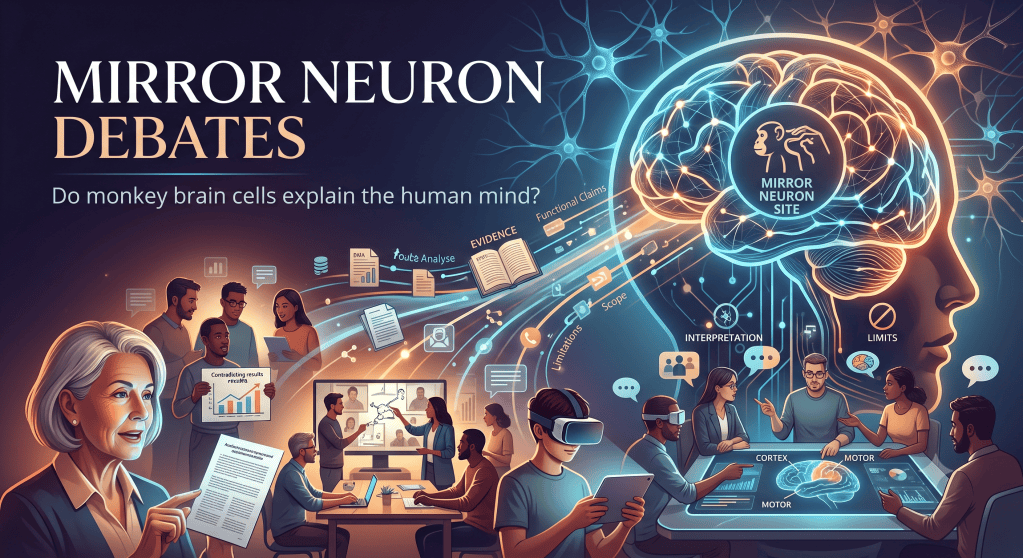
How a landmark 2009 critique by Gregory Hickok challenged mirror neuron theory and reshaped scientific understanding of empathy and social cognition.
Imagine watching someone slice their finger while cooking. Before you consciously think about it, you flinch. For a brief moment, it almost feels as though your own body experienced the injury. Around the turn of the millennium, many neuroscientists believed they had found the explanation for this strange, automatic sense of shared experience: a small population of cells called mirror neurons.
The story of that discovery begins in the early 1990s, with a group of researchers in Parma, Italy, who made an observation that would eventually ripple far beyond the walls of their laboratory. While recording the activity of individual neurons in the brain of a macaque monkey, they noticed something strange. Certain cells in the animal’s premotor cortex fired not only when the monkey reached out and grasped a piece of food, but also when the monkey simply watched a researcher perform the same action. These neurons, in effect, seemed to respond the same way whether the monkey was the one acting or merely the one watching. Giacomo Rizzolatti and his colleagues called these cells mirror neurons, and the name stuck.
By the time the discovery reached a wider audience later that decade, it had already begun to take on a life of its own. Here, it seemed, was a tidy biological explanation for some of the most stubbornly mysterious aspects of human experience: how we read another person’s intentions, how children learn by watching adults, how we feel a flicker of someone else’s pain when we see them get hurt. The neuroscientist Vilayanur Ramachandran captured the mood of the moment when he predicted that mirror neurons would do for psychology what DNA had done for biology, providing a single unifying framework for phenomena that had resisted explanation for a century. It was one of the boldest predictions made about any neuroscience discovery in decades, suggesting that mirror neurons might become the central organizing principle for understanding human cognition itself. It was an exciting time to be interested in the brain, and mirror neurons were, for a while, the closest thing neuroscience had to a celebrity.
That enthusiasm did not go unchallenged. In 2009, the cognitive neuroscientist Gregory Hickok published a paper with a title that read more like a question than a declaration: “The mirror neuron system: a motor-based mechanism for understanding others?” The article, which appeared in the Journal of Cognitive Neuroscience, laid out a detailed case for why mirror neurons could not be doing the sweeping conceptual work that had been attributed to them. The paper did not deny that mirror neurons exist, and it did not claim they are unimportant. What it argued was more precise and, in some ways, more unsettling: much of what the public and even many scientists believed about mirror neurons rested on evidence that could not actually support those conclusions. The essay set off a debate that has continued, in various forms, for well over fifteen years, and it offers a useful window into how scientific ideas capture the public imagination, how they can outrun the evidence behind them, and how the process of correction unfolds when they do.
A Discovery Born From an Accident
The story of mirror neurons begins with an experiment that was not originally designed to find them. Rizzolatti’s team at the University of Parma was studying how neurons in a region of the monkey brain called area F5 controlled hand and mouth movements. The monkeys were fitted with electrodes that recorded the activity of single neurons while they reached for objects like raisins or pieces of fruit. At some point, according to accounts of the discovery, a researcher reached for a piece of food themselves, and a neuron that should only have responded to the monkey’s own movements fired anyway. Curious, the team ran systematic tests and confirmed the pattern held: some fraction of neurons in this motor region responded both when the monkey performed a specific action and when it observed a similar action performed by someone else.
This was a genuinely surprising result. Motor neurons had traditionally been understood as the brain’s output system, the final common pathway through which intentions become movements. Finding cells that also lit up during observation suggested a much closer relationship between acting and perceiving than most researchers had assumed. The initial papers, published through the 1990s, were careful and specific, describing the physiological properties of the cells and speculating modestly about their possible function in recognizing the actions of others.
It was in the interpretation that things began to expand. If a neuron encodes both my grasping of an apple and my observation of someone else grasping an apple, one might reasonably ask whether that shared activity is how I come to understand what the other person is doing. From there it was a short conceptual leap to imagining that the same basic mechanism might explain how people understand facial expressions, spoken language, complex intentions, and even the emotional states of others. Popular science writing embraced the idea with enthusiasm, and by the mid-2000s, mirror neurons were being credited with everything from the origins of human language to the development of empathy to the emergence of civilization itself.
The Cultural Mood That Made Mirror Neurons Irresistible
To understand why the idea spread so quickly, it helps to consider the scientific and cultural climate into which it arrived. Neuroscience was entering a period of enormous public visibility. Brain imaging technology had become more accessible, and headlines about “the brain’s love center” or “the brain’s God spot” were common features of newspapers and magazines. There was a real appetite, both inside and outside the scientific community, for single, elegant mechanisms that could explain complicated human behavior in a sentence or two.
Mirror neurons fit this appetite almost perfectly. The idea could be summarized instantly: we understand other people’s actions because our own motor system mirrors what we see them doing. It had the added appeal of being grounded in hard physiological data from actual neurons, rather than resting purely on behavioral observation or theory, which gave it an air of biological solidity that more abstract psychological concepts often lacked. And it offered an evolutionary story, a way to connect ancient neural machinery in a monkey’s premotor cortex to the richness of human social life, including language, culture, and moral feeling.
This was also a period in which public interest in empathy, autism, and social cognition was growing substantially. Parents, educators, and clinicians were eager for biological explanations of conditions like autism spectrum disorder, and the “broken mirror” hypothesis, which proposed that autism might result from a dysfunctional mirror neuron system, offered a compelling, if ultimately oversimplified, narrative. The hypothesis suggested that difficulties with social understanding and imitation in autism could be traced to a single faulty mechanism, an idea that was intuitive enough to spread widely in both scientific and popular discussions well before the evidence for it was firmly established.
What Hickok’s 2009 Paper Actually Argued
Hickok’s critique did not emerge from nowhere. Years earlier, working on questions about how the brain processes spoken language, Hickok had found that motor regions involved in speech production became active when people simply listened to speech, without producing any themselves. He initially saw this as an unremarkable feature of how auditory and motor systems interact, but other researchers began interpreting his findings through the lens of mirror neuron theory, treating them as evidence that a similar mirroring mechanism supported speech comprehension. Hickok grew increasingly uncomfortable with this interpretation and eventually used the case of speech as the centerpiece of a broader challenge to the entire mirror neuron framework.
His argument rested on a logical test that is easy to state plainly. If a single neural mechanism is responsible both for performing an action and for understanding that same action when someone else performs it, then damage to that mechanism should impair both abilities together. A person who could no longer produce a particular movement should also lose the ability to recognize that movement in others, if the same neurons were doing both jobs. Hickok combed through the existing research literature on brain damage and found the opposite pattern more often than not. People with damage to speech-production areas of the brain frequently retained largely intact speech comprehension, despite being unable to speak fluently themselves. Similarly, some patients with severe difficulty producing certain movements showed no corresponding deficit in recognizing or understanding those same movements when they observed other people performing them.
This dissociation, Hickok argued, was a serious problem for the strong version of mirror neuron theory, the version claiming that motor simulation is necessary for understanding action. He also pointed out a more basic issue with the underlying monkey research: most of the original studies had never actually tested whether the animals understood the actions they observed in any meaningful sense. The neurons responded to observed grasping, but no experiment had shown that this response reflected genuine comprehension of the actor’s goal or intention, as opposed to a simpler form of visual-motor association. Later in his career, Hickok expanded these arguments into a full-length book, in which he catalogued dozens of areas where mirror neuron explanations had been applied, from contagious yawning to language evolution, and argued that in nearly every case the evidence fell well short of what the popular narrative implied.
The Response From Mirror Neuron Researchers
Hickok’s paper did not go unanswered, and the resulting exchange has been one of the more substantive debates in modern cognitive neuroscience. Rizzolatti and his longtime collaborator Corrado Sinigaglia, among others, pushed back on several fronts. They argued that Hickok’s use of brain lesion evidence oversimplified a messy clinical reality, since damage in the brain rarely respects tidy anatomical boundaries, and deficits in patients are often partial, inconsistent, or confounded by damage to nearby regions. A patient who appears to understand actions despite damage to a motor area, they suggested, might still be relying on some spared portion of a distributed mirror system, rather than disproving the theory outright.
Other researchers have argued that Hickok, in his effort to correct the excesses of mirror neuron enthusiasm, swung too far in the opposite direction. Some reviewers of his later book agreed that the strongest claims about mirror neurons deserved serious scrutiny, but felt that he came close to denying the motor system any meaningful role in understanding action at all, a position that a substantial body of research on motor involvement in perception and language does not fully support. This middle-ground position, that motor activity likely contributes something to social understanding without being the sole or even primary mechanism behind it, has become increasingly common among researchers who study the topic today.
A separate and important line of skepticism has come from psychologists who question the assumption that mirror neurons are a specialized, evolutionarily designed system in the first place. The Oxford psychologist Cecilia Heyes has argued extensively that the mirroring properties of these neurons can be explained by ordinary associative learning. On this view, a neuron that responds both when you perform an action and when you observe the same action might simply reflect the fact that, across a lifetime of experience, watching your own hands move while performing an action creates a learned association between the sight of that action and the motor command that produces it. If this is correct, mirror neurons would not be a special-purpose adaptation for social understanding, but rather an ordinary byproduct of how any sufficiently flexible brain learns from repeated experience, a much less dramatic story than the one that captured public attention.
Why the Debate Extended Beyond the Lab
The disagreement over mirror neurons was never purely a technical dispute among specialists, and this is part of why it remains instructive today. It illustrates a pattern that recurs across many fields of science: an initial finding that is genuinely interesting and well-supported gets picked up by popular science writers, television documentaries, and self-help authors, who extend it into domains the original data never addressed. Mirror neurons became, at various points, an explanation offered for why people cry at movies, why yawning is contagious, why some children struggle socially, and why humans developed art and religion. Each of these claims traveled further from the modest laboratory finding that started it all, and Hickok’s critique functioned partly as an attempt to pull the conversation back toward what the evidence could actually support.
This gap between original research and popular interpretation has practical consequences. The broken mirror theory of autism, for example, shaped public understanding of a real and important condition for years, even though subsequent research found that many core predictions of the theory did not hold up. Autistic individuals, contrary to what the theory implied, are not consistently impaired at imitating others or recognizing simple actions, which are the very abilities the broken mirror hypothesis predicted should be disrupted. Some families and educators who had absorbed a simplified version of the theory adopted explanatory frameworks or intervention strategies influenced by a theory that later evidence failed to strongly support, a reminder of how quickly a compelling neuroscience story can move from journal pages into people’s everyday understanding of themselves and their children, often faster than the science itself can be properly tested.
A More Cautious Picture Emerges
In the years following Hickok’s paper, the field has moved toward a considerably more measured view of what mirror neurons can and cannot explain. One important development came from a 2010 study led by Roy Mukamel and colleagues, who managed to record from individual neurons in the brains of human patients undergoing surgery for epilepsy, rather than relying solely on the indirect measures like fMRI that had previously been used to study mirror activity in humans. Their findings supported the existence of neurons in humans with mirror-like properties, though the pattern was more varied and less uniform than the simpler monkey data had suggested, with some neurons actually decreasing their activity during observation rather than increasing it. This kind of nuance, discovered only once direct human recordings became possible, illustrates why Hickok’s original point about extrapolating too quickly from monkey studies to sweeping claims about human cognition deserves to be taken seriously.
Contemporary researchers studying this area today tend to occupy positions that are considerably more careful than the claims that dominated the early 2000s. Few serious scientists now argue that mirror neurons are, by themselves, a complete explanation for empathy, language, or social cognition, while just as few argue that the motor system plays no role at all in how people interpret the actions of others. The consensus, to the extent one exists, treats motor simulation as one contributor among several to social understanding, operating alongside other cognitive processes involved in inferring goals, reading context, and drawing on prior experience with similar situations. Modern accounts increasingly view action understanding as emerging from interactions among motor simulation, perceptual processing, predictive models, memory, and contextual reasoning, rather than from any single mechanism, a framing that fits comfortably alongside the broader predictive-processing view of the brain that has gained traction across cognitive science in recent years. A widely cited 2022 review by Cecilia Heyes and Caroline Catmur argued that the central question is no longer whether mirror neurons exist, but what specific, more modest role they play within a much broader network supporting social cognition. This is a much less dramatic story than the one that first captured public attention, but it is also a story with considerably more evidential support behind it.
What the Mirror Neuron Debate Reveals About Everyday Reasoning
There is something worth noticing here that extends beyond neuroscience itself. Human beings, watching another person wince after stubbing a toe or well up with tears at a wedding, often feel an immediate and visceral pull toward that other person’s experience. It is tempting to want a single, clean mechanism that explains this pull, something as neat as a discovered set of cells in the brain. The appeal of mirror neurons was, in part, the appeal of a simple story that matched a complicated intuition people already held about connection and understanding. A parent comforting a crying toddler, a coworker noticing a colleague’s frustration during a difficult meeting, a stranger flinching at a video of someone falling down stairs, all of these everyday moments seem to call out for a tidy explanation, and mirror neurons briefly appeared to offer one.
The more sober picture that has emerged since Hickok’s critique suggests that social understanding is messier and more layered than a single neural mirror could account for. People rely on facial expressions, tone of voice, past experience with similar situations, cultural context, and deliberate reasoning about what someone else might be thinking or feeling, in addition to whatever contribution the motor system makes. This is, in its own way, a more interesting finding than the simpler one it replaced, because it suggests that empathy and social cognition are not a single trick performed by a small population of neurons, but an achievement built from many interacting systems working together.
Conclusion: Lessons From a Long-Running Debate
The debate that Hickok’s paper set in motion has not ended in a decisive victory for either side, and it probably never will, since science rarely resolves complicated questions with a single knockout argument. What the debate has produced instead is a more carefully calibrated understanding of what mirror neurons are and are not likely to explain, along with a useful case study in how scientific claims can outpace the evidence supporting them when an idea is unusually appealing. The original discovery in Parma remains an important and interesting finding about how certain neurons in the primate brain respond to both acting and observing. What it is not, based on the evidence accumulated since, is a master key that unlocks empathy, language, culture, or the whole of human social understanding on its own.
Looking forward, the mirror neuron story offers a template that is likely to recur as neuroscience continues to develop new tools for peering into the living human brain. Techniques like the direct single-neuron recordings used in the Mukamel study, along with increasingly sophisticated forms of brain imaging and computational modeling, will keep producing findings that are genuinely exciting and genuinely limited in what they can tell us. The lesson of the mirror neuron debate is not that bold neuroscience claims should be dismissed, but that they deserve the same patient scrutiny that Hickok brought to bear in 2009, a willingness to ask exactly what a finding shows, exactly what it does not, and how much weight it can honestly bear before the story we want to tell about ourselves gets ahead of the evidence we actually have.
References
Rizzolatti, G., Fadiga, L., Gallese, V., & Fogassi, L. (1996). Premotor cortex and the recognition of motor actions. Cognitive Brain Research, 3(2), 131–141.
Gallese, V., Fadiga, L., Fogassi, L., & Rizzolatti, G. (1996). Action recognition in the premotor cortex. Brain, 119(2), 593–609.
Ramachandran, V. S. (2000). Mirror neurons and imitation learning as the driving force behind “the great leap forward” in human evolution. Edge.
Hickok, G. (2009). Eight problems for the mirror neuron theory of action understanding in monkeys and humans. Journal of Cognitive Neuroscience, 21(7), 1229–1243.
Hickok, G. (2009). The mirror neuron system: A motor-based mechanism for understanding others? In J. Y. Chiao (Ed.), Progress in Brain Research (Vol. 178, pp. 213–218). Elsevier.
Hickok, G. (2014). The Myth of Mirror Neurons: The Real Neuroscience of Communication and Cognition. W. W. Norton & Company.
Rizzolatti, G., & Sinigaglia, C. (2010). The functional role of the parieto-frontal mirror circuit: Interpretations and misinterpretations. Nature Reviews Neuroscience, 11(4), 264–274.
Heyes, C. (2010). Where do mirror neurons come from? Neuroscience & Biobehavioral Reviews, 34(4), 575–583.
Mukamel, R., Ekstrom, A. D., Kaplan, J., Iacoboni, M., & Fried, I. (2010). Single-neuron responses in humans during execution and observation of actions. Current Biology, 20(8), 750–756.
Dinstein, I., Thomas, C., Behrmann, M., & Heeger, D. J. (2008). A mirror up to nature. Current Biology, 18(1), R13–R18.
Southgate, V., & Hamilton, A. F. de C. (2008). Unbroken mirrors: Challenging a theory of autism. Trends in Cognitive Sciences, 12(6), 225–229.
Heyes, C., & Catmur, C. (2022). What happened to mirror neurons? Perspectives on Psychological Science, 17(1), 153–168.









