
Originally published in March 2010 and comprehensively updated/edited in June 2026.
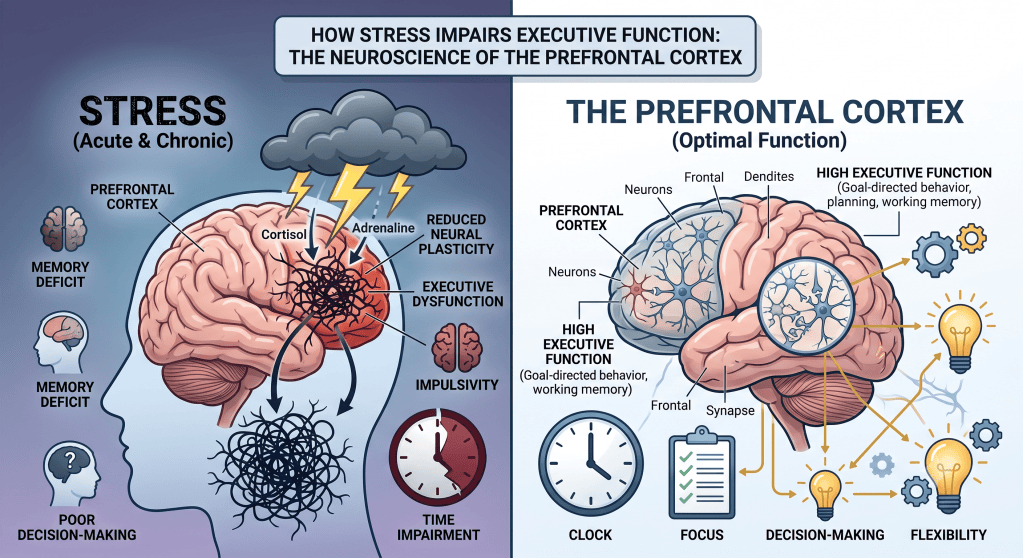
How stress hormones disrupt the prefrontal cortex, impairing memory, decision-making, and self-control, and why chronic stress can reshape the brain itself.
There is a particular kind of failure that almost everyone recognizes. You are under pressure, the deadline is real, and instead of thinking more clearly, you think less clearly. You snap at someone you love over something trivial. You forget the one thing you walked into the store to buy. You reread the same paragraph of a contract four times without absorbing a word of it. None of this feels like a character flaw in the moment, and it shouldn’t, because it isn’t one. It is what happens when the brain’s most sophisticated region gets, quite literally, switched off by the same chemistry that once helped our ancestors survive an encounter with a predator.
When this essay was first drafted in 2010, the world was still working through the psychological aftermath of a global financial collapse, and researchers were newly interested in how prolonged uncertainty about jobs, mortgages, and retirement accounts might be reshaping the way people think, not just how they felt. That question has only grown more relevant. In the years since, a research base that was already active has matured considerably, and it has converged on a strikingly specific answer to an old question: why does stress make smart people do less-than-smart things? The answer lives in a set of biochemical signaling pathways inside the prefrontal cortex, the part of the brain responsible for what psychologists call executive function. Much of the foundational work mapping these pathways comes from the neuroscientist Amy F. T. Arnsten at Yale, whose research on stress signaling in the prefrontal cortex has become a reference point for how scientists understand the relationship between stress and thought itself.
This piece walks through what executive function actually is, how stress interferes with it at the level of brain cells and receptors, what happens when that interference becomes chronic rather than occasional, and why understanding this biology matters for how we think about performance, parenting, mental illness, and the everyday friction of modern life.
What Executive Function Actually Does
Executive function is a term that sounds abstract until you notice how constantly you rely on it. It is the mental toolkit that lets you hold a phone number in mind long enough to dial it, resist the urge to check your phone during a meeting, plan a week’s worth of meals around a grocery budget, or stop yourself mid-sentence when you realize what you were about to say would hurt someone. Psychologists typically break it into a few overlapping capacities: working memory, which is the ability to hold and manipulate information over short periods; inhibitory control, which is the ability to suppress an impulse or an irrelevant thought; and cognitive flexibility, which is the ability to shift strategies when the situation changes.
None of these abilities are exotic. A parent negotiating a toddler’s bedtime routine is using inhibitory control every time they choose not to raise their voice. A driver merging onto a crowded highway is using working memory to track several moving vehicles at once. A small business owner deciding whether to take on a new client is using cognitive flexibility to weigh a decision against shifting financial realities. Executive function is, in a sense, the quiet infrastructure of adult life, and it is disproportionately dependent on a single brain region: the prefrontal cortex.
The Brain’s Newest and Most Fragile Region
The prefrontal cortex sits at the front of the brain, just behind the forehead, and it is often described as the most recently evolved part of the human cortex. It is responsible for what neuroscientists sometimes call top-down control, meaning it can override more automatic, reflexive responses generated by older and more primitive brain structures. This is what allows a person to feel a flash of anger and choose not to act on it, or to feel hungry and still decide to wait until lunch.
The trouble, as Arnsten’s research has emphasized, is that this region is also unusually sensitive to stress. It is, in her framing, both the most evolutionarily advanced part of the brain and the most easily disrupted by it. Even mild stress, if it feels uncontrollable, can measurably impair prefrontal function within minutes. This is not a subtle effect buried in statistical noise; it is often large enough to be obvious to the person experiencing it and to the people around them.
How Stress Hijacks the Thinking Brain
A Chemical Switch, Not a Simple Overload
For a long time, the popular explanation for stress-related mental fog was something like “the brain gets overwhelmed,” as if cognition were a bucket that simply overflows. The actual mechanism, as described in Arnsten’s 2009 review in Nature Reviews Neuroscience, is more specific and, in some ways, more elegant. Stress triggers the release of two chemical messengers in the brain, norepinephrine and dopamine, and this control network turns out to be extraordinarily sensitive to how much of each is present.
At moderate levels, these chemicals actually sharpen prefrontal function. This is why a bit of pressure, a tight deadline or an audience, can make a person more focused rather than less. But the relationship between arousal and performance is not a straight line upward; it follows what researchers call an inverted U-shaped curve. Once norepinephrine and dopamine levels climb past a certain point, typically under conditions of intense or uncontrollable stress, prefrontal function does not merely plateau. It falls off a cliff. The same chemistry that sharpens attention at low doses actively impairs it at high doses.
The Cellular Mechanism: Opening the Wrong Channels
What makes this research particularly significant is that it does not stop at the level of “stress hormones go up, thinking gets worse.” Arnsten’s work traces the effect down to specific molecular pathways inside prefrontal neurons. High levels of catecholamine release activate two intracellular signaling cascades, one built around a molecule called cyclic AMP and an enzyme called protein kinase A, and another built around calcium and an enzyme called protein kinase C. Under high-stress conditions, these pathways cause certain potassium channels in prefrontal neurons to open.
The practical effect of opening these channels is that neurons in the prefrontal cortex effectively go quiet. The specialized networks of cells that normally sustain a thought, hold a plan in mind, or maintain focus on a goal lose their ability to keep firing in a coordinated way. In plain terms, this control network disconnects. It is not destroyed and it is not permanently damaged by a single stressful episode, but for the duration of the stress response, it is functionally offline in a way that is measurable in both animal studies and human brain imaging.
Although these molecular details may sound technical, the central idea is surprisingly simple: excessive stress chemistry changes how prefrontal neurons communicate, making it harder for them to sustain the persistent activity needed for planning and working memory. You do not need to remember the names of the enzymes involved to understand the takeaway: too much of a good thing turns a sharpening signal into a disabling one.
The Amygdala Takes the Wheel
While the prefrontal cortex is being dialed down, a different and older brain structure, the amygdala, becomes more active. The amygdala is closely tied to emotional reactivity and to the formation of habits and reflexive responses. Arnsten and other researchers in this area have described this as a kind of handoff: as deliberate, flexible, top-down thinking becomes harder to sustain, control shifts toward faster, more automatic, and more emotionally driven responses.
This handoff has an evolutionary logic. If a person or animal is in genuine physical danger, the capacity to reflect calmly on multiple options is far less useful than the capacity to react immediately. A brain that hesitates to weigh the pros and cons of fleeing a predator is at a disadvantage compared to one that simply runs. The system that Arnsten describes is not broken; it is a survival mechanism doing exactly what it evolved to do. The problem is that modern life generates a great deal of stress that has nothing to do with physical danger and everything to do with ambiguous, ongoing pressures such as job insecurity, financial strain, or interpersonal conflict, situations where the amygdala’s fast, blunt style of response tends to serve people poorly.
When Stress Becomes Chronic: Structural Changes
So far, we have been looking at changes that disappear once the stressful episode ends: the neurons go quiet, the stressor resolves, and function returns. But what happens when the stress response stays switched on for weeks or months rather than minutes? The picture described so far concerns what happens during and shortly after a stressful episode, effects that are reversible once the stressor passes. Chronic stress introduces a different and more concerning layer, because it appears to produce actual physical changes in the structure of prefrontal neurons rather than just temporary shifts in their activity.
Research from Arnsten’s laboratory and collaborators, including a 2004 study led by Birnbaum on protein kinase C and a 2009 study led by Hains, found that prolonged exposure to uncontrollable stress in animal models causes measurable loss of the small protrusions on neurons called dendritic spines, along with a kind of thinning or atrophy of the dendrites themselves. Dendrites are the branch-like extensions of neurons that receive signals from other cells, and spines are the tiny structures along those branches where many of those connections actually happen. Losing them is not a cosmetic change; it corresponds to a real reduction in the neuron’s capacity to participate in the networks that support working memory.
The proposed mechanism again involves protein kinase C, which appears to become chronically overactive under sustained stress and to interfere with the proteins that anchor spine structures in place. In the Hains study, chronic administration of a chemical that blocks protein kinase C activity prevented much of this spine loss and the associated cognitive impairment in animals, which is one of the stronger pieces of evidence that this specific signaling pathway is not just correlated with the damage but plays a causal role in producing it.
It is worth being careful here about what has and has not been established. Much of this work on structural, physical changes to dendrites comes from animal studies, where researchers can control stress exposure precisely and examine brain tissue directly, something that is not possible in living humans. Human research, largely relying on brain imaging, has found associations between exposure to chronic adversity and both reduced gray matter volume and altered connectivity in prefrontal regions. These human findings are broadly consistent with the animal work, but imaging studies show correlation rather than the kind of direct causal mechanism that can be demonstrated in a laboratory animal, and individual differences in genetics, prior experience, and general resilience likely shape how strongly any one person’s brain responds to chronic stress.
Real-World Manifestations
Understanding this biology changes how a number of everyday situations look. Consider a parent who has been managing a child’s chronic illness for months, sleeping poorly and living with a low but constant hum of worry. Colleagues might notice that this parent seems more forgetful at work, more prone to short temper, less able to plan ahead the way they once did. It would be easy, and unfair, to read this as a decline in the person’s underlying competence or character. What the stress signaling research suggests is closer to a redirection of resources: a prefrontal cortex under sustained catecholamine pressure is simply not operating at its baseline capacity, regardless of how capable the person is under ordinary circumstances.
Or consider financial decision-making, an area where the stakes of impaired executive function are particularly high. Someone facing serious debt or the threat of job loss is, by definition, someone experiencing prolonged and often uncontrollable stress. Ironically, this is precisely the population for whom clear-headed financial planning matters most, and precisely the population whose prefrontal cortex is least equipped, at that moment, to support it. This is not an excuse for poor decisions, but it is a piece of context that reframes them: the same person, under lower stress, may make markedly different and more considered choices.
A less dramatic but very common example is the experience of studying for an exam or preparing for a high-stakes presentation. A moderate amount of pressure in the days leading up to the event tends to sharpen focus, consistent with the lower end of that inverted U-shaped curve. But many students and professionals report that once anxiety crosses a certain threshold, often the night before or the morning of the event itself, their ability to recall well-rehearsed material seems to degrade rather than improve. This lines up closely with what the neurochemistry predicts: a system that helps at moderate arousal and actively hinders at high arousal.
The Role of Controllability
One detail in this research deserves particular attention, because it is easy to overlook and it has practical implications: the stress that most reliably impairs prefrontal function is stress that feels uncontrollable. Arnsten’s work and related studies in behavioral neuroscience have repeatedly found that the same physical stressor produces very different effects on the brain depending on whether the organism experiencing it has any sense of agency over the outcome.
This distinction may help explain why two people in objectively similar circumstances, say, two employees given the same demanding project, can respond so differently. An employee who feels they have some say in how the work gets done, some ability to push back on unreasonable deadlines or adjust their approach, tends to experience the pressure as motivating rather than paralyzing. An employee who feels entirely at the mercy of decisions made elsewhere, with no input and no recourse, is far more likely to experience the kind of stress that Arnsten’s research associates with prefrontal shutdown. The workload might be identical; the psychological and neurochemical experience of it is not.
Clinical and Developmental Relevance
The signaling pathways described in this research are not only relevant to everyday stress; they appear to be implicated in a range of psychiatric conditions. Arnsten has written about how genetic variations or early-life experiences that leave these stress pathways poorly regulated, chronically overactive or insufficiently restrained, may contribute to the prefrontal dysfunction observed in conditions such as post-traumatic stress disorder, certain anxiety disorders, and schizophrenia. These disorders are biologically heterogeneous, and stress signaling represents one contributing pathway among several rather than a universal explanation. This does not mean stress signaling alone explains these conditions, which are influenced by many interacting genetic and environmental factors, but it offers a plausible biological thread connecting early adversity to later difficulties with attention, planning, and emotional regulation.
There is also a striking and somewhat unexpected finding tied to this same pathway: very low levels of lead exposure appear to activate protein kinase C signaling in a way that mirrors the effects of chronic stress on the prefrontal cortex. This has been proposed as one possible explanation for the well-documented cognitive impairments associated with childhood lead exposure, since it suggests a shared molecular route by which two very different insults, a chemical toxin and a psychological stressor, might converge on the same vulnerable brain circuitry. This remains an area of active investigation rather than settled fact, but it illustrates how mechanistic research on stress signaling can generate hypotheses that extend well beyond stress itself.
Why the System Evolved This Way
It is worth stepping back to appreciate why a brain would be built with a switch that deliberately impairs its most sophisticated reasoning capacity under pressure. From an evolutionary standpoint, the prefrontal cortex is a relatively recent and metabolically expensive addition to the mammalian brain. Careful, deliberative thought is useful, but it is slow, and slowness is a liability when speed determines survival. The stress-signaling system that Arnsten describes essentially trades deliberation for speed at exactly the moments when speed has historically mattered most: physical threat, sudden danger, situations with no time for reflection.
The mismatch is significant. Most modern stressors are not brief physical threats but extended conditions that require sustained, flexible thinking, precisely what the fast, reflexive circuitry activated by stress is poorly equipped to provide. A system built for short bursts of danger is instead being asked to run almost continuously, in an environment where stress functions less as an occasional emergency and more as a background condition of daily life.
What the Research Suggests, With Appropriate Caution
It would be tempting to end with a tidy list of techniques guaranteed to protect the prefrontal cortex from stress, but the research does not support that level of certainty, and overstating it would do a disservice to the science. What can be said, carefully, is that several factors appear in the literature as associated with better-preserved executive function under stress: a sense of control or agency over the stressor, adequate recovery time between stressful episodes, social support, and predictability in one’s environment. None of these are guarantees, and individual variation in genetics, prior experience, and overall health means the same circumstances can affect two people quite differently.
It is also worth resisting the temptation to treat every lapse in judgment or memory as a stress-induced biological event. People are forgetful, impulsive, or short-tempered for many reasons that have nothing to do with catecholamine signaling in the prefrontal cortex. The value of this research is not that it explains every human failing, but that it offers a scientifically grounded reason to treat stress-related cognitive lapses, in ourselves and in others, with a measure of realism rather than moral judgment.
Conclusion: A Biology That Still Shapes Modern Life
The work associated with Amy Arnsten and her collaborators has done something genuinely useful: it has taken a phenomenon everyone recognizes intuitively, the sense of not thinking clearly under pressure, and traced it down to identifiable molecules, receptors, and cellular pathways. In that sense, stress is not simply a feeling, it is a change in what kind of thinking the brain is capable of performing at all. In broader terms, stress shifts control away from the brain networks that support planning and self-control toward faster systems optimized for immediate survival. Sustained over time, this same chemistry appears capable of reshaping the physical architecture of prefrontal neurons themselves.
Since this essay was first written in 2010, the broader cultural conversation around stress has shifted considerably, with far more public attention now paid to burnout, chronic workplace pressure, and the cognitive costs of an always-connected environment. The underlying biology described here has not changed, but its relevance arguably has grown, as more people spend more of their lives in conditions of ambiguous, low-grade, difficult-to-escape stress rather than the brief, resolvable threats the system was built to handle. Understanding the mechanism will not, by itself, dissolve the pressures of modern life. But it does offer something worth holding onto: a clearer, less judgmental account of why the mind sometimes falters exactly when we need it most, and a reminder that the capacity for clear thought is not fixed, but deeply responsive to the conditions, controllable or not, in which we ask the brain to work.
References
Arnsten, A. F. T. (2009). Stress signalling pathways that impair prefrontal cortex structure and function. Nature Reviews Neuroscience, 10, 410–422.
Arnsten, A. F. T. (2015). Stress weakens prefrontal networks: molecular insults to higher cognition. Nature Neuroscience, 18, 1376–1385.
Birnbaum, S. G., Yuan, P. X., Wang, M., Vijayraghavan, S., Bloom, A. K., Davis, D. J., Gobeske, K. T., Sweatt, J. D., Manji, H. K., & Arnsten, A. F. T. (2004). Protein kinase C overactivity impairs prefrontal cortical regulation of working memory. Science, 306, 882–884.
Hains, A. B., Vu, M. A., Maciejewski, P. K., van Dyck, C. H., Gottron, M., & Arnsten, A. F. T. (2009). Inhibition of protein kinase C signaling protects prefrontal cortex dendritic spines and cognition from the effects of chronic stress. Proceedings of the National Academy of Sciences, 106, 17957–17962.
Taylor, J. R., Birnbaum, S., Ubriani, R., & Arnsten, A. F. T. (1999). Activation of protein kinase A in prefrontal cortex impairs working memory performance. Journal of Neuroscience, 19, RC23.









