
Originally published in April 2010 and comprehensively updated/edited in June 2026.
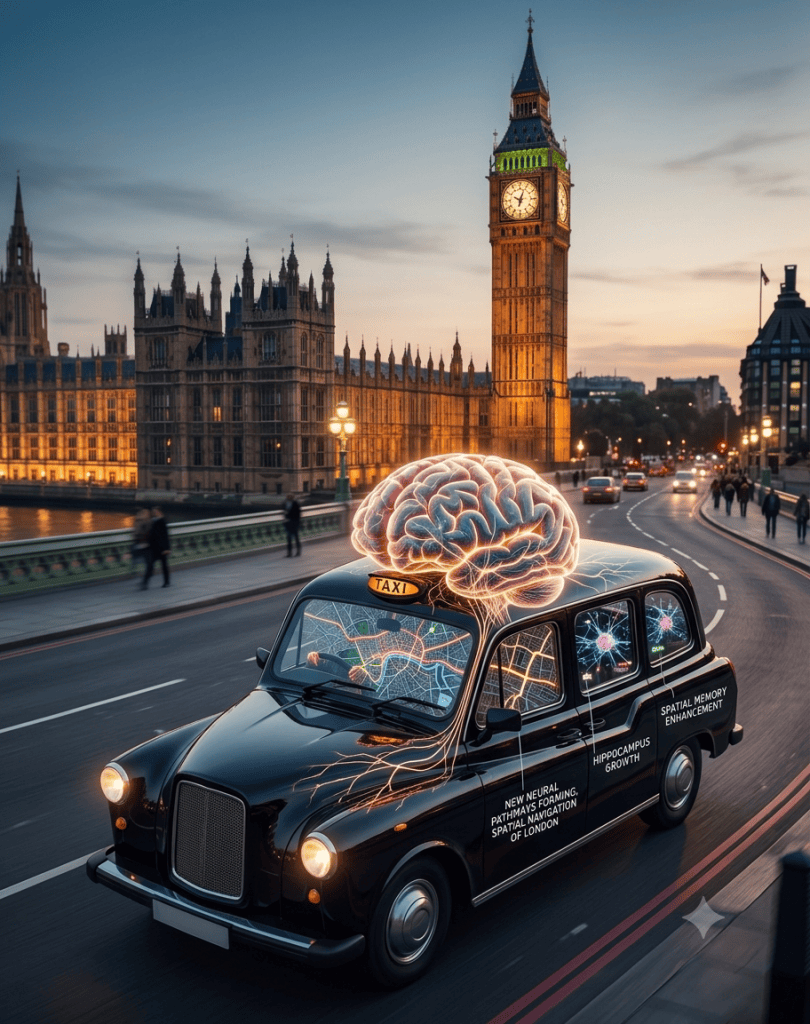
How London taxi drivers’ brains changed with experience, and what their famous hippocampus study reveals about adult neuroplasticity.
In the early 2000s, a quiet but stubborn idea still lingered in both scientific and popular thinking: that the adult brain, once fully developed, was essentially fixed. Childhood was understood to be a window of extraordinary neural flexibility, a time when experience could sculpt the brain in dramatic ways. But adulthood, according to this older view, was different. The architecture was set. You could learn new facts, form new memories, and pick up new skills, but the physical structure of your brain was thought to stay largely the same from your twenties onward. Damage could subtract from it. Aging could erode it. But new experience, in this account, could not meaningfully rebuild it.
That assumption was already under strain by the turn of the millennium, as neuroscientists began using brain imaging technology to look for evidence one way or the other. It was in this atmosphere of scientific transition that a research team led by Eleanor Maguire at University College London decided to study a group of people with an unusually demanding occupational skill: London’s licensed taxi drivers. What they found became one of the most widely cited demonstrations of adult brain plasticity in the scientific literature, and it changed how both researchers and the public thought about the brain’s capacity to change across the lifespan.
This matters well beyond a curiosity about cab drivers. The question of whether the adult brain can physically reorganize itself in response to sustained experience touches on how we think about learning, aging, recovery from injury, and even the everyday habits that shape a person’s mind over the course of a lifetime. The taxi driver studies did not answer every question about adult neuroplasticity, and it is worth being precise about what they showed and what they did not. But they opened a door that has stayed open ever since, and the story of how that happened is worth telling carefully.
The Old Idea of a Fixed Brain
Why science once believed adult brains were static
For much of the twentieth century, the prevailing view among neuroscientists was that the brain’s structure, particularly the number and arrangement of neurons, was determined early in life and did not change afterward in any significant way. This idea had real scientific grounding. Neurons in the central nervous system were known to have a limited capacity to regenerate compared to cells elsewhere in the body, and early studies of brain injury reinforced the sense that lost neural tissue was, for practical purposes, lost for good. The metaphor often used was that of a machine with fixed wiring: the connections might be fine-tuned through use, but the underlying hardware did not change.
This view began to erode gradually through the latter half of the century, as researchers working with animals found evidence that certain brain regions retained more flexibility than expected. Studies in the 1960s and 1970s showed that the brains of young animals raised in stimulating environments developed differently from those raised in impoverished ones, and later work found evidence of new neuron growth in specific regions of the adult brains of rodents and birds. Still, translating these findings into confident claims about the human brain was difficult. Much of the evidence came from animal models, and the tools available for studying the living human brain in detail were limited. What was needed was a way to look inside the heads of healthy adults, repeatedly and safely, to see whether their brains changed in response to specific, real-world experiences.
The arrival of brain imaging
The technology that made this possible was magnetic resonance imaging, or MRI, combined with a computational technique called voxel-based morphometry. This method allows researchers to divide a brain scan into thousands of tiny three-dimensional units, called voxels, and then compare the density or volume of brain tissue in each of those units across different people or across the same person at different points in time. It gave scientists, for the first time, a practical way to ask whether the physical structure of an adult human brain differed measurably based on how that person had spent their time. Maguire’s group recognized that London’s taxi drivers offered an almost perfect natural experiment for testing this question.
The Knowledge: A Uniquely Demanding Test of Memory
To understand why London cab drivers made such a compelling research subject, it helps to understand what becoming one actually requires. Since the 1860s, prospective London taxi drivers have had to pass a famously grueling examination known simply as “The Knowledge.” Candidates are expected to memorize the layout of roughly 25,000 streets within a six-mile radius of Charing Cross, along with thousands of landmarks, and to be able to recall, on demand, the most direct route between any two points in that maze of streets, without the aid of maps or navigation devices. Preparing for this test typically takes between two and four years of dedicated study, often involving candidates riding mopeds through the city for hours a day while mentally rehearsing routes. Many who begin the process do not finish it. The examination itself is oral and unpredictable, and failure rates are high.
This is, in other words, a sustained, real-world exercise in spatial memory and navigation unlike almost anything else that could be studied in an ordinary population. Unlike a laboratory task performed for an hour in a controlled setting, the training for The Knowledge unfolds over years and is embedded in the daily life of the people undertaking it. That made London’s taxi drivers an unusually clean test case for asking whether prolonged, intensive spatial learning leaves a physical mark on the brain.
Eleanor Maguire’s Study
Setting up the comparison
In a study published in the Proceedings of the National Academy of Sciences in 2000, Maguire and her colleagues used structural MRI scans to compare the brains of sixteen licensed London taxi drivers, all men who had been driving for varying lengths of time, with a control group of people who did not drive taxis. This was the opening move in what would become a decade-long line of inquiry, and on its own it could only be suggestive rather than conclusive. The researchers focused their attention on the hippocampus, a seahorse-shaped structure buried deep in the brain that had already been strongly linked, through decades of prior research in both humans and animals, to spatial memory and navigation, as well as to the broader process of forming new long-term memories.
The team used voxel-based morphometry to compare the density of gray matter across the hippocampi of the two groups, and they also measured the overall volume of specific hippocampal regions by hand, as a way of checking their results using two different analytical methods. This dual approach mattered, because it reduced the chance that any difference they found was simply an artifact of one particular technique.
What the researchers found
The results showed a distinctive pattern rather than a simple, uniform difference. Compared to the control group, the taxi drivers had significantly greater gray matter volume in the posterior, or rear, portion of the hippocampus. At the same time, they had somewhat less volume in the anterior, or front, portion of the same structure, relative to controls. Overall hippocampal volume did not differ dramatically between the groups; what differed was the distribution of tissue within the structure.
Perhaps the most striking part of the finding was that the size of this posterior hippocampal difference correlated with how long a person had been driving a taxi. Drivers with more years of experience tended to show a more pronounced volume increase in the posterior hippocampus than those who had been driving for a shorter time. This correlation was important because it suggested the structural difference was connected to the accumulated experience of navigating the city, rather than being something that simply distinguished the kind of person who becomes a taxi driver in the first place.
A cross-sectional design like this one has one built-in weakness: it cannot fully rule out the possibility that people with naturally larger posterior hippocampi simply gravitate toward, and succeed at, taxi driving in the first place. The correlation with years of experience made pure self-selection a less likely explanation, but it did not close the case outright. The 2000 study, in other words, raised a strong possibility rather than settling one. That question needed a different kind of study, and Maguire’s team eventually supplied two.
Three Claims That Often Get Blurred Together
What matters next is how to interpret what was actually measured. Before going further, it is worth separating three different things that discussions of this research tend to collapse into one: structural change, functional reweighting, and behavioral expertise. They are related, but they are not the same claim, and mixing them up is the single most common way this study gets misread.
Structural change is what Maguire’s MRI scans actually measured: the volume and density of brain tissue in a given region. Functional reweighting is a different matter entirely, concerning how efficiently a network of brain regions activates or communicates during a task, something typically measured with functional imaging rather than the structural scans used here. Behavioral expertise is different again: it is simply how well a person performs, which can improve for reasons that have nothing to do with brain structure, from practice effects to better strategy to sheer familiarity with a task.
The taxi driver research established the first of these three. It did not directly measure the second, and it treated the third mainly as a variable to explain, not as proof in itself. A driver’s growing skill at navigating London is not the same evidence as a bigger posterior hippocampus, even though the two plainly relate to one another.
With that distinction in place, we can return to what the hippocampus actually does in this context.
What the Hippocampus Actually Does
This structure, present in duplicate on each side of the brain, plays a central role in forming new episodic memories and in building what researchers call a cognitive map, an internal representation of physical space that supports navigation without constant reliance on visible landmarks. Foundational work on this system, including John O’Keefe’s discovery of place cells in the rodent hippocampus, would later earn a share of the 2014 Nobel Prize.
The hippocampus is also one of the few brain regions where researchers have found evidence, mostly in animals, of new neuron growth in adulthood. Maguire’s scans could not confirm whether this process, neurogenesis, was behind the taxi drivers’ results — structural MRI shows that tissue changed, not why. New neurons, denser branching, more support cells, richer blood supply: any could produce the same picture on a scan, and the mechanism remains unsettled.
Following Up: Ruling Out Alternative Explanations
Comparing taxi drivers with bus drivers
Because the 2000 study could not rule out self-selection on its own, Maguire’s group pursued further research to close that gap. In a study published in 2006, the researchers compared taxi drivers to London bus drivers — a comparison built specifically to eliminate a rival explanation. Bus drivers spend comparable amounts of time behind the wheel in the same city, under similar working conditions and stress levels, but they follow a small number of fixed, repetitive routes rather than navigating flexibly between arbitrary points. If the earlier hippocampal findings were simply the result of long hours of driving, stress, or general occupational experience, bus drivers should show a similar pattern. If the findings were tied specifically to active spatial navigation, taxi drivers should show a distinct advantage. The results favored the second explanation: taxi drivers again showed the greater posterior hippocampal volume, while bus drivers did not, despite comparable driving experience overall. The taxi drivers also outperformed the bus drivers on tests of London’s spatial layout, though bus drivers held their own on other memory tasks — evidence that narrowed the field of explanations without yet proving which one was correct.
Following trainees over time
The decisive evidence — the closest thing this line of research offers to proof of cause and effect — came from a 2011 study that took a longitudinal approach, tracking the same individuals over time rather than comparing different groups at a single moment. Maguire and her colleague Katherine Woollett recruited a group of trainee taxi drivers at the start of their preparation for The Knowledge and scanned their brains before training began. Years later, after some trainees had passed the qualifying examination and become licensed drivers while others had failed or dropped out, the researchers scanned the same individuals again.
Tracking structural change within the same brains over time, and tying that change directly to whether a person underwent and succeeded at the training, is what self-selection alone cannot explain away. The results were striking: those who qualified as taxi drivers showed an increase in posterior hippocampal gray matter that had not been present before training began, while those who failed to qualify, and a separate control group who did not train at all, showed no comparable change. More intriguingly, the trainees who qualified also performed somewhat worse on certain other memory tasks afterward, hinting at a trade-off rather than a pure, cost-free gain — a preliminary finding still awaiting replication.
Taken together, the three studies trace a rising curve of confidence: an exploratory finding, a comparison that eliminated a competing explanation, and a longitudinal design that could finally track cause and effect within the same people. That progression, more than any single result, is what moved the field from an intriguing correlation to a persuasive case that sustained, demanding spatial learning in adulthood can produce measurable structural change in a healthy adult brain.
Placing the Findings Within the Broader Idea of Neuroplasticity
What the study does and does not show
The taxi driver research demonstrated that one specific, intensive form of spatial learning was associated with structural change in one specific brain region closely tied to that kind of learning. That is a narrower claim than it is often given credit for. It did not show that general mental effort or commercial “brain training” produces comparable changes, and it did not show that the whole adult brain is equally plastic. The hippocampus is unusual, not typical.
Each of these studies also involved only a few dozen participants, which is standard for specialized neuroimaging work but still worth keeping in mind when weighing how far to generalize the exact numbers. The broad pattern, at least, has held up well as later research using similar methods in other populations has reached consistent conclusions.
Other windows into adult plasticity
The taxi driver studies were far from the only evidence pointing toward structural plasticity in the adult brain, and situating them alongside other research helps clarify what is and is not unusual about this particular case. Around the same period, other researchers were finding structural brain differences associated with other intensively practiced skills. Professional musicians, for example, have been found in multiple studies to show differences in the brain regions associated with fine motor control and auditory processing compared to non-musicians, with some evidence that these differences relate to the age at which musical training began and how many years it continued. Researchers studying jugglers found that a short period of learning to juggle, just a few months, was associated with measurable gray matter changes in visual and motion-processing regions of the brain, changes that partially reversed when the juggling practice was discontinued. This reversal is itself an interesting finding, hinting that some structural plasticity may not be permanent but instead tracks ongoing engagement with a skill.
Other lines of research have examined people who are bilingual from an early age, finding some structural differences in language-related brain areas compared to monolingual individuals, and have looked at experienced meditators, finding differences in regions associated with attention and emotional regulation, although this area of research has faced more challenges with replication and methodological consistency than the taxi driver work. None of these studies, taken individually, proves that deliberate practice reliably reshapes the brain in a simple, universal way. But taken together, they reinforce the same pattern already established: the adult brain retains real capacity for structural change, concentrated in the regions a given skill actually recruits.
Why This Research Resonated Beyond Neuroscience
Part of what made the taxi driver studies so widely discussed, well beyond academic neuroscience journals, was that they offered an unusually vivid and easy-to-picture illustration of an otherwise abstract idea. It is one thing to be told that the adult brain is plastic; it is another to picture an ordinary person spending years memorizing the streets of a sprawling city and to be shown, in a brain scan, a measurable trace of that effort. The image of a taxi driver’s brain physically reorganizing itself in response to years of navigating London’s tangled streets gave the abstract concept of neuroplasticity a concrete, almost narrative form that was easy to communicate to a general audience.
This resonance arrived at a moment when public interest in brain science was already rising, driven in part by the increasing availability of brain imaging in medical and research settings and by growing popular fascination with self-improvement and lifelong learning. The taxi driver findings fit neatly into a cultural moment that was eager to hear that the brain was not a fixed inheritance from childhood but something that continued to respond, in some measure, to how a person chose to spend their time and attention as an adult. That eagerness sometimes outpaced what the science could responsibly support, leading to popular claims about “rewiring your brain” through various commercial brain-training products that went well beyond the more limited and specific claims the original research actually justified. The gap between the careful, hedged conclusions of the scientific papers and the more sweeping claims made about them in popular media is itself a useful case study in how scientific findings travel and change shape as they move into public conversation.
Implications for Aging, Learning, and Recovery
The taxi driver research also fed into broader conversations about what adult neuroplasticity might mean for aging and cognitive health. If sustained engagement with a demanding spatial task can encourage structural change in the hippocampus, a region also known to be particularly vulnerable to the effects of aging and to conditions like Alzheimer’s disease, then researchers began to ask whether similarly engaging activities might help support cognitive function later in life. This question has motivated a considerable amount of subsequent research into whether various forms of mentally stimulating activity, physical exercise, and social engagement can help preserve hippocampal volume and memory function in older adults. The evidence in this area remains genuinely mixed, with some studies finding modest protective associations and others finding weaker or inconsistent effects, and there is not yet a scientific consensus on which specific activities, if any, produce reliable benefits at a population level. It would be an overstatement to claim that the taxi driver findings alone justify strong claims about how ordinary people should spend their time to protect their cognitive health, but the research did help establish that the underlying biological question, whether adult experience can meaningfully shape brain structure in ways relevant to memory, was a legitimate and answerable one.
Similar reasoning has informed research into neurological rehabilitation, where clinicians and researchers have explored the extent to which structured, repeated practice can help the adult brain compensate for damage caused by stroke or injury, by strengthening or reorganizing surviving neural pathways rather than by regenerating lost tissue outright. The taxi driver studies did not directly address rehabilitation, but they contributed to a broader scientific climate more willing to take seriously the idea that adult brains retain real, if bounded, capacity for structural adaptation, a shift in thinking that has had genuine influence on how some rehabilitation approaches have been designed and studied since.
A Note on the Present Moment
There is a somewhat ironic postscript to this story that has become more relevant with time. The very skill that made London’s taxi drivers such a striking research subject, the internalized mental map built through years of studying The Knowledge, is one that satellite navigation systems have made largely unnecessary for most drivers today. Researchers have begun asking, with the same careful, hedged approach that characterized the original work, whether habitual reliance on GPS navigation might be associated with reduced engagement of the hippocampal navigation systems that the taxi driver studies helped illuminate. This remains an active and unsettled area of research rather than a fully established finding, but it is a fitting continuation of the original question: not simply whether the adult brain can change through sustained effort, but what happens, structurally and functionally, when that effort is no longer required.
Conclusion: A Precise Kind of Plasticity
What this research does not support is the idea that the brain is infinitely rewritable by general mental effort; plasticity, on this evidence, is specific, local, and constrained by function.
That is the claim worth carrying away from a quarter century of research built on a study of London cab drivers. Sustained, specific experience can reshape brain structure in regionally constrained ways — not uniformly, not globally, and not simply because a person decided to think harder. The posterior hippocampus grew because it does the particular kind of work that navigating an unmapped city over years of practice demands, and it grew roughly in proportion to how much of that particular work a person had done. Nothing in this research licenses the leap from that finding to the broader promise, so often made in popular science writing, that any brain can be endlessly optimized through generic mental exercise.
That narrower, more disciplined understanding of adult neuroplasticity has proven more durable than the sweeping version, and it continues to guide serious research into memory, aging, and rehabilitation today. What remains genuinely unclear is how far these constraints generalize — whether the kind of regionally specific, experience-dependent change seen in the hippocampus is a special property of spatial and memory systems, or a template for how other, less-studied parts of the adult brain might respond to their own version of years spent learning the streets.
Selected References
Maguire, E. A., Gadian, D. G., Johnsrude, I. S., Good, C. D., Ashburner, J., Frackowiak, R. S., & Frith, C. D. (2000). Navigation-related structural change in the hippocampi of taxi drivers. Proceedings of the National Academy of Sciences, 97(8), 4398–4403.
Maguire, E. A., Woollett, K., & Spiers, H. J. (2006). London taxi drivers and bus drivers: A structural MRI and neuropsychological analysis. Hippocampus, 16(12), 1091–1101.
Woollett, K., & Maguire, E. A. (2011). Acquiring “the Knowledge” of London’s layout drives structural brain changes. Current Biology, 21(24), 2109–2114.
O’Keefe, J., & Nadel, L. (1978). The Hippocampus as a Cognitive Map. Oxford University Press.
Draganski, B., Gaser, C., Busch, V., Schuierer, G., Bogdahn, U., & May, A. (2004). Neuroplasticity: Changes in grey matter induced by training. Nature, 427(6972), 311–312.









