
Originally published in May 2015 and comprehensively updated/edited in June 2026.
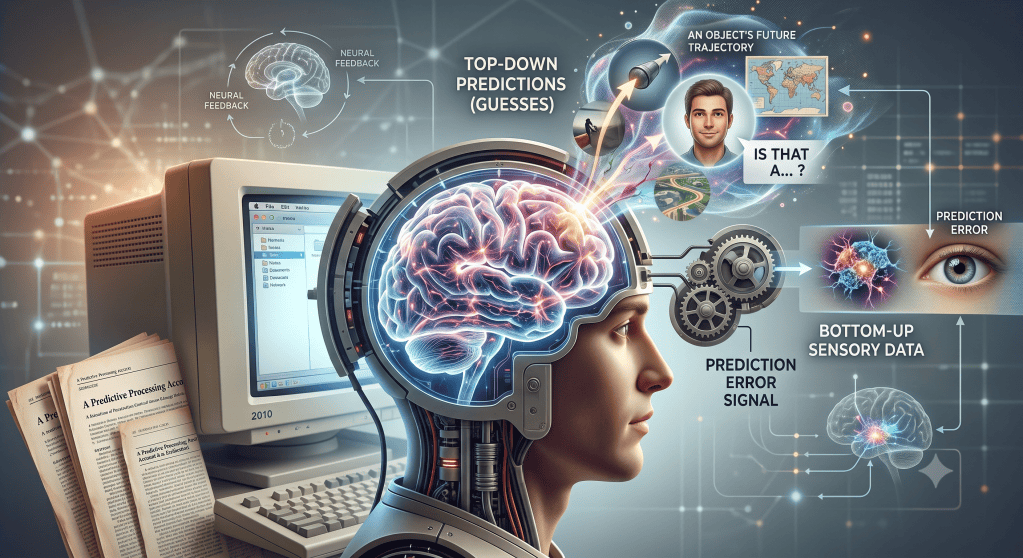
How a 2010 paper by Karl Friston reframed the brain as a prediction machine, and what predictive processing reveals about perception today.
In the winter of 2010, neuroscience was riding a wave of confidence. Brain scanners had become common enough that a steady stream of headlines promised to locate love, guilt, or political opinion inside some tidy patch of cortex. The public had absorbed a simple, almost cartoonish idea of how the brain works: light hits the eye, sound hits the ear, and the brain assembles this raw material into a picture of the world, the way a photo developer turns negatives into prints. It was a comforting story because it matched how perception feels. The world seems to arrive fully formed, without effort, the instant we open our eyes.
That comforting story was already coming apart at the seams among researchers who studied vision, language, and motor control. And in February of that year, a paper landed in Nature Reviews Neuroscience that gave the emerging alternative its most ambitious statement yet. Karl Friston, a neuroscientist and statistician at University College London, published “The Free-Energy Principle: A Unified Brain Theory?” The question mark in the title was doing real work. Friston did not originate the ideas behind this paper. His contribution was to compress several older, separately developed threads of thinking about the mind into a single mathematical currency, borrowed from statistical physics, and show that they had been describing the same underlying process all along.
The idea at the center of that paper, and of the broader research program now known as predictive processing, is disarmingly simple to state and considerably harder to absorb. The brain does not passively receive the world. It constantly predicts it, compares those predictions against incoming sensory signals, and updates itself when the two disagree. Perception, on this account, is less like a photograph and more like a best guess that gets revised as needed. It matters for reasons that go well beyond neuroscience departments. If the brain is fundamentally a prediction engine, that reframes how we think about perception, learning, illusions, and the small daily moments when the world doesn’t match what we expected. This article traces where that idea came from, what it actually claims, and where it has run into trouble.
A Theory Born at a Crossroads
To understand why Friston’s paper landed the way it did, it helps to picture the state of brain science in the late 2000s. Functional MRI had matured from a novelty into a workhorse tool. Studies mapping mental activity onto brain regions multiplied quickly. This was genuinely useful science. But it also encouraged a kind of location-hunting mentality, as though understanding the mind were mostly a matter of finding the right address for each function. Critics worried that neuroscience was collecting an enormous atlas of where things happen without much of a theory for why or how.
A different intellectual lineage runs underneath the 2010 paper, and it is older than most people assume, older than Friston’s own career. It starts with Hermann von Helmholtz, the nineteenth-century physicist and physician who argued that perception involves inference rather than simple recording. Helmholtz described perception as a form of unconscious reasoning, a hypothesis about the world drawn from incomplete sensory clues. That intuition sat mostly dormant for a century, resurfacing in the work of vision researchers who noticed that the brain often behaves as though it fills gaps with its best guess rather than waiting for perfect information. By the mid-2000s, a body of work known as the “Bayesian brain” had given this intuition mathematical teeth, treating perception as a statistical estimation problem, the same kind of problem an engineer solves when a robot has to figure out its position from noisy sensor readings. Friston entered this lineage well after its foundations were already in place, not at its start.
Friston’s paper did not originate this lineage. It compressed it. His role was closer to that of a translator working across several dialects than an author inventing a new language: he took Bayesian perception, ideas from evolutionary biology about how organisms maintain internal stability, and concepts from information theory about minimizing uncertainty, and rewrote all three in one shared mathematical vocabulary. That vocabulary centers on a quantity he called free energy, a stand-in for the mismatch between what an organism expects and what it actually encounters. Reduce that mismatch, and you reduce what physicists call surprise, in a technical rather than emotional sense of the word.
It is worth pausing on that word, because it is easy to misread. Surprise here does not mean an emotional jolt. It refers to how unlikely a sensory event is given an organism’s model of the world. A fish suddenly finding itself out of water is, in this technical sense, experiencing enormous surprise, because almost nothing in its internal model predicted that outcome. The claim is not that brains dislike being startled in the everyday sense. It is that biological systems, to persist over time, need to keep the gap between expectation and reality within survivable limits.
What the Brain Is Actually Doing
Strip away the equations, and the free-energy principle rests on three linked ideas that are easier to hold onto individually.
Prediction Comes First
The traditional view treated the brain as starting from sensory input and building upward toward meaning. Predictive processing flips that order. The brain constantly generates predictions from the top down, drawing on everything it has previously learned about how the world tends to behave, then checks those predictions against the sensory signals arriving from the eyes, ears, and skin. What travels up from the senses, on this account, is mostly the error, the portion of the input the prediction failed to anticipate.
Consider walking into your own kitchen at night without turning on the light. You do not perceive the room from scratch. Your brain has already predicted where the counter is, where the chair usually sits, and roughly what shapes should appear in the dark. Most of the time, the incoming signals confirm those predictions closely enough that no correction is needed, which is part of why the walk feels effortless. It is only when someone has left a bag on the floor where nothing should be that the mismatch registers, often as a startle, before you consciously identify what changed.
Perception as an Educated Guess
If prediction leads and sensory data mostly supplies correction, then what we experience as perception is best described as the brain’s current best hypothesis about the causes of its sensory input, continuously updated. Some researchers in this tradition have described perception as a kind of controlled hallucination, a phrase meant to be provocative rather than literal. The idea is not that ordinary perception is unreal or unreliable. It is that the vivid, seemingly direct experience of seeing a chair or hearing a voice is the end product of an inferential process, one usually anchored tightly to the world by a steady stream of correcting sensory evidence.
This framing helps make sense of certain optical illusions that have puzzled people for generations. A classic example involves ambiguous figures, images that can be seen as one thing or another depending on which interpretation the brain currently favors. Predictive processing suggests these illusions work precisely because perception is not a passive read-out of the image but an active best guess, and sometimes two guesses are almost equally good, so perception flips between them.
Action as a Structural Necessity, Not an Afterthought
Here is where the theory does something more than describe perception, and where its real ambition shows. In Friston’s framework, prediction is not just a feature of how we see or hear. It is a strategy an organism uses across time to keep prediction error low. And that strategy has two separate tools, not one.
The first tool is updating beliefs to match incoming sensation. That is perception. The second tool is changing the world so that it matches an existing prediction. That is action. If you predict your hand will be in a certain position and it currently is not, you have two options. You can revise the prediction, which would be strange, or you can move the hand until sensation catches up to the prediction. Ordinary reaching, walking, and balancing can all be described this way: as the correction of prediction error, carried out through muscles instead of through belief revision.
This is the move that separates the free-energy principle from earlier Bayesian brain accounts, which were mostly theories of perception alone. By treating action as another way of minimizing prediction error, rather than as a separate system that perception merely informs, Friston’s framework gives perception and movement a shared job description. The organism is not trying to match some independent picture of “the world.” It is trying to keep its sensory signals close to what its own predictions expect. That is a narrower claim than saying model and world are brought into agreement, and a more testable one. It is also the claim that lets the paper argue for a theory of the whole brain, rather than a theory of vision or hearing alone.
The Unifying Ambition, and Why It Was Controversial
What set the 2010 paper apart from earlier proposals was its reach. Friston argued that the same free-energy minimization framework could account for neural Darwinism, an influential theory from Gerald Edelman describing how populations of neurons compete and get selected much like organisms in evolution, as well as ideas from optimal control theory used in engineering to describe how systems steer themselves toward a goal with the least wasted effort. The paper’s thesis was that value, expected reward, and its mirror image, surprise or prediction error, kept turning up as the quantity these very different theoretical traditions were all, in their own vocabularies, trying to optimize.
That ambition is exactly what made the paper influential, and exactly what has made it controversial ever since. A theory that claims to explain everything from single-neuron dynamics to conscious perception to the maintenance of body temperature invites an obvious question: is it actually explaining these phenomena, or redescribing them in a new vocabulary flexible enough to fit almost anything after the fact?
What This Framework Does and Doesn’t Claim
That question deserves a direct answer, stated once and clearly, rather than scattered as caveats throughout. Some philosophers of science have argued that a framework this flexible risks losing the kind of falsifiability that separates a scientific theory from a descriptive metaphor, since it can be fitted to almost any observed behavior after the fact. Others have questioned whether the mathematics, for all its elegance, generates genuinely new experimental predictions that could not have been derived from earlier, more modest theories of learning and perception. These are live, unresolved disputes among specialists, not settled objections and not settled vindications.
It is also worth separating two groups of people who talk about this material in public: the researchers who build and test the underlying mathematics, and the science communicators who popularize simplified versions of it through books, talks, and podcasts. These are often not the same people, and the popular versions sometimes present a tidier, more settled picture than the primary literature actually supports. The applications described later in this article, particularly the ones involving pain and other clinical phenomena, are best read in that spirit: as active, evolving hypotheses that illustrate how researchers are using the framework, not as established medical fact. With that boundary set once, the rest of this piece can describe the theory’s ideas and applications plainly, without re-litigating that caution at every turn.
Everyday Signatures of Predictive Processing
Abstract as the mathematics can be, a few ordinary experiences make the theory easier to feel rather than just understand.
The clearest example is the trouble people have unhearing a misheard song lyric. Once someone hears a plausible alternative reading of a line, they often find it difficult to hear the actual lyric again, even with the true words printed in front of them. Predictive processing frames this as a strong, high-confidence prediction overriding an ambiguous acoustic signal. The brain is not being careless. It is doing exactly what the theory says it should do, weighting a confident prior expectation heavily against input that could support more than one reading.
A quieter version of the same effect shows up when people return to a childhood home after many years away. Streets look narrower than memory suggests, and a childhood bedroom seems oddly small. The brain built its predictions around perspectives and proportions calibrated to a smaller body and a less experienced visual system, and those old predictions linger even as new sensory evidence arrives, producing a mismatch that registers as an eerie feeling rather than a simple size comparison.
A third and more clinically significant application involves chronic pain. Some researchers have proposed that persistent pain, in certain cases, may reflect an overly confident prediction of bodily threat that resists updating even after tissue has healed, rather than an ongoing signal of active damage. As already noted, this is a generative and still-developing hypothesis rather than an established fact, and it should never be read as suggesting that chronic pain is imagined. What it offers is a testable account of why pain sometimes outlives its original cause, which is more than earlier models could explain.
A Legacy Still Being Written
In the years following the 2010 paper, predictive processing moved from a specialist proposal into something closer to a dominant framework in theoretical neuroscience, taken up and extended by researchers across psychology, philosophy of mind, computer science, and psychiatry. Philosophers such as Andy Clark helped translate the mathematics into arguments about the nature of mind itself, while other researchers explored how disruptions in predictive machinery might relate to conditions like autism and schizophrenia, generally framing these as hypotheses about altered weighting between predictions and sensory evidence rather than as complete explanations of complex conditions.
The framework has also traveled somewhere its author likely never pictured for it: the software running on ordinary phones and laptops. Somewhere in the last decade, machine learning researchers building systems to predict the next word in a sentence, or the next frame in a video, arrived at a design philosophy that echoes Friston’s brain, whether or not they had read the 2010 paper. Get better at anticipating what comes next, the thinking goes, and something like understanding falls out as a byproduct. It is tempting to call this the same idea wearing different clothes, but that would overstate the kinship. A large language model learns by adjusting millions of numerical weights through a training process with no known analogue inside a skull, while predictive processing describes something happening in living neurons. What the two share is a bet, not a mechanism: that prediction, done well enough, is most of what intelligence is. Fittingly, the traffic runs in both directions, since some of the original inspiration for predictive brain theories came from engineering and control theory in the first place.
What began as an attempt to unify older ideas about neurons and inference has become, over roughly a decade and a half, one of the more durable ways researchers talk about what brains are for. It has not settled every argument it started, and it should not be mistaken for a finished theory of mind. But picture that dark kitchen again, the counter and chair already sketched out by the brain before the lights ever come on, and the whole shift in thinking becomes concrete: perception was never a photograph being developed in real time. It was always a guess, made in advance, waiting to be confirmed or corrected by whatever the world sends back. That is the quiet, constant work the free-energy principle set out to describe, and it is still being written into the next generation of brain science.
Reference
Friston, K. (2010). The free-energy principle: a unified brain theory? Nature Reviews Neuroscience, 11(2), 127–138. https://doi.org/10.1038/nrn2787









