
Originally published in June 2010 and comprehensively updated/edited in June 2026.
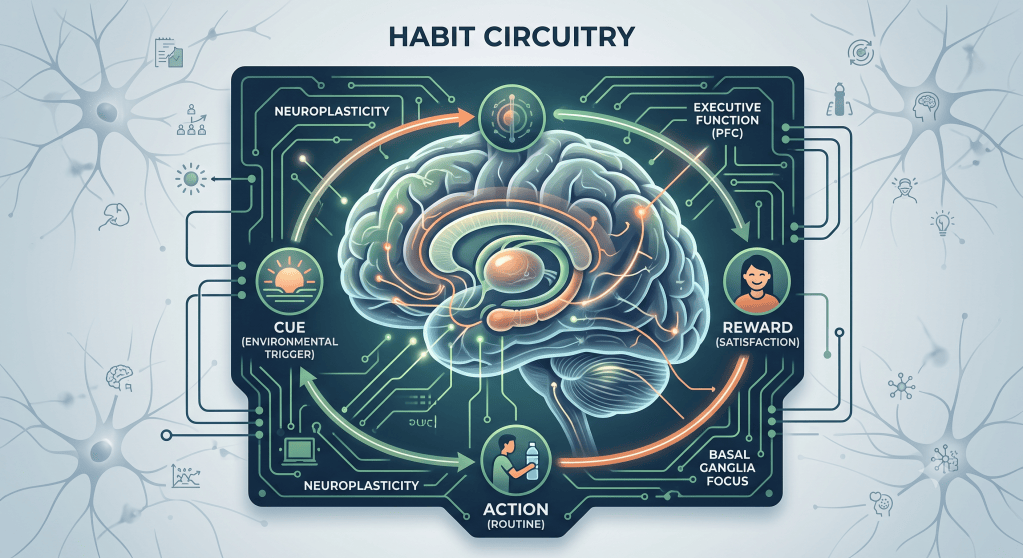
How the basal ganglia turn repeated actions into automatic habits, and why Ann Graybiel’s research still shapes how we understand routines and rituals.
In the years around 2010, self-improvement culture was going through something of a scientific makeover. Bookstores were filling up with titles about willpower, nudges, and the hidden forces that shape decision-making. Behavioral economics had crossed over from academic journals into mainstream conversation, and readers were hungry for an explanation of why they kept doing the same things over and over, often against their own better judgment. Smartphones were just beginning to reorganize daily life, subtly training millions of people into new rituals of checking, scrolling, and refreshing without quite noticing it was happening.
Underneath that cultural fascination, a quieter and more foundational story was already unfolding in neuroscience labs.
Much of it centered on the work of Ann M. Graybiel at the Massachusetts Institute of Technology, whose research asked a deceptively simple question: what is actually happening inside the brain when a behavior stops feeling like a decision and starts feeling automatic? Her answer pointed to a cluster of deep brain structures called the basal ganglia, and it reshaped how scientists think about everything from brushing your teeth to compulsive gambling. This article revisits that body of work, situates it in the cultural moment that made habits such a popular subject, and brings the science up to date with what researchers have learned in the years since.
The topic matters because habits are not a minor quirk of behavior. They make up an enormous share of what people actually do in a given day, and they operate largely outside conscious awareness. Understanding how they form, why they persist, and what can go wrong with the underlying circuitry has implications for addiction treatment, for disorders like Parkinson’s disease and obsessive-compulsive disorder, and for the everyday, unglamorous project of trying to change one’s own routines.
The Machinery Beneath the Routine
For most of the twentieth century, the basal ganglia were something of an afterthought in brain science. They sit deep beneath the cortex, the wrinkled outer layer most people picture when they think of “the brain,” and for decades they were mainly associated with movement. Damage to this region was known to produce disorders like Parkinson’s disease, in which movement becomes slow and rigid, or Huntington’s disease, in which movement becomes involuntary and jerky. That made sense, since one job of the basal ganglia is to help select and smooth out physical actions, but it left the impression that this part of the brain was essentially a motor relay station and not much else.
Graybiel’s research, beginning in earnest in the 1980s and continuing for decades afterward, complicated that picture considerably. Working first with detailed anatomical studies and later with real-time recordings of brain activity in animals, she and her colleagues found that the basal ganglia were involved in something broader than movement alone. They appeared to be central to a process of learning that psychologists had long described in behavioral terms but had never been able to locate in the brain with much precision: the transformation of a deliberate action into an automatic one.
From Anatomy to Behavior
One of Graybiel’s key contributions was identifying substructures within the striatum, the basal ganglia’s main input region, that seemed to specialize in different tasks. She described patches of tissue called striosomes, distinct from the surrounding matrix tissue, and proposed that these patches played a special role in linking behavior to its emotional or motivational value. This was a departure from thinking about the striatum as a single, uniform structure, and it opened the door to asking more specific questions about how habits are evaluated, not just executed.
Learning to Run on Autopilot
Much of the evidence for how habits form came from a deceptively simple laboratory setup: a T-shaped maze, a rat, and a reward waiting at one end. In these experiments, researchers trained rats to run through the maze correctly in exchange for a treat, then used electrodes to record activity in the striatum as the animals learned the task.
What they found was a striking shift in the pattern of brain activity over the course of training. Early on, while the rat was still learning the maze, neurons in the striatum fired throughout the run, tracking the animal’s ongoing decisions and movements in a fairly continuous way. But as the behavior became well practiced and automatic, that pattern changed. Activity became concentrated at the beginning and end of the run, with a relative lull in the middle, almost as though the brain had bundled the entire sequence into a single unit and only needed to flag its start and finish.
Graybiel referred to this bundling process as “chunking,” and it offered a plausible explanation for why well-learned habits feel effortless. Instead of monitoring every step of a familiar routine, the brain appears to compress it into something closer to a single command, freeing up mental resources for other things. This is part of why a person can drive a familiar route home while thinking about something else entirely, or type a well-known password without consciously recalling each character. The behavior has been chunked into a routine that runs largely without moment-to-moment oversight.
It’s worth being careful about what this research does and does not show. The chunking pattern was documented most clearly in specific tasks in rodents, and translating it directly to the full complexity of human habits, which are shaped by language, culture, and social expectation, requires some caution. Still, the basic principle, that repeated behavior tends to become neurally compressed and less dependent on continuous conscious control, has held up reasonably well across many follow-up studies in different species and settings.
Cue, Routine, Reward: A Useful but Simplified Model
Around this same period, the idea of a “habit loop,” consisting of a cue, a routine, and a reward, became a popular shorthand for explaining habit formation to general audiences. The appeal is obvious: a stimulus triggers a behavior, the behavior produces a satisfying outcome, and the loop repeats until the connection is strong enough to run automatically the next time the cue appears.
This framing captures something real and useful about how conditioning works, but neuroscientists studying the basal ganglia would caution against treating it as a complete account of what’s happening in the brain. The three-part loop describes the psychological structure of a habit, not the full biological story of how the striatum encodes, evaluates, and eventually automates that structure. A closer picture, drawn from Graybiel’s work, is that habits function more like stored action patterns in loops connecting the cortex and the striatum, patterns that get continuously fine-tuned by signals, especially from the neurotransmitter dopamine, indicating whether an outcome came in better or worse than expected. The reward, in other words, isn’t simply stamped onto the routine once and then ignored; it keeps quietly recalibrating the routine long after the habit has become well established. The popular loop model is a helpful starting point for thinking about behavior change, but it flattens a more layered and dynamic process happening underneath.
The Evaluative Brain
Perhaps the most conceptually interesting turn in Graybiel’s later work was the suggestion that habits are not as mindless as they appear. It would be easy to assume that once a behavior becomes automatic, the brain simply stops paying attention to it, running the routine like a recording on a loop. Her research pointed to something more nuanced. Even during highly automatic behavior, circuits involving the striatum and connected regions like the orbitofrontal cortex continued to track information about outcomes, effectively keeping a background evaluation running alongside the automatic action.
This matters because it helps explain why habits can still be disrupted by changing circumstances, at least under the right conditions, even though they resist casual willpower alone. If a habitual route to work suddenly floods or a favorite vending machine snack is discontinued, most people adjust, sometimes with visible frustration but without total behavioral breakdown. That adaptability suggests an evaluative layer is still monitoring the situation, ready to flag a mismatch between the expected and actual outcome. At the same time, habits are notoriously resistant to change when the disruption is subtler, such as trying to eat more healthfully or reduce screen time, which points to a tug-of-war between habitual, automatic systems and more deliberate, goal-directed ones. Researchers generally describe this as a competition between at least two partly separate brain systems: one oriented toward efficient, automatic execution, and another oriented toward flexible, outcome-sensitive decision-making. Which system wins out in a given moment depends on factors like stress, fatigue, and how strongly the habit has been ingrained through repetition, though the precise balance of these factors is still an active area of research rather than a settled matter.
Why This Distinction Matters Clinically
This tension between automatic and deliberate control has real diagnostic relevance. In obsessive-compulsive disorder, for example, some researchers have proposed that the balance tips too far toward the habitual system, so that ritualized behaviors, like repeated checking or hand-washing, continue running even when they no longer serve any evaluated purpose and the person recognizes them as excessive. Similarly, some models of addiction describe a progression in which drug-seeking behavior gradually shifts from being driven by a deliberate pursuit of pleasure to becoming a more rigid, cue-triggered habit that persists even after the drug stops producing much reward at all. These are proposed frameworks supported by a mix of animal studies and human brain imaging, rather than fully settled explanations, and researchers continue to debate exactly how much of human addiction and compulsive behavior maps onto this habit-system framework versus other contributing factors.
When the Circuit Misfires
Parkinson’s disease is the clearest illustration of what happens when this circuitry breaks down. It’s caused by the loss of dopamine-producing neurons that project into the striatum, and the resulting symptoms go well beyond slowed movement. Patients often have measurable trouble initiating new automatic sequences and shifting flexibly between behaviors, which fits neatly with the idea that the striatum is central to building and running habitual routines, not just executing individual motions. When the dopamine signal that fine-tunes those routines degrades, both movement and the broader machinery of habit learning suffer together.
The habitual system described earlier, in the discussion of obsessive-compulsive disorder and addiction, offers the other main anchor for thinking about circuit dysfunction. In OCD, the balance between the automatic and deliberate systems appears to tip too far toward the habitual side, so that rituals like checking or hand-washing keep firing even after the person consciously judges them pointless. Addiction shows a related pattern, with drug-seeking behavior gradually hardening from a deliberate pursuit of pleasure into a rigid, cue-triggered habit. Other basal ganglia conditions, including Huntington’s disease and Tourette syndrome, point to the same circuitry from different angles, degeneration of striatal tissue in one case, misfiring of habit fragments in the other, but Parkinson’s and the OCD-addiction pairing remain the most thoroughly studied windows into how this system fails.
Rituals: Habits with Meaning Attached
Stepping outside the laboratory, anthropologists and sociologists have long studied a close cousin of the habit: the ritual. Where a habit like reaching for coffee in the morning is largely functional, a ritual, whether religious, familial, or purely personal, carries symbolic weight beyond its immediate practical purpose. A person doesn’t perform a wedding toast or light a birthday candle because it’s the most efficient way to achieve some outcome; the behavior matters partly because of what it represents.
There is reason to think rituals draw on some of the same underlying neural machinery as ordinary habits, particularly the capacity for behavior to become automatic through repetition, even as the psychological and cultural functions differ substantially. Research in psychology has suggested that ritualized behavior can help reduce anxiety before high-stakes events, a pattern observed in contexts as different as athletes’ pre-game routines and students’ pre-exam rituals. Some researchers propose this works partly because the predictability and structure of a ritual gives the anxious mind something orderly to hold onto, though this remains an area where the psychological explanation is better developed than the underlying neuroscience. The overlap between habit and ritual is a useful reminder that automatic behavior in humans is rarely just mechanical repetition; it’s often woven into systems of meaning that a strictly biological account can describe only partially.
Breaking and Building Habits in Real Life
The scientific picture of habit formation has practical implications, though it’s worth resisting the temptation to oversimplify them into a tidy life-hack. Because habits appear to be encoded through a somewhat separate system from deliberate decision-making, simply resolving to behave differently often isn’t enough to override a well-established automatic routine, which is a familiar frustration to anyone who has tried to quit a habit through sheer determination alone.
What the research does suggest is that habits are more easily modified at the level of cues and context than through willpower applied directly to the behavior itself. Changing the environment that triggers a habitual response, removing a cue, introducing a new one, or altering the setting where the behavior usually occurs, tends to be more effective than trying to consciously override the routine each time it’s triggered. This aligns with the chunking research: if a habit has been compressed into an automatic sequence tied to a specific starting cue, disrupting that cue interrupts the sequence before it can run its course. None of this makes behavior change easy, and individual variation in how quickly habits form or how resistant they are to change remains considerable and not fully explained by current science.
From Lab Rats to Smartphones: Habit Science in the Digital Age
Writing about habit circuitry in the 2010s meant describing largely theoretical extensions of laboratory findings to daily life. Revisiting the topic well over a decade later, those extensions look less speculative, partly because so much of the modern digital environment appears to exploit habit-formation principles, whether or not that was the explicit intent of its designers. Features like notification badges, infinite scroll, and variable reward schedules, where a check of a phone sometimes yields something interesting and sometimes yields nothing, align closely with conditions known from animal research to produce especially persistent, hard-to-extinguish habitual behavior. Unpredictable rewards are consistent with a pattern long documented in conditioning research: they tend to sustain automatic checking behavior more strongly than rewards delivered on a predictable schedule.
This isn’t to suggest that technology companies engineered their products with direct reference to striatal neuroscience, though some clearly drew on adjacent behavioral research. It does mean that the basic circuitry Graybiel described, tuned by millions of years of evolution to make repeated, reward-associated behavior efficient and automatic, is now operating in an environment saturated with far more deliberately engineered cues than it evolved to handle. Researchers studying compulsive technology use have drawn direct comparisons to the habit and addiction literature, while being careful to note that “addiction” is a clinically loaded term and that most heavy technology use, while sometimes problematic, doesn’t meet the same criteria as substance dependence.
Conclusion: The Quiet Architecture of Ordinary Life
Ann Graybiel’s decades of work on the basal ganglia reframed habits from a vague behavioral concept into something with an identifiable neural signature: circuits capable of compressing complex sequences into efficient, largely automatic routines, while still maintaining a quieter evaluative process running underneath. Habits, in this light, are not simply shortcuts the brain takes to save effort. They are one of the brain’s primary mechanisms for converting repeated experience into efficient, stable behavior while remaining sensitive to changing outcomes.
That reframing has consequences well beyond the mechanics of the striatum. It offers a biological grounding for phenomena that touch nearly every area of human life, from the persistence of addiction and the rigidity of compulsive disorders to the mundane comfort of a morning routine or a family ritual. It also complicates the popular self-help narrative that habits can be rewritten through willpower alone. The system is still not fully understood, but the evidence so far points toward changing cues and context, not sheer resolve, as the more reliable lever.
Looking forward, the study of habit circuitry seems likely to become only more relevant as digital environments grow more sophisticated at triggering automatic behavior, and as researchers continue refining treatments for basal ganglia disorders and compulsive conditions. The basic architecture Graybiel identified, formed over evolutionary time to make repeated survival behaviors efficient, is now being tested by a world of engineered cues and instant rewards it never evolved to anticipate. What emerges from her research is a quietly unsettling idea: the routines and rituals a person treats as central to who they are may be shaped more profoundly by well-worn circuitry than everyday intuition suggests.
References
Graybiel, A. M. (1998). The basal ganglia and chunking of action repertoires. Neurobiology of Learning and Memory, 70(1-2), 119-136.
Graybiel, A. M. (2008). Habits, rituals, and the evaluative brain. Annual Review of Neuroscience, 31, 359-387.
Smith, K. S., & Graybiel, A. M. (2016). Habit formation. Dialogues in Clinical Neuroscience, 18(1), 33-43.









