
Originally published in January 2011. Comprehensively updated and edited July 2026.
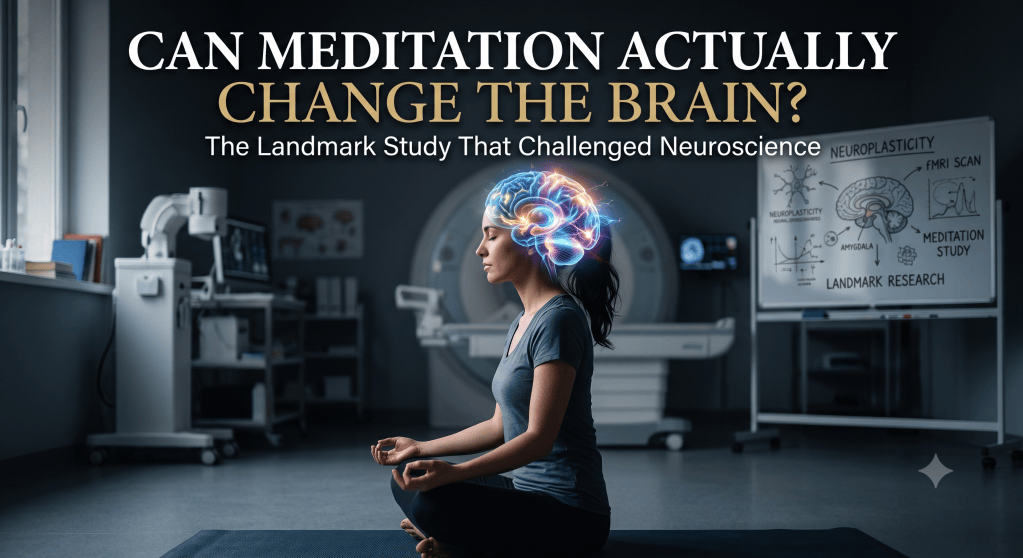
A landmark 2011 Harvard study found that eight weeks of mindfulness meditation changed brain structure. Here’s what it found, and what it didn’t.
In January 2011, a modest paper appeared in the relatively specialized journal Psychiatry Research: Neuroimaging. It had none of the hallmarks of a media sensation. There was no celebrity endorsement, no viral video, no bold claim about curing disease. It was a small brain-imaging study, carried out on just sixteen ordinary adults, none of whom had ever meditated before. And yet within weeks it had been covered by major news outlets around the world, and within a decade it had become one of the most influential papers in mindfulness neuroscience, widely cited in the years that followed and frequently referenced in support of meditation programs in hospitals, schools, prisons, and corporate wellness suites.
The paper, led by researcher Sara W. Lazar and her colleagues at Massachusetts General Hospital and Harvard Medical School, asked a deceptively simple question: if a person practices mindfulness meditation for eight weeks, does their brain actually change? Not their mood, not their self-reported stress levels, but the physical structure of the organ itself. The answer the researchers found, published under the title “Mindfulness practice leads to increases in regional brain gray matter density,” suggested that it does.
To understand why this study mattered as much as it did, it helps to remember the cultural moment it landed in. By 2011, the United States and much of the Western world were emerging from a punishing recession, glued to early smartphones, and increasingly anxious about a pace of life that felt unsustainable. Meditation, long associated with monasteries and countercultural spirituality, was being repackaged as something else entirely: a practical tool for managing attention and stress in a distracted, overworked society. What had been missing was rigorous evidence that could stand up in hospitals and peer-reviewed journals alike, something that showed this ancient practice did something measurable to the brain. Lazar’s study offered exactly that. This article traces the scientific, cultural, and historical threads that made this small imaging study into a turning point in how we think about the mind, the brain, and our own capacity for change.
The World That Was Ready for This Study
Mindfulness had been quietly building momentum for more than three decades before 2011. Physician Jon Kabat-Zinn founded the Mindfulness-Based Stress Reduction program, or MBSR, in 1979, stripping meditation of its religious framing and presenting it as a clinical tool for chronic pain and stress that any hospital patient could learn regardless of belief. For years it remained a niche practice, largely absent from mainstream conversation. That began to shift in the 2000s, as smartphones and constant email made fragmented attention a defining feature of daily life, and as brain imaging technology matured enough to let researchers ask questions that would have been unanswerable a generation earlier.
Meditation research also had a credibility problem to overcome. Earlier studies typically compared experienced meditators to non-meditators without ever tracking the same people over time, which left open an obvious alternative explanation: perhaps people with unusual brains were simply drawn to meditation in the first place, rather than meditation changing anyone’s brain. Lazar had contributed to some of these earlier cross-sectional studies herself and understood their limits. The 2011 paper was designed specifically to close that gap, by scanning the same individuals before and after training rather than comparing different people to one another.
Inside the Landmark Study
A Simple, Careful Design
The research team, led by Britta Hölzel as first author with Sara Lazar as senior author, recruited sixteen healthy adults who had never meditated before. The study was notable, although it involved only sixteen participants in the experimental group, a small sample that would later shape how cautiously its findings could be generalized. Still, by starting with meditation-naïve participants and scanning their brains before any intervention began, the researchers could observe change over time within the same individuals, rather than simply comparing different people to each other.
Participants then completed an eight-week Mindfulness-Based Stress Reduction course, the same structured Kabat-Zinn program that had been used clinically for decades. The program involved guided practices in body awareness, sitting meditation, and gentle mindful movement, along with daily home practice that participants tracked themselves. On average, participants engaged in about half an hour of practice most days of the week, a realistic and sustainable amount rather than an extreme monastic schedule.
Each participant’s brain was scanned using high-resolution MRI both before the program began and again after it ended, roughly eight weeks later. A separate control group of people who did not take the course was also scanned twice, at a similar interval, so the researchers could rule out the possibility that any changes were simply the result of time passing or of being scanned twice.
What “Gray Matter” Actually Means
For readers unfamiliar with brain anatomy, gray matter is the tissue that contains the cell bodies of neurons, the parts of brain cells most directly involved in processing information. Dense concentrations of gray matter generally reflect greater numbers of neurons, more connections between them, or both. Historically, it was assumed that the physical structure of the adult brain was essentially fixed once a person reached adulthood. Over the previous decade, however, a growing body of research on what scientists call neuroplasticity had begun overturning this assumption. Perhaps the most famous example is the finding that London taxi drivers, who must memorize the city’s dense and irregular street map, tend to show enlarged hippocampi, the brain region tied to spatial memory. The Lazar study asked whether a mental practice, rather than a physical or spatial skill, could produce a similar kind of structural change.
The Findings, In Plain Terms
Using a technique called voxel-based morphometry, which allows researchers to measure gray matter density across small three-dimensional units of brain tissue, the team found measurable increases in several regions after just eight weeks of practice.
The most consistent finding was in the hippocampus, a seahorse-shaped structure buried deep in the brain that plays a central role in learning, memory formation, and the regulation of emotional responses. Participants in the meditation group showed a reliable increase in gray matter density here, a change that did not appear in the control group.
The researchers also observed changes in other regions identified through a broader, exploratory analysis of the whole brain. These included the posterior cingulate cortex, an area involved in self-referential thinking and mind-wandering, the temporo-parietal junction, associated with perspective-taking and empathy, and areas of the cerebellum, traditionally linked to movement but increasingly understood to play a role in emotional processing as well. Together, these regions form a plausible network for exactly the kinds of benefits meditators have long described: sharper attention, steadier emotional responses, and a stronger sense of self-awareness.
Critically, none of these changes appeared in the control group, who were scanned on a similar timeline but did not take the course. This comparison was what allowed the researchers to argue, cautiously, that the meditation training itself was responsible for the changes, rather than some unrelated factor affecting everyone over those two months.
What the Study Did Not Claim
It is just as important to describe what the study did not show, because so much of its cultural legacy rests on claims that go beyond the data. This was a small study of sixteen participants in the experimental group, which limits how confidently the findings can be generalized. The researchers measured gray matter density, not cognitive performance directly, so the study could not prove that participants actually became better at learning, remembering, or regulating emotion, only that regions associated with those functions had changed structurally. The study also could not determine how long these changes might last after participants stopped practicing, nor could it fully explain the underlying biological mechanism, whether the changes reflected the growth of new neurons, more connections between existing ones, changes in supporting brain cells, or some combination of these possibilities. Lazar and her colleagues were notably careful in the original paper to frame their findings as evidence of structural correlates associated with mindfulness training, not as proof of a particular clinical benefit. Much of the media coverage that followed, and much of the popular meditation industry that grew up around it, was considerably less careful.
The Immediate Reaction (2011)
The response was swift. Within weeks of publication, the study was covered by major news outlets including CNN, the BBC, Scientific American, and numerous newspapers worldwide, most running some version of the same headline: eight weeks of meditation, measurable brain change. It became one of the first meditation studies to break through into mainstream public consciousness rather than staying confined to specialist journals, helping accelerate mindfulness’s transition into mainstream scientific discussion.
Why This Study Became a Cultural Touchstone
The Right Finding at the Right Moment
Scientific findings rarely become famous on the strength of their evidence alone. They become famous when they answer a question a lot of people are already asking, in a form simple enough to travel. The Lazar study did precisely that. Its central message could be summarized in a single accessible sentence: eight weeks of meditation changed people’s brains. That sentence traveled through newsrooms, wellness blogs, and eventually corporate training materials with remarkable speed, in part because it offered something increasingly rare in the wellness world of the early 2010s, a hard, brain-scan-based number attached to a practice that had previously relied mostly on personal testimony.
This mattered because the previous decade of research into happiness, resilience, and stress reduction had produced a great deal of self-report data, surveys asking people how they felt, which is valuable but also relatively easy to dismiss as subjective or susceptible to expectation effects. A structural brain scan felt different. It offered the appearance of objectivity, a picture rather than a questionnaire, and pictures are inherently more persuasive to a general audience than statistics.
From Laboratory to Living Room
The years following the study’s publication saw an extraordinary expansion of mindfulness into mainstream institutions. Corporations including major technology and finance firms introduced in-house meditation and mindfulness programs, often citing brain research explicitly in their promotional materials. Meditation apps, which barely existed as a commercial category before this period, grew into a multi-billion-dollar industry over the following decade. Hospitals expanded MBSR programs for patients dealing with chronic pain, anxiety, and the side effects of cancer treatment. School systems experimented with classroom mindfulness curricula aimed at improving attention and emotional regulation among children. The United States military, various police departments, and elite athletic programs all incorporated some version of mindfulness training, frequently referencing neuroscience research, with the Lazar study functioning as something close to a founding citation for the entire movement.
None of this expansion happened because of the study alone, of course. It reflected a broader convergence of forces, including rising rates of diagnosed anxiety, growing distrust of pharmaceutical-only approaches to mental health, and a cultural hunger for practices that felt both ancient and scientifically validated at once. But the study provided something the broader mindfulness movement badly needed: a citable, peer-reviewed anchor. When a wellness company or a school administrator wanted to justify a meditation program to a skeptical board or school district, this was very often the paper they pointed to.
The Appeal of a Measurable Mind
There is also a deeper psychological reason this particular study resonated so widely. For much of the twentieth century, popular understanding of the brain leaned heavily on the idea of fixed traits, intelligence, temperament, and emotional stability treated as static qualities set early in life. Abstract claims that the brain retains some capacity to change with experience can feel remote from everyday life. What the Lazar study offered was something more personal and actionable: a specific, ordinary behavior that appeared to reshape brain structure within a realistic time frame. It suggested that a person’s mental habits were not simply symptoms of their neurology but active forces capable of shaping it, an idea that tapped into something people badly wanted to believe about their own capacity for change, now carrying the authority of a peer-reviewed neuroscience journal.
Scientific Context and Later Developments
Replication and the Limits of a Single Study
No single study, however influential, should be treated as final proof of anything, and the scientific community’s engagement with the Lazar findings reflects that principle. In the years following publication, other research groups conducted related studies examining meditation and brain structure, with mixed results. Some found supportive evidence for structural changes associated with contemplative practice, particularly in regions tied to attention and emotional regulation. Others produced more modest or inconsistent findings, and methodological critiques emerged regarding small sample sizes common across this area of research, the challenge of blinding participants to which group they were in, and the general difficulty of isolating meditation practice from other lifestyle factors that might change over an eight-week period.
This pattern is not a mark against the original study specifically so much as a reflection of ordinary scientific practice. Small, carefully designed early studies often identify genuine and important effects while also overstating their precision, and subsequent replication work exists precisely to test, refine, and sometimes narrow the boundaries of an initial finding. By the mid-2010s, meditation neuroscience had matured into a more rigorous field, with larger sample sizes, active control conditions designed to account for expectation effects, and longer follow-up periods. Later meta-analyses pooling this broader body of work have generally found the strongest and most consistent evidence for functional brain changes, meaning shifts in how actively certain regions engage during tasks, while structural findings like the gray matter increases reported by Lazar’s team have proven more variable from study to study. Much of that variability traces back to the same limitation the original paper carried: small sample sizes across the field have made it difficult to establish exactly how reliable, or how large, the structural effects really are.
Distinguishing Correlation, Mechanism, and Meaning
Even with a before-and-after design that strengthens causal inference relative to earlier cross-sectional work, questions about mechanism remain genuinely open. Gray matter density changes detected through MRI reflect changes at a resolution far coarser than individual neurons, so researchers still cannot say with certainty whether such findings reflect new neuron growth, changes in the branching of existing neurons, adjustments in supporting glial cells, alterations in blood flow, or some combination of these processes. This is a reminder that brain imaging, powerful as it is, offers an indirect window into biology rather than a literal photograph of neurons multiplying.
It is also worth noting what this research does not tell us about meditation as a broad category. Mindfulness-Based Stress Reduction is a specific, structured eight-week program, and its effects should not be assumed to generalize automatically to every meditative tradition, every app-based guided session, or every duration of practice. The scientific literature on contemplative practice has grown to recognize considerable diversity within what gets casually lumped together as “meditation,” and researchers today are generally more careful to specify which technique, dosage, and population they are studying.
Meditation, Attention, and the Modern Mind
Why the Findings Still Resonate
More than a decade after its original publication, the Lazar study’s core relevance has, if anything, deepened rather than faded. The conditions that made mindfulness culturally appealing in 2011, namely constant connectivity, fragmented attention, and elevated background stress, have intensified rather than eased in the years since. Smartphones have grown more sophisticated and more central to daily life, algorithmic content feeds are explicitly engineered to capture attention, and public conversation about burnout, anxiety, and cognitive overload has only grown louder. Against that backdrop, a study suggesting that a manageable daily practice could measurably support attention and emotional regulation retains obvious appeal.
At the same time, the scientific community’s more nuanced later understanding offers a useful corrective to some of the earlier hype. Meditation is not a neurological cure-all, and structural brain changes detected on an MRI scan do not automatically translate into dramatic real-world benefits for every individual. What the research does support is a more modest but still meaningful claim: sustained mental practice can be associated with measurable changes in brain structure and function, consistent with what researchers have observed in other forms of skill learning and adaptation.
Beyond Individual Psychology
The story of this study is not only about neuroscience; it is also a case study in how scientific findings travel through culture, and how the incentives of media coverage, wellness industries, and public appetite can amplify a modest finding into a sweeping cultural narrative. That process is worth examining on its own terms. The original researchers were careful and appropriately cautious. The version of their finding that reached the public, filtered through headlines and marketing copy, was often considerably bolder than the data supported. This gap between careful science and popular interpretation is not unique to meditation research, but the Lazar study offers a particularly clear and well-documented example of how it happens.
Conclusion
The 2011 study by Hölzel, Lazar, and their colleagues did not prove that meditation is a cure for stress, nor that eight weeks of practice will reliably reshape anyone’s brain in predictable ways. What it did do was something quietly significant: it offered credible, peer-reviewed evidence that a purely mental practice, undertaken by ordinary people with no prior experience, could be associated with measurable structural changes in brain regions tied to memory, emotional regulation, and self-awareness. In doing so, it helped move mindfulness out of the realm of anecdote and into the domain of testable science, giving a centuries-old contemplative tradition a foothold in modern medicine, education, and workplace culture.
Its broader significance lies less in any single statistic and more in what it represented: proof, however preliminary, that the adult brain remains genuinely responsive to how a person spends their attention. That idea arrived at a moment when Western culture was grappling with the costs of distraction and overload, and it has only grown more relevant since. As neuroscience continues to refine its understanding of how contemplative practices interact with brain structure and function, the Lazar study is likely to be remembered less as the final word on meditation and the brain, and more as the moment a long-standing human practice was finally invited into serious scientific conversation, and the conversation has not stopped since.
Scientific Reference
Hölzel, B. K., Carmody, J., Vangel, M., Congleton, C., Yerramsetti, S. M., Gard, T., & Lazar, S. W. (2011). Mindfulness practice leads to increases in regional brain gray matter density. Psychiatry Research: Neuroimaging, 191(1), 36–43.









