
Originally published in August 2011. Comprehensively updated and edited July 2026.
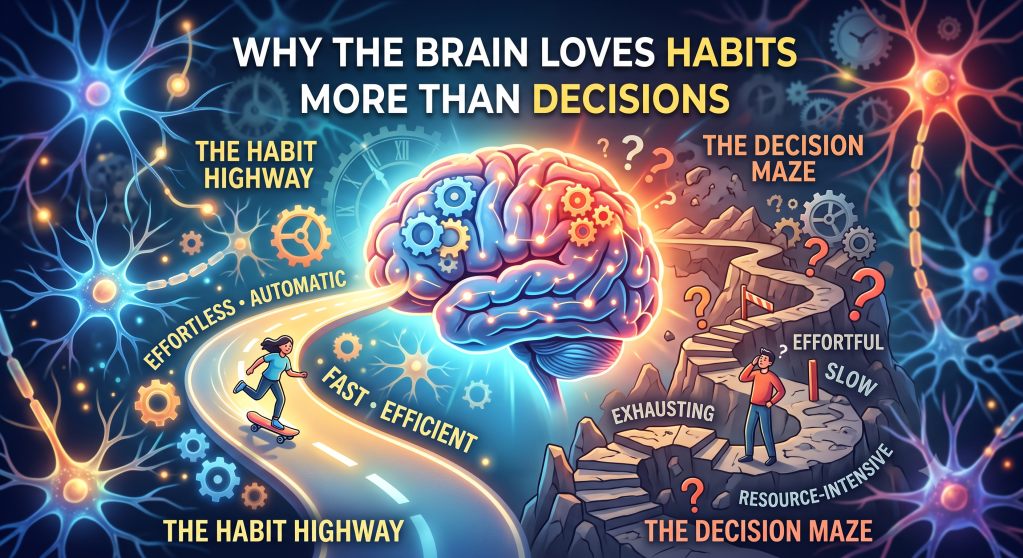
How the brain turns repeated actions into habits, why automatic behaviors are so powerful, and what neuroscience reveals about changing patterns.
In the late 2000s and early 2010s, a quiet shift was taking place in how scientists talked about behavior. For most of the twentieth century, psychology had been preoccupied with decisions — the choices people made, the willpower they exercised, the rational calculations (or failures of rationality) that supposedly steered daily life. But a growing body of neuroscience was suggesting something less flattering and far more interesting: most of what we do isn’t decided at all. It’s run.
This was also a cultural moment ripe for the idea. Self-help culture in the early 2010s was saturated with talk of willpower, discipline, and “just deciding” to change. Bookstores were stacked with titles promising that better choices would produce a better life. Yet anyone who had ever tried to quit checking their phone, break a snacking pattern, or stop biting their nails knew that willpower alone rarely won. The gap between what people intended and what they actually did was becoming impossible to ignore, and neuroscience was starting to explain why.
At the center of that explanation sat a cluster of structures buried deep in the brain called the basal ganglia. Once considered a relatively minor player involved mostly in movement, the basal ganglia turned out to be central to something much bigger: the brain’s capacity to take a sequence of actions, no matter how complicated, and compress it into something automatic. Researchers like Ann Graybiel at MIT had spent decades tracing how this compression happens, and their findings reshaped the way scientists — and eventually the public — understood habits, addiction, decision fatigue, and the strange, often uncomfortable feeling of doing something you didn’t quite mean to do.
This article traces that story. It looks at how the basal ganglia turn repeated actions into routines, why the brain seems to prefer this arrangement even when it works against our stated goals, and what more than a decade of additional research since the original version of this piece has confirmed, complicated, or overturned. Along the way, it connects the neuroscience to something almost everyone has experienced: the sense that a part of you is on autopilot, and that autopilot is not always working in your favor.
The Brain’s Energy Problem
To understand why habits exist at all, it helps to start with a basic fact about the brain: it is extraordinarily expensive to run. Although the brain makes up only about two percent of an adult’s body weight, it consumes roughly twenty percent of the body’s resting energy. Every neuron that fires, every synapse that transmits a signal, draws on a limited fuel supply. In evolutionary terms, an organ this costly had better be worth it — and largely, it is. But that cost also creates pressure toward efficiency wherever efficiency is possible.
Conscious, deliberate thought is one of the most energy-intensive things a brain can do. When you’re weighing options, holding several pieces of information in mind, and consciously monitoring your own behavior, you’re recruiting the prefrontal cortex, the region just behind your forehead responsible for planning, judgment, and self-control. This kind of effortful thinking is powerful, but it’s also slow and metabolically demanding, and it doesn’t scale. It’s worth noting that the brain’s total energy use doesn’t spike dramatically between an idle moment and a hard problem; the overall draw stays fairly steady. Rather than dramatically increasing the brain’s total energy use, demanding cognitive tasks redistribute activity toward networks involved in executive control, pulling resources away from other processes to support focused, deliberate reasoning. The cost of conscious thought, in other words, shows up more as a reallocation than as a surge. A brain that had to consciously deliberate over brushing its teeth, walking down stairs, and reading each word on this page would burn through its resources long before lunch.
Habits solve this problem. Once a behavior becomes automatic, it requires less conscious involvement from the prefrontal cortex. Instead, control increasingly relies on older, more efficient circuitry that can execute a familiar sequence with minimal oversight. This is the basic tradeoff at the heart of habit formation: the brain sacrifices flexibility for efficiency. A habit is harder to interrupt or adjust on the fly, but it’s cheap to run, fast to execute, and frees up conscious attention for whatever is new or uncertain in the moment.
Meet the Basal Ganglia
The basal ganglia are not a single structure but a group of interconnected regions sitting deep beneath the cerebral cortex, near the center of the brain. The key players include the striatum, which is often considered the basal ganglia’s main input hub, along with the globus pallidus, the substantia nigra, and the subthalamic nucleus. For decades, this circuitry was studied mainly in the context of movement disorders. Parkinson’s disease, which involves the loss of dopamine-producing neurons in the substantia nigra, causes the tremors and stiffness that come from a breakdown in basal ganglia function. That research history is part of why, for a long time, the basal ganglia were thought of primarily as a motor control system.
That view began to change as researchers realized the basal ganglia weren’t just coordinating movement — they were coordinating sequences of behavior more broadly, including habits that had nothing to do with physical motion, like patterns of thought or emotional response. The striatum, in particular, turned out to be a kind of switchboard that could take input from the cortex, the brain’s outer layer responsible for higher-order thinking, and gradually take over routine sequences that the cortex had originally directed.
The Habit Loop, Simplified
One of the clearest ways to describe how this works is through what researchers and popular writers have called the habit loop: a cue triggers a routine, the routine produces a reward, and over repeated trials, the brain begins to anticipate the reward as soon as it detects the cue. This three-part structure — cue, routine, reward — became widely known to the public in the years after this article’s original 2011 publication, most notably through Charles Duhigg’s 2012 book The Power of Habit, but the underlying neuroscience had already been building for years before that.
What makes this loop powerful isn’t just that it links a trigger to a behavior. It’s that the loop becomes increasingly self-contained. Early in learning, the whole sequence requires active attention and cortical involvement. But as the behavior repeats, the basal ganglia begin to “chunk” the entire routine into a single, streamlined unit. Ann Graybiel’s research, using rats navigating a maze for a reward, showed this chunking directly at the level of brain activity. In the early stages of learning the maze, neurons throughout the striatum fired continuously as the rat worked through the task, reflecting effortful, moment-to-moment processing. But as the maze became familiar, that pattern changed dramatically. Neural activity became concentrated at the beginning and end of the run, almost as though the brain had bracketed the entire sequence with a “start” and “stop” signal and let the middle run on autopilot.
This chunking is the neural signature of a habit. It’s the same reason an experienced driver can pull out of a driveway, merge onto a familiar road, and arrive at work with little memory of the individual decisions involved. The middle of the sequence has been chunked into something the brain no longer needs to supervise closely.
Dopamine and the Shifting Reward Signal
Dopamine plays a central role in this process, though its function is often misunderstood. Dopamine isn’t simply a “pleasure chemical,” despite how it’s frequently described in casual conversation. It’s more accurately understood as a signal related to prediction and expectation. Early research by neuroscientist Wolfram Schultz found that dopamine neurons fire strongly when an animal receives an unexpected reward. But as the animal learns to associate a cue with that reward, the dopamine signal shifts. It stops firing as strongly at the reward itself and starts firing instead at the cue that predicts it.
This pattern, often called a reward prediction error, closely resembles the update rule at the heart of reinforcement learning, a branch of computational modeling in which an agent adjusts its behavior based on the gap between an expected outcome and the outcome it actually receives. The resemblance isn’t coincidental; dopamine’s prediction-error signal has become one of the clearest known links between a biological learning process and a formal computational one.
This shift matters enormously for habit formation. It means that as a behavior becomes habitual, the brain’s sense of anticipation moves earlier in the sequence — toward the trigger, not the payoff. This is part of why habits can feel like they have a pull or an urge attached to the cue itself, sometimes well before the rewarding part of the behavior has even started. Someone with a habit of checking their phone the moment they feel bored may notice the urge arriving with the boredom, not with whatever they find once they unlock the screen.
A useful way to think about habit science is this: the brain does not merely decide who we are through conscious choice. In large part, it builds who we are through repetition.
From Deliberate Action to Automatic Behavior
Not every repeated action becomes a full-fledged habit, and the transition isn’t instantaneous. Researchers generally distinguish between goal-directed behavior, which is guided by an explicit sense of the outcome and its current value, and habitual behavior, which runs largely independent of whether the outcome is still desirable in the moment. These two systems appear to rely on somewhat different circuitry within the basal ganglia and its connections to the cortex, and the balance between them shifts as a behavior is repeated.
A classic way researchers have tested this distinction is through what’s known as outcome devaluation. In animal studies, a researcher trains an animal to perform an action for a food reward, then makes that food less desirable — for instance, by allowing the animal to eat its fill of it beforehand, or by pairing it with mild illness. If the behavior is still goal-directed, the animal will reduce or stop performing the action, because it recognizes the outcome is no longer worth pursuing. But if the behavior has become habitual, the animal often keeps performing it anyway, seemingly on autopilot, even though the reward it’s chasing isn’t something it wants anymore.
This finding has an uncomfortable resonance with everyday human experience. Plenty of habitual behaviors — reaching for a snack while watching television, refreshing an app out of boredom — persist even when a person can articulate, in the moment, that they don’t actually want the outcome. The behavior has become less dependent on the neural systems that evaluate whether the goal is still worthwhile. Instead, it responds to a cue and runs its course.
Why This Isn’t a Simple Story of Weak Willpower
It’s tempting to read this research as a story about self-control failing, but that framing somewhat misses the point. The basal ganglia’s habit system is not a design flaw. It’s a feature that allows the brain to function efficiently across an enormous range of tasks. Without it, every trivial action would require the same level of deliberate oversight as a genuinely difficult decision, and the prefrontal cortex would be overwhelmed almost immediately.
The trouble arises when the environment changes faster than habits do, or when a habit that once served a purpose keeps running after that purpose has disappeared. A habit formed to cope with stress in one context, for instance, might continue firing in response to similar-feeling cues in a completely different context, long after the original circumstances have changed. The habit system isn’t tracking whether the response still makes sense; it’s tracking whether the cue is present.
This is part of why simply “deciding” to break a habit is often ineffective on its own. The prefrontal cortex, seat of conscious intention, can set a goal, but it isn’t the system running the habitual behavior day to day. Overriding an established habit loop typically requires either avoiding the cue altogether, or deliberately building a new routine that responds to the same cue with a different action — essentially competing for control of the same loop rather than trying to argue the habit out of existence through willpower alone.
The Cultural Backdrop of Habit Science
It’s worth pausing on why this research landed with such cultural force in the early 2010s. The years surrounding the original publication of this article were marked by growing public fascination with self-optimization — a period when fitness trackers, productivity apps, and behavior-change programs were becoming mainstream consumer products rather than niche interests. At the same time, there was a rising skepticism about the effectiveness of willpower-based approaches to change, fueled partly by research on decision fatigue and self-control depletion that was widely discussed in that era, even as some of the underlying findings would later face replication challenges.
Basal ganglia research offered something different from either pure willpower narratives or pure environmental determinism. It suggested a middle path: behavior change was possible, but it worked more like redesigning a system than winning an argument with yourself. This reframing had appeal well beyond neuroscience circles. It showed up in corporate wellness programs, addiction treatment approaches, habit-tracking apps, and educational strategies aimed at building routines in children. The idea that the brain treats habitual behavior almost like a separate, semi-autonomous process gave people a new vocabulary for something they had long experienced but struggled to explain: the sense of doing something automatically, almost against their own stated intentions.
What More Recent Research Has Added
In the years since this article was first written, the basic idea that repeated behavior recruits increasingly efficient cortico-striatal circuits has held up reasonably well, but the picture has become considerably more detailed and, in some ways, more cautious.
One important refinement concerns how quickly and completely control actually shifts from goal-directed to habitual systems. Later research has emphasized that these two systems don’t operate as a simple on-off switch. Rather, they appear to run somewhat in parallel, with their relative influence over behavior shifting gradually depending on factors like how much a behavior has been repeated, how stressed or distracted a person is, and how stable the environment has been. Under stress or heavy cognitive load, people and animals tend to lean more heavily on habitual responses, since the goal-directed system requires more attentional resources to operate. This helps explain why habits, both good and bad, tend to become more dominant during periods of high stress, exactly when people often most want to exercise deliberate control.
Researchers have also worked to clarify the role of a specific region within the striatum called the dorsolateral striatum, which appears especially important for well-established, automatic habits, in contrast to more medial and ventral striatal regions that stay more involved in flexible, goal-directed behavior. This regional distinction has helped explain some puzzling findings in addiction research, where compulsive drug-seeking behavior appears to become increasingly tied to dorsolateral striatal circuitry as a substance use pattern becomes more entrenched, even as the drive to seek the substance becomes progressively less connected to the pleasure it originally provided. This lines up with the broader dopamine research: the anticipatory signal shifts toward the cue, while the substance itself may deliver less and less of a subjective reward over time, yet the seeking behavior persists or even intensifies.
There has also been meaningful growth in understanding how habits can be deliberately reshaped rather than simply suppressed. Work on so-called habit reversal and cue-competition strategies has reinforced the idea that new routines attached to old cues tend to be more durable than attempts to simply eliminate a behavior through suppression or avoidance alone. Some researchers have also explored how sleep and memory consolidation processes interact with habit strengthening, suggesting that the neural chunking Graybiel first observed in rodents may continue to be reinforced during rest, not only during the waking repetitions themselves.
Finally, it’s worth noting a point of appropriate scientific humility: while animal studies, particularly in rodents, have provided the clearest and most detailed evidence for basal ganglia habit circuitry, translating these findings precisely to human behavior involves some uncertainty. Human habits are entangled with language, social context, and complex goal structures in ways that are harder to fully capture in a laboratory maze. Much of what’s discussed as established in this area is well-supported by converging evidence across species and imaging studies, but the finer mechanistic details in humans specifically remain an active and evolving area of research rather than a fully closed case.
Habits Don’t Just Shape Behavior — They Shape the Self
There’s a further layer to this story that goes beyond circuitry and reward signals: habits appear to play a role in shaping how people understand themselves. This connection isn’t a neuroscience finding in the strict sense — it comes more from psychology and sociology — but it fits naturally alongside the basal ganglia research, because it helps explain why habitual behavior feels so tied to identity rather than just convenience.
One relevant strand is self-perception theory, developed by psychologist Daryl Bem, which proposes that people often infer their own attitudes and traits by observing their own behavior, in much the same way they might infer someone else’s character by watching what that person does. Under this view, someone who repeatedly runs in the morning doesn’t just develop a habit of running; over time, they come to think of themselves as “a runner,” and that self-concept then reinforces the behavior further. The habit and the identity build each other up in a feedback loop.
A related idea, often discussed under the heading of identity-based habits, suggests that behavior change tends to be more durable when it’s framed around who a person is trying to become rather than simply what they’re trying to do. Wanting to exercise more is a goal; seeing oneself as someone who takes care of their body is closer to an identity, and identities are stickier than isolated intentions because they get reinforced by every small piece of matching behavior, not just the big ones.
Narrative identity research, associated with psychologists like Dan McAdams, adds another dimension. This body of work looks at how people construct an evolving life story to make sense of who they are, and it suggests that habitual patterns often become woven into that story as evidence of character — “I’ve always been disciplined,” or “I’ve never been a morning person.” These narratives can become self-fulfilling, since a story a person tells about themselves shapes which cues they attend to and which routines they’re inclined to repeat or resist.
None of this means identity is simply downstream of basal ganglia activity, or that changing a habit is as simple as changing a story. The relationship likely runs in both directions: repeated behavior shapes self-concept, and self-concept shapes which behaviors get repeated. But it does suggest that the neural machinery discussed throughout this article isn’t operating in isolation from the psychological sense of self. The loops being chunked in the striatum are, in a very real sense, also loops being written into a person’s ongoing account of who they are.
Habits in the Age of Constant Cues
There’s a reason this topic has only grown more relevant since 2011 rather than fading into a settled corner of neuroscience textbooks. Modern environments are extraordinarily rich in cues — notification sounds, app icons, scrolling feeds — each one capable of triggering a well-rehearsed loop before conscious deliberation even has a chance to weigh in. Many digital products have evolved around engagement patterns that strongly interact with the cue-routine-reward learning mechanisms the basal ganglia rely on. A notification serves as the cue; opening the app is the routine; the small hit of novel information or social validation serves as the reward, often on an unpredictable schedule that makes the loop even more resistant to extinction.
Understanding this circuitry doesn’t hand anyone an easy fix, but it does reframe the problem usefully. The struggle against a persistent habit — whether it’s a media consumption pattern, an eating pattern, or something else entirely — isn’t best understood as a referendum on someone’s character or willpower. It’s a contest between an efficient, deeply practiced neural loop and a more effortful, resource-intensive system trying to assert a different goal. Recognizing that contest for what it is tends to produce more effective strategies than treating every lapse as evidence of some personal failing.
Conclusion
The basal ganglia’s role in habit formation reveals something fundamental about how brains are built: efficiency and flexibility are almost always in tension, and evolution has favored solutions that let organisms have both, in different measure, depending on the task. Deliberate, effortful thought remains indispensable for genuinely new problems, but it’s simply too costly to apply to everything. Habits are the brain’s answer to that cost — a way of taking hard-won, repeated experience and compressing it into fast, low-effort routines that don’t need to be relearned or reconsidered each time a familiar cue appears.
What began as research into rodent movement disorders and maze-running rats has grown into a framework that touches addiction treatment, education, product design, and the everyday, often frustrating experience of trying to change a pattern that no longer serves you. The picture that’s emerged over more than a decade of additional research is more nuanced than the original story: control shifts gradually rather than completely, stress tilts the balance toward automatic responses, and specific circuits within the striatum play distinguishable roles in flexible versus rigid behavior.
Looking forward, this line of research seems likely to keep intersecting with some of the more pressing behavioral questions of the coming years — from how digital environments are engineered around attention and habit loops, to how addiction treatment might better target the specific circuitry that sustains compulsive behavior after reward has faded, to how habit science might inform education and skill-building earlier in life. The core insight, though, is likely to remain stable: the brain doesn’t merely decide who we are through conscious choice. In large part, it builds who we are through repetition, quietly compressing our most repeated actions into the routines that make up so much of daily life.
Scientific Reference
- Graybiel, A. M. (1998). The basal ganglia and chunking of action repertoires. Neurobiology of Learning and Memory.
- Graybiel, A. M. (2008). Habits, rituals, and the evaluative brain. Annual Review of Neuroscience.
- Schultz, W., Dayan, P., and Montague, P. R. (1997). A neural substrate of prediction and reward. Science.
- Yin, H. H., and Knowlton, B. J. (2006). The role of the basal ganglia in habit formation. Nature Reviews Neuroscience.
- Everitt, B. J., and Robbins, T. W. (2016). Drug addiction: updating actions to habits to compulsions ten years on. Annual Review of Psychology.
- Bem, D. J. (1972). Self-perception theory. Advances in Experimental Social Psychology.
- McAdams, D. P. (2001). The psychology of life stories. Review of General Psychology.
- Duhigg, C. (2012). The Power of Habit: Why We Do What We Do in Life and Business.









