
Originally published in January 2013 and comprehensively updated/edited in July 2026.
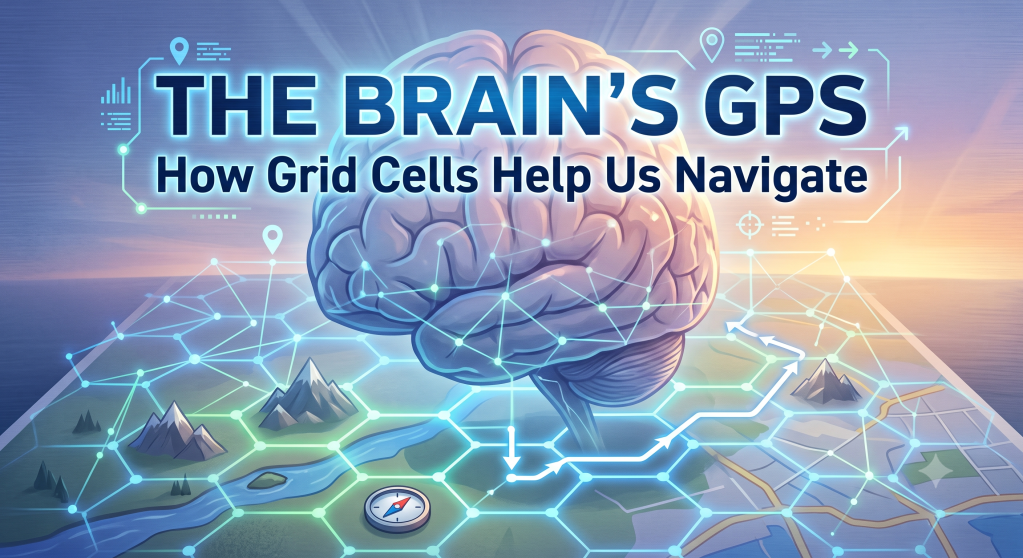
How Norwegian researchers discovered grid cells, the brain’s internal coordinate system, and why this Nobel Prize-winning finding still shapes neuroscience today.
In January 2013, the idea of a phone that could tell you exactly where you stood on Earth had already become mundane. GPS units sat in nearly every car dashboard and every pocket, and a generation of commuters had started outsourcing a skill that humans had relied on since before written language: knowing where they were and how to get somewhere else. It was a strange moment to be a neuroscientist studying navigation, because the very software people were using to replace their sense of direction turned out to share a deep structural resemblance to something already built into the brain. Researchers in Norway had spent the previous decade quietly mapping a biological coordinate system, a grid of neurons that fires in patterns so regular and so mathematically clean that they look more like the output of an engineer than the product of evolution. Unlike a satellite-based GPS receiver, however, the brain’s navigation system does not calculate position from an external signal. It builds an estimate from movement, memory, and sensory information.
That discovery, of what came to be called grid cells, did more than explain how rats find their way through a maze. It reframed how scientists think about memory, imagination, and the brain’s ability to represent our movement through the world. In late 2013, the Karolinska Institute began deliberating over a Nobel Prize that would recognize this line of research, and by October 2014 the decision was made. Understanding grid cells means understanding one of the more elegant discoveries in modern brain science, and more than a decade later, it also means tracking a body of research that has kept surprising the very scientists who started it.
A Question as Old as Wandering
Long before anyone could record a single neuron, philosophers and psychologists puzzled over how animals and people navigate. Edward Tolman, working with rats in the 1940s, proposed that animals build something like a mental picture of their environment rather than simply memorizing a fixed sequence of turns. He called this a cognitive map. At the time, the idea was controversial. Behaviorism dominated psychology, and the field was skeptical of any explanation that assumed an animal held an internal representation of anything. Tolman’s rats, however, kept behaving as though they understood the layout of a maze as a whole, not just as a chain of habits. It would take another three decades before anyone found direct neural evidence for what he was describing.
Place Cells: The First Piece of the Puzzle
The breakthrough began with a different, related discovery. In 1971, neuroscientist John O’Keefe, working at University College London, recorded electrical activity from individual neurons in the hippocampus of freely moving rats. He found cells that fired only when the rat was in a specific location within its environment. Move the rat to a different corner of the enclosure, and a different set of cells would fire. O’Keefe called these place cells, and the discovery gave Tolman’s old idea a physical home in the brain. The hippocampus, it turned out, held something like a set of location markers, each one active only when the animal occupied a particular spot.
Place cells answered part of the question. They told the brain where an animal currently was. But they did not explain how the brain calculated distance, direction, or the relationships between places it had not yet visited. That answer would come from a lab study working on the tissue right next door to the hippocampus.
The Discovery of Grid Cells
In the early 2000s, May-Britt Moser and Edvard Moser, a husband-and-wife team running a lab at the Norwegian University of Science and Technology in Trondheim, were investigating the entorhinal cortex, a region that feeds information into the hippocampus. Earlier studies of this area had used electrodes placed near one end of the structure and had found only weak, unclear spatial signals. Working with colleagues including Marianne Fyhn, Sturla Molden, and Menno Witter, the Moser team decided to record from a different part of the entorhinal cortex and to test animals in much larger enclosures than researchers had previously used.
What they found did not initially look like anything new. Individual neurons seemed to fire like place cells, activating when the rat was in a certain spot. But because the rats were exploring larger spaces, the researchers eventually noticed that these neurons did not fire in just one location. They fired in many locations, and when the team plotted all the firing spots for a single neuron onto a map of the enclosure, the pattern that emerged was a nearly perfect grid of triangles, tiling the entire floor like a honeycomb. The finding was published in the journal Nature in 2005 and quickly became one of the most discussed results in systems neuroscience that decade.
Why a Hexagonal Grid
The specific geometry mattered. A hexagonal, triangular grid is the most efficient way to cover a two-dimensional surface using the fewest number of firing fields for a given resolution. In other words, evolution appears to have converged on close to the mathematically optimal solution for representing space with a limited number of neurons. Unlike place cells, which respond to the unique features of a specific room or maze, grid cells produce the same triangular firing pattern in a completely dark room, regardless of the shape of the enclosure or the presence of walls, smells, or lighting cues. That consistency suggested the grid was not built from external sensory landmarks. Instead, it appeared to be generated internally, largely from information about the animal’s own movement.
How Grid Cells Build an Internal Map
This is where grid cells connect to a much older idea in navigation known as dead reckoning, or path integration. Sailors without modern instruments used to track their position by recording their speed, heading, and elapsed time, continuously updating an estimate of where they were relative to where they started. Grid cells appear to give the brain a biological version of this same calculation. As an animal moves, signals related to speed and direction update the firing pattern of grid cells, allowing the brain to keep a running estimate of position even without any visual landmarks at all.
This internal tracking system works alongside place cells and a third cell type called head-direction cells, which fire depending on which way an animal’s head is pointed, functioning something like an internal compass. Together, these three systems, position, distance, and orientation, give the brain the raw materials for a working spatial map. Researchers have also identified boundary-related cells that respond to environmental edges and landmarks, providing additional information about the shape and limits of a space. The entorhinal cortex appears to generate the coordinate grid, the hippocampus appears to tag specific locations within it, and head-direction cells anchor the whole system to a consistent sense of which way is which. It is worth being careful here about the limits of the evidence. Researchers know a great deal about the firing patterns themselves, but the exact computational process by which these signals are converted into a usable, updatable map remains an active area of modeling and debate rather than a fully settled question.
Recognition: The 2014 Nobel Prize
In October 2014, the Nobel Assembly at the Karolinska Institute awarded the Nobel Prize in Physiology or Medicine jointly to John O’Keefe and to May-Britt Moser and Edvard Moser for discovering cells that make up what the Nobel committee described as a positioning system in the brain. It was a fitting pairing. O’Keefe’s place cells and the Mosers’ grid cells were, in a real sense, two halves of the same discovery, separated by more than three decades of research and only a short distance within the brain. May-Britt Moser had trained in O’Keefe’s academic lineage earlier in her career, which made the shared prize feel less like a coincidence of timing and more like the natural closing of a scientific loop that had opened in the early 1970s.
Grid Cells in the Human Brain
For years after the initial 2005 discovery, an open question loomed over the field: did any of this apply to people? Recording directly from individual neurons in a healthy human brain is not something researchers can ethically do, so scientists had to find indirect methods. In 2010, Christian Doeller, Caswell Barry, and Neil Burgess, working at University College London, used functional MRI to look for a large-scale signature of grid-cell-like activity while volunteers navigated a virtual reality environment. Because grid cells across a region tend to align their orientation with one another, the researchers predicted that brain activity would show a six-fold, hexagonal pattern of variation as people moved in different directions relative to that shared grid orientation. That is exactly what they found, concentrated in the entorhinal cortex and in a broader network of regions tied to memory and spatial thinking. A few years later, in 2013, researchers led by Joshua Jacobs got even closer to direct evidence, recording from electrodes implanted in the brains of epilepsy patients undergoing evaluation before surgery, and finding neurons with activity patterns consistent with grid-cell coding.
These human findings mattered for reasons beyond simple curiosity. The entorhinal cortex is one of the earliest brain regions to show measurable decline in normal aging. It is also among the first areas affected in Alzheimer’s disease. Researchers have since found that disruption of grid cell function in animal models tracks closely with the kind of spatial memory loss and disorientation that often shows up early in Alzheimer’s-related decline. This gives grid cell research a practical stake in human health, not just a theoretical one, though it is worth being clear that this connection describes a correlation between entorhinal decline and navigational symptoms rather than a fully worked-out causal treatment target.
Beyond Physical Space: Grid Cells and Abstract Thought
One of the more surprising developments in the years following the original discovery has been evidence that grid-like coding is not limited to physical movement through a room. Researchers using fMRI have found similar hexagonal signal patterns when people navigate abstract, conceptual spaces, such as mentally arranging objects along dimensions like size and color rather than moving through physical rooms. Other work has linked grid-like signals in the entorhinal cortex to eye movements during visual scene viewing and to memory formation, suggesting that the same coordinate system the brain uses to track physical location may also be recruited more generally to organize relationships between ideas, concepts, and remembered experiences. This line of research remains younger and more exploratory than the core spatial findings, and scientists are still working out how far the analogy between physical grids and conceptual grids actually extends.
Continued Breakthroughs: What Researchers Have Learned Since
Grid cell research did not stop at the Nobel Prize. In 2025, the Moser lab, still active at the Kavli Institute for Systems Neuroscience in Trondheim, published findings suggesting that grid-cell networks may do more than track location. Researchers found evidence that these circuits generate a kind of predictive representation of nearby space, allowing the brain not only to know where it is, but to anticipate where it might go next. Related work from the same group found that entorhinal activity organizes itself around meaningful moments in an animal’s experience, not just raw movement through space, hinting that the grid may be woven more tightly into memory than the original 2005 discovery suggested.
Other researchers have pushed in a different direction, testing whether grid-like signals hold up under passive viewing rather than active movement, and some have failed to find a clear signal in that condition. The result is a useful reminder that the field still tests its own claims rather than treating early findings as settled.
Why This Matters Beyond the Laboratory
It is worth pausing on why a set of neurons in a rat’s brain, and later a rough analog in the human brain, deserves this much attention. Grid cells offer one of the clearest examples in neuroscience of an abstract computational idea, essentially a coordinate system, implemented directly in biological tissue. That has made the discovery valuable well outside neuroscience departments. Engineers building autonomous robots and self-driving navigation systems have drawn on grid-cell-inspired models to design more efficient spatial memory systems, since a hexagonal, self-generated coordinate grid turns out to be a genuinely useful engineering solution, not just a biological curiosity.
For ordinary people, the more immediate relevance may be personal rather than technical. The sense of getting lost, whether in a new city or in a familiar building during a moment of distraction, has a concrete neural basis rooted in this same system of place cells, grid cells, and head-direction cells working together. And because entorhinal cortex health is tied to healthy aging, changes in someone’s navigational ability, becoming unusually disoriented in familiar places, for instance, are taken seriously by clinicians today as a potential early signal worth discussing with a doctor, rather than dismissed as ordinary forgetfulness.
Conclusion
The story of grid cells traces a long arc, from Edward Tolman’s contested idea of a cognitive map in the 1940s, through John O’Keefe’s discovery of place cells in 1971, to the Moser lab’s 2005 discovery of the hexagonal grid itself, and finally to the 2014 Nobel Prize that recognized this line of work as one of the defining achievements of modern neuroscience. What makes the discovery endure, more than a decade after that prize was awarded, is how much room it left for further questions. Researchers are still working out how grid cells, place cells, head-direction cells, and boundary-related cells interact, how their combined function changes with age and disease, and whether the same coordinate-like coding the brain uses for physical space also underlies how people organize abstract knowledge and ideas.
As virtual reality, brain-computer interfaces, and AI-driven navigation systems continue to develop, the basic insight behind grid cells, that the brain builds its own internal coordinate system rather than simply reacting to the world, is likely to remain a reference point for years to come. The rats running through Trondheim’s laboratory enclosures in the early 2000s turned out to be carrying, quite literally, a map of how brains build maps.
Scientific Reference
Tolman, E.C. (1948). Cognitive maps in rats and men. Psychological Review, 55(4), 189–208.
O’Keefe, J., & Dostrovsky, J. (1971). The hippocampus as a spatial map: preliminary evidence from unit activity in the freely-moving rat. Brain Research, 34(1), 171–175.
Fyhn, M., Molden, S., Witter, M.P., Moser, E.I., & Moser, M.B. (2004). Spatial representation in the entorhinal cortex. Science, 305(5688), 1258–1264.
Hafting, T., Fyhn, M., Molden, S., Moser, M.B., & Moser, E.I. (2005). Microstructure of a spatial map in the entorhinal cortex. Nature, 436(7052), 801–806.
Doeller, C.F., Barry, C., & Burgess, N. (2010). Evidence for grid cells in a human memory network. Nature, 463(7281), 657–661.
Jacobs, J., et al. (2013). Direct recordings of grid-like neuronal activity in human spatial navigation. Nature Neuroscience, 16(9), 1188–1190.
Fu, H., et al. (2017). Tau pathology induces excitatory neuron loss, grid cell dysfunction, and spatial memory deficits reminiscent of early Alzheimer’s disease. Neuron, 93(3), 533–541.
The Nobel Assembly at Karolinska Institute (2014). The Nobel Prize in Physiology or Medicine 2014: Press Release.
Vollan, A.Z., Gardner, R.J., Moser, M.B., et al. (2025). Left–right-alternating theta sweeps in entorhinal–hippocampal maps of space. Nature.
Kanter, B.R., Lykken, C.M., Polti, I., Moser, M.B., & Moser, E.I. (2025). Event structure sculpts neural population dynamics in the lateral entorhinal cortex. Science, 388, eadr0927.









