
Originally published in March 2013 and comprehensively updated/edited in July 2026.
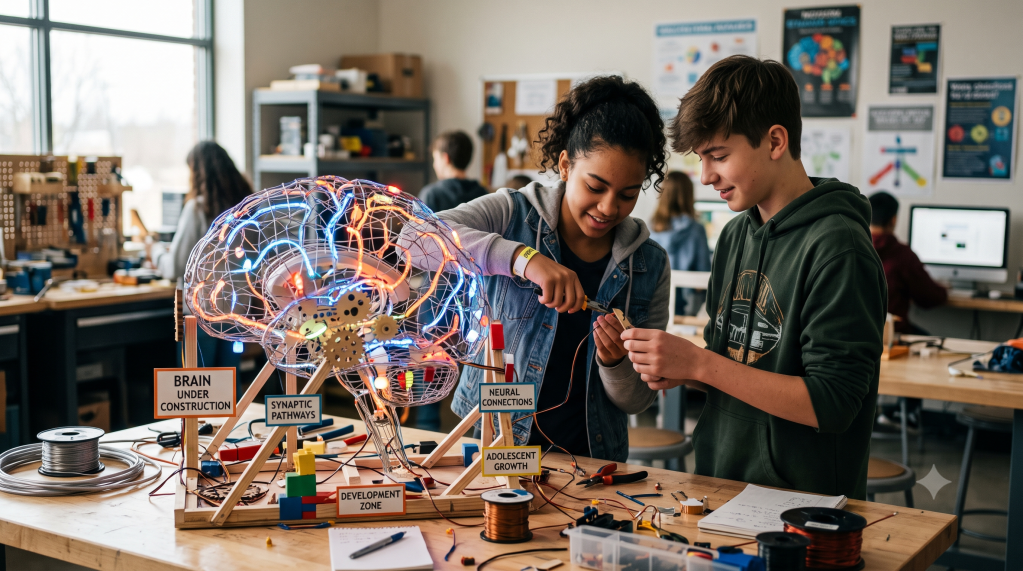
Why teenagers take more risks than adults—and how a decade of brain research reshaped schools, courtrooms, and our understanding of adolescent development.
In the early 2010s, a curious kind of consensus was forming about teenagers, and it wasn’t coming from parents or teachers. It was coming from brain scanners. For decades, the standard explanation for adolescent recklessness had leaned on hormones, rebellion, or simple immaturity of character. But a wave of long-running neuroimaging studies, many of them tracking the same children for a decade or more, was starting to offer something more precise: a picture of a brain that develops unevenly, with the systems that generate excitement and reward maturing years before the systems that rein them in. This was not a metaphor. It was a measurable, replicated pattern showing up in scan after scan.
The timing mattered. Smartphones were rapidly becoming ubiquitous among teenagers, texting had overtaken talking, and social media was reorganizing how adolescents formed friendships and measured their own worth. At the same time, the American legal system was in the middle of a quiet revolution, as the Supreme Court repeatedly cited brain science to limit how harshly juveniles could be punished. Educators were rethinking how school schedules and disciplinary policies interacted with a still-developing brain. The adolescent brain, in other words, had become both a scientific puzzle and a matter of public policy, all at once.
This piece traces that story: what the major longitudinal studies actually found, how researchers translated those findings into a workable model of adolescent decision-making, and how that model reshaped conversations in classrooms and courtrooms. It also revisits, with the benefit of another decade of research, which parts of that early picture have held up and which have needed revision.
A Decade of Watching Brains Grow Up
Long before smartphones or Instagram, researchers at the National Institute of Mental Health had begun one of the most ambitious projects in developmental neuroscience: repeatedly scanning the same children’s brains as they aged, sometimes every two years, from childhood into their late twenties. The project, led for many years by child psychiatrist Jay Giedd, eventually followed thousands of participants, making it one of the largest and longest-running efforts of its kind. Cross-sectional studies, which compare different people at different ages, can suggest patterns, but they can’t rule out the possibility that older and younger brains simply differ for reasons unrelated to development. A longitudinal design, following the same person over time, gets much closer to actually watching development happen.
What the scans showed complicated a simple, intuitive idea people once had about brain growth: that mental maturity comes from a brain getting bigger. Instead, the researchers found that overall brain volume is nearly adult-sized well before adolescence. What changes dramatically after that is not size but structure. Gray matter, the tissue made up of neuron cell bodies, does not simply keep multiplying. Rather than increasing continuously, it follows an inverted U-shaped developmental trajectory, expanding through childhood before gradually thinning through adolescence. Different brain regions reach their peak thickness at different times, a process most researchers interpret as synaptic pruning, the elimination of underused neural connections in favor of more efficient ones. White matter, made of the insulated fibers that connect distant brain regions, does keep increasing steadily into the twenties, reflecting ongoing myelination, the process by which nerve fibers get wrapped in a fatty coating that speeds up signal transmission.
The Prefrontal Cortex Finishes Last
The order in which these changes unfold turned out to matter as much as the changes themselves. Regions supporting basic sensory and motor functions mature relatively early. The prefrontal cortex, the area behind the forehead responsible for planning, weighing consequences, and controlling impulses, is consistently among the last regions to complete this remodeling, continuing to change into the mid-twenties. Giedd summarized the practical upshot of this finding simply: the part of the brain most involved in long-range planning and decision-making is the last one to finish developing. That single observation, repeated across multiple cohorts and replicated by other labs internationally, became the anchor point for nearly everything that followed in adolescent brain research.
It’s worth being careful about what this evidence does and doesn’t establish. The imaging studies are very good at showing that structural change is happening, where it’s happening, and roughly when. They are much weaker at proving exactly what that structural change means for behavior in a given teenager on a given day. Structure and function are related, but the leap from “this region is still maturing” to “this explains why my son texted while driving” involves several inferential steps that researchers have had to test separately, using different kinds of studies entirely.
Two Systems, Different Clocks
That further testing came largely from behavioral and functional imaging research, and by around 2008, two research groups working independently, one led by psychologist Laurence Steinberg at Temple University and another led by neuroscientist B.J. Casey, had converged on a strikingly similar explanation, later refined and popularized through the early 2010s. It became known as the dual systems model, sometimes called the maturational imbalance model. The core idea is that adolescent risk-taking doesn’t come from a single broken component. It comes from two systems developing on different schedules.
The Accelerator: Reward and Sensation-Seeking
The first system is often described as socioemotional or reward-related, centered on subcortical structures like the ventral striatum, along with connections to the amygdala and related limbic regions. This system responds strongly to rewards, novelty, and social stimulation, and research suggested it becomes especially reactive around puberty, likely influenced by the surge of hormonal and dopamine-related changes that accompany sexual maturation. Sensation-seeking, the appetite for new and intense experiences, tends to rise sharply in early adolescence and then gradually decline afterward, tracking this system’s heightened early reactivity.
The Brakes: Cognitive Control
The second system supports what researchers call cognitive control: the capacity to plan ahead, inhibit an impulse, and weigh long-term consequences against short-term temptations. It relies heavily on the lateral prefrontal cortex and its connections to parietal regions. Unlike the reward system, cognitive control develops gradually and doesn’t finish maturing until the early-to-mid twenties. Behavioral testing backs this up: performance on tasks requiring sustained self-control keeps improving in slow, steady increments well past the teenage years, without the early spike seen in reward sensitivity.
Why the Timing Gap Matters
The consequence of pairing an early-maturing accelerator with a slow-maturing set of brakes is a window, roughly spanning adolescence, where the pull toward reward and novelty can outpace the capacity to regulate it. This doesn’t mean teenagers are incapable of good judgment. In calm, unhurried, low-arousal situations, adolescent reasoning looks a lot like adult reasoning. The gap becomes most visible under conditions of emotional arousal, time pressure, or social evaluation, precisely the conditions under which real-world risky decisions, from reckless driving to substance experimentation, tend to happen.
Peers Change Everything
One of the more surprising refinements to this picture came from research on peer influence. Adolescents don’t just take more risks in the abstract; they take dramatically more risks specifically when other teenagers are watching. In laboratory driving simulations, teens made far riskier choices with same-age peers present than when alone, while adults’ behavior barely changed either way. Functional imaging work extended this further, finding that the mere presence of peers appeared to amplify activity in reward-related brain regions during risky choices, suggesting that peer presence isn’t just adding social pressure on top of a fixed level of risk tolerance. It may be recalibrating how rewarding the risk itself feels in the moment. This helped explain something parents and teachers had long observed anecdotally: that a teenager who behaves sensibly alone can behave very differently in a car full of friends, not necessarily because of peer pressure in the traditional sense, but because the presence of peers appears to change the underlying calculus of what feels worth doing.
From Lab to Courtroom: Neuroscience Meets Juvenile Justice
This body of research didn’t stay confined to academic journals. It became a central piece of evidence in a series of U.S. Supreme Court cases reshaping how the justice system treats juvenile offenders. In Roper v. Simmons (2005), the Court barred the death penalty for crimes committed by minors. In Graham v. Florida (2010), it ruled that juveniles could not be sentenced to life without parole for non-homicide offenses. The trend culminated in Miller v. Alabama (2012), decided the same year this research was consolidating into public consciousness, in which the Court ruled that mandatory life-without-parole sentences for juveniles, even in homicide cases, violated the Eighth Amendment’s ban on cruel and unusual punishment.
The Court’s reasoning leaned explicitly on developmental science. Groups including the American Psychological Association filed briefs arguing that adolescents are neurologically less culpable than adults because the brain regions responsible for judgment and impulse control aren’t yet communicating with adult-level coordination. The Court’s opinion pointed to what it called “fundamental differences between juvenile and adult minds,” reasoning that mandatory maximum sentences failed to account for the mitigating features of youth, including impulsivity, susceptibility to peer pressure, and a still-forming character.
This should be read with some caution. Brain science did not single-handedly decide these cases; the Court’s reasoning also drew on decades of criminological and psychological research on recidivism, culpability, and the purposes of punishment, and the legal doctrine of proportionality has roots that predate modern neuroimaging entirely. What the imaging research provided was corroborating, mechanistic support for a set of intuitions the legal system had already been moving toward. It gave judges and lawmakers a biological account to sit alongside the behavioral one, which made an already-building shift in juvenile sentencing philosophy harder to dismiss as merely sentimental.
Rethinking School and Parenting in Light of the Data
Outside the courtroom, this research quietly reshaped conversations among educators and parents. School start times became one flashpoint, as sleep researchers noted that adolescent circadian rhythms naturally shift later, making early morning classes a poor match for how teenage brains and bodies actually function, a case that combined with the risk-taking research to argue for treating adolescence as a genuinely distinct developmental stage rather than an inconvenient phase to be managed with adult-style discipline.
Zero-tolerance disciplinary policies, popular in schools through the 1990s and 2000s, came under similar scrutiny. If an instance of poor judgment reflects a temporarily uneven brain rather than a fixed character flaw, then permanently expelling a student for a single lapse looks less like justice and more like a mismatch between policy and the science it claims to be responding to. None of this meant abandoning consequences or structure. If anything, the research reinforced the value of consistent boundaries, since a still-developing cognitive control system benefits from external scaffolding while it finishes maturing internally. But it shifted the emphasis from punishment aimed at deterrence toward interventions aimed at building the very self-regulation skills that were still under construction.
What We’ve Learned Since 2013
More than a decade on, it’s worth asking how well this picture has held up. The core structural finding, that gray matter follows an inverted U-shaped trajectory while white matter increases steadily into the mid-twenties, has been replicated repeatedly and remains on solid footing. The basic sequencing claim, that prefrontal regions mature later than more primitive ones, also continues to be well supported.
The dual systems model itself has had a more complicated decade. It proved enormously useful as a simplifying framework, but later researchers, including some of the original architects of the idea, pushed back against overly literal readings of it. Reviews published in the years following noted that much of the supporting evidence relied on cross-sectional comparisons or single time-point assessments rather than the kind of true longitudinal tracking needed to confirm that the two systems actually develop on different timelines within the same individuals. Some studies failed to find the clean “imbalance” predicted by the model when they tried to measure it directly, and researchers have increasingly emphasized that adolescent risk-taking is shaped by a wider mix of factors, including individual differences in temperament, environment, and specific context, not a single universal neural mismatch that applies identically to every teenager.
Newer, even larger studies, including the NIH-funded Adolescent Brain Cognitive Development (ABCD) Study, which follows thousands of children from age nine or ten through early adulthood and launched in the mid-2010s specifically to address some of these limitations, offer denser data and better statistical power than the earlier generation of research. Findings from that effort have generally supported the broad developmental sequence identified by the original NIMH work while adding considerable nuance about individual variability, the role of environment and adversity, and the limits of using brain scans to predict any single teenager’s behavior. The field has moved, in other words, from a somewhat tidy two-system story toward a messier but more accurate picture involving many interacting systems and substantial variation across individuals.
Caveats and Open Questions
A few things are worth stating plainly. Brain imaging findings describe group-level averages and statistical trends; they cannot diagnose or predict the behavior of an individual teenager. The dual systems framework is best understood as a useful working theory that organized decades of scattered observations into a coherent, testable structure, not as an established biological fact carved into stone. And correlation between brain maturation and behavior does not, by itself, establish that one directly causes the other in the simple, one-directional way early popular accounts sometimes implied; the relationship likely runs in both directions, with experience shaping brain structure just as structure shapes behavior.
Conclusion
What emerged from more than a decade of scanning teenage brains was not a story of broken or deficient adolescents, but a story of asynchronous development, a temporary and biologically ordinary mismatch between systems that seek reward and systems that regulate it. That mismatch helped explain long-observed patterns in adolescent behavior, from car crash statistics to susceptibility to peer influence, without requiring recourse to character or willpower as the primary explanation. It also gave courts, schools, and parents a more precise, evidence-grounded vocabulary for thinking about a stage of life that had often been described only in moral or disciplinary terms.
The years since have tempered some of the field’s earlier confidence, replacing a tidy two-system narrative with a more complicated, individually variable picture, which is itself a normal part of how good science matures. What hasn’t changed is the underlying practical insight: adolescence is not simply smaller adulthood, and treating it that way, in a courtroom, a classroom, or a living room, tends to produce worse outcomes than treating it as its own distinct, temporary, and ultimately self-correcting developmental stage. As new tools continue to track how digital environments, sleep patterns, and social structures interact with this developmental window, that basic reframing, of adolescence as construction rather than deficiency, remains one of the more durable contributions this research era produced.
Scientific Reference
Giedd, J. N., Blumenthal, J., Jeffries, N. O., Castellanos, F. X., Liu, H., Zijdenbos, A., Paus, T., Evans, A. C., & Rapoport, J. L. (1999). Brain development during childhood and adolescence: A longitudinal MRI study. Nature Neuroscience, 2(10), 861–863.
Lenroot, R. K., & Giedd, J. N. (2006). Brain development in children and adolescents: Insights from anatomical magnetic resonance imaging. Neuroscience & Biobehavioral Reviews, 30(6), 718–729.
Casey, B. J., Getz, S., & Galvan, A. (2008). The adolescent brain. Developmental Review, 28(1), 62–77.
Steinberg, L. (2008). A social neuroscience perspective on adolescent risk-taking. Developmental Review, 28(1), 78–106.
Chein, J., Albert, D., O’Brien, L., Uckert, K., & Steinberg, L. (2011). Peers increase adolescent risk taking by enhancing activity in the brain’s reward circuitry. Developmental Science, 14(2), F1–F10.
Strang, N. M., Chein, J. M., & Steinberg, L. (2013). The value of the dual systems model of adolescent risk-taking. Frontiers in Human Neuroscience, 7, 223.
Casey, B. J., Jones, R. M., & Somerville, L. H. (2011). Braking and accelerating of the adolescent brain. Journal of Research on Adolescence, 21(1), 21–33.
Miller v. Alabama, 567 U.S. 460 (2012).
Graham v. Florida, 560 U.S. 48 (2010).
Roper v. Simmons, 543 U.S. 551 (2005).
Pfeifer, J. H., & Allen, N. B. (2021). Puberty initiates cascading relationships between neurodevelopmental, social, and internalizing processes across adolescence. Biological Psychiatry, 89(2), 99–108.
Icenogle, G., & Cauffman, E. (2021). Adolescent decision making: A decade in review. Journal of Research on Adolescence, 31(4), 1006–1022.









