
Originally published in September 2014 and comprehensively updated and edited in July 2026.
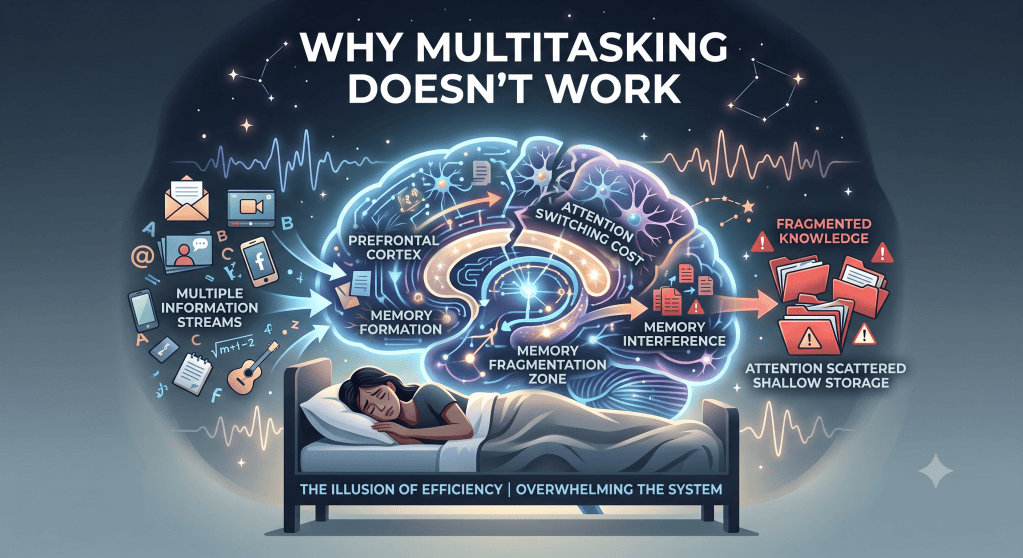
Research shows multitasking is actually rapid task switching—every switch carries measurable costs to attention, accuracy, productivity, and mental focus.
In 2014, the smartphone had already rewired the rhythm of daily life. Most adults in developed countries carried one, and a fast-growing share checked it dozens of times a day. Open browser tabs multiplied. Email pinged in one window while a spreadsheet waited in another. Office culture had started to prize the employee who could “juggle” five projects at once, and job listings openly asked for candidates who could “multitask effectively.” The word itself had migrated from computer science, where it once described a processor executing several programs in rapid succession, into ordinary conversation, where it came to describe a person doing the same.
There was a quiet irony buried in that borrowed word. Computers that “multitask” don’t actually do multiple things at the same moment either — they switch between tasks so quickly that the switching becomes invisible to the user. The human brain does something similar, except the switching is far from invisible. It costs time. It costs accuracy. And across a growing body of cognitive psychology research, it costs something harder to measure but easier to feel: the sense of depth and control that comes from giving one thing your full attention.
This article looks at what psychology and neuroscience have learned about task switching and attention — the mechanics behind the popular idea of multitasking — and why decades of research keep arriving at the same conclusion. The findings matter well beyond the workplace, touching how people drive, learn, and experience their own minds in an environment engineered to interrupt them.
The Myth Behind the Word
To understand why multitasking doesn’t work the way people assume it does, it helps to separate two very different things that get lumped under the same label. The first is genuine parallel processing — doing two things literally at the same time, using separate mental systems that don’t compete with each other. Walking while having a casual conversation is a good example. Walking is largely automatic, handled by well-practiced motor circuits, so it leaves enough spare mental capacity for a chat. The second is task switching — rapidly shifting conscious attention back and forth between two or more activities that both require deliberate thought. Answering emails while sitting in a meeting, or texting while driving, falls into this second category.
Cognitive psychologists have known for decades that the brain has almost no capacity for the second kind. When a task requires conscious, goal-directed thinking — reading, writing, solving a problem, holding a conversation that requires real listening — the brain’s executive control system processes it in a fundamentally serial way. One thing at a time. What looks like doing two demanding things simultaneously is, almost without exception, actually rapid alternation between them, with the brain paying a toll every time it switches.
That toll has a name in the research literature: switch cost.
What Happens Inside the Brain When You Switch Tasks
The clearest early demonstration of switch costs came from a set of experiments published in 2001 by psychologists Joshua Rubinstein, Jeffrey Evans, and David Meyer. Working with young adult volunteers, they had participants alternate between different kinds of tasks — solving simple math problems, then classifying geometric shapes, then back again — while the researchers precisely measured how long each switch took and how the difficulty of the tasks affected that timing. The team measured how quickly people responded depending on whether the tasks were familiar or unfamiliar and whether the rules involved were simple or complex.
The results showed something that felt intuitive once it was demonstrated, even though most people don’t experience it consciously: switching between tasks isn’t free. Every time attention shifted from one task to another, it produced a measurable cost in time, along with more errors and reduced overall efficiency, and that cost grew larger when the tasks were complex or unfamiliar. Rather than being one continuous stream of thought, the researchers proposed that switching involves two distinct mental steps. The first, sometimes called goal shifting, is the decision to stop doing one thing and start doing another. The second, sometimes called rule activation, is the process of pulling up and re-engaging the specific mental rules and context needed for the new task — and then, when you switch back, doing that all over again for the original task. Neither step is instantaneous, and while a single switch might only cost a fraction of a second, those fractions accumulate quickly once someone begins toggling back and forth repeatedly.
Executive control depends heavily on working memory — the limited mental workspace used to hold goals, rules, and relevant information while performing a task. Every time attention shifts, portions of that workspace must be cleared and reconstructed around the new objective. The larger and more complex the information being maintained, the greater the cognitive effort required to rebuild that mental context after an interruption. That’s a large part of why switch costs aren’t fixed: they scale with how much a task is asking working memory to hold onto in the first place.
That accumulation matters more in some situations than others. Losing a few tenths of a second while folding laundry and half-watching television is trivial. Losing that same fraction of a second while driving in heavy traffic, or performing any task where safety and precision matter, is not. Later researchers modeled these dynamics in more mathematical detail, showing that the size of a switch cost depends heavily on how dominant or familiar each task is relative to the other, and on whether a person has to remember exactly where they left off in the task they’re returning to.
It’s worth being precise about what this research does and doesn’t claim. The switch-cost findings are strong and well replicated under controlled lab conditions, but they can’t tell us exactly how large the cost is for any specific person doing any specific pair of tasks in daily life — that depends on how practiced each task is and how much they compete for the same mental resources. The lab work establishes the mechanism; a precise real-world productivity number is a separate extrapolation, and popular claims putting a single dramatic percentage on “how much multitasking costs you” deserve some skepticism.
Chronic Multitaskers and the Media Environment
If the 2001 task-switching studies described the mechanics of a single switch, a landmark study published in 2009 asked a bigger and more unsettling question: what happens to a person’s attention system after years of habitually juggling multiple streams of media at once — texting while watching television, browsing while listening to music, keeping several browser tabs and a phone conversation going simultaneously?
Stanford researchers Eyal Ophir, Clifford Nass, and Anthony Wagner set out to identify people who described themselves as heavy media multitaskers and compare them against people who reported little media multitasking, then ran both groups through a series of cognitive tests. The results showed that the heavy multitaskers were more susceptible to interference from irrelevant environmental stimuli and from irrelevant information already stored in memory. The assumption going in, shared by many of the researchers themselves, was that people who multitask constantly must have developed some kind of practiced advantage — better filtering, quicker switching, a trained-up mental muscle for handling many inputs at once. Instead, the lead researcher reported that after searching for whatever advantage the heavy multitaskers might have, the team simply could not find one.
In one representative experiment, both groups were shown simple visual displays and asked to ignore distracting elements around the object they were tracking. The heavy media multitaskers had more trouble filtering out the irrelevant surrounding information — they kept drawing it in even when they had been told explicitly to ignore it. Across several different tests measuring memory, attention filtering, and the ability to switch cleanly between tasks, the pattern held. Heavy media multitaskers made more errors on tasks that required holding relevant information in mind while ignoring distractors, and they showed slower response times along with larger switch costs on the direct task-switching experiments.
This finding deserves a careful caveat, because it’s easy to overstate. The Stanford study was correlational — it compared people who already differed in their media habits, rather than randomly assigning some people to multitask heavily and others not to. That means the researchers could not rule out the possibility that people with weaker attentional control were simply drawn to media multitasking in the first place, rather than multitasking causing the attentional weakness. Subsequent replication efforts have produced a mixed picture: some later studies reproduced the core pattern, while others found smaller or less consistent effects, and a meta-analysis combining multiple replication attempts described the overall relationship as real but modest rather than dramatic. The honest scientific summary is that heavy media multitasking is reliably associated with somewhat weaker attentional filtering, but the field has not settled the question of cause and effect with the certainty that popular coverage of the original study sometimes implied.
The Twenty-Three-Minute Problem
Switch costs measured in fractions of a second in a laboratory are one thing. The costs of interruption in an actual workday are another, and that gap is exactly what informatics researcher Gloria Mark set out to measure at the University of California, Irvine, in a body of work that began in the mid-2000s and has continued for two decades since.
Rather than bringing people into a lab, Mark’s team followed real office workers through their actual jobs, tracking every interruption and every switch between tasks over the course of full workdays. Her research found that when interrupted work was resumed on the same day, it took an average of twenty-three minutes and fifteen seconds to return to it. Just as strikingly, people rarely went straight back to the task they had been interrupted from — there were typically about two other tasks squeezed in between before they returned to the original one. Each of those intervening detours carries its own switching cost, layered on top of the interruption itself.
Mark’s more recent tracking suggests this pattern has intensified: the window of time people spend on a given screen before shifting elsewhere has shrunk considerably since her earliest observations, pointing to an attention environment that has grown more fragmented, not less. That more recent figure rests on a thinner, less independently replicated evidence base than the original twenty-three-minute finding, so it’s best read as a suggestive trend rather than an established constant.
One of the more counterintuitive parts of Mark’s research is what interruptions do to subjective experience rather than just objective output. Her field studies found that people working under frequent interruption often complete their tasks in roughly the same amount of total time as people working without interruption — but they report significantly higher stress, frustration, and mental effort along the way. In other words, interrupted work doesn’t necessarily take longer to finish; it simply costs more to produce, in a currency that doesn’t show up on a timesheet. That distinction matters, because it means the real toll of a fragmented workday is often invisible in output metrics even as it accumulates in exhaustion.
Cognitive psychologists have offered a physiological explanation for part of that exhaustion. Shifting attention between tasks appears to draw more heavily on the brain’s limited store of oxygenated glucose than sustained, focused work does. That’s a plausible and widely cited mechanism rather than a fully settled one — the underlying metabolic research is harder to pin down precisely than the behavioral switch-cost findings — but it fits a pattern many people recognize from experience: a day spent hopping between tabs and notifications tends to feel more depleting by evening than a day spent absorbed in one demanding task, even when the two days involved comparable amounts of actual work.
When Switch Costs Turn Dangerous
Nowhere is the gap between how capable people feel while multitasking and how capable they actually are more consequential than behind the wheel of a car.
In the early 2000s, psychologist David Strayer and his colleagues at the University of Utah set out to directly compare the driving impairment caused by cell phone conversation against the driving impairment caused by legal intoxication, using a high-fidelity driving simulator so they could measure both groups under identical conditions. They found that when drivers were talking on either a handheld or hands-free phone, their braking reactions were delayed and they were involved in more simulated collisions than when they weren’t on the phone, while intoxicated drivers, by contrast, drove more aggressively — following closer to the car ahead and braking harder. But once the researchers controlled for driving conditions and time spent on the road, the cell phone drivers actually showed greater overall impairment than the legally intoxicated drivers.
That finding runs against most people’s instincts, in part because the two forms of impairment feel and look so different. A driver who has been drinking often drives noticeably badly, weaving or reacting sluggishly in ways that are easy to spot from outside the car. A driver talking on the phone typically looks completely normal — hands on the wheel, eyes seemingly on the road — while the actual bottleneck occurs entirely inside the head. Strayer’s broader body of research found that the impairment isn’t primarily about hands leaving the wheel or eyes leaving the road; the same delays showed up with fully hands-free devices, because the limiting resource is attention itself, not the physical mechanics of holding a phone. Some of that same research documented that drivers conversing on a phone often failed to form a lasting memory of objects directly in their field of view, even when their eyes had passed right over them — a phenomenon researchers have described as a form of inattentional blindness.
This is one area where the psychological research has fed directly into public policy, with hands-free driving laws and workplace safety guidance shaped in part by these findings — though it’s also an area where the “as bad as drunk driving” framing has occasionally been stretched further in public conversation than the original researchers intended, since they were comparing the two forms of impairment on specific measures, not claiming the two situations are identical in every respect.
Why the Feeling of Multitasking Fools Us
If the evidence against multitasking is this consistent, why does it remain such a durable habit and such a common source of workplace pride? Part of the answer lies in a gap between subjective experience and objective performance that shows up repeatedly in this research. People who multitask heavily often feel busy, engaged, and productive while doing it — the rapid alternation between tasks can produce a sense of momentum that focused, single-track work sometimes lacks. But feeling productive and being productive are measured very differently in these studies, and the self-reports of habitual multitaskers about their own effectiveness have not tended to line up well with their actual performance on controlled tests.
There’s also a self-reinforcing quality to attention fragmentation that Mark’s more recent work has pointed to. Once a mind has spent an extended stretch switching rapidly between inputs, it doesn’t necessarily settle back into sustained focus the moment the external interruptions stop — there’s some evidence that the switching pattern itself becomes a kind of momentum, making the next switch, even a voluntary one initiated by the person rather than an outside notification, more likely. That’s a newer and less thoroughly established idea than the core switch-cost findings, but it offers one plausible explanation for why a chaotic, interruption-heavy morning can leave someone struggling to concentrate even after the emails stop arriving.
None of this means the brain is simply bad at handling complexity — it means that conscious, deliberate attention runs through a single narrow channel, and that channel can only be shared by trading, not splitting.
What the Research Doesn’t Settle
It’s worth being clear-eyed about the limits of this body of work, since the topic is prone to overstatement in popular writing. The laboratory switch-cost studies are well replicated, but translating a fraction-of-a-second lab cost into a precise real-world productivity loss is an extrapolation, not a direct finding. The Stanford media multitasking study identified a real association between chronic multitasking and weaker attentional filtering, but its causal direction remains unresolved, and later replication attempts paint a more modest picture than the original headlines suggested. Gloria Mark’s twenty-three-minute figure rests on solid field observation, though her more recent, more dramatic claims about shrinking attention spans build on thinner evidence and are best treated as an emerging trend rather than an established fact. The driving research is the least ambiguous of the group, since the outcomes being measured — braking time, collision rate — are unambiguous and directly tied to safety.
Taken together, the research doesn’t rule out multitasking of every kind — pairing an automatic task with a demanding one works fine. What it rules out is the common belief that two demanding mental tasks can both get full, high-quality conscious attention at the same time.
The Broader Significance
The 2014 version of this conversation centered on smartphones, open-plan offices, and the early anxieties of a culture adjusting to constant connectivity. More than a decade later, the underlying mechanism hasn’t changed at all. What has changed is the intensity of the environment asking that mechanism to work overtime: notification-driven software, algorithmically optimized feeds, and an expanding array of devices competing for attention have made interruption more frequent, not less, since these foundational studies were first published.
That trajectory gives the original research a kind of forward-looking relevance its authors likely didn’t anticipate. The task-switching experiments of 2001 were conducted with simple geometric shapes and arithmetic problems; the environments people now navigate daily deliver a far denser and more continuous stream of competing demands. Whether attention-management tools, workplace policy, or simply a cultural shift in how “responsiveness” gets valued will meaningfully counterbalance that trend is an open question — one that behavioral scientists, employers, and technology designers are still actively working through. What the cognitive psychology of the past several decades has already established, clearly and repeatedly, is the basic mechanism at stake: the mind was not built to do two demanding things at once, no matter how convincingly it can be made to feel otherwise.
Scientific Reference
Rubinstein, J. S., Meyer, D. E., & Evans, J. E. (2001). Executive control of cognitive processes in task switching. Journal of Experimental Psychology: Human Perception and Performance, 27(4), 763–797.
Ophir, E., Nass, C., & Wagner, A. D. (2009). Cognitive control in media multitaskers. Proceedings of the National Academy of Sciences, 106(37), 15583–15587.
Mark, G., Gudith, D., & Klocke, U. (2008). The cost of interrupted work: More speed and stress. Proceedings of the SIGCHI Conference on Human Factors in Computing Systems, 107–110.
Strayer, D. L., Drews, F. A., & Crouch, D. J. (2006). A comparison of the cell phone driver and the drunk driver. Human Factors, 48(2), 381–391.
Strayer, D. L., & Johnston, W. A. (2001). Driven to distraction: Dual-task studies of simulated driving and conversing on a cellular telephone. Psychological Science, 12(6), 462–466.
Uncapher, M. R., & Wagner, A. D. (2018). Minds and brains of media multitaskers: Current findings and future directions. Proceedings of the National Academy of Sciences, 115(40), 9889–9896.









