
Originally published in June 2015 and comprehensively updated and edited in June 2026.
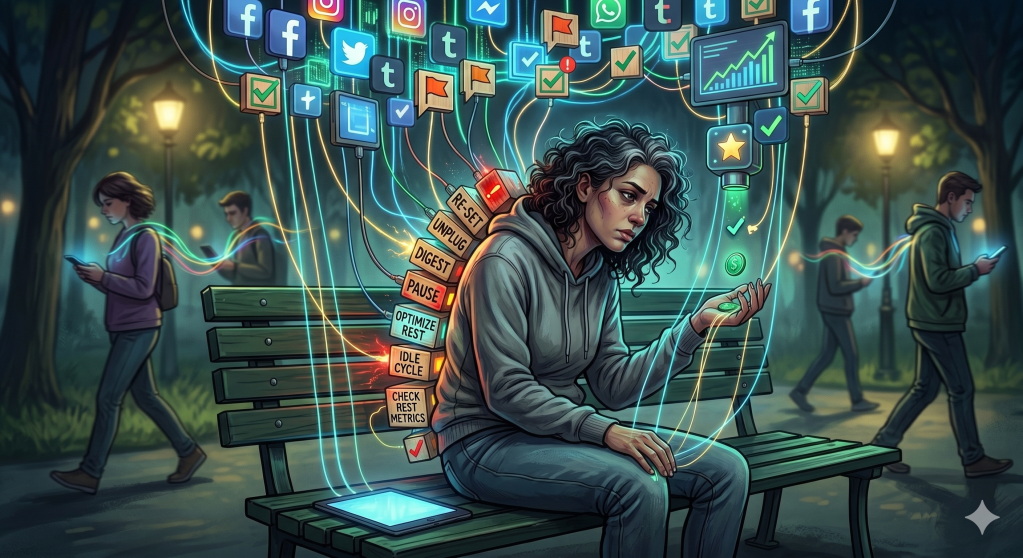
At some point in the last two decades, rest stopped being something people did and became something people had to justify.
It happened gradually, which is partly why so few noticed it happening. The culture didn’t announce that idleness had become suspect or that an unscheduled afternoon was something requiring an explanation. It simply built, layer by layer, a set of conditions in which stillness felt wrong — vaguely irresponsible, faintly embarrassing, like arriving at a party to find everyone else already working. Rest didn’t disappear. It just began to feel unnatural.
That feeling is worth examining carefully, because it isn’t random and it isn’t inevitable. It has specific origins: in how technology restructured the experience of time, in how economic anxiety rewrote the meaning of leisure, in how social comparison became a continuous background process rather than an occasional event. And it has real consequences — not just for productivity or mental health in some abstract sense, but for the basic human capacity to recover, to think clearly, and to experience something other than the low-grade pressure of perpetual availability.
This essay traces how rest became culturally suspect, what that shift did to the nervous system and the psyche, and what it takes to restore something that never should have needed restoring in the first place.
How Rest Lost Its Legitimacy
Leisure Was Once a Sign of Civilization
It was not always this way. For much of Western history, leisure was treated not as the absence of productivity but as its highest expression. The ancient Greek concept of skholē — from which the English word “school” derives — referred to the free time in which a person could pursue thought, philosophy, and civic life. It was the condition that made wisdom possible, and it was reserved for those considered fully human in the cultural sense of the term. Work, by contrast, was what you did when necessity demanded it.
This began to shift with the Protestant Reformation of the 16th century, which introduced the idea that one’s relationship with labor was also one’s relationship with God. Hard work became a moral virtue. Idleness became, in the Calvinist framework, not just wasteful but sinful. The Industrial Revolution then mechanized and monetized this ethic, replacing the flexible rhythms of agricultural life with factory schedules that measured and monetized every hour. By the 20th century, the Protestant roots of the ethic had faded, but the moral residue remained: busy people were virtuous, idle people were suspect.
What changed in the 21st century was the addition of visibility. For most of industrial history, how hard someone worked was largely private knowledge. The factory floor was observed, but what a person did with their evenings and weekends was their own business. The smartphone and the social media platform changed that entirely, creating a condition in which the appearance of busyness could be broadcast continuously to an audience — and in which not broadcasting felt like falling behind.
The Smartphone and the End of Downtime
The iPhone launched in 2007. It is difficult to overstate how completely that device, and the ecosystem it created, restructured the human experience of time.
Before smartphones, there were gaps in the day that nothing filled. The commute. The waiting room. The ten minutes between meetings. These weren’t scheduled for anything because there was nothing available to schedule them with. They were, in retrospect, involuntary rest — not restorative in any deliberate sense, but genuinely unoccupied. The mind wandered. Attention drifted. The nervous system, without knowing it, got small moments of recovery built into the texture of the day.
Smartphones colonized those gaps. Not through any grand design, but through the simple logic of availability: if something interesting or useful was always accessible, the neutral state became not rest but consumption. Email could be checked. News could be scanned. Social media feeds could be refreshed. The gaps filled themselves almost automatically, and the baseline expectation shifted from occasional availability to continuous presence.
By 2015, when the original version of this essay was written, the condition was already well established. The average American was checking their smartphone more than 80 times per day, according to research by psychologist Larry Rosen. The distinction between work time and personal time had become largely theoretical for anyone with a professional email account and a device that never left arm’s reach. The concept of being “off” — genuinely unreachable, genuinely disengaged — had become socially unusual enough to require explanation and, for many people, to produce a low-grade anxiety.
What had been lost, without anyone quite deciding to lose it, was the experience of unstructured time. Not scheduled rest, not strategic recovery — but genuinely empty time with no agenda and no audience.
The Economics of Anxiety
Technology alone doesn’t fully explain the shift. The economic landscape of the early 21st century played an equally significant role in making rest feel dangerous.
The 2008 financial crisis fractured a certain social contract: the implicit promise that loyalty, credentials, and consistent effort would produce stable employment and a reasonably predictable life. In the years that followed, job insecurity increased, wages stagnated relative to the cost of living, and gig work — flexible and precarious by design — became a growing portion of the labor market. For many people, particularly younger workers, the message was clear: no institution would protect you. Your safety depended on your own continuous output and visibility.
In that climate, rest acquired a specific psychological texture: it felt like exposure. Like falling behind while everyone else was moving. Like the moment you stopped watching your back in a competitive environment. The anxiety wasn’t irrational — it was a reasonable response to real conditions. But it attached itself to leisure in a way that made ordinary downtime feel hazardous, and it persisted even for people whose actual circumstances didn’t require it. Anxiety, once calibrated to a threat, doesn’t easily distinguish between the period when the threat is active and the period when it isn’t.
The result was a widespread internalization of vigilance that didn’t clock off when the workday ended. Rest became something people tried to do while a quiet alarm was running in the background, monitoring whether they could afford it.
What the Brain Actually Does During Rest
The Default Mode Network
The Default Mode Network and the Self
For a long time, neuroscientists assumed that the brain’s activity decreased during periods of rest. Imaging studies in the late 1990s and early 2000s overturned this assumption in ways that still haven’t fully permeated popular understanding.
What researchers discovered was that when the brain is not engaged in a directed task, a specific network of regions becomes more active, not less. This network — involving the medial prefrontal cortex, the posterior cingulate cortex, and the angular gyrus, among other areas — was named the default mode network because it appeared to be the brain’s default state when nothing else was demanding attention. Its activity wasn’t random noise. It was purposeful.
The default mode network is associated with self-referential thinking, the processing of past experiences, the mental simulation of future scenarios, and the generation of creative insight. These are the functions that get described in popular writing about rest, and they matter. But the more interesting finding, and the one less commonly discussed, is what the default mode network appears to be doing at a deeper level: constructing a continuous, coherent narrative of the self.
The neuroscientist Mary Helen Immordino-Yang, whose research examines the relationship between emotion, learning, and the default mode network, has argued that the processing that occurs during rest isn’t simply maintenance — it’s identity work. The brain, in unstructured time, integrates experiences into a coherent autobiographical account: connecting what happened to what it means, situating recent events within the larger story of who a person is and where they’re headed. This is how a difficult conversation becomes a lesson, how a loss becomes part of an understood life, how scattered daily experiences accumulate into something resembling wisdom rather than just data.
This is not something the directed, task-focused mind does well. The prefrontal cortex in high-demand mode is oriented toward the immediate — what needs to happen now, what the next step is, what the output should be. The default mode network’s processing is slower, more associative, more interested in meaning than in efficiency. When it gets crowded out by continuous stimulation, the cost isn’t only cognitive in the familiar sense — diminished creativity, depleted focus. The cost is something closer to narrative fragmentation: the experiences accumulate but don’t cohere. Life happens without being fully digested into the self that’s living it. The phenomenon many people in always-connected environments report — that weeks blur together, that recent months feel somehow thin in memory — may be a symptom of exactly this. Not that the time wasn’t experienced, but that it was never processed into the autobiographical record that makes time feel lived rather than merely elapsed.
Sleep and the Consolidation of Experience
The most important rest the brain requires is sleep, and the cultural relationship with sleep during this period was, to put it plainly, troubled.
Sleep is not a passive state. During deep slow-wave sleep, the brain replays and consolidates memories, transferring information from short-term hippocampal storage to longer-term cortical networks. During REM sleep, it processes emotional experiences — essentially doing a kind of overnight therapy, integrating emotionally charged events into the broader narrative of experience in a way that reduces their acute charge. The glymphatic system, active primarily during sleep, flushes metabolic waste from brain tissue, including the proteins implicated in neurodegenerative disease. Growth hormone, essential for cellular repair, peaks during the first hours of sleep. Immune function, emotional regulation, metabolic health, and cardiovascular function are all substantially dependent on sleep quality and quantity.
When rest began feeling unnatural, sleep was among the first casualties. A culture that treated waking hours as a resource to be maximized had obvious incentives to minimize the hours spent unconscious. The social messaging was explicit — prominent figures in entrepreneurship and tech boasted publicly about sleeping four or five hours and framed it as a competitive advantage. More insidiously, the technology that made rest feel unnatural also made sleep harder to achieve: the blue light emitted by screens suppresses melatonin production, and the cognitive and emotional activation produced by late-night social media or email kept the nervous system in a state poorly suited to sleep onset.
The consequences were not subtle. The CDC has described insufficient sleep as a public health epidemic. Chronic sleep deprivation degrades attention, working memory, emotional regulation, and immune function — while simultaneously impairing the ability to accurately assess how impaired one is. People who are chronically sleep-deprived tend to believe they’ve adapted, when the evidence suggests they’ve simply lost the baseline against which to measure their impairment.
The Psychological Cost of Perpetual Availability
Attention as a Finite Resource
The psychologist William James, writing in 1890, described attention as “the taking possession by the mind, in clear and vivid form, of one out of what seem several simultaneously possible objects or trains of thought.” What James intuited, and what modern cognitive neuroscience has confirmed, is that attention is not infinitely elastic. It is a limited resource that depletes with use and requires recovery.
The attention economy — the term coined by economist Herbert Simon and later developed by others to describe the competition for human attention as a scarce and valuable resource — was built on a fundamental asymmetry: the systems competing for attention were designed by teams of engineers optimizing for engagement, while the attention they were competing for belonged to individuals with no particular defense against being engaged. Notifications, variable reward schedules, infinite scroll — these features were not accidental. They were deliberately engineered to capture and hold attention, which meant that the individual on the receiving end of them was continuously spending attentional resources in ways they didn’t choose and often didn’t notice.
The cumulative effect was a kind of attentional poverty: a state in which the capacity for sustained, directed focus was chronically depleted, not by any single demand but by the aggregate of countless small claims on the same limited resource. Rest, in this environment, couldn’t function as recovery because the devices available during rest were continuing to make attentional demands. It was like trying to let a muscle recover while continuing to use it.
The Comparison Machine
One of the more psychologically significant features of the social media environment that made rest feel unnatural was the transformation of social comparison from an occasional to a near-continuous process.
Social comparison — the tendency to evaluate oneself in relation to others — is a normal and ancient feature of human psychology, documented by Leon Festinger in the 1950s. People have always noticed what others are doing, achieving, and appearing to feel. What social media changed was the scale, frequency, and curated nature of the comparisons being made. Instead of comparing yourself to the people in your immediate social environment — a naturally limited sample — you were now comparing yourself to a global feed of selectively presented highlights, optimized by algorithms to surface the most engaging (often the most impressive or distressing) content.
The research on social comparison and wellbeing is consistent: upward comparisons — evaluating yourself against people who appear to be doing better — reliably produce negative affect, decreased self-esteem, and increased anxiety. The social media feed was, by design, a machine for generating upward comparisons. And those comparisons didn’t stay neatly contained within the time spent on the platform. They followed people into the rest of their day, including into moments that should have been restful. Lying on a couch on a Saturday afternoon, having just seen a feed full of people apparently achieving things, produced a specific species of guilty restlessness that rest itself couldn’t resolve — because the feeling came from comparison, not from actual inactivity.
The Anxiety That Wouldn’t Shut Off
Psychologists distinguish between state anxiety — the acute stress response to a specific, identifiable threat — and trait anxiety — a more generalized, persistent disposition toward worry and vigilance that operates even in the absence of a specific threat. The conditions of the 2010s were unusually effective at converting the former into the latter.
A person who spent several years with their phone within reach at all times, checking notifications reflexively, monitoring their performance metrics against others’, and absorbing a news cycle optimized for emotional engagement, was effectively training their nervous system toward chronic low-level activation. The system that evolved to detect and respond to threats was being continuously supplied with threat-relevant signals — not acute dangers but the ambient pressure of comparison, consequence, and connectivity. Over time, that training produced something resembling a set point: a baseline level of arousal that became what normal felt like.
Rest, in that context, didn’t just feel unproductive. It felt physiologically wrong. The nervous system had recalibrated to expect stimulation, and the absence of it registered as something closer to threat than relief. The anxiety of stillness wasn’t irrational — it was the entirely predictable output of a system that had been conditioned to stay on.
Attempting to Commodify Recovery
The Instrumentalization of Rest
The cultural recognition that rest had become difficult arrived on schedule, monetized and packaged for consumption.
By the mid-2010s, “wellness” had become a significant industry — spa retreats, meditation apps, sleep-tracking devices, adaptogenic supplements, and a vocabulary of self-care that positioned recovery as something to be optimized rather than simply experienced. This was not without value: the mainstreaming of mindfulness gave many people access to practices with genuine evidence behind them, and the broader cultural legitimization of rest as a need rather than a weakness was a meaningful shift.
But the wellness industry also carried a structural contradiction: it was selling recovery as a product within the same attention economy that had made recovery difficult. The meditation app required your phone. The sleep tracker added another metric to monitor. The self-care content filled the feed alongside everything else competing for attention. Recovery had been acknowledged as important — and then immediately recruited into the machinery of productivity, optimization, and consumption that had undermined it in the first place.
This is the more interesting critique, and it goes deeper than the obvious irony. Modern culture never actually opposed rest. It did something subtler and more durable: it instrumentalized rest. It permitted rest, even celebrated rest — but only rest that could be justified by its outputs. Sleep because it improves performance. Meditate because it sharpens focus. Take a vacation because you’ll return more productive. The permission to rest was conditional on the rest being in service of something else. Rest for its own sake — rest as a legitimate end rather than a means — remained quietly suspect.
When rest is valued primarily as an input to performance, it changes the phenomenology of the experience itself. A person lying in a hammock while mentally calculating whether they’ve rested enough to justify their next productive sprint is not, in any meaningful sense, resting. The monitoring is the problem. The optimization instinct doesn’t pause for rest — it colonizes rest, turning it into another domain where performance can be assessed and found wanting. The result was a peculiar new form of exhaustion: the effort of recovering correctly. Tracking sleep scores. Calculating recovery readiness. Scheduling mindfulness as a line item. Rest had been transformed from a state into a task, complete with its own metrics and its own anxiety about whether you were doing it well enough.
What Recovery Actually Looks Like
The Distinction Between Passive and Active Rest
Not all rest is equivalent, and understanding the difference is more useful than treating recovery as a single category.
Recovery from chronic stress isn’t simply a matter of stopping the stressor. Neuroscientist Bruce McEwen’s work on allostatic load — the cumulative biological cost of sustained stress — shows that the nervous system’s recalibration isn’t instantaneous in either direction. Just as it gradually adjusts upward to sustained activation, it adjusts downward only with consistent, genuine recovery. Occasional rest in a generally high-activation life provides incomplete recovery. The nervous system needs enough signal, repeated over enough time, to actually reset.
Passive rest — lying on a couch, doing nothing in particular — serves genuine recovery functions, particularly when the nervous system is depleted. The problem is that passive rest in the presence of stimulating technology often isn’t actually passive: scrolling a feed while lying down is cognitively and emotionally activating, however horizontal the body. The posture is rest. The brain activity is not.
Active rest — walking, light physical activity, casual conversation, creative play without stakes or audience — engages the body and mind in ways that facilitate recovery without demanding the kind of directed, goal-oriented processing that depletes attentional resources. There is strong evidence that moderate physical movement promotes neurogenesis, improves sleep quality, and reduces cortisol levels. Nature exposure has a measurable restorative effect on attentional capacity — a finding associated with attention restoration theory, developed by Rachel and Stephen Kaplan — because natural environments engage what they call “soft fascination,” a low-demand form of attention that allows directed attention to recover.
What both passive and active rest share, when they work, is the absence of monitoring. No performance metrics. No audience. No optimization. The nervous system’s signal, finally unambiguous, that nothing is required.
Where Things Stand in 2026
A Slow Cultural Shift
The conditions that made rest feel unnatural haven’t fully resolved, but the conversation around them has changed in ways that matter.
The pandemic years — despite their considerable costs — produced an inadvertent experiment in how people experience time when the external scaffolding of busyness is reduced. For some, the reduction of commuting and social obligation created unexpected encounters with stillness that were uncomfortable at first and eventually valuable. For others, the blurring of work and home created an even more relentless version of the always-on condition. Both experiences contributed to a cultural conversation about sustainability, attention, and rest that is more sophisticated than the one available a decade earlier.
The attention economy has also begun facing more explicit scrutiny. App usage limits, notification controls, and the growing “digital minimalism” movement — popularized in part by computer scientist Cal Newport — reflect a growing awareness that managing one’s relationship with technology is not just a preference but a genuine cognitive and psychological necessity. The smartphone isn’t going away, but the naive assumption that more connectivity is straightforwardly better has eroded considerably.
The Question Productivity Cannot Answer
The deeper problem that made rest feel unnatural was not primarily technological. Technology was the delivery mechanism for a set of economic anxieties, social comparisons, and cultural values that preceded it. The smartphone made those forces more constant and more immediate, but it didn’t create them.
Which is why the most interesting pressure on the busyness culture may be coming not from a cultural shift in values, but from a structural one. As artificial intelligence absorbs growing portions of routine cognitive labor — the emails, the summaries, the scheduling, the first drafts, the reports that once took hours — the moral framework that made productivity synonymous with worth begins to lose its object. For centuries, the Protestant work ethic and its secular descendants could point to human effort as the essential ingredient: you were valuable because you worked, and your work was the primary way value got created. What happens to that equation when the work increasingly doesn’t require you?
This is not a science fiction scenario. It is a pressure that is already reshaping professional life in measurable ways, and it confronts a culture that spent two decades teaching itself to derive identity and self-worth from output metrics. If the metrics are increasingly generated by machines, what do people do with the time? And more to the point of this essay — are they capable of doing anything with it? A culture that has spent twenty years training people to feel uncomfortable with stillness, to treat unoccupied time as a problem and rest as something requiring justification, is not automatically equipped to inhabit the space that opens up when the busyness is no longer required.
The capacity to rest — genuinely, without justification, without monitoring whether the rest is making you more productive — may turn out to be one of the more consequential skills of the coming decades. Not because of anything a wellness brand is selling, but because the alternative is a population that has been optimized out of meaning-making and doesn’t have the inner resources to locate it elsewhere. The default mode network’s work — the autobiographical integration, the slow construction of a coherent self from the raw material of experience — can’t be automated. It requires exactly the kind of unhurried, unmonitored, unproductive time that the last twenty years systematically dismantled.
Conclusion: What Rest Was Always Doing
Rest began feeling unnatural because of a convergence of forces — technological, economic, social — that systematically made stillness feel irresponsible and activity feel necessary. None of those forces were accidental. They emerged from specific pressures and were reinforced by specific incentives. Understanding them clearly is more useful than simply exhorting people to take more breaks.
What the science makes plain is that rest is not optional for the systems it serves. The default mode network needs unstructured time. The glymphatic system needs sleep. The attentional system needs genuine recovery from demand. But the deepest function of rest is one that productivity frameworks aren’t designed to measure at all: the slow, associative, unhurried work of assembling experience into a coherent self. The integration of what happened into what it meant. The construction of autobiographical memory — not as archive but as identity.
When rest began feeling unnatural, this is what was quietly disrupted. Not just recovery, not just performance, but the capacity to absorb one’s own life as it was being lived. Experiences accumulated but didn’t fully cohere. Time passed without being registered as anything more than elapsed. The self that was supposed to be built from the accumulated material of a life had less and less unstructured time in which to do the building.
That capacity is recoverable. But recovering it requires more than scheduling a rest day or downloading a meditation app. It requires recognizing that the instrumentalization of rest — the idea that stillness is valuable only for what it produces — is itself part of the problem. Rest is not a productivity strategy. It is the condition in which a person becomes, slowly and without any particular efficiency, more fully themselves.









