
Originally published in June 2015 and comprehensively updated and edited in June 2026.
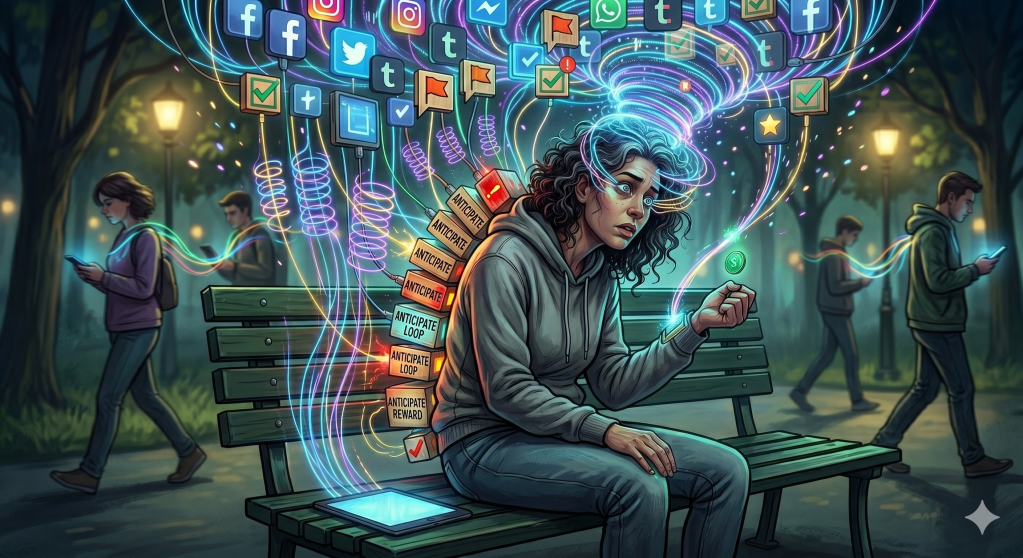
How smartphone notifications rewired human attention, created anticipation loops in the brain, and reshaped social behavior.
There is a particular kind of restlessness that emerged sometime in the early 2010s. It wasn’t quite anxiety. It wasn’t quite boredom. It was something in between — a low-grade, persistent alertness, a sense that something might be happening just out of view. People began checking their phones not because they expected a specific message, but because checking had become its own kind of reflex. The act of looking replaced the need for a reason.
By 2015, this behavior had become ordinary enough that it barely warranted comment. Phones were face-down on dinner tables. Conversations were interrupted mid-sentence. People lying awake at night reached for devices before their eyes had fully adjusted to the dark. The smartphone had not merely become a tool people used. It had become something closer to an extension of the nervous system — a second channel of awareness that was always half-open, always listening.
What drove that restlessness wasn’t random. It was, in large part, the notification: that small intrusion of sound, vibration, or light that announced something, somewhere, was demanding attention. Understanding how notifications worked on the human brain — and what that meant for behavior, relationships, and cognition — became one of the more pressing questions of the decade. The answers drew on neuroscience, behavioral psychology, and sociology, and they pointed toward a structural change in how many people related to time, attention, and the feeling of being present.
But buried inside that structural change was a distinction that rarely got named directly, even as its effects accumulated everywhere. People were no longer simply responding to signals. They were monitoring for possible signals. And those are not the same psychological state.
The Architecture of Interruption
To understand notification culture, it helps to understand what a notification actually does, mechanically, to the brain.
Human attention is not a fixed resource that can simply be switched from one task to another without cost. Cognitive research going back decades has established that shifting focus between tasks requires mental effort — a process sometimes called “attentional switching.” When attention is broken and then re-engaged, there is a recovery period. Researchers including Gloria Mark at the University of California, Irvine, found that after an interruption, it could take more than twenty minutes to return to a state of deep engagement with a task. Interruptions are not free. They carry cognitive overhead.
Notifications are, by design, interruptions. They are engineered to capture attention. Early mobile notification systems were modeled, at least functionally, on the principles of what behavioral researchers call “variable ratio reinforcement” — a pattern most closely associated with B.F. Skinner’s mid-twentieth century work on operant conditioning. The basic idea is straightforward: when rewards arrive on an unpredictable schedule, the behavior of checking or seeking becomes more persistent, not less. A slot machine pays out unpredictably, and that unpredictability is precisely what makes it compelling. Notifications work similarly. Most are mundane — a promotional email, a social media like, a system update. But occasionally one carries something meaningful. The ratio of meaningful to meaningless cannot be predicted in advance. So people check.
This is not a metaphor. Neuroscientists studying reward systems have documented that anticipation of a possible reward activates the brain’s dopaminergic pathways in ways that confirmed, certain rewards sometimes do not. The neuroscientist Wolfram Schultz’s research on dopamine and reward prediction showed that dopamine neurons respond most strongly not to rewards themselves, but to cues that predict possible rewards. The notification ping is exactly such a cue. It says: something might be here. And that possibility is neurologically potent.
Here is where the deeper shift begins. In older models of behavior, a signal prompted a response. You heard a sound; you looked. You received a letter; you read it. The signal came first. The response followed. What the anticipation loop does is invert that sequence. The checking behavior runs before any signal arrives — because the architecture of the system has conditioned the brain to treat the absence of a notification as a provisional state, one that might end at any moment. People are not waiting to be interrupted. They are pre-interrupted, perpetually poised.
The Loop Takes Shape
By 2015, this dynamic had organized itself into what might fairly be called an anticipation loop — a behavioral cycle that fed on itself.
The loop worked roughly like this: a notification arrives; the person experiences a small spike of arousal or curiosity; they check their device; the content may or may not be rewarding; the device is set down; anticipation of the next notification begins almost immediately; eventually another notification arrives, or enough time passes that the person checks anyway, just in case. Then the cycle restarts.
What made this loop durable was not any single notification, but the overall rhythm the system established. The phone became a kind of ambient presence, always potentially delivering something. People were not simply responding to notifications; they were in a continuous relationship with the possibility of notifications.
This is the distinction worth pausing on. Responding to a signal is episodic. Something happens; you react; the reaction completes; you return to baseline. Monitoring for a possible signal is continuous. There is no baseline to return to, because the monitoring state never fully closes. It runs in the background of meals, conversations, sleep, and thought — a low-level vigilance that does not switch off, only dims.
Psychologists studying this period used terms like “continuous partial attention” — a phrase coined by tech executive Linda Stone in the late 1990s but increasingly apt a decade and a half later — to describe what happened to awareness in this environment. No single thing receives full focus. Instead, awareness is distributed thinly across the primary task and the background channel of the phone, always ready to redirect. This was adaptive in one sense: it allowed people to stay loosely connected to multiple streams of information simultaneously. But it came at a cost to depth. And crucially, it established a new resting state — not stillness, but vigilance.
The sociologist Judy Wajcman noted around this period that the subjective experience of time pressure was increasing even as technological tools theoretically made tasks faster. Part of her explanation was that connectivity had colonized downtime. The moments that used to be genuinely idle — waiting for a bus, sitting in a waiting room, the first few minutes before sleep — had become additional surfaces for the anticipation loop to operate. Idleness, for the first time, felt like a gap the loop was designed to fill.
There is a deeper neurological explanation for why this state is so persistent, one that goes beyond dopamine and reward. Contemporary neuroscience has increasingly understood the brain not as a passive receiver of information but as a prediction engine — an organ constantly generating models of what is likely to happen next, and updating those models as new information arrives. In this framework, the anticipation loop isn’t simply promising rewards. It is promising information. Every check is an attempt to collapse uncertainty into certainty, to resolve an open question the brain is already running. This helps explain why the loop operates even when people don’t consciously want a reward — when they check their phone during a quiet moment and don’t particularly expect good news. The brain is not hunting for pleasure. It is attempting to close a loop of unresolved prediction. Uncertainty is the real engine of checking behavior. The notification is the reset button the brain keeps reaching for.
When the Loop Goes Social
Technology rarely changes behavior in isolation. What escalated the anticipation loop was a social layer that crystallized around it.
As smartphones became the primary channel for both personal and professional communication, the expectation of rapid response began to normalize. This shift happened without explicit negotiation. There was no moment at which people collectively agreed that a text message should be answered within minutes rather than hours. It simply became, over time, what felt expected. Expectations, once established, are enforced informally — through the seen receipt, the double blue check mark, the implicit awareness that the other person’s phone is almost certainly on and nearby.
Communication researchers documented what some called “the availability norm” — the growing assumption that a person who carries a smartphone is, by default, reachable. Being unreachable required explanation. Taking time to respond required justification. What had once been the exception — instant contact — became the baseline.
This transformed the anticipation loop from a personal behavioral tic into a social contract. Checking for messages was no longer only self-directed behavior driven by personal curiosity. It was also an obligation, or at least felt like one. Ignoring a notification carried a low-grade social risk. Responding promptly carried a social reward. The loop was no longer just neurological — it was normative. Other people’s expectations became part of the architecture that kept the cycle running.
For workers especially, this created a new kind of stress. Research on what occupational psychologists termed “psychological detachment” — the ability to mentally disengage from work during off-hours — found it was increasingly compromised. Email and messaging apps that blended professional and personal contact on the same device made it structurally difficult to maintain a boundary between work time and personal time. A phone already in hand for personal reasons became a channel through which work could always intrude. The anticipation loop, which had begun as a feature of how individuals related to their devices, had become a feature of how organizations related to their employees.
The Economic Engine Behind the Loop
It would be incomplete to discuss notification culture without acknowledging that none of this was accidental.
By the mid-2010s, the technology industry had developed a sophisticated understanding of the behavioral dynamics described above. Designers and engineers working on social platforms had access to vast data on what drove engagement, what kept users returning, what made the loop stick. Persuasive technology, a field pioneered by Stanford researcher B.J. Fogg in the early 2000s, had given the industry a vocabulary and a framework for designing systems that changed behavior. Notifications were a primary tool in that framework.
This doesn’t mean the engineers who built these systems were acting with cynical intent. Many genuinely believed they were building tools that connected people and made communication easier — and in many cases they were right. The connective value of smartphones and social platforms was real. The problem was that the incentive structures of advertising-supported platforms aligned around maximizing time spent engaged, and maximizing engagement meant maximizing the frequency and compulsiveness of checking behavior. The anticipation loop was good for business. That fact shaped product decisions, often without anyone in the room naming it explicitly.
Tristan Harris, a former design ethicist at Google, became one of the more prominent voices arguing that the attention economy — the system by which platforms competed for user attention in order to sell it to advertisers — had structural incentives that were in tension with user wellbeing. The basic economic analysis was not controversial: advertising-driven platforms profit more from more attention, and more attention was obtained through notification design. The anticipation loop had become, in economic terms, a product feature. It was not a side effect of building communication tools. In many cases, it was the goal.
What emerged from this alignment of neuroscience, design, and economic incentive was something with a kind of systemic momentum. Individual platforms competed to trigger the loop more reliably than their competitors. Users habituated and required more stimulation to produce the same checking behavior. The loop tightened. The monitoring state deepened.
What the Research Found
By the time this essay was first written in 2015, a body of empirical research had begun accumulating on the effects of heavy smartphone use and notification-driven behavior. The conclusions were often more nuanced than media coverage suggested.
On cognitive performance, the evidence was consistent: the presence of a smartphone — even a silent, face-down one — reduced working memory and fluid intelligence in tasks requiring focused thought. Adrian Ward and colleagues at the University of Texas at Austin found that mere proximity to a device, regardless of whether it was in use, reduced cognitive capacity. The anticipation loop consumed resources even when it was technically idle.
On sleep, the effects were clearer. Blue-spectrum light from screens disrupted circadian rhythms. But independent of that, the monitoring state itself interfered with sleep onset. Rest requires a kind of attentional surrender. The anticipation loop — defined by its refusal to fully close — made that surrender structurally difficult.
On social connection, the picture was more complicated. Smartphones had genuinely expanded social contact for many people, particularly those who were geographically isolated. But there was consistent evidence that the quality of face-to-face interaction was degraded when devices were present, even when not actively used. The mere possibility of interruption changed conversations — made them feel more provisional, less deeply engaging. The anticipation loop didn’t just fragment individual attention. It altered the relational texture of being with other people.
Research on adolescents attracted particular attention. The developmental psychologist Jean Twenge documented a significant shift in American teen mental health indicators beginning around 2012, coinciding with widespread smartphone adoption. Rates of loneliness, depression, and anxiety increased; in-person social activity and sleep declined. Establishing causation in population-level data is methodologically difficult, and Twenge’s conclusions were debated. But subsequent longitudinal research added support to the general direction of the effect.
The Inner Experience of the Loop
Statistics don’t fully capture what living inside the anticipation loop felt like from the inside.
What many people described, when they reflected on it, was a kind of fractured presence — the sense of being physically somewhere while part of attention was perpetually elsewhere, monitoring the channel. Moments that might have been experienced as quiet — a walk, a meal, time with a child — were threaded through with low-level distraction. Not constant distraction. Not overwhelming distraction. Just enough to take the edge off full presence.
There was also something harder to name: a changed relationship with time. The next notification was always hypothetically imminent. Something might arrive that would change the mood of the moment, provide validation, deliver news, require response. This persistent hypothetical — the not-yet-arrived notification — kept a portion of awareness oriented toward the near future rather than anchored in the present. The anticipation loop did not merely interrupt experience. It reoriented experience, tilting it forward, toward what might come next.
Mindfulness researchers would recognize this as the opposite of present-moment awareness, which requires releasing the pull of what might happen. The loop made that release structurally difficult — not through willpower failure, but through design. It was the architecture of the system, not the weakness of the individual, that kept the monitoring state open.
Writers and philosophers reached for various frameworks. Some drew on the concept of flow — the state of deep absorption in a challenging task described by psychologist Mihaly Csikszentmihalyi — noting that flow required the kind of sustained, uninterrupted attention the anticipation loop chronically undermined. Others connected it to older discussions about the conditions necessary for contemplative thought. The question running beneath all of these frameworks was the same: what is lost, and what is gained, when a technology changes not just what people do, but how being present feels?
Adaptation and Pushback
Human beings are adaptable, and cultures develop responses to technologies that disrupt established patterns.
By the mid-2010s, the first significant pushback against notification culture was taking shape. Individual behavioral strategies emerged: phones on airplane mode during meals, designated phone-free hours, turning off all but the most essential notifications. Platform features responded — Apple’s “Do Not Disturb” mode, introduced in 2012, grew more sophisticated over subsequent years into Screen Time, Focus modes, and notification summaries. A growing “digital wellness” category of apps explicitly aimed to help people manage the loop, a paradoxical development but not without genuine utility.
There was also a broader cultural conversation. Books like Cal Newport’s Deep Work (2016) made the case for cultivating the ability to sustain focus in an environment engineered against it. “Digital detox” entered popular vocabulary. Organizations began experimenting with after-hours communication boundaries.
The negotiation was uneven. Workers with autonomy over their schedules had more capacity to implement these strategies. Those in lower-wage service jobs or genuinely on-call roles had less. The freedom to step outside the anticipation loop was partly a function of economic privilege, which meant the costs of notification culture were not equally distributed.
The deeper limitation of the pushback, though, was structural. Individual tools — better notification settings, mindfulness apps, phone-free dinner rules — addressed the symptoms of the loop without touching its source. If the anticipation loop was engineered into platforms by incentive structures that rewarded engagement above all else, then the full response required changing those incentive structures, not just the habits of individual users. This tension between individual management and systemic design remained largely unresolved.
From 2015 to 2026: The Loop Evolves
In the decade since this essay was first written, the anticipation loop has deepened in some ways, been partially addressed in others, and — most recently — undergone a structural evolution that its original critics did not fully anticipate.
The algorithmic feed intensified the variable reward dynamic. Scrolling replaced discrete notification-checking for many users, but the underlying mechanism was similar: unpredictable, personalized content delivered in a format optimized to hold attention. The anticipation loop expanded beyond the notification ping into the architecture of the feed itself. It was no longer triggered by an alert; it was the default state of being on the platform.
Wearable devices extended the loop to the body. Smartwatches delivering haptic taps for each notification made it even harder to maintain physical distance from the monitoring state. The loop moved from pocket to skin.
Then came artificial intelligence — and with it, a development that complicates any simple narrative of the loop being gradually tamed.
Early optimism held that AI would help manage the anticipation loop by filtering, summarizing, and prioritizing. AI-powered inboxes would surface only what mattered. Summaries would replace the need to check. And to some extent, this has happened. Notification summaries and AI-drafted reply suggestions have reduced the raw friction of communication for many users. But a different dynamic has also emerged, one that deserves careful attention.
AI systems — assistants, agents, recommendation engines — are themselves sources of new anticipation. People now find themselves checking whether an AI has completed a task, generated a document, surfaced a recommendation, or sent a message on their behalf. The objects of anticipation have multiplied. Where the original notification loop asked has someone responded to me?, the AI-augmented loop adds: has the AI done something I should know about? The monitoring state has not contracted. It has gained new channels.
More subtly, AI-generated content has accelerated the volume and apparent personalization of information arriving through every channel — which intensifies the variable reward dynamic rather than reducing it. When more of what arrives in a feed or inbox is plausibly relevant, the ratio of meaningful to meaningless shifts just enough to justify more checking. The loop tightens again, wearing new clothes.
Whether AI ultimately makes the anticipation loop more manageable or simply more sophisticated is one of the genuinely open questions of the current moment.
Conclusion: Standing Watch
Notification culture was not a glitch or an accident. It emerged from the convergence of neuroscience that understood reward-based motivation, engineering that applied those insights to maximize engagement, economic models that monetized that engagement, and social norms that crystallized around the resulting behaviors. The anticipation loop was the natural product of that convergence — and it proved remarkably durable.
But the most important thing about the anticipation loop may not be how it was built or who profited from it. It may be what it represents as a shift in the human nervous system’s default relationship with the world.
For most of human history, the relationship between people and signals was episodic. Something happened — a sound, a sight, a message — and you responded. The response completed. You returned to whatever you were doing. Attention was called up by events and released between them. The resting state was rest.
Notification culture changed that resting state. Through the mechanisms of variable reward, predictive uncertainty, social obligation, and economic design, it trained a significant portion of the population to maintain a continuous monitoring posture — not waiting for a specific event, but staying perpetually alert to the possibility of any event. The scientific literature on the consequences is real but not catastrophic; individual differences matter enormously; the technology carries genuine benefits that should not be dismissed. None of that is in dispute.
What is worth naming clearly is what the shift actually looks like, at the level of lived experience. It is not the responsiveness of a person going about their day. It is the vigilance of a sentry — someone who cannot fully rest because their job is to watch, and the watching never officially ends. We built systems that put a significant portion of humanity on psychological watch. The post is manned around the clock. The notification, when it arrives, is almost never the emergency that would justify the posture.
That is what changed. And it is, at minimum, worth knowing.









