
Originally published in July 2015 and comprehensively updated and edited in June 2026.
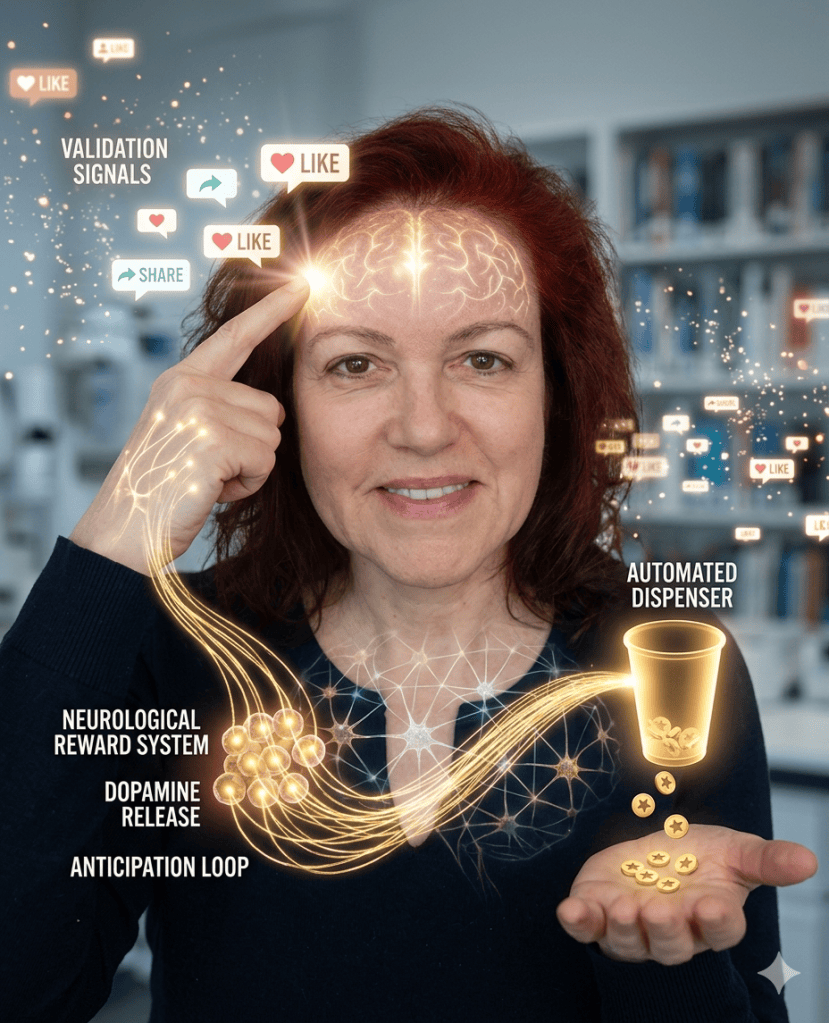
How the brain’s reward circuitry was colonized by social media likes, reshaping self-worth, behavior, and identity
In 2026, a growing share of online approval no longer comes from human beings at all. Automated accounts generate likes at scale. AI systems leave comments indistinguishable from a person’s. Synthetic engagement inflates the metrics that platforms use to rank and distribute content. The counter goes up. And somewhere in the brain of whoever posted that content, something responds.
To understand why that response happens — and why it may not matter much whether the approval is genuine — it helps to go back to the moment this system was first assembled.
Sometime around 2012, a new kind of social anxiety quietly took root. It wasn’t the old kind — the sweaty-palmed fear before a speech, the dread of being laughed at in a room. This one was subtler, and it arrived in the aftermath of sharing something online. A photo. An opinion. A milestone. Then: the waiting. The checking. The arithmetic of approval conducted in real time, through a counter anyone could see.
Consider what that waiting actually looked like. A sixteen-year-old posts a photo before school and spends the first two periods checking her phone under the desk, watching the number climb or stall, adjusting her read of the morning accordingly. A first-time writer publishes an essay and refreshes the page forty times in the first hour. A new parent shares a birth announcement and feels, with some embarrassment, that the likes are somehow a referendum on the moment itself. These are not pathological behaviors. By 2015, they were ordinary ones.
The “like” button, introduced by Facebook in 2009 and rapidly adopted across platforms, had done something that few predicted at the time: it took the ancient human need for social approval and made it quantifiable, immediate, and public. What followed was not simply a change in online behavior. It was a change in how a significant portion of the population experienced validation itself — what triggered it, what it felt like, and what happened when it was withheld. Understanding that change requires looking at the brain’s reward circuitry, the evolutionary roots of social approval, and the specific design choices that made digital validation so psychologically potent.
The Brain Was Already Wired for This
The need for social approval is not a modern invention. It is ancient, and it exists for good reasons.
Human beings are profoundly social animals. For most of evolutionary history, survival depended on group membership — access to food, protection, cooperative labor. Being excluded from the group was, in the most literal sense, dangerous. The brain, shaped by this pressure over hundreds of thousands of years, developed machinery to monitor social standing with great sensitivity, registering approval as rewarding and rejection as painful, using some of the same circuitry that processes physical pleasure and physical pain.
At the center of this system is a neurotransmitter called dopamine — but not in the simplified way it’s often described. Dopamine is not simply the “pleasure chemical.” Contemporary neuroscience understands it primarily as a signal for incentive salience: it drives the wanting of a reward more than the enjoying of one. More precisely, it tracks what researchers call “reward prediction error” — the gap between what the brain anticipated and what it actually received. Dopamine fires most intensely not when a reward arrives, but when a reward is unpredictably possible. This distinction matters considerably for understanding what social media did to people, because it means the neurological response isn’t simply to the like itself. It’s to the uncertainty before the like arrives.
When something signals social approval — a smile, a compliment, a gesture of inclusion — the brain’s reward system responds. The striatum, a region involved in reward processing, shows elevated activity. There is a signal that reads, roughly: this is worth pursuing; do more of what produced it. Social media platforms, whether by design or fortunate accident, learned to trigger that signal at unprecedented scale and frequency.
The Loop, and Why It Won’t Close
Before examining what the like button changed, it helps to understand what it replaced.
For most of human history, social approval arrived in analog form. A nod across a fire. A laugh at a story well told. The slow accumulation of reputation within a community small enough that everyone knew your name. These signals were real and they mattered, but they were diffuse, contextual, and not easily enumerated. You could not check how many people had approved of your dinner last night. The feedback existed, but it had no counter.
The like button digitized approval — reduced it to a discrete unit that could be counted, compared, and tracked over time. A 2013 study by Dar Meshi and colleagues found that receiving positive social feedback activated the ventral striatum, a key reward hub, in ways that tracked with how much subjects valued their own reputation. The reward system was not simply responding to pleasant information. It was encoding social standing as a form of value, alongside food and money.
What emerged from that encoding was a reinforcement loop: share content, receive validation, feel rewarded, share again. The loop fed itself. Over time, the kinds of content that earned approval crowded out the kinds that didn’t — a selection pressure operating largely below conscious awareness. A person might notice, after several months, that their posts had become more performance-oriented, more calculated, more tuned to audience. They might not be able to say exactly when that shift happened.
The unpredictability of the reward made the loop more durable, not less. Not every post performed well. Not every refresh delivered something gratifying. But the variability itself intensified the drive to check — because dopaminergic systems respond most strongly to uncertain rewards, not guaranteed ones. The slot machine principle applies. The possibility of approval was neurologically more potent than approval itself.
The Brain Is Not Hunting for Pleasure. It Is Trying to Close an Open File.
There is a dimension here that reward-based accounts alone cannot explain, and it is arguably the more important one.
Contemporary neuroscience has come to understand the brain not as a passive receiver of experience but as a prediction engine — a system constantly generating models of what is likely to happen next and updating those models as new information arrives. Every moment involves the brain running predictions, then registering errors when reality deviates from expectation. The discomfort produced by unresolved predictions is itself a driver of behavior.
Posting something online and waiting for a response creates exactly this kind of open prediction. The brain has committed to an expectation — how will this be received? — but the outcome is unresolved. That unresolved state is something the brain finds genuinely uncomfortable. It motivates action. Every check of the notifications is an attempt to collapse uncertainty into information, to get the prediction error back to zero.
This is why people check for responses even when they don’t expect good news. The brain is not hunting for pleasure. It is trying to close an open file. And the absence of validation can feel worse than neutral — not because it is punishing, but because it leaves the file open. The waiting continues. This framework — sometimes called predictive processing — suggests that the compulsiveness of validation-seeking may be less about rewards than about the brain’s intolerance of unresolved uncertainty. Platforms that create open predictions and then delay or vary their resolution happen to align with a deep feature of how minds work — whether by design or by the iterative logic of engagement optimization.
When the Score Becomes the Self
The neurological dimension of digital validation matters. But it doesn’t fully account for what social media did to the experience of identity.
There has always been a distinction between private experience and public performance. People have an internal sense of themselves and a more curated version they present in social contexts. This is normal. The sociologist Erving Goffman called it impression management — the largely unconscious work of presenting a self that will be well received. Everyone does it. What social media platforms did was not invent this performance, but change its conditions: making it permanent, searchable, continuous, and quantitatively evaluated.
The response to that performance arrived as numbers, in real time, visible to anyone. And numbers are not like feelings. A feeling of social acceptance is fuzzy and hard to compare. A like count is precise and immediately comparative. This created something genuinely new: the possibility of outsourcing the question am I valued? to a counter. Before quantified feedback existed, self-worth was assembled internally — imperfectly, inconsistently, but anchored inside. The like button introduced the possibility of externalizing that calculation. The score on the screen became a proxy for a judgment the brain was already running.
The post and the poster are hard to separate when the post is a selfie, a personal opinion, a story from your own life. Validation of the content felt like validation of the self. And crucially, the feedback was now visible to others — meaning the social standing it conferred or denied was not a private inference but a public record.
Think of what this meant for a teenager navigating identity formation — a developmental stage where peer approval already carries outsized neurological weight. Research by neuroscientist Leah Somerville and colleagues found that social evaluation activates reward circuitry more intensely in adolescents than in adults. The same like hits differently at fourteen than it does at thirty-four. Adolescents who grew up inside these systems were running an experiment on their developing reward architecture that had no historical precedent. The brains most sensitive to social approval signals were receiving those signals at the highest volume and frequency in human history.
People whose self-worth was already anchored externally — dependent on others’ evaluations rather than internal standards — found the platform particularly difficult to disengage from. Psychologist Jennifer Crocker’s concept of “contingent self-worth” describes this pattern: when a person feels good about themselves primarily through external validation, a system that delivers external validation continuously and quantifiably is less a communication tool than a nervous system prosthetic.
It doesn’t augment the self. It substitutes for a function the self was meant to perform.
A Distorted Mirror
One of the most psychologically consequential features of social media validation was not the direct feedback loop, but the comparison environment it created.
The feed was not a representative sample of human experience. People share highlights — their best photos, happy announcements, achievements. The difficult, the mundane, and the unglamorous are systematically absent. A 2013 study by Ethan Kross and colleagues found that passive Facebook use was associated with declining well-being over time, with social comparison as the likely mechanism. People measured their lives against curated performances of others’ lives and found themselves wanting.
But the comparison wasn’t only between lives. It was between validations. You were not only measuring your experience against their experience. You were watching their like count next to yours. This second-order comparison — not just how am I doing but how much does anyone care how I’m doing — introduced a dimension of social evaluation that had no precedent in face-to-face interaction.
That this dynamic kept people on the platform was not incidental. Engagement — even anxious, comparative engagement — generates ad impressions. The comparison engine was, economically, a feature.
The Loop Was the Product
The validation loop was not an accidental byproduct of building communication tools. It was refined and amplified through deliberate design, shaped by an industry with both the data to understand what was happening and the economic incentives to make it happen more.
The mechanism is straightforward once you follow the money. Social media platforms running on advertising revenue sell one thing: user attention. Attention generates ad impressions. More time on platform means more revenue. This creates structural pressure to maximize engagement — not as a vague goal, but as a measurable metric tracked in real time. The neurological reward system described above was, in this context, the core asset. A platform that reliably triggered dopaminergic reward circuitry had discovered a mechanism for converting human neurobiology into a commodity. User attention, harvested through the validation loop, became the raw material of one of the most profitable industries in history.
These design choices were made inside a clear economic logic. Instagram’s internal research on adolescent users, portions of which became public in 2021, found that the platform worsened body image for a significant portion of teenage girls — in part because the validation system rewarded appearance-related content with particular consistency, training the loop toward a narrow and damaging set of inputs. The reward circuitry was being triggered reliably. That it was also, in certain contexts, being triggered in harmful directions was secondary to the primary metric: engagement.
Adaptation and the Limits of Individual Solutions
Human beings adapt, and the cultural response to the validation loop has been real — if uneven and incomplete.
Individual strategies emerged: posting without checking returns, turning off notifications, curating feeds to reduce comparison exposure. Therapists began helping clients recognize when their mood was being driven by metrics and disengage from that feedback. The concept of “likes as mood regulation” entered clinical vocabulary. Some users developed a practice that would have seemed absurd five years earlier — deliberately not looking at the response to something they had shared, as a way of preserving the act from the evaluation.
At the platform level, Instagram began testing the removal of public like counts in 2019, eventually making it optional. A study examining the effects of hiding like counts suggested modest but real improvements — reduced anxiety, less comparison-driven behavior — though the effect was limited by the change being optional and by other engagement metrics remaining visible. It was the first significant acknowledgment, built into product design, that the validation loop had costs worth addressing.
The broader cultural conversation evolved as well. “Clout,” “engagement,” and “going viral” became everyday vocabulary, signaling both the normalization of digital validation metrics and a growing awareness of their somewhat absurd dimensions. People began talking openly about unfollowing accounts that made them feel bad, distinguishing between connection and performance as online goals.
None of this amounted to a resolution. The economic incentives that produced the loop had not changed. Individual management strategies helped individuals but did not alter the system. The tension between personal coping and structural design remains largely unresolved.
From 2015 to 2026: The Loop Deepens, Then Complicates
In the decade since this essay was first drafted, the validation economy became more sophisticated in some ways and began showing new strains in others.
Short-form video, driven primarily by TikTok’s rise, intensified the loop in ways static content had not. The algorithmic feed replaced the social graph as the primary content distributor — meaning validation was no longer primarily about whether friends approved, but whether an algorithm decided something deserved wider distribution. The metrics multiplied: views, watch time, shares, saves, and opaque ranking signals determining whether a video reached ten people or ten million. A creator who uploads a video and refreshes the analytics every fifteen minutes is not doing something unusual in this environment. That behavior is the rational response to a system where algorithmic amplification can arrive without warning and disappear just as fast.
The creator economy formalized the validation loop into something resembling a labor market. Follower counts became credentials. Engagement rates appeared on media kits. The dopaminergic reward of social approval became entangled with economic anxiety in ways that made disengagement from the feedback system genuinely difficult. For a growing class of people, monitoring validation metrics was not recreational behavior but professional necessity. The loop was no longer something happening to people. It was something people were employed to optimize.
Longitudinal research on social media and mental health, which had been suggestive in 2015, accumulated considerably over the following decade. The American Psychological Association’s 2023 health advisory and a formal advisory from the U.S. Surgeon General both addressed the risks of heavy social media use for adolescents — a level of institutional attention that reflected the weight of evidence, even amid ongoing methodological debate about causation.
Then artificial intelligence introduced a new dimension that the original architects of the validation loop did not anticipate. AI-generated content began competing in feeds alongside human-created content, often indistinguishably. AI could be used to optimize posts for maximum engagement, reverse-engineering the validation system at scale. And AI-generated social interaction — automated comments, synthetic likes, AI personas — began raising a question with no clean answer: what does validation mean when an unknown portion of the approving signals are not coming from human beings?
Conclusion: The Signal and the Source
Validation as a neurological reward system did not begin with social media, and it will not end when social media transforms into whatever comes next. The brain’s appetite for social approval is older than civilization. What changed was the delivery mechanism — and the delivery mechanism turned out to matter enormously.
By making approval quantifiable, immediate, public, and perpetually available, digital platforms gave the ancient reward system inputs it was not evolutionarily prepared to handle at this scale. The like button was, functionally, an electrode placed into circuitry that evolved to respond to the occasional, hard-won approval of a small group of people who actually knew you. The system responded as designed — enthusiastically, repeatedly, and often at the expense of the slower, internally anchored sources of self-worth that do not arrive with a counter attached.
The broader significance is not simply that social media can make people feel bad. It is that the design of information environments shapes the reward systems of the people living inside them, in ways those people usually cannot see from the inside. These are design choices. They have psychological consequences. And the incentive structures that produced them have not fundamentally changed.
But perhaps the deepest consequence is the one emerging most quietly now. The validation systems that taught a generation to externalize self-worth — to read the counter as an answer to am I valued? — are being populated, in growing measure, by signals that are not what they appear to be. Automated likes. AI-generated comments. Synthetic engagement from accounts that don’t correspond to real people. The number goes up. The brain responds. The reward circuitry that evolved to read social signals from faces and voices appears sensitive to the signal itself, even when the source is uncertain. People can learn to discount artificial approval once they know it is artificial. But the reward response tends to register before that evaluation occurs. The wanting precedes the questioning.
The signal arrives before the source can be verified.
That may be the most important sentence in this essay — not because it is alarming, but because it is precise. It names something about how the brain works that was always true, but that we only built systems capable of exploiting recently. The question this era leaves open is not whether people will eventually learn to discount manufactured approval. Many will. The question is what happens to a sense of self that was trained, for years, to read the counter as the answer — when no one can say, with confidence, who is counting anymore.









