
Originally published in August 2015 and comprehensively updated and edited in June 2026.
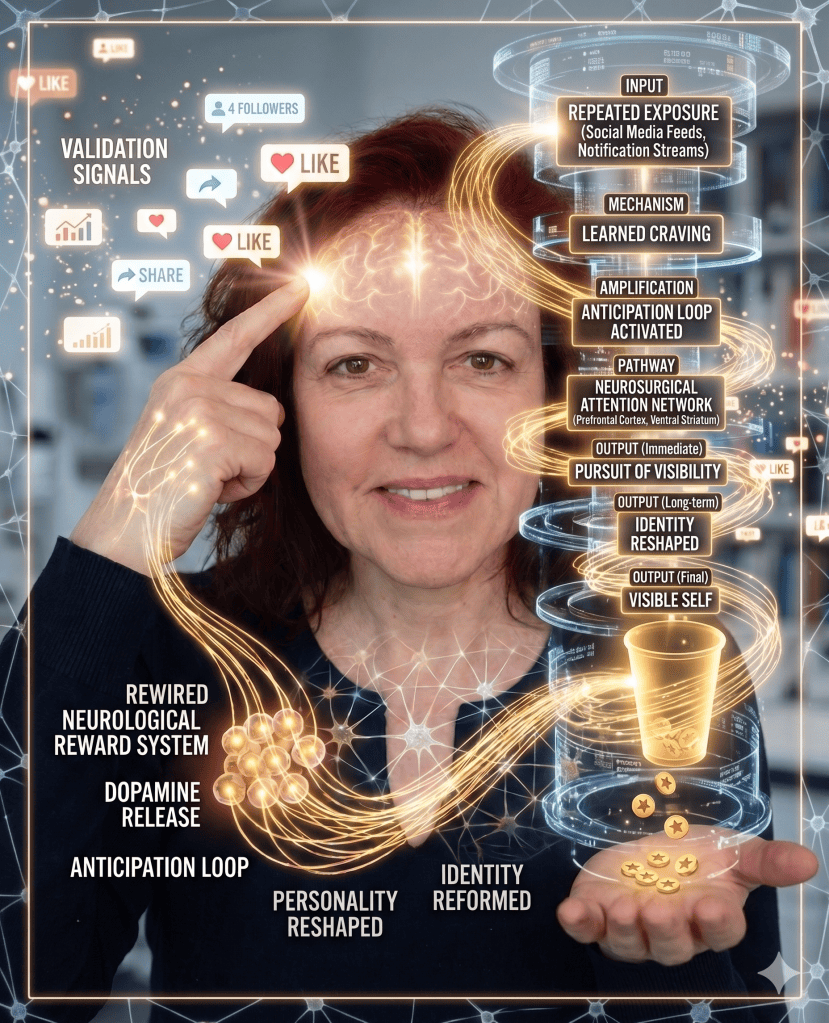
Social media may have changed more than behavior. Through years of attention-driven reinforcement, it may have trained many people to experience life through the anticipated gaze of an audience.
One of the strangest effects of social media is that many people no longer experience moments directly.
Before a moment is fully felt, part of the mind has already begun asking how it would look to an audience.
A beautiful sunset becomes a potential photograph. A conversation becomes a potential story. An emotion becomes a potential caption. The experience is still occurring, but it is occurring alongside an evaluation: Would this translate?
This phenomenon is often described as a behavioral problem. People are distracted. They seek validation. They are addicted to their phones.
These explanations capture part of the picture, but they may not reach the deepest change.
What appears to have changed for many people is not merely behavior. It is perception.
Over years of engagement with attention-driven platforms, the brain may have learned to filter experience through the anticipated gaze of others. The question is no longer simply whether something happened. It is whether it is visible, legible, shareable, and likely to attract a response.
If this account is correct, social media’s most significant psychological effect is not that it encouraged people to seek attention. It is that repeated attention-seeking may have become a perceptual habit—an attentional lens through which experience itself is increasingly organized.
Understanding how such a shift might occur requires examining two things: the brain’s ability to adapt to repeated experience and the unique rewards associated with social attention.
The Adaptive Brain
The brain is not a static organ.
Throughout life, neural pathways are strengthened, weakened, and reorganized in response to repeated activity. This capacity, known as neuroplasticity, is one of the most fundamental features of the nervous system.
The principle is simple: what the brain does repeatedly becomes easier for the brain to do again.
Practice a musical instrument for years and the neural systems supporting that skill become more efficient. Repeatedly navigate a complex city and the brain adapts to support that task. Experience leaves traces.
Importantly, neuroplasticity is indifferent to whether a behavior is beneficial or harmful. The mechanism that allows expertise to develop is closely related to the mechanism that allows habits and compulsions to form.
What matters is repetition and reinforcement.
This becomes relevant when considering the modern attention economy.
For much of human history, social rewards arrived intermittently through ordinary interaction. Digital platforms transformed this process into something continuous. Posting, monitoring responses, and seeking engagement became activities that could be repeated dozens or hundreds of times each day.
The scale of reinforcement was unprecedented.
Why Attention Is Such a Powerful Reward
Human beings are deeply social creatures.
Across evolutionary history, being noticed, recognized, and valued by others carried obvious advantages. Social inclusion increased access to resources, protection, cooperation, and mating opportunities. Social exclusion carried risks.
The modern brain still reflects this history.
Attention is not merely pleasant. It is meaningful. Being seen by others activates reward systems that overlap with those involved in other desirable experiences.
This does not mean attention is inherently unhealthy. Quite the opposite. Recognition, belonging, and social connection are fundamental human needs.
The significance of social media lies in the way it transformed those needs into measurable, continuously available signals.
Instead of receiving social feedback through ordinary interaction, users began receiving streams of quantified responses: likes, shares, comments, views, followers.
Ancient social motivations suddenly had a new interface.
The behavioral logic was straightforward.
A post receives attention.
Attention feels rewarding.
The brain learns to repeat whatever produced the reward.
Over time, attention-seeking can become increasingly automatic—not necessarily as a conscious strategy but as a default orientation toward the environment.
When Seeking Becomes Seeing
Most discussions of social media stop at this point.
The story usually ends with habit formation.
But habits often extend beyond their original context.
A behavior repeated frequently enough can begin to shape what a person notices, values, and attends to.
This is where the more interesting possibility emerges.
Many heavy social media users report a recognizable experience. They find themselves mentally framing experiences as content while those experiences are still unfolding.
A meal is not simply enjoyed.
It is also evaluated.
A vacation is not simply experienced.
It is also documented.
An emotional moment is not simply felt.
It is also considered from the perspective of how it might appear to others.
The important shift is subtle.
Attention is no longer being sought after an experience.
The anticipation of attention becomes part of the experience itself.
This essay’s central claim can be stated simply:
Attention-seeking, when sufficiently reinforced, can evolve from a behavior into a perceptual habit.
The brain learns not only to pursue attention but to organize experience around the possibility of receiving it.
The question Will this be seen? begins influencing perception before the moment is fully lived.
The Audience That Moves Inside
The most powerful audiences are not always external.
At first, social media operates through a visible feedback loop. People post, receive responses, and learn from those responses.
Over time, however, something more interesting may occur.
The audience becomes internalized.
People often report carrying a kind of imagined observer with them even when they are offline. They find themselves evaluating moments according to their potential visibility. Experiences are quietly sorted into categories: interesting, impressive, shareable, forgettable.
This process is usually not conscious.
It functions more like a background filter.
What attracts attention receives additional psychological weight. What does not translate into content receives less.
The consequence is not necessarily distortion of reality but distortion of salience.
Certain experiences become easier to notice because they perform well.
Others become easier to overlook because they do not.
The things most vulnerable to this process are often the least visible forms of fulfillment: private relationships, quiet competence, long-term commitments, solitary reflection, gradual personal growth.
These experiences matter enormously, but they rarely generate engagement metrics.
A mind trained to prioritize visibility may gradually assign them less importance than they deserve.
Identity Under Continuous Observation
Human identity has always been social. People have always developed a sense of self partly through interaction with others.
What social media changed was the intensity and continuity of that feedback.
For much of history, self-presentation occurred in specific contexts and before relatively limited audiences.
Digital platforms dramatically expanded both the size of the audience and the frequency of evaluation.
The self that receives feedback is rarely the whole self.
It is a selective presentation.
Over time, that presentation can become increasingly optimized for response. It becomes more polished, more coherent, more predictable, and more aligned with whatever has been rewarded before.
Meanwhile, the private self remains messy, contradictory, uncertain, and unfinished.
The risk is not that people become fake.
The risk is that the performed self receives so much reinforcement that it begins to feel more real than the private one.
This challenge may be particularly significant during adolescence, when identity formation is still underway and sensitivity to peer evaluation is naturally heightened.
Building a stable sense of self becomes more difficult when self-understanding develops under conditions of continuous public feedback.
The Incentives Behind the System
None of this requires conspiracy.
It requires incentives.
Platforms built around advertising revenue benefit from engagement. Engagement increases when people repeatedly return to seek attention, monitor responses, and maintain visibility.
A user who increasingly experiences life through the possibility of audience reaction is likely to generate more content and spend more time on the platform.
From a business perspective, this is valuable.
From a psychological perspective, it creates an environment optimized for reinforcing audience-oriented perception.
The adaptation is understandable.
The environment is what deserves scrutiny.
What the Evidence Actually Shows
The strongest evidence does not prove that social media changes perception itself.
It does show several related phenomena.
Researchers have linked social-media-centered forms of self-worth with increased anxiety, social comparison, and emotional volatility. Communication researchers have documented the importance of the “imagined audience” in shaping online self-presentation. Social neuroscience has demonstrated meaningful overlap between social rewards and broader reward-processing systems.
What remains less established is the specific mechanism proposed here.
The idea that repeated attention-seeking eventually becomes a durable perceptual orientation remains, at present, a synthesis rather than a settled scientific conclusion.
Yet the hypothesis is worth considering because it connects several well-established observations into a coherent pattern.
Neuroplasticity demonstrates that repeated behaviors reshape cognitive tendencies.
Reward systems demonstrate that attention can function as a powerful reinforcer.
Research on imagined audiences demonstrates that people routinely model observers in their minds.
The possibility explored here is that these processes, operating together over years, may gradually alter how experience itself is filtered and interpreted.
Whether future research confirms this model remains an open question.
The Framework Deepens
The environment that originally inspired these concerns has become even more powerful.
Short-form video dramatically increased the scale of potential attention. A single post can now reach millions of people with no prior social connection.
The imagined audience has expanded far beyond the boundaries of ordinary social life.
The creator economy added another layer. For many people, audience attention is no longer merely psychological. It is economic. Visibility has become a source of income.
The question Will this translate? is no longer just a cognitive habit. For some, it is a professional necessity.
Artificial intelligence introduces an even stranger possibility.
Increasing portions of the attention environment are now shaped by algorithms, automated recommendations, synthetic content, and potentially non-human forms of engagement.
If people have learned to experience life through the anticipation of observation, it becomes increasingly relevant to ask what happens when the observers are no longer entirely human.
The answer remains unclear.
The question itself would have sounded bizarre a decade ago.
The Technologies That Change What We Notice
The deepest technologies do not merely change what people do.
They change what people notice.
The brain that learned to filter experience through an anticipated audience did not malfunction. It adapted.
The adaptation was appropriate.
The environment was unusual.
This distinction matters because it shifts the conversation away from blame. The issue is not that people became shallow. The issue is that attention-driven systems rewarded certain patterns of perception and discouraged others.
The challenge is that perceptual habits are difficult to recognize from the inside.
A person can delete an app.
They can disable notifications.
What is harder is noticing the invisible question that may have become woven into experience itself:
Will this be seen?
Yet neuroplasticity works in both directions.
What is learned can, over time, be relearned.
Experiences organized around presence rather than performance, relationships rather than visibility, and participation rather than documentation can gradually cultivate different attentional habits.
Whether this shift is needed broadly across society remains an open question.
But it is increasingly worth asking.
Because if an entire generation has been trained to experience portions of life as content, then the most important issue may not be what social media changed about behavior.
It may be what it changed about attention itself.









