
Originally published in November 2016 and comprehensively updated and edited in June 2026.
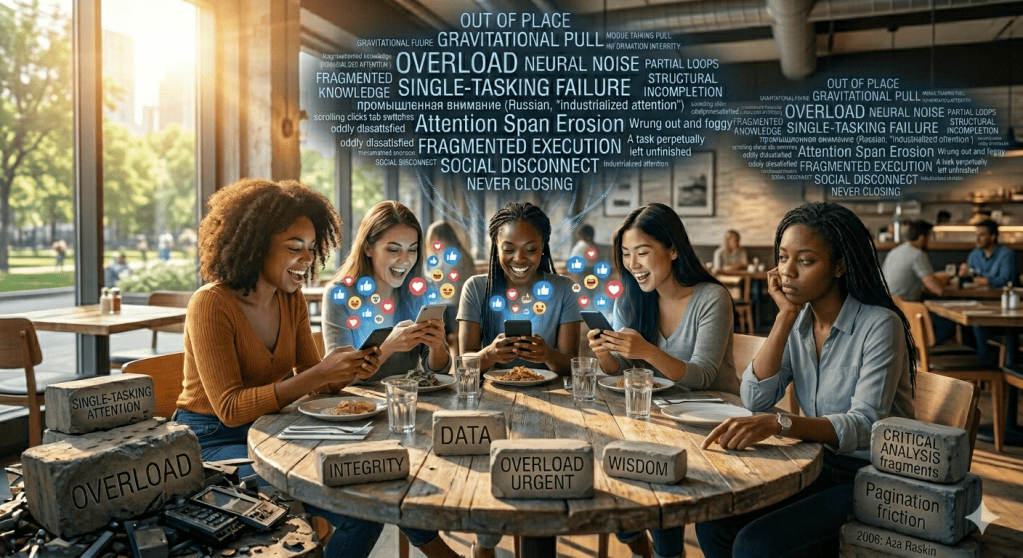
Why did boredom become so hard to tolerate? An exploration of the psychology, neuroscience, and technology behind our collective inability to sit with an unoccupied mind.
There was a moment—somewhere around 2012 or 2013—when waiting in line stopped being something people just did. The slight shuffle, the idle glance around, the quiet mental drift that had accompanied human waiting since the invention of the queue: all of it began to disappear. In its place came the phone, extracted from the pocket with a reflex so fast it barely registered as a choice. The screen lit up. The moment was filled.
Nobody announced this shift. No one voted on it. But something significant happened in those years, and it wasn’t just about smartphones. It was about our relationship with a state of mind that had been a normal, if unwelcome, part of human experience for as long as anyone could remember. Boredom—the feeling of having nothing engaging to do, of time moving too slowly, of mental restlessness without direction—had always been uncomfortable. What changed was that it became, for many people, genuinely intolerable. And understanding why that happened requires looking at psychology, neuroscience, technology, and the particular social pressures of the early twenty-first century together.
This is an examination of how boredom went from an ordinary human inconvenience to something we collectively organized our environments to escape at all costs—and what that reorganization has cost us in return.
What Boredom Actually Is
Before exploring why boredom became intolerable, it helps to understand what boredom actually is. Psychologists define it more precisely than everyday language suggests. Boredom is not the same as fatigue, depression, or simple laziness. It’s a specific motivational state: the feeling of wanting to engage in something satisfying but being unable to find it. Researchers John Eastwood, Alexandra Frischen, Mark Fenske, and Daniel Smilek described it in a 2012 paper as “an aversive state of wanting, but being unable, to engage in satisfying activity.”
That distinction matters. Boredom is a signal, not just a symptom. It tells you that your current situation isn’t meeting your need for meaningful engagement. In that sense, it functions somewhat like hunger—an uncomfortable signal pointing toward a real need.
The experience of boredom also has neurological texture. When people are bored, brain imaging studies show that a region called the default mode network becomes highly active. This is the network associated with mind-wandering, daydreaming, self-reflection, and imagining hypothetical futures. For decades, neuroscientists considered this network a kind of background hum—what the brain did when it wasn’t doing anything important. But research over the past twenty years has complicated that picture considerably.
The Surprisingly Productive Brain at Rest
The default mode network turns out to be involved in some of the most cognitively sophisticated things humans do: autobiographical memory, creative problem-solving, perspective-taking, planning, and the construction of a coherent sense of self. When your mind wanders, it isn’t wasting time. It’s often processing experiences, generating novel associations, and preparing for future challenges.
A 2014 study by researchers at the University of Central Lancashire, published in the journal Creativity Research Journal, found that participants who completed a boring task before a creativity exercise produced more creative output than those who went straight to the creative work. The boredom appeared to trigger mind-wandering, and the mind-wandering fueled the creative thinking. Other research has linked daydreaming to insight problem-solving—the kind of sudden “aha” moment that doesn’t come from focused analysis but from a looser, more associative mental state.
None of this means boredom is secretly pleasant or that we should seek it out constantly. It’s uncomfortable by design—that discomfort is the signal. But it does mean that the instinct to immediately eliminate boredom, to fill every moment before the sensation can take hold, may be depriving us of something useful. The question is why that instinct became so much stronger in the years after 2010 than it had ever been before.
The Attention Economy and the Engineering of Engagement
The answer begins in Silicon Valley, but it extends far beyond it.
In the early years of the web, the internet was largely a tool for finding information. You went somewhere specific, got what you needed, and left. The design philosophy was functional. By the mid-2000s, something had shifted. Social platforms weren’t just tools—they were destinations. And the business model that had come to dominate them depended entirely on keeping people there as long as possible.
The phrase “attention economy” was coined by psychologist and Nobel laureate Herbert Simon in the 1970s, long before the internet existed. Simon observed that in a world where information is abundant, the scarce resource isn’t information—it’s the human attention required to process it. Whoever captures attention captures value. The commercial internet turned this insight into an engineering discipline.
The design choices that followed were not accidental. Infinite scroll—pioneered by social platforms around 2006 and subsequently adopted almost everywhere—removed the natural stopping points that had previously existed in digital content. The notification system, which began as a practical communication tool, was gradually weaponized to create what psychologists recognize as a variable-ratio reinforcement schedule: the same mechanism that makes slot machines so compulsive. You don’t know when the next rewarding notification will arrive, so you check constantly.
Tristan Harris, a former design ethicist at Google, described this process in unusually direct terms in a 2016 presentation that later went public: these were systems designed to “hijack” psychological vulnerabilities, exploiting the brain’s dopamine response systems to create compulsive checking behavior. The design goal wasn’t user satisfaction—it was user engagement, and those two things, it turned out, were quite different.
Dopamine, Novelty, and the Restless Brain
Understanding why these systems worked so effectively requires a brief detour into neuroscience.
The neurotransmitter dopamine is often described, imprecisely, as the brain’s “pleasure chemical.” Neuroscientists are more careful: dopamine is heavily involved in learning, motivation, novelty detection, and reward prediction—a system concerned less with pleasure itself than with the anticipation of it. It responds most powerfully to unpredictability, to the possibility of reward rather than its guaranteed delivery. That distinction matters, because it explains why a feed that might contain something interesting is more compelling than one that always does.
The brain evolved this system in an environment where novelty genuinely mattered. A flash of movement in the undergrowth, an unfamiliar smell, an unexpected sound: these were signals worth attending to. In the modern information environment, this ancient circuitry encounters a landscape it was never designed for—an essentially infinite stream of novel stimuli, available at any moment, shaped by teams of engineers and behavioral scientists to be as attention-capturing as possible.
The result is not that technology overpowers human psychology, but that it learns to cooperate with some impulses while bypassing others. It amplifies the brain’s appetite for novelty while quietly routing around the slower, more effortful systems that might otherwise pause, reflect, or tolerate discomfort. The gap between the first flicker of restlessness and the first swipe of a screen has shrunk to something close to zero.
The Social Costs of Always Being Available
There was another dimension to this transformation that had less to do with technology design and more to do with social norms.
The smartphone didn’t just create a new entertainment delivery system. It created new expectations about availability and responsiveness. Being unreachable—even briefly, even voluntarily—came to feel socially suspect. The professional culture of many industries moved toward a presumption of continuous availability. In personal relationships, delayed responses to messages required explanation. The social pressure to be always on was diffuse and largely unspoken, but it was real, and it reinforced the technological pressure to keep the phone nearby and the screen lit.
This created a feedback loop. The technology made boredom escapable. The social norms made disengagement feel costly. Together, they made the mere act of sitting quietly with one’s own thoughts feel not just uncomfortable but vaguely irresponsible.
Sociologist Sherry Turkle at MIT documented this dynamic with particular care in her 2015 book Reclaiming Conversation. Through years of interviews with teenagers, college students, and adults in professional settings, she found a consistent pattern: people had become deeply uncomfortable with what she called “being alone with their thoughts.” The discomfort wasn’t new—humans have always had a somewhat uneasy relationship with unstructured mental time—but its intensity had increased dramatically, and its reach had extended to contexts, like family dinners and face-to-face conversations, where it had previously been held in check by social convention.
The Study Nobody Wanted to Believe
The discomfort people feel with unoccupied mental time was documented in a provocative and widely discussed 2014 study led by Timothy Wilson at the University of Virginia, published in Science. In a series of experiments, researchers asked participants to sit alone in a room with nothing to do for periods of six to fifteen minutes. They were told they could think about whatever they liked. Most found it genuinely unpleasant.
In the most startling portion of the study, participants were given the option to administer mild electric shocks to themselves during the thinking period—shocks they had previously indicated they would pay to avoid. A substantial minority chose the shocks over the sustained quiet. Among men, the figure was 67 percent. Among women, 25 percent.
The study attracted significant attention and some methodological criticism afterward—replication is always a legitimate concern with counterintuitive findings—and it shouldn’t be taken as definitive proof that humans can’t tolerate their own minds. What it did capture, credibly, was something many people recognize from lived experience: that unstructured mental time had become actively aversive for a meaningful portion of the population. The specific numbers are less important than the phenomenon they pointed toward.
Historical Perspective: Boredom Wasn’t Always Like This
It’s worth stepping back and noting that boredom, as a cultural problem, is relatively modern.
The word “boredom” didn’t appear in English until the mid-nineteenth century. This doesn’t mean the experience didn’t exist before then—it clearly did, and writers from Seneca to Pascal to Kierkegaard described something very much like it. But the particular form it took, and the particular urgency of escaping it, has varied considerably across history.
Pascal’s observation in the seventeenth century that “all of humanity’s problems stem from man’s inability to sit quietly in a room alone” is often quoted as timeless wisdom, but it’s also a historically specific complaint. Pascal was writing in an era when urban life was accelerating, print culture was expanding, and the contemplative traditions that had previously structured human time were losing their grip on daily life. He was observing an early version of the same tension.
The Industrial Revolution intensified things. Factory work imposed rigid time discipline on populations accustomed to the variable rhythms of agricultural life. Leisure time—now a distinct category, separate from work—became something to be filled. The entertainment industries of the nineteenth and twentieth centuries (penny presses, music halls, cinema, radio, television) grew up in response to this need. Each new medium made distraction cheaper, more available, and more powerful.
What happened in the 2010s was a step change in that long historical process, not a departure from it. The smartphone and the social media ecosystem it carried did what every previous entertainment technology had done, but more completely. They made distraction available in every context, at any moment, at essentially no cost. They removed the last remaining situations in which boredom was structurally guaranteed.
What Gets Lost When Boredom Disappears
The colonization of idle time has costs that are only now beginning to be understood.
One of the clearest is the effect on children’s development. Developmental psychologists have long emphasized the importance of unstructured time for children—not structured play, not scheduled activities, but genuinely open time with no particular agenda. This kind of time is associated with the development of self-directed attention, the ability to tolerate frustration, imaginative play, and the emergence of intrinsic motivation. When every moment of childhood is filled with stimulation, these capacities don’t develop as readily.
In 2016, when this essay was first drafted, those concerns were still largely speculative—the data was suggestive but contested, and it was easy to dismiss them as a new variant of the moral panics that had accompanied every previous communications technology. A decade later, the picture looks different. Research on adolescent mental health published over the course of the late 2010s and early 2020s—including large-scale analyses by psychologist Jean Twenge and epidemiological data from the United States and United Kingdom—documented significant increases in anxiety, depression, and loneliness among teenagers that tracked closely with smartphone adoption rates. The causal picture remains genuinely complex, and researchers still disagree about the magnitude of the effect, but the question has moved from “is there something here?” to “exactly how does it work, and for whom?”
A second cost is what might be called attentional fragmentation. Cognitive psychologist Gloria Mark at the University of California, Irvine, has studied workplace attention for years. Her findings, replicated across multiple studies, suggest that the average time a person spends on any single task before switching has declined dramatically over the past two decades—from roughly two and a half minutes in 2004 to around 47 seconds in more recent research. Importantly, her work also shows that switching attention is costly: it takes time to fully reengage with a task after an interruption, and performance suffers.
The habit of constant switching, developed through years of managing multiple information streams, appears to generalize beyond screens. People who frequently use media multitasking—consuming multiple streams of content simultaneously—perform worse on standard tests of attentional control than those who don’t. The mechanism is not fully understood, but one hypothesis is that the habit of scanning for novelty interferes with the ability to sustain focused attention on a single thing.
The Paradox of Stimulation Seeking
There is a psychological paradox at the center of all this. The behaviors people adopt to escape boredom often make boredom worse over time.
This is a familiar pattern from addiction research. Chronic overstimulation reduces sensitivity to stimulation—a phenomenon called hedonic adaptation. What was exciting becomes ordinary; a stronger dose is required to produce the same effect. Applied to digital media, this suggests that constant stimulation not only prevents the development of the attentional capacities needed to tolerate boredom—it actively increases the baseline level of stimulation required to feel engaged. The person who has spent years scrolling through an infinite feed of video content may find that a walk, a book, or a conversation with a friend provides insufficient stimulation to hold their attention, not because those things aren’t valuable, but because the sensitivity to subtler forms of engagement has eroded.
This is speculative territory—the research is newer and the mechanisms aren’t fully established. But it aligns with what many clinicians, educators, and thoughtful observers have been reporting from lived experience since at least the mid-2010s.
It’s also where the word in this essay’s title earns its weight. Intolerable does not mean that people now experience boredom more intensely than previous generations did. It means the threshold for enduring it has changed. A sensation once routinely endured for minutes or hours—on a bus, in a waiting room, between tasks—is now often interrupted within seconds. The feeling itself may not be stronger. Our willingness to remain with it may simply be weaker. And that shift in tolerance, not the subjective intensity of boredom itself, is what makes the present moment genuinely different from what came before. that deserves serious consideration. What if boredom didn’t actually become intolerable? What if technology simply revealed that people always hated boredom—and now have better tools for escaping it? There is probably truth in that view. Humans have always sought distraction wherever they could find it, and the historical record of penny presses, taverns, and gossip suggests that idle minds have always looked urgently for something to fill them. Yet efficiency can itself be transformative. A temptation that appears occasionally has different consequences than one available every waking moment. The question isn’t whether people have always disliked boredom—they have—but whether removing virtually all friction from the escape changes something fundamental about how we develop the capacity to tolerate it.
The Cultural Response
None of this went entirely unnoticed. The cultural response to the colonization of idle time was, characteristically, uneven.
By 2016, a “mindfulness” movement had grown from the margins of clinical psychology into a mass-market phenomenon. Meditation apps, corporate wellness programs, and countless popular books encouraged people to do something that had previously required no encouragement at all: sit quietly and attend to their own experience. The irony that people were using their smartphones to access apps designed to help them stop using their smartphones was not lost on observers. At the time, this felt like a cultural curiosity—a niche corrective to mainstream excess, adopted mostly by the already-converted.
The wellness framing of mindfulness was sometimes criticized—fairly—for extracting contemplative practice from its original context and turning it into a productivity tool. But whatever its limitations, the movement was at least correctly diagnosing something: that the capacity for sustained, undirected mental presence had become degraded, and that this degradation had consequences worth taking seriously.
In 2016, concerns about the attention economy were also beginning to surface, but they were still largely confined to technology writers and a handful of unusually candid insiders. The critique felt, to many people, overwrought—the kind of thing anxious adults say about technologies they don’t fully understand. That changed. In 2018, the Center for Humane Technology gave the critique an institutional home. Legislation in various jurisdictions began, slowly and imperfectly, to address the more aggressive engagement-optimization practices, particularly those directed at children.
By 2026, these conversations have matured considerably. The early debates—were smartphones really harmful? was social media really addictive?—have given way to more nuanced questions about dosage, context, individual variation, and the specific mechanisms of harm. The research base has grown substantially. The social consensus, while far from complete, has shifted enough that the question is no longer whether these technologies reshape attention, but how, for whom, and what might be done about it.
A Forward-Looking View
The changes documented here are not going to reverse themselves. The technologies exist, the economic incentives behind them remain powerful, and the habits they have cultivated are deeply embedded. But understanding how boredom became intolerable—and why that matters—is a necessary starting point for thinking clearly about what comes next.
The capacity to tolerate discomfort without immediately eliminating it is not a trivial psychological ability. It underlies patience, creativity, emotional regulation, and the kind of sustained attention that complex work requires. These are not archaic virtues suited to a slower era. They are functional capacities that remain as relevant in a complex modern world as they have ever been—perhaps more so, given the complexity of the problems that world presents.
The interesting questions now are less about diagnosis and more about what individuals, institutions, and societies can do to preserve or restore these capacities in an environment not designed with them in mind. Some of the answers are likely to involve technology—better design, better defaults, better regulatory frameworks. Some will involve practices that look, in a high-technology age, almost anachronistically simple: time without devices, spaces without notifications, the deliberate cultivation of stillness in daily life.
None of this requires romanticizing boredom. It doesn’t have to be pleasant to be useful. The question is simply whether we are capable of tolerating the discomfort long enough to let it do its work—to let the mind wander where it will, generate what it generates, and return with something that constant stimulation would never have produced.
The answer to that question, in the years ahead, will shape more than just individual well-being. It will shape the quality of thought, the capacity for creativity, and the attention we are able to bring to problems that genuinely require i









