
Originally published in July 2017 and comprehensively updated and edited in June 2026.
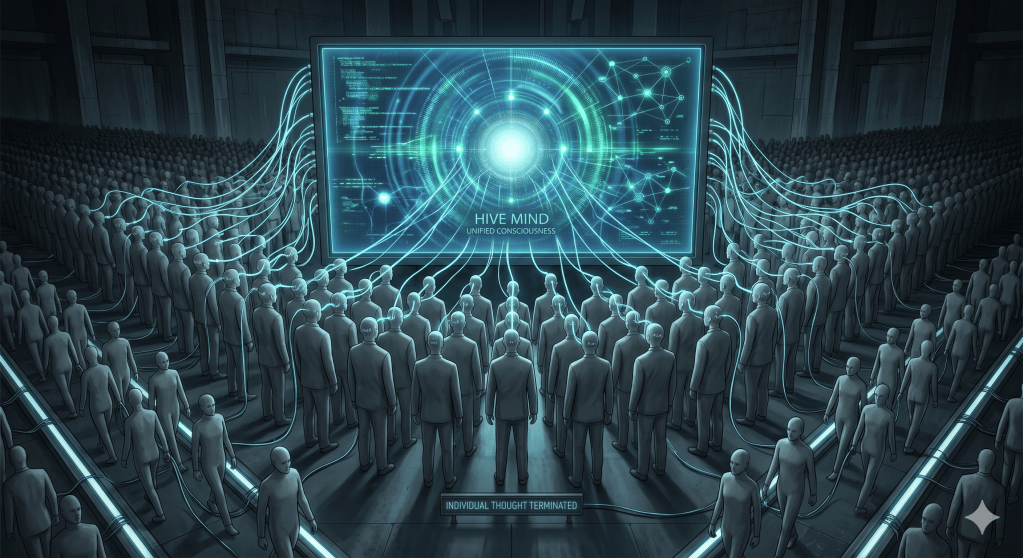
How social media, neuroscience, and group psychology combined to shift human cognition away from individual reasoning — and what the research tells us about why it happened.
There are moments in history when you can feel the ground shifting — not through any single earthquake, but through a long, slow tremor that only becomes obvious once you’ve moved far enough away from it. The decade roughly spanning 2007 to 2017 was one of those moments. The smartphone became universal. Social media grew from a novelty into infrastructure. And somewhere in that transition, something happened to the way human beings form opinions, make decisions, and construct their own sense of reality.
This isn’t a story about technology making people stupid. That framing is too simple, and it’s also a little self-flattering — it implies the rest of us, standing just outside the spell, are immune. What actually happened is more interesting, and in some ways more troubling. Across the developed world, and increasingly everywhere else, the process by which individuals arrive at their own conclusions began to change. Group identity started doing more of the cognitive work that people used to do alone. The social environment became the primary source not just of information, but of interpretation — the filter through which information got its meaning.
This essay is an attempt to understand how that happened, what the science says about why it’s so durable, and what it means for human cognition and social life.
The Machinery of the Social Mind
To understand why humans became more susceptible to collective thinking in the digital age, it helps to understand why we were susceptible in the first place. Individual reasoning, it turns out, has always been less independent than we imagine.
Humans are intensely social animals. The evolutionary pressures that shaped our cognition didn’t optimize for individual truth-seeking — they optimized for survival in social groups. For most of human history, being cut off from your group meant death. Conforming to group norms, reading social signals accurately, and aligning your beliefs with the people around you were adaptive behaviors. They kept you alive and reproduced.
Psychologists have studied the downstream effects of this for decades. In 1951, Solomon Asch ran a series of experiments that became landmarks in social psychology. He showed participants two cards: one with a single reference line, and one with three lines of obviously different lengths. He asked them to say which of the three lines matched the reference. The task was almost comically easy — the lines weren’t even close in length. But when participants were placed in a room with actors who confidently gave the wrong answer, roughly 75 percent of real subjects went along with the incorrect group response at least once. Not because they couldn’t see the right answer. Because the social pressure to conform was stronger than the evidence in front of their eyes.
Asch’s experiments were conducted in person, with real social stakes. What digital networks did was scale that dynamic to billions of people simultaneously, and make the pressure constant rather than episodic.
How the Brain Handles Disagreement
Neuroscience has since given us a clearer picture of what’s happening inside the skull when someone faces social disagreement. A 2011 study by Vasily Klucharev and colleagues at Erasmus University found that when a person’s opinion differed from the group’s, it activated the brain’s error-monitoring system — the same system that fires when you make a mistake. The anterior cingulate cortex and the ventral striatum, structures deeply involved in detecting conflict and regulating reward, responded to social disagreement as if the brain had done something wrong.
What this means is that conformity isn’t just a social calculation. It’s neurologically reinforced. The brain is wired to experience disagreement with one’s social group as an error signal — something uncomfortable that needs to be resolved. And the resolution that requires the least cognitive effort is usually the same one: update your beliefs to match the group’s.
This mechanism existed long before Twitter. But Twitter — and Facebook, and YouTube, and every other platform built on social feedback — gave it a continuous, quantified outlet. Every like, share, and retweet became a small neurological reward. Every piece of content that generated disagreement became a small neurological penalty. Over time, the incentive structure shaped what people were willing to say, think about, and believe.
Dunbar’s Number and the Collapse of Social Scale
The anthropologist Robin Dunbar proposed in the 1990s that the human brain can maintain stable social relationships with roughly 150 people. Beyond that number — now commonly called Dunbar’s Number — our capacity for genuine social tracking breaks down. We lose the ability to accurately model other people’s intentions, history, and character. Our social cognition starts to rely on shortcuts.
For most of human history, this wasn’t a practical problem. Your actual social world rarely exceeded Dunbar’s limit. Your community, your extended family, your trade network — these were manageable. You knew people as full individuals.
Social media didn’t just expand that number. It shattered the ceiling entirely. By the mid-2010s, a typical social media user was nominally connected to hundreds or thousands of people, and exposed to the opinions, behaviors, and identities of millions more. Faced with a social environment it couldn’t individually track, the brain did what it always does when complexity exceeds capacity: it categorized.
This is the part the familiar Dunbar story often leaves out. Once social complexity exceeds our ability to model individuals, category-thinking stops being a preference and becomes a necessity. You can’t extend the same nuanced mental model you’d apply to a close friend to a thousand strangers. So you stop trying. Instead of treating people as individuals with complex inner lives, users began processing them as representatives of groups — political tribes, cultural identities, ideological positions. And crucially, once you’re sorting people into categories, you need to know which category you belong to. The need to track your group becomes the foundation for a much stronger sense of group identity. Dunbar’s limit, in this way, isn’t just a ceiling on relationships. It’s a threshold at which identity starts doing the cognitive work that individual judgment used to do. The social world gets flattened into a map of allies and enemies, in-group and out-group, people whose statements should be trusted and people whose statements should be dismissed.
The Echo Chamber Effect: More Than Just Confirmation Bias
By the time researchers were studying social media behavior systematically, a common explanation for ideological clustering was “confirmation bias” — the tendency to seek out information that confirms what you already believe. That’s real, but it’s only part of the story.
A 2016 study published in the Proceedings of the National Academy of Sciences by Michela Del Vicario and colleagues analyzed millions of Facebook users across different types of content communities. They found that users didn’t just prefer information that confirmed their views — they formed discrete, self-reinforcing information clusters that were almost structurally isolated from each other. Information moved quickly within clusters and almost never crossed between them. The researchers found this was driven less by individual choice than by the algorithmic architecture of the platform itself, which optimized for engagement and therefore for emotional resonance, which correlated strongly with in-group content.
This matters because it reframes the problem. People weren’t primarily choosing to live in information bubbles through conscious preference. The environment itself was structured to produce that result. The individual’s agency was downstream of a system design they didn’t choose and mostly couldn’t see.
Identity-Protective Cognition
One of the most important concepts in understanding why group thinking became so durable is something researchers call identity-protective cognition. The term comes from work by legal scholar and psychologist Dan Kahan at Yale, whose research focused on why scientific literacy doesn’t reliably produce scientific consensus.
Kahan and his colleagues found something counterintuitive: people who scored higher on tests of numeracy and scientific reasoning were actually more likely to interpret new data in ways that matched their cultural or political identity, not less. More cognitive capacity, in other words, didn’t make people better at evaluating evidence. It made them better at rationalizing their existing group position.
The logic makes sense once you think about it. For most people, updating a core belief — especially one that’s tied to group membership — carries enormous social costs. You might lose standing in your community, alienate people you care about, or face the psychological discomfort of no longer knowing who your people are. The rational move, from a purely social cost-benefit perspective, is to protect the belief. And people with greater analytical ability often become more skilled at defending positions that are important to their social identity.
This is not a partisan observation. Kahan’s research found identity-protective cognition operating across the political spectrum, on issues ranging from climate science to gun policy to nuclear waste storage. The specific beliefs differed; the underlying cognitive pattern did not.
The Acceleration: 2010–2017
Understanding the baseline psychology is one thing. Understanding why things accelerated so dramatically in the early 2010s requires looking at the specific features of the technological and social environment that came online in that window.
The smartphone became genuinely ubiquitous around 2012 and 2013 in the developed world. By 2015, Americans were checking their phones on average 85 times per day, according to a study by researchers at Nottingham Trent University. The social feedback loop — post something, check for responses, receive validation or disapproval — moved from occasional to constant. It stopped being something people did and started being something people lived inside.
At the same time, the major platforms were racing to increase engagement. Facebook introduced the algorithmic News Feed in 2009 and began heavily weighting emotional content — particularly content that generated anger or outrage — because such content drove more clicks, shares, and time on site. Twitter’s retweet function, introduced in 2009, radically amplified the speed at which ideas spread, but also increased the speed at which mobs could form around shared targets. YouTube’s recommendation algorithm, later found to push users systematically toward more extreme versions of whatever they were already watching, was optimized entirely for watch time, with no weight assigned to accuracy or balance.
These were not designed as radicalization engines. They were designed to capture attention. But attention, in humans, is most reliably captured by the socially and emotionally salient. And what’s socially and emotionally salient tends to be things that activate in-group loyalty and out-group threat detection — the oldest parts of our social cognition.
The Measurement of Collective Conformity
Some of the most compelling evidence that something real was happening to group cognition comes from analysis of language. In 2019, researchers using computational linguistics found that political speech had become dramatically more homogeneous within parties and more polarized across them — legislators weren’t just voting together more, they were speaking more similarly. Parallel research tracking language on Twitter and Reddit found the same convergence in online communities, with users adopting shared phrases and rhetorical patterns at rates that accelerated sharply after 2012. The significance isn’t just political. Linguistic homogenization suggests the conformity was cognitive rather than merely behavioral — people weren’t only agreeing on issues, they were starting to process the world through the same conceptual frameworks.
What This Does to Individual Thinking
The cumulative effect of these forces on individual cognition is harder to measure than behavioral outputs, but the evidence that exists is suggestive.
A widely discussed 2015 report from Microsoft Canada found that average human attention span had dropped to about eight seconds — shorter than a goldfish, as popular reporting breathlessly noted. The eight-second figure was later contested, and “attention span” is not a single cognitive phenomenon. But something the report did capture was a measurable decrease in what researchers call “sustained attention” — the ability to remain focused on a single task or thought over time without external interruption.
More robust research from cognitive psychologists found related effects. The mere presence of a smartphone on a desk, even face down and silenced, measurably reduced cognitive performance on tasks requiring sustained attention, according to a 2017 study by Adrian Ward and colleagues at the University of Texas at Austin. The phone didn’t need to be used. Its presence alone was enough to pull cognitive resources toward the social monitoring function it represented.
What this describes, across the research literature, is an environment that was systematically rewarding fast, emotionally resonant, socially legible responses — and systematically penalizing the slower, more effortful, more individuated work of actually thinking something through. The incentives of the social media environment were not aligned with independent reasoning. They were aligned with social performance.
The Outsourcing of Opinion Formation
Psychologists have a term for the cognitive work we save by relying on trusted others rather than evaluating everything ourselves: “social epistemic dependence.” It’s not inherently pathological. No one can personally verify every claim they encounter. We rely on experts, institutions, and trusted social networks to extend our knowledge beyond what we can directly evaluate. This is rational.
What changed in the digital era was not that social epistemic dependence existed, but that the sources people were relying on shifted. Trusted institutions — journalism, academic research, public health authorities — declined in perceived credibility across much of the population. Into that space moved something different: the immediate social group, as represented through the feed. Opinion formation became less about consulting expertise and more about reading the room. The question shifted from “what does the evidence say?” to “what do people like me believe?”
This is a meaningful cognitive shift, and it’s one the research on motivated reasoning would predict. Kahan’s work, Asch’s work, Klucharev’s neuroimaging — all of it points toward a species that, given sufficient social pressure and a sufficiently ambient social environment, will progressively outsource more of its reasoning to the group.
The Irony of Personalization
There is a deep irony at the center of this story. The digital revolution was widely understood, at least initially, as a liberation of individual expression. The web gave individuals publishing platforms. Social media gave individuals audiences. Recommendation algorithms were supposed to customize each person’s information environment to their unique interests. The internet, in its original promise, was a tool for radical individual autonomy.
What it actually produced, in aggregate, was something closer to the opposite. The personalization that was supposed to liberate individuals ended up sorting them into groups. The platforms that were supposed to give everyone a voice ended up amplifying the voices that performed group loyalty most legibly. The recommendation systems that were supposed to reflect individual tastes ended up driving convergent behavior within demographic clusters.
The philosopher Eli Pariser coined the term “filter bubble” in 2011 to describe the way personalized algorithms could insulate users from information that challenged their worldview. What the subsequent decade made clear was that filter bubbles weren’t a bug the technology industry needed to fix. They were an emergent property of optimization for engagement — a structural outcome of building systems that rewarded social resonance.
Where This Leaves Us
None of this is an argument that independent thought has died, or that people are simply robots executing the instructions of their social group. Human cognition is more varied and resilient than any single force can eliminate. There were, even in the thick of this transformation, individuals and communities actively working against the grain — seeking out disconfirming information, maintaining intellectual heterodoxy, resisting the pull of tribal epistemology.
But it is an argument that the environment changed in ways that made individual thinking harder and more costly — cognitively, socially, and in some measurable sense neurologically. The systems built to connect humanity turned out to have strong opinions about how thinking should be done, and those opinions favored speed over depth, social legibility over idiosyncrasy, and emotional resonance over accuracy.
The question of whether that equilibrium can shift — whether institutions, individuals, or platform design can reestablish conditions more hospitable to genuine independent reasoning — was still very much open as of the time this essay was first written, and remains open now. What the research establishes is the nature of the problem: not a crisis of information, exactly, but a crisis of the cognitive and social conditions under which information gets evaluated.
That may be the more important finding. Floods of fact-checking, corrections, and counter-messaging haven’t reliably moved public opinion when that opinion is rooted in identity and social belonging rather than evidence. Changing the information environment alone isn’t sufficient. What would need to change is the deeper architecture — the incentive structures, the social costs of heterodox belief, the neurological and psychological conditions under which people actually do their thinking.
Understanding that is at least a start.









