
Originally published in May 2018 and comprehensively updated/edited in June 2026.
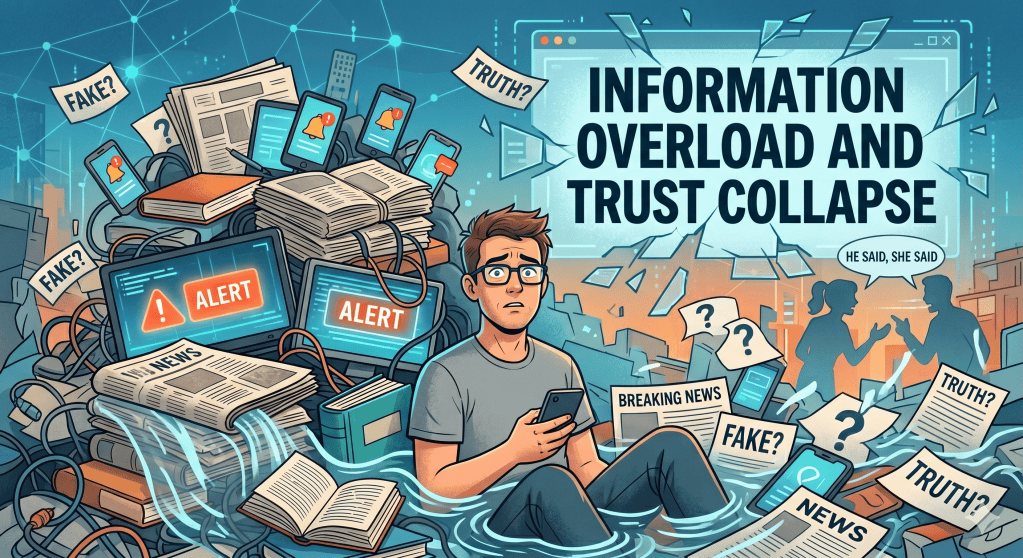
How the explosion of digital information overwhelmed human cognition, eroded trust in institutions, and fractured shared reality — and what research tells us about the consequences.
There is a particular feeling that many people cannot quite name but immediately recognize: the sensation of reading the news for twenty minutes and walking away knowing less than when you started. Not because you learned nothing, but because what you learned seemed to contradict something else you also just learned. The sources disagree. The experts disagree. The fact-checkers disagree about the fact-checkers. You close the browser tab not with clarity, but with a kind of low-grade exhaustion that didn’t exist before.
This is the lived experience of information overload, and it has a consequence that took researchers and observers years to fully appreciate: it doesn’t just make people tired. It makes people stop trusting.
The relationship between the sheer volume of information flooding modern life and the collapse of institutional trust is one of the defining features of early twenty-first century society. It didn’t happen overnight, and it wasn’t the product of any single technology or political movement. It emerged gradually from the intersection of neurological limits, social psychology, technological acceleration, and structural changes in how media and information operate. Understanding it requires stepping back and looking at all of those pieces together.
The Human Brain Was Not Built for This
To understand information overload, it helps to start with biology. The human brain is an extraordinary organ, but it evolved to process the information demands of a very different environment. Our ancestors needed to track threats, read social dynamics, remember seasonal patterns, and navigate physical spaces. They did not need to process several hundred pieces of new information before noon.
Cognitive load theory, developed by educational psychologist John Sweller in the late 1980s, describes the mental effort required to process and store information. The brain’s working memory — the mental workspace where we actively think — is limited. When it gets overwhelmed, something has to give. We begin to rely on shortcuts.
Those shortcuts are known in psychology as heuristics, and they’re not inherently bad. Most of the time, they work reasonably well. We trust sources that look familiar. We give more weight to information that matches what we already believe. We accept the judgments of people who seem credible or authoritative. These are efficient strategies when information is scarce. When information is abundant and contradictory, they become liabilities.
Psychologist Daniel Kahneman, in his influential work on decision-making, described two systems of thinking. System 1 is fast, automatic, and emotionally driven. System 2 is slow, deliberate, and analytical. Under conditions of cognitive overload, System 1 takes over. We respond more emotionally, more reflexively, and less critically. The explosion of information in the digital age has substantially increased reliance on fast, intuitive forms of reasoning when people consume news and current events.
This is not a character flaw. It is a predictable neurological response to an environment we were not designed to inhabit.
How We Got Here: The Architecture of Abundance
The information environment didn’t become overwhelming by accident. It was built that way, largely through a series of technological and economic decisions that each seemed reasonable at the time.
The rise of the internet in the 1990s democratized publishing. Anyone could put words on the web. This was, genuinely, a liberating development — marginalized voices gained platforms, niche interests found communities, and information barriers fell. But it also meant that the traditional gatekeeping functions of established media — editorial judgment, fact-checking, source verification — were no longer prerequisites for reaching an audience.
The shift accelerated in the 2000s with blogs, and then again in the 2010s with social media. By the middle of that decade, the primary distribution channel for news and information for hundreds of millions of people was an algorithm. And those algorithms were not designed to inform. They were designed to maximize engagement — to keep users on the platform as long as possible, because attention translates to advertising revenue.
What maximizes engagement, as it turned out, is not accuracy or nuance. It’s emotional intensity. Content that provokes outrage, fear, or tribalistic solidarity spreads further and faster than content that is careful and measured. This created a systematic selection pressure: the information that traveled widest was, structurally, the information most likely to be inflammatory, simplified, or false.
A 2018 study by researchers at MIT, published in the journal Science, analyzed the spread of true and false news stories on Twitter over more than a decade. False news spread significantly faster, reached more people, and penetrated deeper into networks than accurate news. The researchers found that this disparity was driven primarily by human behavior, not bots. People found novel, often surprising or emotionally charged misinformation more interesting than the truth, and they shared it accordingly.
By 2018, the average American was encountering more information in a single day than a medieval scholar might have processed in a month. But quantity was only part of the problem. The more corrosive issue was quality — not just the presence of false information, but the difficulty of distinguishing it from accurate information in an environment designed to maximize stimulation rather than clarity.
What made this especially disorienting was a structural inversion that few people consciously registered: information had become abundant at precisely the moment attention had become scarce. The bottleneck in modern communication was no longer access to information — it was the limited capacity of human attention. And in an economy built around capturing that attention, the incentive was never to help people think more clearly. It was to hold them in place a little longer.
Trust as Infrastructure
Trust in institutions — governments, media organizations, scientific bodies, courts — functions something like infrastructure. Most people don’t think about it until it breaks. When it works, it allows a society to coordinate, to share common frameworks for understanding reality, and to make collective decisions based on shared evidence. When it erodes, every social function that depended on it becomes harder to execute.
The erosion of institutional trust in Western democracies did not begin with the internet. Watergate, the Vietnam War, corporate fraud scandals, the failures of intelligence agencies in the lead-up to the Iraq War — these were real events that provided legitimate reasons for skepticism about powerful institutions. The cynicism was, in many cases, earned.
But something changed in the 2010s. The erosion became less discriminating. It was no longer primarily directed at specific institutions that had demonstrably failed. It became a generalized suspicion — a baseline assumption that authorities were lying, that expertise was for sale, that any official account was probably concealing something worse. Researchers began calling this “epistemic crisis,” a breakdown not just of trust in particular sources but in the shared norms and standards by which societies evaluate what is true.
The political scientist Russell Hardin, who spent much of his career studying trust, argued that trust is fundamentally a relationship — it requires knowledge of the trusted party’s interests and competence. Information overload makes that knowledge nearly impossible to maintain. When a person cannot keep track of who is saying what, cannot verify competing claims, and cannot even identify credible referees to adjudicate between them, the rational response is not reasoned skepticism. It is categorical distrust or, alternatively, categorical trust in a single preferred source that feels emotionally reliable.
Both responses are problematic. The first leads to paralysis and disengagement. The second leads to the kind of closed information ecosystem that makes correction nearly impossible.
The Psychology of Distrust
Understanding why information overload feeds distrust requires a brief excursion into social psychology, specifically the study of motivated reasoning.
Motivated reasoning describes the way people evaluate evidence differently depending on whether the conclusion supports or threatens something they already believe. When confronted with evidence that challenges a deeply held view, people don’t neutrally assess it — they instinctively search for reasons to dismiss it. When confronted with evidence that confirms what they already believe, they tend to accept it with far less scrutiny.
This tendency exists in everyone to some degree. It becomes dramatically more pronounced under conditions of uncertainty and threat. When people feel that their worldview or their group identity is under attack, motivated reasoning intensifies. The result is that highly partisan or emotionally charged information environments don’t simply fail to change minds — they actively harden existing beliefs.
Leon Festinger, the psychologist who first described cognitive dissonance in the 1950s, documented this in an early and striking study. He infiltrated a doomsday cult and observed what happened when the prophesied apocalypse didn’t arrive. Rather than abandoning the belief, most members doubled down, concluding that their faith had saved the world. Disconfirmation didn’t correct the belief; it strengthened it.
This dynamic — sometimes called the “backfire effect,” though subsequent research has complicated the picture — helps explain why simply providing accurate information to people who hold false beliefs often fails to work. Under the right conditions, correction can make the false belief stronger. The person doesn’t update toward accuracy; they update toward greater resistance.
Information overload creates those conditions reliably. When a person feels cognitively overwhelmed, they retreat toward the familiar and the emotionally resonant. Correction feels like an attack. Nuance feels like obfuscation. The source offering simple, clear, emotionally satisfying explanations — even false ones — has a structural advantage over sources offering complex, qualified, but accurate ones.
The Collapse of the Shared Epistemic Commons
Perhaps the most significant consequence of information overload and trust collapse isn’t that people believe wrong things. It’s that they increasingly inhabit entirely separate information worlds with no meaningful overlap.
The concept of a “marketplace of ideas” — the Enlightenment notion that, given free access to competing claims, people will gravitate toward truth — assumed certain background conditions: that bad arguments could be reliably identified and discarded, that there were shared standards for evaluating claims, and that there were common referees whose judgments most people would accept. Those conditions are now in serious question.
Eli Pariser, in his 2011 book The Filter Bubble, was among the first to articulate clearly how algorithmic personalization was producing fragmented information environments tailored to individual preferences. The concern at the time was that people would simply stop encountering perspectives different from their own. That turned out to be accurate, but the downstream effect was more severe than many anticipated: people didn’t just stop seeing different perspectives. They stopped sharing a common factual baseline.
By the late 2010s, polling consistently showed that Americans of different political affiliations disagreed not just about policy but about empirical facts — about crime rates, economic statistics, and scientific findings. This wasn’t primarily a product of differing values. It was a product of consuming fundamentally different information about the same world.
Sociologists call this “epistemic fragmentation,” and its implications for democracy are serious. Democratic governance depends on some minimal shared understanding of reality. Policies can be debated, values can differ, but when citizens disagree about what is factually happening, the common ground required for productive political disagreement largely disappears. What remains is conflict that cannot be resolved through argument, only through power.
Science, Expertise, and the Problem of Complexity
No institution suffered from this dynamic more visibly in the 2010s than science.
The relationship between scientific expertise and public understanding has always been complicated. Science produces probabilistic conclusions that require nuance; public communication tends to flatten nuance. Scientists speak carefully about confidence intervals and replication; headlines say “Scientists say X causes Y.” The gap between how science works and how it is reported created years of slow-burning misunderstanding.
Information overload accelerated this into crisis. The internet gave previously marginal voices — vaccine skeptics, climate contrarians, alternative medicine advocates — the same apparent platform as peer-reviewed research. For a user scrolling through social media, a viral tweet from an anti-vaccine advocate and a link to a published study appeared in identical format, with no visual signal about their relative credibility.
At the same time, genuine failures within scientific institutions — the replication crisis, in which large portions of published findings in psychology and other fields proved difficult or impossible to reproduce, and cases of outright fraud in high-profile studies — gave critics legitimate ammunition. The appropriate response to those failures was internal reform and greater methodological rigor. Instead, in the broader information environment, they were treated as evidence that scientific expertise itself was unreliable.
Science communicator Carl Sagan’s famous description of a “baloney detection kit” — a set of critical thinking tools for evaluating claims — assumed an audience with the time, training, and motivation to apply those tools. Information overload makes that assumption increasingly heroic. Most people don’t have the bandwidth to evaluate primary sources for every contested claim they encounter. They need to delegate epistemic authority to trusted intermediaries. When those intermediaries — experts, institutions, journalists — have lost credibility, there is no reliable fallback.
Platform Design and the Amplification of Doubt
It’s worth being specific about how platform design contributed to trust collapse, because the mechanisms were not always obvious.
Beyond the content itself, platform design shaped the basic experience of receiving information. The infinite scroll, the notification, the metric of likes and shares — these features trained users to consume information in fragments, at speed, without sustained attention. The reading experience that develops critical judgment requires slowing down, sitting with ambiguity, and revisiting arguments. The social media experience trains the opposite: fast consumption, immediate reaction, and the satisfaction of sharing before fully evaluating. Researchers studying media literacy found that this mode of consumption mattered as much as the content itself — people who read long-form journalism were better at identifying misinformation than those who primarily consumed news through social feeds, not because they were smarter, but because the format encouraged different cognitive habits.
There is also the question of correction. For most of the 2010s, retractions and clarifications did not travel as well as original false claims. A story that went viral based on false information would eventually be corrected, but the correction rarely reached the same audience at the same scale. The false claim stayed in the ecosystem. The correction reached mainly people who were already skeptical of it.
Living With Collapse: The Social and Personal Consequences
By the late 2010s, the effects of information overload and trust collapse were visible not just at the societal level but in the daily texture of personal life.
Polling data from organizations including Gallup and the Pew Research Center showed sustained, multi-year declines in Americans’ confidence in major institutions — media, government, financial institutions, organized religion. This wasn’t uniform: trust in local institutions tended to remain higher than trust in national ones, and personal relationships with professionals (one’s own doctor, one’s own mechanic) held up better than abstract trust in professions as a whole. But the overall trend was unmistakable.
Perhaps more telling were the social consequences at the personal level. Families reported straining under disagreements that had become impossible to resolve, not because the underlying values were incompatible but because family members couldn’t even agree on what had happened. Long-standing friendships broke over political disagreements that were, at their core, disagreements about basic facts. The problem wasn’t really ideology. It was inhabiting separate information environments and having no shared referees to consult.
Psychologists studying this period noted elevated anxiety levels and something they described as “decision fatigue” related specifically to news consumption. People were consuming more information than any previous generation and feeling less informed and more uncertain as a result. Some researchers drew comparisons to the psychological effects of a noisy urban environment — chronic low-level stress that is hard to attribute to any single source and therefore hard to address.
The behavioral response for many people was withdrawal. Studies of news consumption showed that a growing percentage of people were deliberately choosing to reduce their news intake, not because they didn’t care, but because engagement with the information environment had become emotionally costly and cognitively exhausting without feeling productive. This “news avoidance” had its own consequences: people who opt out of news consumption don’t opt out of the world. They just become more susceptible to the most emotionally compelling fragments that do break through their filters.
The Path Forward: Literacy, Structure, and the Limits of Individual Effort
It would be easy, at this point, to offer a tidy set of prescriptions. Read slower. Check your sources. Be skeptical of content that makes you angry. These are reasonable habits. But placing the entire burden of navigating an overwhelming information environment on individual cognitive discipline misunderstands the nature of the problem.
Media literacy education has value, and research supports teaching people to evaluate sources and identify common misinformation patterns. But studies consistently find that literacy training has limited effects on people who are already in high-trust relationships with unreliable sources, or who are consuming information under conditions of cognitive overload. The interventions that work at the individual level often assume conditions — time, attention, motivation — that the information environment itself has eroded.
The structural changes that made information overload and trust collapse possible were largely the product of design choices — about how platforms reward content, how algorithms distribute information, how media organizations are funded, and what obligations those who control information infrastructure have to the public. Undoing those changes is, at minimum, partly a structural and regulatory question, not just an educational one.
Researchers studying “prebunking” — inoculating people against misinformation before they encounter it by explaining the manipulation techniques used — have shown more durable effects than traditional debunking. The idea is to build resistance to the techniques themselves rather than specific false claims, which change constantly. This approach treats the problem as one of pattern recognition rather than fact correction, which maps more accurately to how misinformation actually spreads.
There is also growing evidence that the architecture of trust recovery differs from the architecture of trust destruction. Trust collapses quickly, often through dramatic and highly publicized failures. It rebuilds slowly, through consistent, verifiable performance over time, and almost never through argument alone. Institutions that want to recover credibility cannot simply assert that they deserve it. They have to demonstrate it repeatedly, in ways that are transparent enough to observe.
When the Content Itself Becomes Synthetic
The 2020s introduced a challenge that earlier analysts of information overload had not fully anticipated. The problem had always been framed as one of volume and curation — too much information, too poorly sorted. But as generative artificial intelligence matured, information systems were no longer merely selecting and distributing content produced by humans. They were capable of producing it.
The implications are significant. Every cognitive strategy people had developed for evaluating information — assessing the source, noticing stylistic cues, checking for corroboration — assumed that the content in question originated with a human who had some relationship to the events described. Synthetic media, including AI-generated text, fabricated images, and audio and video designed to mimic real people, dissolved that assumption. The challenge shifted from evaluating competing accounts to something more fundamental: determining whether a piece of content reflected any human experience of reality at all.
This is not a problem that media literacy training, as it existed through the late 2010s, was designed to address. The skills required to navigate a world of synthetic media are different in kind from those required to identify a misleading headline or a biased source. And crucially, the psychological burden is heavier. Skepticism about specific sources is manageable. Skepticism about the authenticity of all content is cognitively exhausting in a way that may simply push more people toward withdrawal, or toward the closed information ecosystems where trusted figures curate reality on their behalf. Information overload, in this sense, did not plateau — it found a new accelerant. The result is not merely more misinformation, but a deeper uncertainty about what can be trusted in the first place.
Conclusion: Information Without Understanding
The era of information overload that crystallized in the late 2010s was, in a fundamental sense, a crisis of translation. Humanity had built extraordinary machinery for generating and transmitting information. It had not kept pace in building machinery for turning that information into understanding.
The consequences rippled outward in ways that continued to unfold through the 2020s. Trust collapse made it harder to respond collectively to shared threats, from public health emergencies to environmental change. Epistemic fragmentation made it harder to hold political debates that could produce workable compromises. The erosion of shared informational reality made it easier for actors — both domestic and foreign — to exploit the resulting confusion.
None of this was inevitable. The choices that built this information environment were made by people in specific institutional contexts with specific incentive structures. Different choices, different structures, and different incentives could produce different outcomes. That is both the sobering and the hopeful conclusion.
The human capacity for understanding is not fundamentally broken. Millions of people manage to navigate complex information environments with considerable sophistication. The problem is that the environment has been engineered, largely by accident, to overwhelm that capacity rather than support it. Rebuilding an information environment that works with human cognition rather than against it is among the more consequential challenges of the coming decades. Information overload and trust collapse are not endpoints. They are warnings about what happens when the architecture of information outpaces the institutions and habits needed to make sense of it.
Selected References
Daniel Kahneman — Thinking, Fast and Slow (2011) John Sweller — Cognitive Load Theory (1988) Soroush Vosoughi, Deb Roy, Sinan Aral — “The Spread of True and False News Online,” Science (2018) Eli Pariser — The Filter Bubble (2011) Leon Festinger, Henry Riecken, Stanley Schachter — When Prophecy Fails (1956) Carl Sagan — The Demon-Haunted World (1995) Russell Hardin — Trust and Trustworthiness (2002)









