
Originally published in June 2018 and comprehensively updated/edited in June 2026.
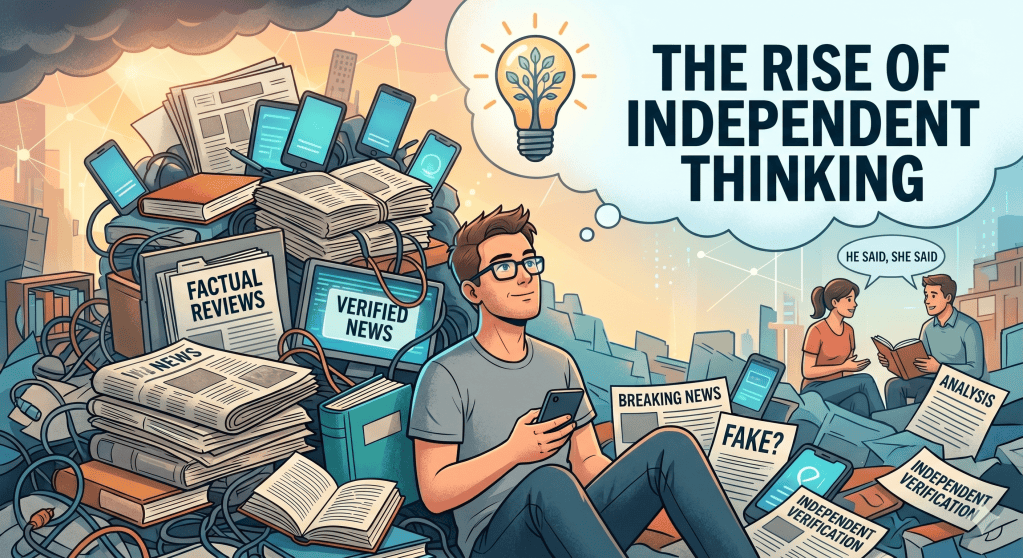
Explore the rise of independent thinking — tracing its roots in institutional failure, the psychology of belief, and technology’s role in reshaping how we decide what to trust.
Imagine spending an hour trying to answer a simple question — say, whether a particular food is good for you. You read three articles and find three different conclusions. You watch a doctor explain the science on YouTube, listen to a researcher discuss the studies on a podcast, and scroll past an influencer citing the same evidence to argue the opposite point. Each source sounds confident. Each one cites something. By the end of the hour, you trust none of them completely — and, almost without noticing, you trust your own judgment a little more than you did when you started.
That experience, repeated across millions of people and thousands of topics, is not an accident. Specific historical, psychological, and technological forces produced it — and together they have quietly changed how a significant share of the population relates to knowledge, expertise, and truth.
There is something unusual about a world this saturated with opinions, data, and algorithmic content: the average person feels, more than ever, that they need to figure things out for themselves. Trust in institutions has declined. Suspicion of consensus has grown. This is the story of that shift — not a philosophy class concept or a self-help platitude, but a real psychological and cultural phenomenon, built from the collapse of deference to authority, the fracturing of shared information ecosystems, and the science of how human minds actually form beliefs. Understanding how we got here requires tracing several intertwined stories: the decline of institutional trust, the psychology of belief, and the technologies that transformed information itself.
When Authority Wasn’t a Dirty Word
To understand the present, it helps to look at what came before. For most of the twentieth century in the Western world, there was a relatively stable ladder of trust — a structure that governed who people turned to when they wanted to know what was true. Doctors, professors, journalists, clergy, and government officials occupied elevated rungs, not because they were infallible, but because the systems that credentialed them were broadly trusted.
This deference was not blind. People questioned, grumbled, and dissented. But there was a shared sense that certain institutions — universities, newspapers of record, the scientific community — followed standards that made their conclusions more reliable than an uninformed individual’s. Walter Cronkite could end a broadcast with “and that’s the way it is,” and most Americans took that as a reasonable summary, not because Cronkite was right about everything, but because the alternative — verifying it yourself — wasn’t really on offer.
The ladder started cracking in the 1970s. Watergate showed that the government lied at the highest levels. The Tuskegee syphilis study showed that medical institutions could knowingly harm the people they were supposed to protect. Vietnam broke the credibility of military and political leadership for an entire generation. These weren’t isolated scandals — they were systemic revelations, and the doubt they left behind kept compounding for decades.
The Fracture Lines Deepen
By the late 1990s and early 2000s, the internet was doing something unprecedented: it democratized access to information and the production of it at the same time. Anyone could publish. Anyone could find a counter-narrative for any mainstream claim. Anyone could find a community of people who shared their doubts.
This was genuinely liberating in many ways. For people whose experiences had been erased from official histories, the internet offered visibility. For curious minds everywhere, it removed friction from the pursuit of knowledge. Primary sources — scientific papers, government documents, historical records — that once required library access were suddenly a search away.
But it also changed the relationship between information and credibility. When a carefully reported news article sat next to a blog post making the opposite claim, readers had to judge which one to trust — usually without the training, context, or time to do it well. The playing field of ideas had been leveled in a way that erased the visual difference between careful scholarship and confident-sounding misinformation. Leveling the field didn’t make the two more equal; it just made them harder to tell apart.
The 2008 financial crisis accelerated things further. Consider what that moment felt like from the outside. Ordinary people — retail investors, homeowners, workers — watched the most credentialed economists, the most sophisticated financial institutions, and the most trusted regulators fail to see a catastrophe coming, or stay silent when they did. Many had simply followed the conventional wisdom: trust the experts, diversify, the market corrects over time. Then the bottom fell out. For millions who lost jobs, savings, and homes, the lesson was hard to argue with: the experts don’t always know, and they don’t always tell you the truth even when they do. In the years that followed, “do your own research” shifted from an academic habit to something closer to a survival strategy.
The Psychology of Trusting Yourself
Why does the appeal of independent thinking run so deep? Part of the answer sits in some well-documented features of how minds actually work.
The Illusion of Explanatory Depth
One of the more humbling findings in cognitive science is what researchers Philip Fernbach and Steven Sloman called the “illusion of explanatory depth.” People consistently overestimate how well they understand complex systems — everything from how a toilet works to how trade policy affects employment. When asked to provide a detailed, step-by-step explanation, most discover that their understanding is far shallower than they assumed.
What makes this relevant is that the illusion runs in both directions. People overestimate their own grasp of things while underestimating how much expertise actually requires. A doctor who has spent fifteen years studying a disease and a patient who has spent two weeks reading forums may both feel equally confident — but confidence is the one thing that doesn’t track years studied. That is the trap: the feeling that tells you whether to trust your own judgment is not built from the same material as the judgment itself.
Motivated Reasoning and the Feeling of Thinking
Psychologist Jonathan Haidt’s research in moral psychology suggests that people rarely reach beliefs through purely rational deliberation. Instead, we reach a conclusion first — driven by intuition, emotion, or group identity — and build reasons for it afterward. He called this “the rider and the elephant”: the emotional, intuitive elephant goes where it wants, and the rational rider mostly narrates the trip after the fact.
This means the feeling of thinking carefully and independently isn’t the same as actually doing it. Two people can look at the same facts and reach opposite conclusions, each convinced they got there through honest analysis.
The implications are especially sharp for the culture of skepticism. Rejecting mainstream views can feel like intellectual courage, and sometimes it is. But it can just as easily be conformity to a different audience — a counter-cultural group, a political tribe, an online community that rewards contrarianism as proof of intelligence. The content of the belief changes; the dependence on someone else’s approval does not.
Predictive Brains and the Cost of Changing Your Mind
Psychology describes what people do. Neuroscience helps explain why the pattern is so persistent.
Modern neuroscience increasingly treats the brain not as a passive receiver of information but as a prediction engine. Rather than waiting for sensory data and then interpreting it, the nervous system constantly generates models of what it expects, then checks those predictions against what actually arrives. When reality matches the prediction, processing is smooth. When it doesn’t, the brain registers what researchers call a prediction error and has to decide whether to update the model or discount the signal.
This framework, known as predictive processing and associated with researchers including Karl Friston and Andy Clark, carries a real implication: revising a well-established belief costs the brain energy. Holding two contradictory ideas, tolerating ambiguity, genuinely entertaining a worldview that conflicts with your own — these aren’t just uncomfortable. They take real neural effort. The impulse to dismiss conflicting evidence may not be ideology at all. It may just be a brain protecting a model it already paid to build.
Independent thinking, genuinely practiced, asks the brain to do something it resists by nature: sit with uncertainty long enough to actually update. That resistance isn’t always stubbornness. Sometimes it’s just biology.
How Social Identity Shapes What We Believe
Human beings are not solitary reasoners. Our beliefs form, hold, and change within social contexts — and one of the more uncomfortable findings in social psychology is how thoroughly group identity drives that process.
Henri Tajfel’s social identity theory, developed in the 1970s, showed that people derive a significant portion of their self-concept from group membership and actively work to maintain a positive image of those groups. When a belief becomes associated with a particular group identity, holding or rejecting it becomes an act of social belonging, not just an intellectual choice. And here is the part that rarely gets said out loud: the belief doesn’t have to be tested for the badge to feel earned. Wearing “I question everything” is often easier than actually questioning anything — the label can be adopted in an afternoon, while the habit it claims to describe takes years.
In practice, this means that what looks like “independent thinking” is sometimes group-dependent thinking under a different label. A person who rejects mainstream medical guidance because “the government lies” may be no more independently minded than someone who accepts that guidance without question. Both are outsourcing their belief formation — one to official institutions, one to an oppositional subculture. The ladder of trust hasn’t disappeared; it’s just been flipped upside down.
The terms “echo chamber” and “filter bubble” capture a related dynamic. Research on how much algorithmic curation really drives this is genuinely mixed — self-selection seems to do more of the work than most people assume. But regardless of mechanism, it has never been easier to build an information environment that simply agrees with you. Many people, consciously or not, have done exactly that.
Technology’s Double Role
Technology made independent thinking easier and harder at the same time. The internet put an extraordinary amount of information within reach of anyone with a connection. But abundance created its own problem: when everything is available, the bottleneck shifts from access to evaluation. And evaluating information is a skill — one that requires practice, domain knowledge, and a tolerance for uncertainty that does not come naturally.
What economist Tim Wu called the “attention economy” made things harder still. Social media platforms, news outlets, and content creators of every kind live or die by engagement. The psychology of attention is consistent: novelty, emotional arousal, social threat, and outrage win. Content that makes people anxious or angry at an out-group spreads faster than measured, nuanced analysis ever will. No conspiracy required — just an economy that pays per click, rewarding whatever keeps people clicking.
Artificial Intelligence and the New Frontier
By the mid-2020s, a new dimension had entered the picture — one that may end up mattering more than anything before it.
Artificial intelligence systems became capable of generating text, images, audio, and video that could be difficult or impossible to distinguish from human-produced content. If the internet let anyone publish, AI let anyone produce professional-looking content at massive scale, with minimal effort, for nearly nothing. A single person could now seed the information environment with thousands of plausible-sounding articles, studies, or testimonials — and not all of them false, which is exactly what makes the problem hard.
The challenge this poses for independent thinking is different in kind, not just degree. It’s not just that there’s more misinformation. The cognitive shortcuts people have always used to judge credibility — does this look professionally produced, does it match what other sources say, does this person seem to know what they’re talking about — no longer work. Synthetic media can be polished, internally consistent, and footnoted with fabricated citations, with no human author anywhere in the chain.
Picture searching a contested topic and pulling up fifty articles, each with a different byline, a different outlet, a different tone of voice — and discovering that all fifty trace back to the same underlying model, prompted fifty slightly different ways. Nothing about any single article looks fake. The deception lives in the aggregate, in the false impression of fifty independent people having checked the same thing and agreed.
There is also a subtler dynamic at work. AI has become a research assistant for millions of people — a tool for answering questions, summarizing evidence, and navigating complex topics. That’s genuinely useful. But it also introduces a new kind of outsourced reasoning. Someone who asks an AI to explain a controversial issue and accepts the answer without scrutiny isn’t thinking independently — they’re delegating. Using AI as a tool and using it as a substitute for judgment can look identical from the outside, which is exactly why the distinction matters. Independent thinking in the age of AI now requires a second layer of scrutiny: not just evaluating the information, but evaluating the thing that evaluated it for you.
Perhaps most concerning is what some researchers call synthetic consensus — manufactured agreement that looks, from the outside, exactly like many people independently reaching the same conclusion. “If many different sources agree, it’s probably true” is generally a sound rule. It breaks down the moment many different sources can be one source, wearing different bylines.
What Genuine Independent Thinking Looks Like
After tracing all of this — the psychological limits of self-knowledge, the social pressures on belief, the way the information environment itself can be engineered — it’s worth asking what independent thinking actually means. Is it even possible?
The short answer is yes, but it asks for something more effortful and humbler than the popular image suggests. Independent thinking isn’t mainly about rejecting mainstream views, distrusting experts, or following your gut. It’s about taking responsibility for how you arrive at beliefs — doing the work of weighing evidence while staying honest about what you don’t know.
Philosophers and cognitive scientists sometimes call this intellectual humility: holding every belief loosely enough to remember it was formed from a limited vantage point, and keeping confidence tethered to evidence rather than conviction. It sits between blind deference and reflexive skepticism. A genuinely humble thinker doesn’t assume the expert is always right — but also doesn’t assume that doubt alone counts as insight.
Several habits tend to mark genuinely careful thinkers. They hold beliefs with roughly the confidence the evidence warrants — willing to say “I don’t know” even when social pressure pushes toward certainty. They engage with the strongest version of the opposing argument, not the weakest. They pay attention not just to what they believe but to how they got there — whether the conclusion followed honest engagement with evidence, or whether the evidence-gathering started with the conclusion already decided. And they seek out multiple independent sources, not to treat them all as equally reliable, but to see where they agree and diverge, and to understand why.
None of this is glamorous. It doesn’t feel like rebellion, and it earns none of the social rewards that come with confident, tribal certainty. But it’s closer to what independent thinking actually is — as opposed to what it feels like.
Looking Forward
The forces that produced the rise of independent thinking haven’t stopped. Political polarization, which hardened in the 2010s, has deepened in many democracies. Trust in mainstream media, scientific institutions, and government remains historically low. The information environment is more complex, more contested, and harder to navigate than it was even a decade ago.
At the same time, there are genuine countervailing forces. Media literacy programs have expanded. A generation that grew up online has developed real instincts for spotting inauthentic content. The scientific community has gone through a meaningful reckoning with replication failures and weak methods — slow self-correction, but real self-correction.
Here is the irony the last several thousand words have been circling: the same decades that produced millions of people determined to think for themselves also produced more ways to avoid it than at any point in history — communities that will do your verifying for you as long as you join, AI that will reason on your behalf as long as you ask, algorithms that will hand you agreement disguised as evidence as long as you keep scrolling. Independent thinking didn’t decline because people stopped wanting it. It got harder to practice in direct proportion to how badly everyone wanted to believe they were already doing it.
That’s a harder, less satisfying message than either “trust the experts” or “question everything.” But the future probably won’t belong to those who trust everything, or to those who trust nothing. It will belong to whoever learns to sit with uncertainty without being ruled by it.









