
Originally published in July 2018 and comprehensively updated and edited in June 2026.
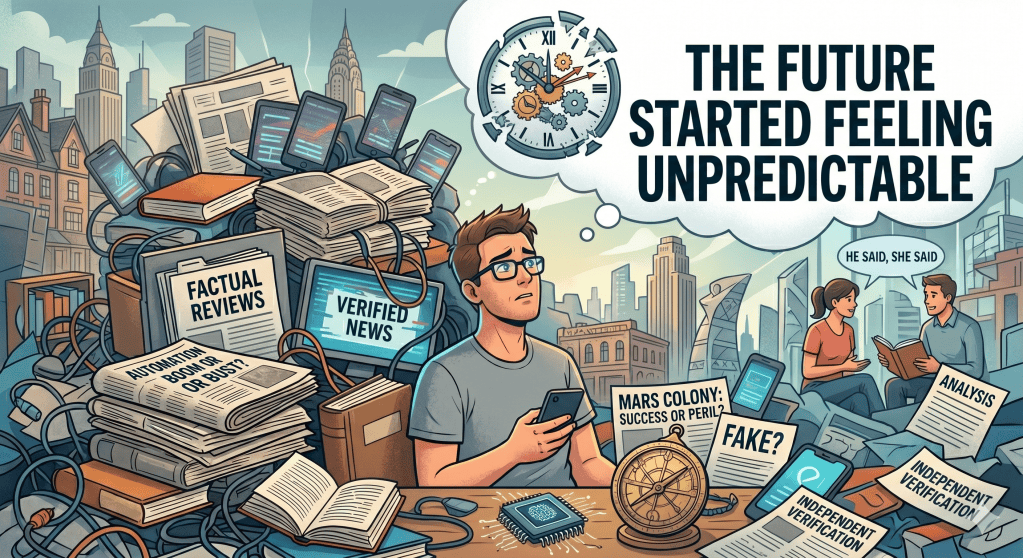
Why social media’s rise in the mid-2010s made daily life feel more uncertain, reshaping attention, comparison, mental health, and the way people understood the future.
There was a particular feeling that settled over a lot of people in the mid-2010s, one that’s hard to name precisely but easy to recognize in hindsight. It wasn’t quite fear, and it wasn’t quite excitement. It was something closer to vertigo, a sense that the rhythms of daily life had quietly changed beneath people’s feet, and that something they couldn’t fully name was responsible.
For a growing number of people, the cause traced back to the same object: the phone in their pocket, and more specifically, the feeds they kept opening on it.
By 2018, smartphones and social media had moved from novelty to near-universal habit in a remarkably short span of time. What had started as a way to stay in touch with friends had become, for many people, the primary lens through which they experienced the news, formed opinions, compared their lives to others, and filled the small gaps of boredom that used to pass quietly. Alongside that shift came a quieter and more troubling one: rising rates of self-reported anxiety, sleep disruption, and a vague but persistent unease that researchers, journalists, and ordinary users alike began trying to connect to the platforms themselves.
It’s worth pausing on what this actually looked like in practice, because the texture of it is easy to forget once it becomes routine.
It meant unlocking the phone before getting out of bed, not for any particular reason, just out of habit. It meant feeling a faint pull toward a notification badge even when experience suggested it was unlikely to contain anything important. It meant checking the news dozens of times a day and somehow feeling less informed rather than more. The stories rising to the top of a feed weren’t organized primarily by significance; they were organized by engagement. The things that provoked the strongest emotional reactions were often the things most likely to be seen.
A person could go to sleep with no sense that anything unusual was happening and wake up to discover that an argument, controversy, or public scandal had already unfolded online while they slept, complete with alliances, narratives, and conclusions that seemed to have materialized overnight. News had once arrived in relatively predictable packages: a morning paper, an evening broadcast, a beginning and an end. Now it arrived as weather, ambient and constant, impossible to fully step outside of.
The question researchers, journalists, parents, and ordinary users spent the next several years trying to answer was whether these changes were merely altering habits or fundamentally reshaping the way people thought, felt, and experienced the world.
The interesting question was never whether social media was simply good or bad. It was what happened when a technology optimized for engagement became the environment through which hundreds of millions of people experienced reality. Understanding why this period felt so psychologically unsettled requires looking not only at what people were seeing on their screens, but at what those screens were doing to attention, emotion, and people’s sense of where the future was heading.
How Social Media Became Inescapable So Quickly
To understand the anxiety this period generated, it helps to remember how fast the underlying technology moved.
Smartphone ownership in the United States crossed roughly 50 percent of adults around 2012 and continued climbing rapidly from there. By the middle of the decade, platforms such as Facebook, Instagram, Twitter, and Snapchat had accumulated hundreds of millions—and in some cases more than a billion—active users. This wasn’t a gradual cultural shift measured across generations. It was a large-scale reorganization of human attention compressed into less than a decade.
What made the transition especially disorienting wasn’t simply the speed of adoption. The platforms themselves kept changing while people were still adjusting to the previous version. Facebook increasingly relied on algorithmic ranking. Instagram abandoned chronological feeds in favor of algorithmic curation. Infinite scrolling, recommendation systems, and engagement-focused design features became increasingly common.
Users weren’t adapting to a stable technology. They were adapting to a moving target.
The companies building these platforms had access to enormous amounts of behavioral data and continuously modified their products based on what kept people engaged. The result was a communication environment that evolved faster than most people could consciously understand.
The Shift From Connection to Comparison
The original promise of social media was connection.
It offered a way to stay close to distant friends, discover communities, and maintain relationships across geographic boundaries. For many people, those benefits were real.
Yet by the mid-2010s, researchers and users alike were beginning to notice something else happening alongside those advantages. Platforms built around sharing photographs, updates, achievements, and milestones naturally encouraged comparison. Users rarely posted ordinary moments. They posted highlights.
Psychologists have studied social comparison for decades. In the 1950s, Leon Festinger proposed that people evaluate themselves partly by comparing their circumstances to those around them. What changed during this period wasn’t the existence of comparison itself. It was the scale and frequency of the comparisons being presented.
A person in previous decades might compare themselves to a few dozen people in their immediate social environment. A person in 2017 could be exposed to carefully curated glimpses into the lives of hundreds or thousands of people in a single day, most of them displaying unusually attractive, successful, exciting, or flattering versions of reality.
The result wasn’t necessarily conscious envy. More often it was a subtle shift in expectations. When exceptional moments become the most visible moments, they begin to feel normal.
What the Research Actually Found
As concerns about social media grew, scientific research attempted to determine whether the worries were justified.
Some of the most influential work came from psychologist Jean Twenge and colleagues, who analyzed large datasets examining technology use and adolescent mental health. Their findings suggested that heavier smartphone and social media use correlated with higher rates of reported depression, loneliness, and psychological distress among teenagers, particularly girls.
The research attracted substantial attention and helped shape a broader public narrative that social media was driving a mental health crisis among young people.
Other researchers urged greater caution.
In 2019, Oxford researchers Amy Orben and Andrew Przybylski examined similar datasets and concluded that while the relationship between technology use and wellbeing appeared real, the statistical effect sizes were relatively small. Their argument was not that social media had no impact, but that many public claims were stronger than the available evidence justified.
Part of the difficulty stemmed from the nature of the data itself. Most studies during this period were correlational. They could show that heavy social media use and poor mental health often occurred together, but they could not reliably determine whether one caused the other.
It is plausible that extensive social media use contributes to anxiety, loneliness, or depression. It is equally plausible that people already experiencing those difficulties are more likely to spend time online. In many cases, both processes may occur simultaneously.
A smaller number of studies attempted more rigorous experimental designs. One widely discussed 2018 study led by economist Hunt Allcott asked participants to deactivate Facebook for four weeks. Those who did reported modest improvements in wellbeing and reductions in political polarization, suggesting at least some genuine causal effect from the platform itself.
The most defensible scientific conclusion was neither that social media was harmless nor that it was catastrophically damaging. The evidence pointed toward real but generally modest average effects, with larger impacts concentrated among particular groups who were already vulnerable for other reasons.
The Neuroscience of the Scroll
Statistics tell only part of the story. To understand why social media proved so psychologically compelling, it’s useful to examine what happens inside an individual brain during the act of scrolling.
Social media feeds operate in a way behavioral scientists describe as a variable-ratio reinforcement schedule. Rewards arrive unpredictably rather than according to a fixed pattern. Most posts may be uninteresting, but occasionally a user encounters something surprising, emotionally stimulating, validating, or rewarding.
This is the same underlying principle that makes slot machines difficult to walk away from.
The brain responds not only to rewards themselves but also to the possibility of rewards. Uncertainty generates anticipation, and anticipation can be highly motivating. As a result, people often continue checking feeds not because every visit is rewarding but because the next one might be.
The comparison to gambling is sometimes exaggerated in public discussion, but the underlying psychological mechanism is well established. Decades of behavioral research and later neuroscience work on dopamine signaling support the basic principle.
What makes this particularly significant is that many of these features were not accidental. Around this time, several former technology executives publicly acknowledged that engagement-focused features such as infinite scrolling, notifications, and social feedback mechanisms had been intentionally designed to encourage repeated use.
The platforms were not merely competing for users’ time. Increasingly, they were competing for users’ attention.
Why Unresolved Information Keeps the Body on Alert
The reward mechanics of scrolling are only part of the story.
The content itself also matters.
Human stress systems evolved to handle threats with relatively clear beginnings and endings. A threat emerges, the body mobilizes resources, the threat is addressed, and physiological systems return toward baseline.
Social media often disrupts this pattern.
Instead of encountering one identifiable problem, users encounter a continuous stream of partially resolved and emotionally activating information: a disturbing headline, a political argument, a tragedy, a controversy, an alarming statistic, and then another one immediately afterward.
Many of these events never reach a satisfying resolution from the perspective of the individual observer. They simply disappear beneath newer content.
The result can be a persistent state of low-level vigilance. Rather than responding to a single acute stressor, people remain exposed to a constant flow of potential concerns without a natural stopping point.
The Specific Vulnerability of Adolescents
While social media affected nearly every age group, researchers consistently found stronger negative associations among adolescents, particularly adolescent girls.
Developmentally, this is not especially surprising.
Adolescence is a period during which social approval and peer status carry unusual psychological weight. Brain systems involved in social reward are highly active, while the regions responsible for long-term planning and impulse control are still developing.
This combination creates heightened sensitivity to feedback from peers precisely at the stage of life when social identity is still being formed.
For many teenagers, social media became a continuous source of evaluation, comparison, and validation. Yet the relationship was rarely straightforward. Surveys conducted throughout the period often found adolescents describing social media as both a source of stress and a source of genuine connection.
The fairest interpretation is not that social media created entirely new vulnerabilities. Rather, it amplified existing ones. For some users, especially those already struggling with isolation, anxiety, body image concerns, or social comparison, the platforms intensified pressures that were already present.
The End of a Shared Information Environment
There was another change taking place beneath the surface of all this, one that received less attention than mental health concerns but may have contributed just as much to the feeling of unpredictability that defined the period.
For much of the twentieth century, people inhabited a relatively shared information environment. They watched many of the same broadcasts, read many of the same newspapers, and encountered major events through many of the same channels.
People disagreed about politics, culture, and public affairs, but they were often reacting to a common set of stories.
Social media altered that arrangement.
Information no longer arrived in the same order for everyone, or even from the same sources. Algorithms increasingly personalized what users saw based on their interests, behaviors, and engagement patterns.
Two people living in the same city could open their phones and encounter entirely different versions of reality.
One person might spend the morning immersed in political outrage and conclude society was falling apart. Another might spend the same morning seeing entertainment news, travel photography, and fitness content. Neither perspective was necessarily false, but each represented only a narrow slice of a much larger world.
This fragmentation made collective expectations harder to maintain. Public attention seemed to shift unpredictably. Viral controversies appeared suddenly and disappeared just as quickly. Trends emerged overnight. Narratives changed without warning.
The future felt harder to anticipate because the informational foundations people used to understand the present had become increasingly individualized.
In this sense, social media did more than accelerate information. It personalized reality itself.
Why This Felt Like the Future Itself Becoming Unpredictable
Stepping back from the research, it’s worth asking why this technological shift generated such a widespread sense that the future itself had become harder to predict.
Part of the answer lies in the absence of precedent.
Previous communication technologies had transformed society as well, but they generally arrived more gradually and often had recognizable predecessors. Social media’s combination of scale, speed, personalization, and algorithmic curation created something genuinely different.
Individuals, parents, educators, policymakers, journalists, and even the engineers building these systems were trying to understand their consequences while living inside them.
Science lagged behind deployment. Regulation lagged behind science. Cultural norms lagged behind all of it.
People could feel changes occurring in their own habits, attention spans, relationships, and emotional lives without possessing a clear framework for understanding those changes. Something important seemed to be happening, but no one could say with confidence where it was leading.
That gap between experiencing a transformation and understanding it is what makes a period feel unpredictable.
It wasn’t merely uncertainty about technology. It was uncertainty about the future shape of society itself.
Conclusion
The years surrounding 2018 marked a moment when a genuinely new psychological environment became a daily reality for a large share of the population. The algorithmically curated feed transformed how people consumed information, related to one another, experienced social comparison, and understood the world around them.
The research that emerged from this period painted a more nuanced picture than either the most alarmed headlines or the most dismissive responses suggested. Social media appears to have had real but generally modest average effects on mental health, with larger consequences concentrated among particular groups and operating through identifiable psychological mechanisms rather than any single universally harmful pathway.
Yet the deeper significance of the period extends beyond questions of anxiety, dopamine, or screen time.
What made these years feel so unsettled was that people were adapting to a new informational reality before anyone fully understood its consequences. The systems shaping attention, emotion, and public conversation evolved faster than science, culture, or institutions could keep pace with them.
The uneasy feeling many people associated with this era was not irrational. It reflected a reasonable response to living through a rapid transformation in the basic texture of daily life. The world had become more connected, more personalized, more immediate, and in many ways more difficult to interpret.
For the first time, large numbers of people were experiencing reality through systems designed not primarily to inform them, but to engage them. And for a period, before society had learned how to adapt, that made the future feel less like something people were shaping together and more like something arriving one scroll at a time.









