
Originally published in July 2018 and comprehensively updated/edited in June 2026.
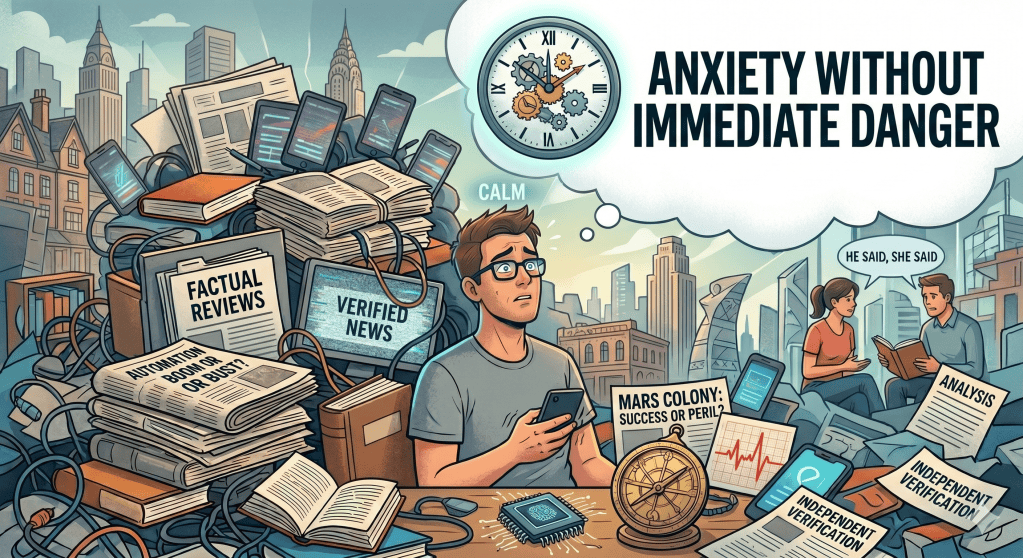
Why do modern people feel anxious without obvious danger? Explore the neuroscience, social media, economic uncertainty, and cultural forces behind rising anxiety rates.
Something shifted in the cultural mood sometime around the mid-2010s. It wasn’t a single event but a slow accumulation — a background hum of unease that more and more people were noticing and naming. Anxiety became the defining psychological complaint of the era. Prescriptions for anti-anxiety medications climbed. Wait lists at therapists’ offices stretched for months. College counseling centers reported demand they couldn’t keep pace with. Mental health apps multiplied across app stores, each promising to quiet the noise.
What made this wave unusual wasn’t just its scale. It was its character. The anxiety people were describing often had no obvious source. There was no invading army at the city gates, no famine, no immediate physical threat. Life by many historical measures was safer, more comfortable, and more medically advanced than any generation before had enjoyed. And yet something felt wrong — persistently, diffusely, unshakably wrong.
This is the paradox at the center of anxiety without immediate danger: why does a system designed to protect us from harm so often fire in the absence of any real threat? The nervous system evolved to survive predators, not notifications — but it cannot tell the difference. Why did modern, relatively secure societies begin producing anxiety at rates that looked more like symptoms of collective illness than normal variation in human mood? The answer requires looking at how anxiety works in the brain and body, how the modern world changed the conditions under which that system operates, and how cultural, technological, and social forces combined to create a uniquely anxious moment in human history.
What Anxiety Actually Is
Before exploring why anxiety became so widespread, it helps to understand what it is at a biological level — because the popular understanding often misses something important.
Anxiety is not a malfunction. It is, at its core, a threat-detection and preparation system that evolved over millions of years. When the brain perceives danger — or even the possibility of danger — a cascade of physiological changes begins. The amygdala, a small almond-shaped structure deep in the brain, fires rapidly. Stress hormones including adrenaline and cortisol flood the bloodstream. Heart rate increases. Muscles tense. Digestion slows. Attention narrows. The body is, in a literal sense, preparing for fight or flight.
This response is extraordinarily effective for the kinds of threats humans faced through most of evolutionary history: predators, physical confrontations, food scarcity, environmental hazards. The problem is that the system cannot easily distinguish between a tiger and a tense email from a boss. It responds to perceived threats, not only to actual physical ones. And the modern world has become extraordinarily good at generating perceived threats.
Neuroscientists sometimes describe two broad pathways of threat processing in the brain. One is fast and automatic — the amygdala receives sensory information and fires before the thinking brain has time to evaluate it. The other is slower and more deliberate, involving the prefrontal cortex, which can assess, contextualize, and often dampen the alarm signal. In healthy functioning, these systems work together. Anxiety disorders, and subclinical chronic anxiety, often involve an overactive fast pathway and an underactive regulatory pathway — a system chronically tilted toward alarm.
The Body Keeps Score
Research in psychophysiology has established clearly that anxiety isn’t just a mental experience. It lives in the body. Chronically elevated cortisol affects the immune system, cardiovascular health, sleep architecture, memory consolidation, and metabolic function. The phrase “anxiety without immediate danger” isn’t merely poetic — it describes a body running emergency protocols in non-emergency conditions, burning resources and creating wear in ways that accumulate over time.
This is why the rising rates of anxiety documented from roughly 2012 onward weren’t just a cultural or psychological curiosity. They were a public health matter. Jean Twenge, a psychologist at San Diego State University who has tracked generational shifts in mental health data, documented significant increases in anxiety and depression symptoms, particularly among adolescents and young adults, during this period. Her analyses tied much of the trend to changes in how young people were spending their time — specifically, the shift toward screen-based socializing and away from in-person interaction.
The Smartphone and the Rewiring of Social Life
No account of the anxiety surge of the 2010s can avoid the smartphone. By 2012, smartphone ownership had crossed into majority territory in the United States, and social media use — already well-established — had migrated from desktop computers into something people carried in their pockets and checked hundreds of times a day.
This wasn’t simply a change in technology. It was a change in the basic rhythm of human attention and social experience. Humans are profoundly social animals. The threat-detection system in the brain is especially attuned to social threats — rejection, exclusion, status loss — because for most of human history, losing standing in a group could be as dangerous as a physical predator. Getting cast out meant reduced access to food, protection, and mates.
Social media platforms, almost without intending to, built environments that activated this social threat-detection system continuously. The public quantification of approval (likes, followers, shares) made status visible and measurable in real time. The permanent, searchable nature of online interactions meant that social missteps had longer tails. The algorithmically curated feeds that emerged — optimized for engagement rather than wellbeing — tended to surface outrage, conflict, and catastrophe, because those are the stimuli that trigger the threat-detection system and hold attention.
Comparison Without Context
Psychologists have long understood that humans evaluate their own situations partly by comparing themselves to others. Social comparison theory, developed by Leon Festinger in the 1950s, described this as a basic feature of how people understand their own abilities and circumstances. In most of human history, the pool of people available for comparison was small — your village, your neighborhood, your workplace.
Social media destroyed those natural limits. Suddenly a teenager in a mid-sized city was not comparing herself to her immediate peers but to the most curated, filtered, and successful presentations of millions of people. Research consistently found that passive scrolling through social media — particularly image-heavy platforms — was associated with lower mood and higher anxiety, while active, genuine communication with known individuals had more neutral or positive effects. The medium had separated social connection from many of its benefits while retaining and amplifying many of its pitfalls.
The particular harm to adolescents during this period was significant. The teenage brain is neurologically in a heightened state of social sensitivity — peer relationships and social belonging carry enormous weight in ways that are partly driven by ongoing brain development. Dropping that brain into an environment of constant public evaluation, comparison, and potential humiliation was, many researchers argued, a serious mismatch between biological vulnerability and environmental demand.
The News Environment and the Politics of Threat
The transformation of the media environment during this period compounded what smartphones had already set in motion. The economic collapse of traditional journalism, combined with the rise of digital advertising models that rewarded clicks and engagement, pushed news organizations toward a more emotionally charged, conflict-driven style of coverage. This was less a conspiracy than a structural outcome. Alarming headlines drive traffic. Outrage keeps people reading. The same algorithmic dynamics that shaped social feeds also shaped the news environment.
What was qualitatively new wasn’t the existence of disturbing news but its ubiquity and delivery mechanism — available on the same devices people used for everything else, pushed through notifications directly to the attention at any hour. Heavy news consumers in experimental studies showed elevated stress hormones and more negative assessments of societal wellbeing, even when their personal circumstances were stable.
The Perceived Gap Between Personal and Collective Experience
One of the stranger features of anxiety in this era was the gap that opened between how people assessed their own lives and how they assessed the state of the world. Survey data consistently showed that people rated their personal situations as reasonably stable while simultaneously rating the country or the world as being in serious trouble.
This gap itself is a form of chronic low-grade anxiety. It means living with a persistent sense of ambient threat that can’t be acted upon directly, can’t be resolved through individual effort, and can’t be escaped. The inability to either confront or avoid the source of stress is, in clinical terms, one of the conditions most reliably associated with psychological distress. Prolonged helplessness in the face of perceived threat is one of the more reliable laboratory models of depression and anxiety.
Economic Uncertainty and the New Landscape of Stability
The psychological backdrop to all of this was an economic transformation that had been underway for decades but that crystallized in new ways after the 2008 financial crisis. Younger workers in particular were entering adulthood in conditions that looked different from what prior generations had experienced.
The career path that involved joining an organization, building seniority, and expecting relative stability had become less reliable. Automation and globalization had displaced categories of work that previous generations had taken as permanent. Housing costs in major cities had risen far faster than wages. Student debt had grown into a structural feature of the lives of millions of college graduates. The gig economy offered flexibility but removed many of the social support structures — health insurance, retirement benefits, predictable income — that reduce baseline financial anxiety.
When uncertainty becomes a permanent feature of life rather than a temporary situation, the threat-monitoring system doesn’t get to stand down.
When Material Security Isn’t Enough
There’s a common assumption built into how wealthy societies discuss mental health: that psychological distress is primarily a problem of deprivation. Fix poverty, fix anxiety. Secure the basics, and wellbeing follows. The data from this period complicated that story considerably.
Many of the people experiencing the sharpest rises in anxiety during the 2010s were not materially deprived by historical standards. They had housing, food, access to medical care, and more consumer choice than any previous generation. What they often lacked was something harder to quantify: predictability, permanence, and the sense that the ground beneath them was solid. Economic life had become more contingent. Careers felt less like paths and more like improvisations. The institutions that previous generations had relied on for stable identity — long-term employers, religious communities, civic organizations — had weakened or fragmented.
The distinction matters because it reframes what kind of problem chronic anxiety is. Modern societies can satisfy material needs while systematically undermining psychological security. Those are two different things, and conflating them leads to policy responses and individual coping strategies aimed at the wrong target.
Chronic Stress, Sleep, and the Feedback Loop
One underappreciated mechanism through which the modern environment generates and sustains anxiety involves sleep — or rather, its degradation.
Sleep is not simply rest. During sleep, particularly during slow-wave and REM stages, the brain consolidates memories, processes emotional experience, and restores the chemical balance that emotional regulation requires. Research by neuroscientist Matthew Walker and others has documented in detail how sleep deprivation affects the brain’s threat-processing systems: it amplifies amygdala reactivity, reduces prefrontal regulatory control, and produces a brain that is essentially tilted toward anxiety.
The conditions of contemporary life — artificial light that disrupts circadian rhythms, screens emitting blue light before bed, work schedules that don’t align with biological sleep needs, caffeine culture, the ambient stimulation of always-available entertainment — have contributed to widespread sleep insufficiency. The CDC has described insufficient sleep as a public health epidemic. And given the relationship between sleep quality and emotional regulation, sleep deprivation is not merely a side effect of anxious living — it is a mechanism that sustains and amplifies it.
The feedback loop matters here. Anxiety disrupts sleep. Disrupted sleep amplifies anxiety. The person who wakes at 3 AM with racing thoughts about tomorrow’s obligations is not experiencing a malfunction — they are caught in a well-documented neurological loop that can be very difficult to exit without deliberate intervention.
The Collapse of Recovery Time
Running beneath all of these forces — the phones, the news, the economic precarity, the social comparison — is a phenomenon that rarely gets named directly but may be the most consequential of all: the disappearance of psychological off-switches.
For most of human history, stress had a natural rhythm. Work ended when the sun went down or when the task was done. Social interaction required physical presence, which meant it also required physical absence. News arrived by newspaper, once a day. Mail came once. Stores closed. The demands of the social world had built-in limits that were structural, not a matter of personal willpower.
Those limits collapsed over the course of roughly two decades. Work now follows people home through email and messaging apps; the expectation of availability has expanded to fill whatever space people don’t actively defend. Social comparison is no longer confined to moments of actual social contact — it’s available during meals, before sleep, during what used to be solitary time. News has no closing edition. The stimulation environment has no off position.
This matters enormously for how the nervous system recovers. The stress response is not just designed to activate in the presence of threat — it’s designed to deactivate once the threat passes. That deactivation is not a luxury; it is biologically necessary. Cortisol levels need to drop. The amygdala needs periods of quiet. The prefrontal cortex, depleted by sustained vigilance, needs time to restore its regulatory capacity. Without genuine recovery windows, the system doesn’t reset. It runs at elevated baseline indefinitely.
The result is a population that is not experiencing acute stress in the old sense — the kind you recover from — but something more like chronic low-level activation that never fully resolves. The body cannot distinguish between an emergency and a rehearsal for one, and when rehearsals never stop, the physiology of emergency becomes the new normal. This is partly why sleep interventions, digital boundaries, and deliberate disconnection — however unglamorous — show up consistently in the research literature as among the more effective tools for reducing anxiety. They are not remedies for the symptoms. They are attempts to restore the recovery windows that the modern environment has quietly removed.
Anxiety and the Search for Certainty
There is a cognitive dimension to anxiety that the neuroscience alone doesn’t fully explain, and it has to do with the human relationship to uncertainty.
Research by Michel Dugas and colleagues identified what psychologists call “intolerance of uncertainty” as a central feature of generalized anxiety. This is the disposition to find ambiguity itself threatening — to need to know, to need resolution, to experience open questions as distressing rather than interesting. People high in intolerance of uncertainty show elevated anxiety across a wide range of situations, and they engage in behaviors — excessive checking, reassurance-seeking, planning and over-planning — aimed at reducing uncertainty, often at the cost of increasing preoccupation.
The information environment of the 2010s was, in a sense, perfectly calibrated to activate and frustrate this tendency. It offered the illusion of more information while actually producing more noise, more conflict, and more unresolvable complexity. Following news feeds compulsively, checking social metrics repeatedly, refreshing email — these behaviors have the psychological structure of compulsive reassurance-seeking. They feel like attempts to reduce uncertainty, but they rarely achieve that goal and often increase agitation.
The Paradox of Control in a Complex World
Related to intolerance of uncertainty is the broader human need for a sense of control — what psychologists call “locus of control.” Research consistently shows that people who experience their outcomes as largely the result of their own choices and actions show better mental health outcomes than those who experience themselves as at the mercy of external forces. The sense of agency, even when partially illusory, is psychologically protective.
Modern complexity creates genuine challenges for this need. Systems have become more interconnected, less legible, and more subject to forces that individuals cannot meaningfully influence. Climate change, algorithmic employment, global financial interconnection, technological disruption — these are real phenomena with real effects on individual lives, and they are also genuinely outside individual control. The anxiety they produce is not irrational. It reflects an accurate perception that the world is subject to forces that cannot be managed at the personal scale.
What Got Better and Why That Mattered Less Than Expected
It’s worth noting what this analysis could leave out: by many objective measures, life for most people in wealthy nations was getting better during this period, not worse. Crime rates in the United States had been falling for decades. Medical care had improved. Infant mortality continued to decline globally. Extreme poverty worldwide had dropped substantially. People were living longer, healthier lives.
This is not an argument that the anxiety was unfounded or that real problems didn’t exist. It’s an observation that the relationship between objective conditions and subjective psychological experience is mediated by many factors — including how information about conditions is processed, framed, and distributed. The paradox of rising anxiety in conditions of relative security points toward the role of perception, comparison, information exposure, and social environment in shaping psychological wellbeing.
It also points toward the limits of what material improvements can do for human flourishing in the absence of other conditions — social connection, meaningful work, belonging, a sense of purpose, adequate sleep, and a reasonable relationship to uncertainty. These are not luxuries on top of material needs. They are, the evidence suggests, deeply woven into what human psychological health requires.
Living in the Gap
By the late 2010s, anxiety had become a topic of cultural conversation in ways that didn’t have many precedents. It was discussed openly in ways that depression rarely was a generation earlier. Mental health literacy — the ability to recognize and name psychological experiences — had improved significantly, particularly among younger generations, and the stigma that had long surrounded mental health conditions was genuinely declining. More people sought help. That shift was, on balance, progress.
But the openness carried its own complications. There was evidence that the widespread cultural vocabulary for anxiety had effects on how people interpreted their own internal states — that labeling normal stress, discomfort, or sadness as anxiety could, in some cases, amplify the experience and increase avoidance behaviors. Language shapes experience. The cultural framing of anxiety as both ubiquitous and medically significant had effects that weren’t always straightforward, even when the underlying intention was compassionate.
Looking Forward
The conditions that produced the anxiety surge of the 2010s did not resolve cleanly. The informational environment continued to evolve, growing more complex and more saturated. Economic uncertainty persisted in different forms. The relationship between technology and human attention remained an active and unresolved question.
What changed was understanding. By the early 2020s, there was a substantially richer scientific literature on the mechanisms connecting environment, technology, social comparison, sleep, and anxiety. There was growing recognition that individual psychological resilience, while important, was not sufficient to address conditions with structural and environmental causes. Conversations about the design of digital platforms, the structure of work, the conditions of urban life, and the information environment began to include psychological wellbeing as a legitimate variable — not merely an individual problem to be managed.
Anxiety without immediate danger will not be solved by willpower or positive thinking. It calls for understanding how the threat-detection systems in human brains interact with environments those brains did not evolve to navigate — and for taking seriously the idea that changing those environments may matter as much as helping individuals cope with them.









