
Originally published in August 2018 and comprehensively updated/edited in June 2026.
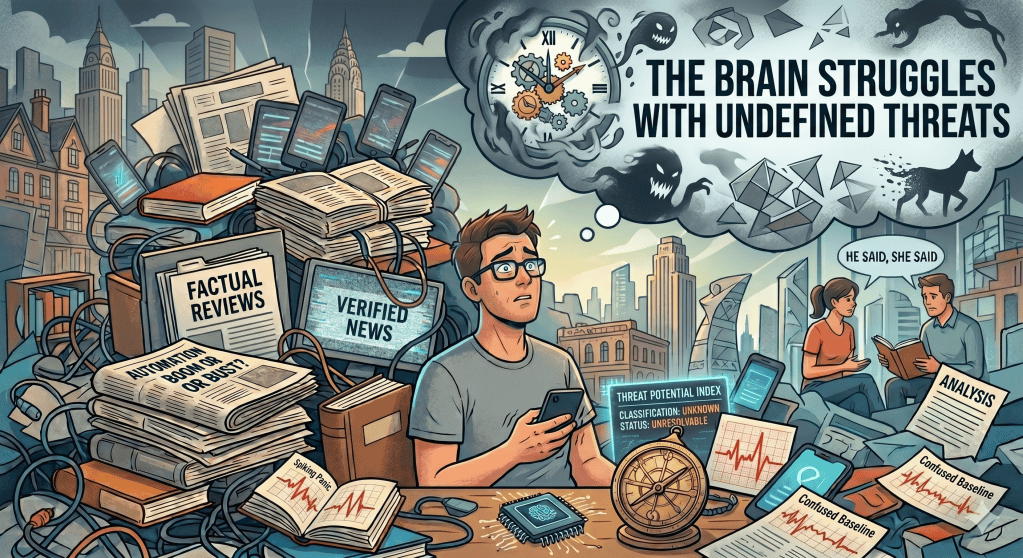
Why does anxiety persist even when no specific threat exists? This essay explores the neuroscience of undefined threat, the psychology of chronic stress, and how the modern information environment exploits the brain’s ancient alarm systems.
There is a particular kind of anxiety that doesn’t attach itself to anything specific. No tiger in the grass. No creditor on the phone. Just a low, persistent hum of unease that follows you through the day like a shadow you can’t locate. It’s the feeling that something is wrong without knowing what, or that something bad is coming without knowing when. For millions of people, that feeling became the ambient soundtrack of daily life sometime in the mid-2010s — and it hasn’t quieted much since.
Consider a fairly ordinary Tuesday morning. Your bills are paid. Nobody is threatening you. Your family is safe. But before breakfast you’ve absorbed headlines about war, economic instability, layoffs in your industry, a new disease outbreak, political conflict, and artificial intelligence disrupting entire professions. None of these things requires action from you right now. Yet your nervous system has registered each as potentially relevant to your survival — and the day hasn’t really started.
What’s strange is that this kind of diffuse, object-less fear is, in some ways, harder for the human brain to process than fear with a clear target. We are built for the concrete. Evolution tuned our threat-detection systems for problems with edges — a predator, a cliff, a rival. When the danger is real, immediate, and visible, the brain knows exactly what to do. When the threat is everywhere and nowhere at once, the system keeps running without resolution, burning fuel and producing nothing but wear.
Understanding why the brain struggles with undefined threats — and why modern life seems engineered to produce them — requires a look at the architecture of fear itself, the social conditions that amplified it, and what the research tells us about living in a state of chronic, unresolved alarm.
How the Brain Processes Threat
The Machinery of Fear
The brain’s threat-response system is ancient and fast. At its core sits the amygdala, a small, almond-shaped cluster of neurons buried deep in the brain’s temporal lobe. The amygdala acts as a kind of early-warning station, constantly scanning incoming sensory information for signs of danger. When it detects a potential threat, it doesn’t wait for a committee decision. It fires immediately, triggering a cascade of hormonal responses — adrenaline, cortisol, norepinephrine — that prepare the body for action.
This response is often called “fight-or-flight,” though researchers now prefer the more expansive “fight-flight-freeze,” since immobility is also a common threat response in many animals, including humans. The point is that the system is designed for rapid mobilization. Blood flows to large muscle groups. Heart rate increases. Non-essential functions like digestion and immune activity get temporarily deprioritized. The entire organism shifts into emergency mode.
This system is extraordinarily effective against concrete, time-limited threats. The problem is that it was not designed for the kinds of threats that dominate contemporary life. It was designed for lions, not for dread.
When the Threat Has No Shape
Neuroscientist Joseph LeDoux, whose decades of research on the amygdala helped build the modern understanding of fear, has argued that what we experience as “fear” is actually a composite of two separate processes. One is a rapid, largely unconscious defensive reaction — the kind the amygdala initiates before your conscious mind has even registered what happened. The other is a more deliberate cognitive appraisal — the thinking brain trying to make sense of what’s going on and decide how to respond.
Under normal circumstances, these two systems work in rough coordination. You hear a loud bang, the amygdala fires, you startle — and then your prefrontal cortex steps in, processes the context (it was a car backfiring), and downregulates the alarm. The fear resolves.
But undefined threats short-circuit this resolution process. When the stimulus is ambiguous — a vague worry, a social environment that feels subtly hostile, a persistent sense that the world is unstable — the brain’s threat-monitoring systems can remain active because the cognitive appraisal process never arrives at a sufficiently clear resolution. The threat stays open. The alarm keeps ringing.
Research in cognitive neuroscience has consistently shown that uncertainty amplifies the brain’s threat response. A 2016 study published in Nature Communications, led by researchers at University College London, found that uncertainty about whether a negative event would occur was more stressful, by measurable physiological indicators, than certainty that the negative event would occur. People who knew they were going to receive a mildly painful stimulus showed lower stress responses than people who didn’t know whether they would receive one. Certainty, even of bad news, is something the brain can work with. Uncertainty keeps it suspended.
The Environment That Feeds Undefined Threat
Information Overload and Threat Inflation
The digital media environment that crystallized in the late 2000s and expanded aggressively through the 2010s created conditions that are, from a neurological standpoint, nearly ideal for producing chronic, unresolved threat states. The reasons involve both the volume and the structure of information.
Human attention is a scarce resource, and media platforms — social networks, news aggregators, content recommendation systems — compete for it. Research in behavioral science has repeatedly confirmed that negative, alarming, and threatening content reliably captures attention more effectively than neutral or positive content. This is not a media invention; it reflects the brain’s natural prioritization of potential threats. But digital platforms operationalized and optimized this bias at scale. An algorithm that maximizes engagement will, almost mechanically, surface more threatening content, because threatening content keeps people watching, scrolling, and reacting.
The result was an information environment where the average news consumer was exposed to a volume and variety of potential threats that had no historical precedent. Pandemics, political instability, economic collapse, climate catastrophe, social conflict — all arriving in the same feed, often stripped of context, competing for attention with personal posts and advertisements. Each individual item might be real and worth knowing about. But the aggregate effect was a threat landscape that the brain had no framework to evaluate or resolve.
Psychologist Steven Pinker has argued, with substantial statistical evidence, that many dimensions of human life have objectively improved over time — rates of violent death, extreme poverty, child mortality, and a range of other concrete harms have declined substantially over the long run. That argument can be contested on various grounds, and it does not apply uniformly across populations. But even granting Pinker’s data, the perception of threat has not followed the trajectory he describes. And perception, not statistical reality, is what the amygdala responds to.
Social Comparison and Status Anxiety
Beyond the news cycle, social media introduced a second mechanism for producing undefined threats: constant, unavoidable social comparison at scale. Psychologist Leon Festinger described the basic mechanics in 1954 — humans evaluate their own status and worth partly by measuring themselves against others. That’s a functional process in small social groups where comparisons are grounded in relatively complete knowledge of other people’s lives. Social media transformed it into something different: a comparison environment based almost entirely on curated self-presentation, operating against billions of people, where almost everyone else appears more successful, more attractive, and more content than they actually are.
The threat this produces is characteristically undefined. It’s not “I am losing my job” or “I cannot pay my rent.” It’s a diffuse sense of inadequacy — a social threat without clear edges that the brain cannot easily resolve or dismiss. Studies examining social media use and psychological wellbeing have found consistent associations with increased anxiety and depressive symptoms, particularly among younger users, though the causal mechanisms are still being refined.
Political and Institutional Uncertainty
The political climate of the late 2010s added a third layer. Across multiple Western democracies, institutions that had provided a stable background of predictability — stable governance, established norms of political behavior, reliable media ecosystems, trust in expertise — came under significant stress. Whatever one’s political orientation, the effect was to introduce uncertainty into domains that had previously been taken for granted.
From a psychological standpoint, this matters because background stability functions as a kind of cognitive resource. Knowing that certain things will not change — that basic social contracts will hold, that tomorrow will resemble today in its broad outlines — frees up mental bandwidth for the ordinary demands of life. When that background stability is disrupted, the cognitive load increases. More things require active monitoring. More outcomes feel uncertain. The threat-detection system runs hotter.
Researchers studying what they call “systemic threat” — threats to the social order rather than to the individual directly — have found that these types of threats activate similar psychological responses to personal threats, including increased preference for order and predictability, heightened sensitivity to outgroup members, and reduced cognitive flexibility. The brain responds to social instability partly as it responds to physical danger: by narrowing attention, increasing vigilance, and becoming more prone to categorical thinking.
The Body Keeps the Score — But So Does the Mind
Chronic Activation and Its Costs
The physiological costs of sustained stress activation are well-documented. Cortisol, the primary stress hormone, is adaptive in short bursts. Chronic elevation is a different matter. Research has linked prolonged elevated cortisol to impaired immune function, cardiovascular stress, disrupted sleep architecture, metabolic changes, and cognitive effects including impaired memory consolidation and reduced executive function — the prefrontal cortex capacities that enable planning, impulse control, and nuanced reasoning.
There’s a compounding problem here. The cognitive capacities most useful for evaluating complex, ambiguous threats — sustained reasoning, tolerance of uncertainty, emotional regulation — are precisely the ones chronic stress degrades. Research on cognitive load, and neuroscientist Amy Arnsten’s work on the prefrontal cortex, points toward the same conclusion: a brain under prolonged stress shifts control toward more reflexive, emotionally driven systems. It becomes less capable of resolving the very conditions that are straining it.
Anxiety as a Feature, Not a Bug
It’s worth stepping back to note that anxiety — even chronic anxiety — is not simply a malfunction. It is the output of a system that is working as designed, responding to inputs it was built to take seriously. The problem is a mismatch between the system’s design parameters and the environment it’s currently operating in.
Evolutionary psychologists sometimes describe this as a “mismatch” problem: adaptations that were highly functional in the environment where they evolved can become maladaptive when the environment changes faster than selection can track. The amygdala’s sensitivity to potential threats was a valuable asset on the savanna. In an environment that delivers a continuous stream of simulated threats through a glowing rectangle we carry in our pockets, the same sensitivity can produce a state of near-constant low-grade alarm without any corresponding benefit.
Psychologist Randolph Nesse, who has written extensively on what he calls “the smoke detector principle” in mental health, makes a similar point. A smoke detector calibrated to avoid false negatives — to ensure it goes off whenever there is real fire — will necessarily produce many false alarms. The cost of a false alarm is minor irritation. The cost of missing a real fire is catastrophic. Natural selection, like a cautious engineer, calibrates threat detection toward false alarms. That’s why the brain overestimates threats. It’s not irrationality; it’s a design choice with a logic behind it.
The problem, Nesse argues, is when the false alarm rate becomes so high that the system is essentially always on — when the smoke detector is blaring continuously and you have no way to check whether there’s actually a fire.
If chronic anxiety is partly an environmental mismatch rather than a personal defect, then the relevant question becomes less “How do we eliminate anxiety?” and more “How do we help the brain operate effectively inside conditions it did not evolve for?”
Finding Resolution in an Unresolved World
What Research Suggests About Coping With Diffuse Threat
Research on resilience and stress regulation offers some consistent themes, though it’s important not to overstate what any individual coping strategy can accomplish in the face of structural conditions.
One of the most robust findings in this area is the importance of perceived control. Psychologist Martin Seligman’s early work on learned helplessness demonstrated that uncontrollable stressors are significantly more damaging than controllable ones, even when the objective level of harm is similar. When organisms cannot act effectively on their environment, the stress response becomes chronic and the organism tends toward passivity and psychological deterioration. When some degree of control is available — even limited, partial control — the experience of stress changes substantially.
For undefined threats, this suggests that one functional strategy is converting them, where possible, into defined problems. Not because the definition is always accurate, but because a specific, bounded problem is one the brain can actually engage with. This is part of why cognitive behavioral therapy — which focuses on identifying, examining, and challenging specific thought patterns — has proven effective for anxiety disorders. It gives the amygdala’s activation somewhere to go.
Another consistent finding involves social connection. Researcher Sheldon Cohen and colleagues have produced extensive evidence that social support functions as a buffer against stress, reducing the physiological impact of threatening experiences. This is not simply a psychological comfort; it appears to operate through measurable biological pathways including effects on cortisol regulation and immune function. The social brain — and humans are intensely social animals — processes belonging and isolation as survival-relevant information. Isolation amplifies threat perception. Connection reduces it.
Physical activity has a well-documented regulatory effect on the stress response system, partly through its effects on cortisol, partly through increased production of neurotrophic factors that support prefrontal cortex function, and partly through mechanisms that are still being worked out. This is not a novel finding, but it is one that the research continues to support.
What does not reliably help, despite its intuitive appeal, is compulsive information-seeking. The instinct to monitor a threatening environment continuously — to keep refreshing, keep checking, keep consuming information about potential threats — feels like prudent vigilance but functionally extends and amplifies the threat state rather than resolving it. Multiple studies on news consumption and psychological wellbeing have found that higher-frequency news consumption is associated with increased anxiety without a corresponding increase in feeling prepared or informed.
The Broader Picture
It would be a mistake to locate the problem of undefined threat entirely within individuals and their coping strategies. The conditions that produce chronic, unresolved threat states are partly structural — built into the architecture of information systems, economic arrangements, and social institutions. Addressing them requires attention at those levels as well.
But understanding the neurological and psychological mechanisms involved is genuinely useful, for at least two reasons. First, it allows us to be more precise about what is actually happening when people experience modern anxiety — to recognize it not as weakness or irrationality, but as a predictable response of a well-designed system to a poorly designed environment. Second, it points toward levers that can make a real difference in individual experience even when structural conditions remain unchanged.
The brain struggles with undefined threats not because it is broken, but because it was built for a world where threats were concrete, immediate, and resolvable. The task of navigating a world where they often are not is one that every generation since industrialization has faced in some form, and that the digital age has intensified substantially. Naming the difficulty clearly is at least a start.
Conclusion: Living With the Open Alarm
There’s a quiet irony at the center of this topic. The brain’s threat-detection system is one of evolution’s more impressive achievements — fast, sensitive, and calibrated to keep us alive. The same system, transplanted into the information environment of the early twenty-first century, becomes a source of chronic distress without a corresponding survival benefit. The alarm keeps ringing because the environment keeps feeding it signals, and because many of the threats it detects are real enough to demand attention but shapeless enough to resist resolution.
What research across psychology, neuroscience, and behavioral science consistently suggests is that the experience of unresolved threat is not simply a cognitive problem — something to be thought away. It is embodied, physiological, and deeply social. It responds to movement, to connection, to perceived agency, and to the gradual conversion of vague dread into specific, manageable concerns. It does not respond well to more information, more monitoring, or more exposure to the systems that generate the alarm.
The years since this essay was first drafted in 2018 have not made the landscape of undefined threat simpler. A global pandemic, renewed geopolitical instability, the rapid acceleration of artificial intelligence, and continued fracturing of information ecosystems have all added layers. The underlying neurological story has not changed — if anything, research has deepened and refined it. But the environmental conditions the brain is trying to navigate have become, if anything, harder to resolve.
That is not an argument for despair, and it is not a political prescription. It is an observation about the gap between the tool and the task. The human brain is remarkable. The world it currently operates in presents it with challenges it was not specifically designed to handle. Understanding that gap with some precision seems like the necessary first step toward navigating it with some wisdom









