
Originally published in September 2018 and comprehensively updated/edited in June 2026.
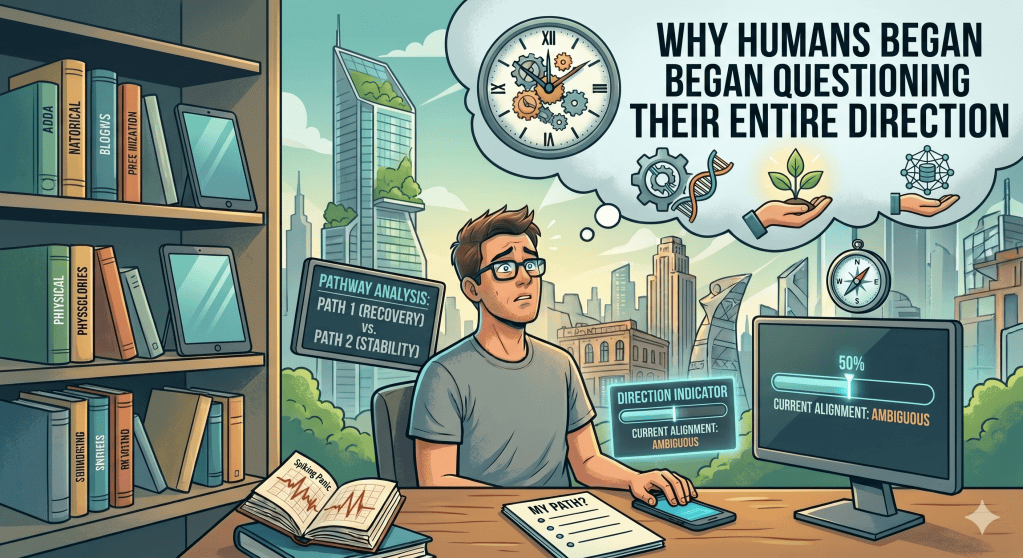
Why did so many people begin questioning humanity’s direction in the late 2010s? A deep look at the psychology, science, and cultural forces behind a civilization’s moment of self-doubt.
There is a particular kind of unease that settles in when people realize the path they are on might not be the right one — not just personally, but collectively. It is not panic, exactly. It is something quieter and more disorienting, like driving a long stretch of highway before suddenly wondering whether you missed your exit miles back. The unease is sharpest not when things are clearly falling apart, but when they are still mostly working, and yet something feels fundamentally wrong.
That feeling — diffuse, persistent, hard to name — became one of the defining psychological and cultural textures of the late 2010s. The technology that had once promised liberation now seemed to be surveilling and manipulating. The institutions built to organize modern life were losing public trust at a measurable pace. Political systems in dozens of countries were surfacing frustrations that had been building for decades. And beneath all of it, something was shifting in the way ordinary people thought about the future — not just whether it would be comfortable, but whether it was even legible. Whether the map they had been handed still corresponded to any actual territory.
This is not an article about a single crisis or a single cause. It is an attempt to understand a broader phenomenon: the moment when humans, across many different contexts and cultures, began questioning their entire direction. Why did that questioning intensify when it did, rather than a decade earlier or later? What does psychology tell us about how people respond when the future stops being predictable? And what did the world look like — scientifically, culturally, economically — when that reckoning finally arrived?
The Ground Shifts Beneath Us
Progress Was Supposed to Feel Better Than This
For most of the twentieth century, the dominant story in wealthy industrialized nations was one of progress. Science lengthened lives. Technology reduced backbreaking labor. Rising incomes lifted millions out of poverty. Liberal democracy, for all its imperfections, seemed to be spreading. The arc, as it was often put, bent toward justice.
What made the late 2010s so psychologically jarring was not the absence of progress. By many measurable standards, the world was still improving. Extreme global poverty had declined sharply over the previous two decades. Life expectancy, on average, was still rising. Medical advances were producing treatments for diseases that had once been death sentences.
And yet satisfaction was not keeping pace with these gains. Surveys across multiple countries showed declining trust in institutions, rising rates of anxiety and loneliness, and a growing sense that society was heading in the wrong direction. In the United States, polling consistently found that large majorities of Americans believed the country was “on the wrong track,” even during periods of economic growth. Similar sentiments were recorded in the United Kingdom, France, Germany, and elsewhere.
This disconnect — between material progress and subjective wellbeing — is not merely a political talking point. It is something psychologists and behavioral economists have studied carefully, and it reveals something important about how human beings actually process their circumstances.
The Psychology of Unmet Expectations
One of the most durable findings in psychology is that people do not evaluate their lives in absolute terms. They evaluate them relative to expectations, comparisons, and narratives. This matters more than it might seem, because it means that rising material circumstances can coexist with — and even generate — rising dissatisfaction, if expectations are rising faster.
That is precisely the trap the late 2010s stepped into. Expectations had been set extraordinarily high — and not just by individual optimism. The optimism was structural. It was embedded in institutions, in political rhetoric, in the implicit promises of the digital economy. Silicon Valley did not merely sell products; it sold a story about the future. Politicians of virtually every stripe had spent decades promising that growth, innovation, and the right policies would eventually deliver prosperity and security to everyone who played by the rules. When reality failed to match that elevated baseline, the resulting dissatisfaction was amplified by the size of the gap.
There is also what researchers call the “hedonic treadmill” — the well-documented tendency for people to adapt quickly to improvements in their circumstances and return to a roughly stable baseline of satisfaction. Rising incomes, new technologies, and greater convenience get absorbed and normalized faster than people anticipate. What were once remarkable novelties become expected defaults, and the absence of further improvement starts to feel like stagnation or decline.
This dynamic had a particular bite in the digital era, because the technologies being introduced were specifically engineered to feel necessary within months of their arrival. The smartphone went from luxury to social obligation in under a decade. What is striking is not that people felt entitled — it is that the systems around them were actively cultivating that entitlement as a business model. A civilization generating more and more, but spending enormous energy manufacturing the desire for still more, was always going to struggle with the question of whether any of it was actually working.
When Technology Turned Strange
The Promise and the Pivot
The early internet was animated by a genuine sense of democratic possibility. Information would be freely shared. Distance would collapse. Gatekeepers would lose their power. The tools being built in Silicon Valley were widely understood — and widely sold — as instruments of human liberation.
For a while, this story held. Social media platforms launched with language about “connecting the world.” Smartphone manufacturers framed their products as extensions of human capability. The assumption embedded in most of this discourse was that more connection, more information, and more technology were straightforwardly good things.
By the mid-2010s, that assumption was under serious strain. Researchers were finding associations between heavy social media use and increased anxiety and depression, particularly in adolescents. Journalists and whistleblowers were documenting how platform algorithms optimized for engagement at the expense of accuracy, amplifying outrage and misinformation because those things kept people clicking longer. The business models of the most powerful technology companies turned out to depend on the continuous harvesting and monetization of user attention — and the economics of that model gave platforms a direct financial interest in anxiety. Threat-related content reliably generates more engagement than neutral content. This is not a design flaw; it is an emergent property of systems that reward engagement regardless of its psychological character.
The result was an information environment that was, in a very technical sense, shaped against the wellbeing of the people inside it. And because this environment was also where public discourse now largely lived, its distortions bled into politics, culture, and the shared sense of what was real.
Trust Collapses Slowly, Then All at Once
The Erosion of Institutional Confidence
Parallel to the technology reckoning was a broader collapse in institutional trust that had been accumulating for years before it became impossible to ignore. In the United States, the general trend lines were long-running: Gallup had been measuring confidence in institutions since the early 1970s, and the graph for most major institutions — Congress, banks, newspapers, organized religion, the medical system — traced a long, uneven decline over roughly half a century.
What made the late 2010s distinctive was the breadth and pace of the erosion. The financial crisis of 2008 had already delivered a massive shock to confidence in financial institutions and the politicians who had overseen their deregulation. A decade of slow recovery, marked by rising inequality and stagnant wages for large portions of the workforce, sustained the anger. But the crisis also catalyzed a deeper questioning: if the experts and institutions that were supposed to manage the economy had been so wrong, what else might they be wrong about?
Sociologists studying trust have identified what they call “trust cascades” — processes in which a failure of confidence in one domain spreads to adjacent ones. When a person concludes that financial regulators failed them, it lowers the credibility threshold for believing that other regulators, other experts, other institutions have also failed. This is not necessarily irrational. It reflects a reasonable updating of prior beliefs based on new evidence. But it can also accelerate past what the evidence supports, producing a generalized distrust that becomes corrosive to social cohesion.
When Shared Reality Frays
The collapse of trust in institutions contributed to something that concerned researchers across multiple disciplines: the fraying of what sociologists call “shared epistemic ground” — the common factual baseline that makes public discourse and collective decision-making possible.
This was not entirely new. Propaganda, misinformation, and contested facts have existed as long as human communication. But the combination of social media fragmentation, declining trust in traditional media gatekeepers, and algorithmic personalization created conditions that accelerated the divergence of information environments. People were not just disagreeing about policies or values — they were increasingly operating from different facts.
The psychologist Jonathan Haidt had spent years studying moral psychology, and his core finding was uncomfortable: most moral and political reasoning is not the product of cool deliberation. It is largely post-hoc rationalization — people reach conclusions based on intuition and social identity, then use reasoning to construct justifications after the fact. This was not a cynical claim. It was a description of how the human cognitive system actually functions, built for group cohesion and social navigation more than for arriving at truth.
What the algorithmic information environment did was take this feature of human cognition and industrialize it. Platforms that rewarded engagement had a structural incentive to surface content that triggered strong intuitive responses — outrage, fear, contempt, tribal solidarity — because those responses drove clicks, shares, and return visits. The result was not merely a noisier public square. It was a feedback loop in which the most inflammatory versions of any given conflict became the most visible ones, and the people encountering those versions had their intuitions confirmed and sharpened rather than complicated.
This is why simply providing people with more accurate information rarely worked as a corrective. The problem was not fundamentally informational. It was structural: the architecture of the information environment was optimized for entrenchment.
The Science of Meaning and Its Disruption
What Humans Actually Need
Viktor Frankl, the Austrian psychiatrist who survived the Holocaust and went on to found logotherapy, argued that the search for meaning was the primary motivational force in human life — more fundamental than the pursuit of pleasure or the avoidance of pain. His insight came partly from direct observation: in the concentration camps, the prisoners who survived longest were not necessarily the physically strongest, but those who retained some sense of purpose, some reason to keep going. Frankl was not romanticizing suffering. He was making an empirical claim about human psychology, and subsequent decades of research have broadly supported it.
What makes this relevant to the late 2010s is not just that meaning was under pressure — it is which specific dimensions of meaning were under pressure, and how they reinforced each other. Roy Baumeister’s research identified four sources of felt meaning in human life: purpose, values, efficacy, and self-worth. The cultural moment was eroding all four simultaneously, and not independently.
Purpose was undermined by economic precariousness and technological disruption that made long-term planning feel increasingly speculative. Values were being contested in public discourse at an unusual intensity, with basic moral and social norms relitigated daily across social media in ways that generated more heat than resolution. Efficacy — the felt sense that individual action matters — was being crushed by the scale of the problems being discussed, from climate change to inequality to political dysfunction, and by political systems that often seemed structurally insulated from ordinary people’s concerns. And self-worth was under constant algorithmic pressure, as platforms delivered an endless stream of social comparisons calibrated to maximize engagement rather than foster genuine connection.
The compounding effect is the thing worth paying attention to. Losing one anchor of meaning is difficult. Losing all four at once, through different channels, while being continuously reminded of it by a news feed — that is a different order of experience.
The Loneliness Factor
One variable that research increasingly identified as central to the broader malaise was loneliness — and not just as a side effect of the other problems, but as a driver of them. Lonely people are more susceptible to misinformation and tribal thinking, more likely to seek belonging through ideological communities online, and more likely to experience the kind of status anxiety that makes social comparison corrosive rather than motivating.
Robert Putnam had documented, in his landmark 2000 study, a decades-long decline in civic and community participation — the retreat from shared associational life into private, isolated experience. But what the late 2010s revealed was that this trend had not only continued; it had found a digital accelerant. The platforms built ostensibly to connect people had, in ways that took years to become visible, substituted the performance of connection for its substance.
The distinction matters. Research on social bonding consistently finds that what produces genuine belonging is not the quantity of interactions but their quality — specifically, interactions characterized by mutual attention, reciprocal vulnerability, and the felt sense of being known rather than observed. Much of what social media delivered was the inverse: interactions that were public, optimized for audience, and structured around the logic of broadcasting rather than dialogue. You could have thousands of followers and still feel profoundly unseen.
John Cacioppo’s research at the University of Chicago demonstrated that chronic loneliness is not merely an emotional state — it has measurable physiological consequences, including elevated cortisol, disrupted sleep, and impaired immune function. This means the loneliness epidemic of the late 2010s was not a soft cultural complaint. It was a public health phenomenon, with real costs distributed across real bodies, that existing institutions were not equipped to address because they did not have a category for it.
When the Future Became Unreadable
The Script That Stopped Working
There is a question hiding inside all of this that takes a while to reach the surface: why did the questioning become so acute in the late 2010s specifically? The stresses described above — economic inequality, institutional decay, social fragmentation, ecological strain — were not new. Most of them had been building for decades. So why did the reckoning arrive when it did rather than earlier?
Part of the answer is that the late 2010s were the moment when a particular organizing fiction — one that had structured the adult expectations of multiple generations — became visibly, undeniably unreliable.
For most of the twentieth century, the majority of people in wealthy industrialized countries could hold in their heads a reasonably coherent picture of the future. It was not guaranteed, and it was certainly not equally available to everyone. But the narrative existed and had enough basis in reality to function as a practical guide: get educated, find stable work, buy a home, form a family, retire at a predictable age. The path was a known quantity. You could see where it led.
By the late 2010s, each step in that sequence had become genuinely uncertain in ways that were not individual failures but systemic ones. Higher education had expanded enormously, but so had its costs, and the return was increasingly unclear. Stable long-term employment was giving way to contract work, gig arrangements, and the permanent ambient threat of automation. Home ownership in most major cities had drifted out of reach for younger adults even with professional incomes. Retirement — for those not fortunate enough to have defined-benefit pensions — had been transformed from an expectation into a probability distribution that depended on market performance over decades that no one could reliably forecast.
The future had become illegible.
The Psychology of Temporal Disorientation
This matters because of something researchers in psychology call “future orientation” — the degree to which a person is able to think about, plan for, and feel a sense of continuity with their future self. It turns out that future orientation is not a luxury or a personality trait; it is a cognitive function closely tied to motivation, resilience, and the ability to delay gratification for longer-term goals. When future orientation breaks down, a cascade of psychological effects follows.
Research on what psychologists call “temporal self-continuity” — essentially, how connected people feel to their future selves — has found that when that connection weakens, people become more present-focused in ways that are not always adaptive. Short-term thinking increases. Risk appetite changes in unpredictable directions — sometimes becoming more conservative and paralyzed, sometimes more reckless, because if the future is genuinely uncertain, the logic of sacrifice for later payoff erodes.
There is also the phenomenon of what the sociologist Zygmunt Bauman called “liquid modernity” — a condition in which the stable social structures that used to provide scaffolding for individual lives have melted away, replaced by fluid, temporary arrangements that demand constant adaptation. Bauman was writing about this long before the late 2010s, but the period brought his diagnosis into sharp relief. When nothing is permanent — not jobs, not communities, not the institutions that once validated particular paths through life — the cognitive burden of navigating existence increases dramatically. Every choice becomes high-stakes because there is no default to fall back on.
What this produced, at a cultural scale, was something more than dissatisfaction. It produced a kind of directional vertigo. When the path forward is clear, people may be unhappy with their progress, but they still know which direction is forward. When the path itself dissolves, the question is no longer “are we moving fast enough?” It is “where are we going?” That is not merely an economic question or a political one. It is an existential one.
The Collapse of Confidence in the Intergenerational Contract
Underlying the loss of the personal narrative was something even broader: the erosion of confidence in the intergenerational contract — the implicit understanding that each generation would build on what the previous one had established, and that children would, as a general rule, live better than their parents.
In the United States, that assumption had been empirically solid for most of the twentieth century. Raj Chetty’s research at Harvard used tax records spanning decades to track absolute mobility — the probability that a child would earn more than their parents at the same age. For children born in 1940, that probability was around 90 percent. For children born in 1984, it had fallen to approximately 50 percent. Half a century of progress on the most fundamental measure of the American social promise had been reversed in roughly a generation.
This was not just an American pattern. Researchers across multiple countries documented the same directional change: younger cohorts faring worse, relative to their parents’ generation at the same age, than at any point in the post-war period. The specifics varied by country and by demographic group, but the general trajectory was consistent enough to constitute a structural shift rather than a cyclical fluctuation.
The psychological weight of this is not primarily about money. It is about the story. Humans are, among other things, storytelling animals. We organize our lives around narratives of progress, purpose, and continuity. A society in which that narrative is credible — in which “things will get better” is a reasonable expectation rather than a polite fiction — is one where people can tolerate considerable present hardship. A society in which that narrative has broken down has a much harder time holding itself together, because the shared story that made individual sacrifice legible has lost its coherence.
The questioning of direction in the late 2010s was not, at its root, a crisis of information or technology or politics. It was a crisis of narrative. The map that had guided several generations of human planning and expectation had stopped matching the territory — and enough people had noticed, roughly simultaneously, to make the mismatch impossible to explain away.
The Question Behind the Questions
What Are We Actually Optimizing For?
Perhaps the most intellectually significant development of this period was the emergence of a more fundamental challenge — not to any specific policy or institution, but to the underlying assumptions about what progress meant and what human civilization was ultimately trying to achieve.
For most of the modern era, “progress” had been more or less operationalized as economic growth, measured in GDP. This was always a rough proxy, and its limitations had been noted by economists since at least the 1970s. But by the late 2010s, the critique had become mainstream. Research on subjective wellbeing had accumulated enough evidence to constitute a genuine challenge to growth as the primary metric of collective success.
The economist Angus Deaton, who won a Nobel Prize for his work on consumption, poverty, and health, had been tracking what he called the “deaths of despair” in working-class America — a surge in mortality from suicide, drug overdose, and alcohol-related disease that was concentrated among middle-aged white Americans without college degrees. This was not a story of material deprivation in the conventional sense. It was a story about meaning, status, and belonging — about what happens to people when the social and economic structures that organized their lives and their sense of self collapse.
The New Zealand government began measuring national wellbeing across a broader set of indicators than GDP. The Organization for Economic Cooperation and Development developed a Better Life Index tracking dimensions including community, work-life balance, civic engagement, and subjective wellbeing. These were not marginal academic experiments; they were mainstream policy institutions beginning to operationalize the possibility that the old metrics were measuring the wrong things.
The Ecological Dimension
Running alongside all of this was the growing awareness that the material trajectory of industrial civilization was unsustainable in ways that could no longer be deferred. Climate science had reached consensus decades earlier that human greenhouse gas emissions were warming the planet in ways that would have serious long-term consequences. But the gap between scientific consensus and collective action remained vast — and the reasons for that gap were themselves revealing.
Psychologists studying climate inaction identified several structural features of the challenge that made it resistant to the normal mechanisms of human response. The threat was abstract and temporally displaced — its worst consequences were projected to fall on future generations in a way that weakened the immediate threat response. It was global in scale but experienced as local, making it easy to externalize responsibility. And it required collective coordination at a level that exceeded any existing institutional capacity.
This created what researchers called a “tragedy of the commons” at civilizational scale — a situation in which individually rational behavior aggregated into collectively catastrophic outcomes. And the awareness of this dynamic was itself psychologically disorienting: people could understand the problem, see the logic of the trap, and still feel unable to act in ways adequate to the stakes.
Where This Leaves Us
The questioning that intensified in the late 2010s did not produce easy answers — and it would be dishonest to suggest otherwise. What it produced, more than resolution, was a broader and more honest accounting of the gap between where humanity had ended up and where it might want to go.
The threads running through this accounting were more connected than they appeared on the surface. The loneliness and the institutional distrust and the meaning crisis and the ecological anxiety were not separate problems that happened to arrive at the same time. They were expressions of the same underlying rupture: the collapse of a shared story about the future. When the intergenerational contract frays — when the promise that things will get better for the next generation becomes statistically dubious — the whole cultural scaffolding that was built on that promise begins to shake. Institutions that derive legitimacy from serving a progress narrative lose their footing. Technologies that were sold as instruments of that progress start to look like exploitative systems. The very metrics used to measure success begin to look like the wrong metrics.
The psychology of genuine change — at any scale — consistently finds that it requires first becoming conscious of the assumptions that have been running in the background. That is uncomfortable work. It tends to produce, before it produces clarity, a period of disorientation and contested meaning that looks from the outside like chaos. The late 2010s were that period.
What the research from psychology, neuroscience, sociology, and economics cumulatively suggested was that human beings had built systems extraordinarily productive in certain narrow dimensions — generating wealth, information, connectivity, technological capability — while neglecting the things that actually produced flourishing: genuine belonging, meaningful work, coherent narratives, trusted institutions, and a credible picture of the future.
The questioning was, in that sense, overdue. Industrial civilization had been running a particular experiment for roughly two hundred years — betting that material growth would eventually deliver the good life, and that the good life could be sufficiently described in material terms. The late 2010s did not end that experiment, but they produced enough data to seriously complicate the hypothesis.
What came after — the pandemic years, the political instabilities, the acceleration of AI in the early 2020s — would test whether the questioning had produced wisdom or merely more noise. The jury remains out. But the fact that the question was being asked seriously, across disciplines and cultures and contexts, represented something significant: the beginning of a reckoning with whether the path that felt like progress was actually leading anywhere most people wanted to go.
That is not a comfortable position for a civilization to occupy. It is, however, a necessary one. Directions cannot be corrected until they are questioned. And they cannot be questioned until enough people notice, at roughly the same time, that something is wrong.









