
Originally published in October 2018 and comprehensively updated/edited in June 2026.
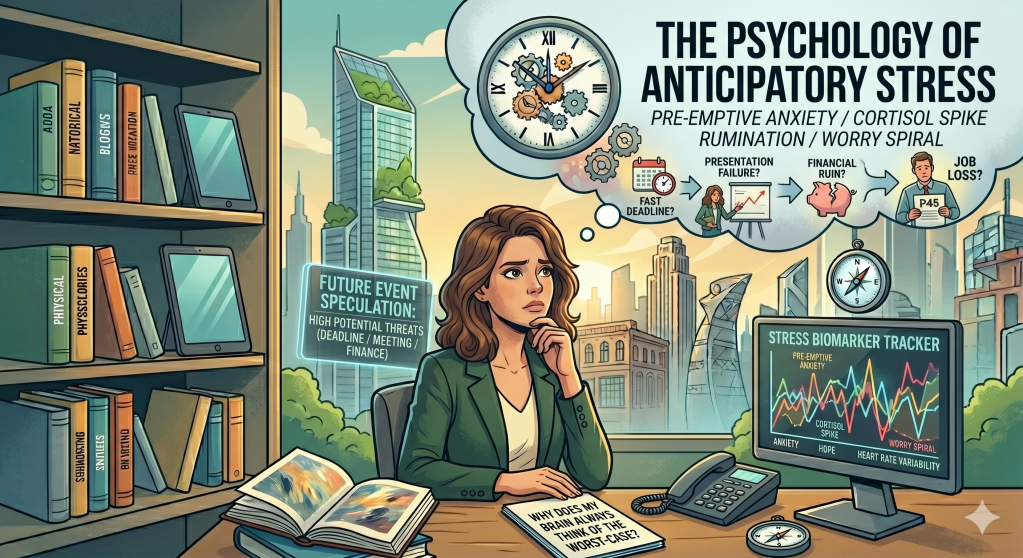
Explore the psychology and neuroscience of anticipatory stress — why the brain generates dread before events occur, how chronic anticipation affects the body, and what research reveals about productive versus damaging forms of forward-looking anxiety.
There is a particular kind of dread that has nothing to do with what is happening right now. It lives in the gap between the present moment and some future event — a medical appointment, a difficult conversation, a job interview, a looming deadline. The event hasn’t occurred. Nothing has gone wrong yet. And yet the body tightens, sleep becomes elusive, and the mind rehearses worst-case scenarios with remarkable enthusiasm. This is anticipatory stress, and for many people, it is more exhausting than the actual event ever turns out to be.
Understanding why this happens — and what it reveals about human psychology and neuroscience — has become increasingly relevant in a world that seems engineered to keep us perpetually oriented toward the future. Modern life is saturated with advance notice. We schedule months ahead, receive early warnings, track shipments in real time, and consume news cycles designed to generate concern about what might happen next. The result is a population that spends enormous cognitive and emotional resources responding to events that haven’t occurred yet and, in many cases, never will.
This article explores the psychology and neuroscience of anticipatory stress: what it is, why the brain generates it, how it affects the body and mind over time, and what distinguishes useful anticipation from the kind that quietly wears people down.
What Anticipatory Stress Actually Is
Anticipatory stress is not simply worrying. It is a physiological and psychological state that the body enters in response to a perceived future threat. The distinction is subtle but important. Worry is primarily cognitive — it involves repetitive, often verbal thought about possible negative outcomes. Anticipatory stress is broader. It encompasses worry, but it also includes emotional responses like anxiety and dread, behavioral changes like avoidance or over-preparation, and measurable physiological shifts involving the nervous system and hormonal activity.
Researchers sometimes distinguish between anticipatory anxiety, which refers specifically to emotional arousal before a threatening event, and anticipatory stress more generally, which can include responses to events that are uncertain, ambiguous, or merely unfamiliar. For practical purposes, the two overlap considerably. A person dreading a performance review is experiencing something that involves all of these elements simultaneously — emotional, cognitive, and physical.
What makes anticipatory stress conceptually interesting is that it demonstrates the brain’s remarkable — and sometimes problematic — capacity to treat imagined events as functionally real. When you vividly anticipate a threatening situation, the brain regions associated with fear and threat detection respond in ways that substantially resemble how they would respond to an actual threat. The amygdala, a small almond-shaped structure deep in the brain that plays a central role in processing emotional significance, does not cleanly distinguish between something you are experiencing and something you are imagining with sufficient clarity and emotional weight.
The Brain’s Threat Anticipation System
To understand why anticipatory stress exists at all, it helps to think about what the brain is fundamentally trying to do. The nervous system evolved not simply to react to threats but to predict them. An organism that can anticipate a predator before seeing it has a survival advantage over one that only responds once the predator is already there. Anticipation, in evolutionary terms, is a feature.
The brain accomplishes this through what neuroscientists call predictive coding — a framework suggesting that the brain is constantly generating predictions about what will happen next and comparing incoming information against those predictions. When reality matches expectation, little adjustment is needed. When the future looks threatening or uncertain, the system flags it, and the stress response is one way of mobilizing the organism to prepare.
The prefrontal cortex, which handles complex planning and reasoning, works in concert with the limbic system, including the amygdala and hippocampus, to generate anticipatory emotional responses. The hippocampus, best known for its role in memory, also helps the brain simulate future scenarios by drawing on past experience. When someone dreads a confrontation with a difficult colleague, the hippocampus is essentially constructing a mental simulation using memories of past confrontations, which the amygdala then evaluates for threat level. The resulting emotional response — anxiety, tension, dread — is not irrational. It is the product of a system doing exactly what it was designed to do.
The problem is that this system evolved for a different kind of threat landscape. Short-term physical dangers — the proverbial predator — trigger the stress response, which is then resolved relatively quickly through fight or flight. Modern stressors tend to be longer in duration, more ambiguous, and more social in nature. A performance review scheduled three weeks from now is not a predator in the grass, but the brain can treat it with similar urgency for a sustained period. The result is a stress response that never fully resolves because the threat never fully arrives or departs.
The Role of Cortisol and the HPA Axis
When the brain perceives a threat — present or anticipated — it activates the hypothalamic-pituitary-adrenal axis, or HPA axis, triggering the release of cortisol, the body’s primary stress hormone. Research has confirmed that this response doesn’t wait for the threat to arrive. A 2010 study published in Psychoneuroendocrinology found that participants showed measurable cortisol increases simply when anticipating a social evaluative threat. The body had begun its stress response in advance of any actual event.
In short bursts, that preparation is adaptive. But when anticipated threats are chronic — when uncertainty is ongoing and there is always something to dread — sustained cortisol elevation begins to work against the body. Chronic high cortisol is associated with disrupted sleep, impaired memory, increased inflammation, and elevated cardiovascular risk. The immune system, initially primed by acute stress, becomes suppressed under prolonged stress. The body pays a physiological price for preparing itself for an emergency that never fully arrives or resolves.
Uncertainty as the Engine of Anticipatory Stress
One of the most reliable findings in stress research is that uncertainty amplifies anticipatory stress substantially. A known negative outcome is often less distressing than an unknown one of similar or even greater severity. People consistently prefer predictable pain or discomfort over unpredictable pain, even when the predictable version is objectively worse in some respects. The reason appears to be that certainty, even bad certainty, allows the brain to allocate its resources more efficiently. Uncertainty forces the system to prepare for multiple possible outcomes simultaneously, which is metabolically and cognitively expensive.
Arie Kruglanski’s work on the need for cognitive closure — the desire to arrive at a firm answer rather than remain in a state of ambiguity — helps explain individual differences in how people tolerate uncertain waiting periods. People with a high need for cognitive closure tend to find anticipatory stress more intense because open-ended uncertainty conflicts directly with their cognitive preferences. They are more likely to seek reassurance, engage in repetitive checking behaviors, or rush toward decisions simply to end the discomfort of not knowing.
This relationship between uncertainty and anticipatory stress has significant implications for how modern information environments affect wellbeing. News media that specialize in speculative coverage of future possibilities — economic forecasts, political scenarios, health risks — create precisely the conditions most likely to sustain anticipatory stress responses. The information itself is often not inherently harmful, but the psychological framing of ongoing, unresolved uncertainty can engage the brain’s threat anticipation systems in ways that are difficult to turn off.
When Anticipation Becomes Avoidance
Not all responses to anticipatory stress are created equal. Some are adaptive. A person anxious about a job interview who channels that energy into thorough preparation is using anticipatory stress productively. The physiological arousal is real, but the behavioral response transforms it into something useful. This is sometimes called facilitative anxiety — the kind that improves performance by increasing effort and attention.
The more problematic response is avoidance. When the discomfort of anticipating something becomes intense enough, the most immediately appealing option is to stop thinking about it — to delay, distract, or find reasons not to engage. Avoidance provides immediate relief, because it temporarily removes the mental focus on the threatening future event. But avoidance tends to sustain and intensify anticipatory stress over time. The thing being avoided doesn’t go away; it continues to exist in the background, often growing in psychological magnitude precisely because it is being avoided.
Research in cognitive behavioral therapy has documented this cycle extensively. Avoidance prevents what therapists call exposure and processing — the natural habituation that occurs when people actually confront feared situations or, in the case of anticipatory stress, allow themselves to think clearly about anticipated events rather than fleeing from the thought. Paradoxically, people who engage more directly with their anticipatory anxiety — who deliberately think through what they fear and what they would do — tend to show lower overall distress than those who rely on distraction or suppression.
This is one reason that catastrophic thinking and avoidance often coexist. A person might simultaneously engage in worst-case-scenario rumination (a form of unproductive engagement) and practical avoidance (not taking concrete steps to address the situation). The rumination feels like dealing with the problem but lacks the resolution-oriented structure that reduces distress. The avoidance provides momentary relief but prevents real preparation. Together they constitute what many psychologists describe as the anxiety maintenance cycle.
Social Dimensions: How Anticipatory Stress Spreads
Stress is not only an individual experience. It is also social. Research in what sociologists and psychologists call emotional contagion has shown that stress responses can spread through social networks — in families, workplaces, and communities — via behavioral cues, verbal communication, and even, in some studies, olfactory signals associated with the stress response. When the people around us are anticipating something threatening, we often pick up that signal and incorporate it into our own threat assessments.
This social transmission of anticipatory stress has been particularly visible during periods of collective uncertainty — economic downturns, public health events, social upheaval. Even individuals who are not personally at immediate risk can develop significant anticipatory stress responses based on the ambient anxiety in their social environment. The anticipatory stress becomes, in a sense, collective.
Modern social media has accelerated and widened this transmission considerably. But the more precise observation is this: social media doesn’t merely spread stress. It spreads anticipation of stress. Platforms optimized for engagement tend to surface high-arousal content — threatening scenarios, expressions of urgent concern, worst-case projections — before any outcome has been determined. Users absorb not just the anxiety of others but specifically their forward-looking dread, which then activates the same anticipatory threat responses in the reader. The mechanism is the same emotional contagion, compressed in time and expanded in scale.
Distinguishing Productive from Unproductive Anticipatory Stress
There is a meaningful difference between the anticipatory stress that prepares and motivates and the anticipatory stress that exhausts without purpose. Understanding that difference is not merely therapeutic — it reflects something important about the nature of human agency.
Psychologist Gabriele Oettingen has studied the relationship between mental simulation and motivation in work that spans several decades. Her research on what she calls mental contrasting suggests that the most effective approach to anticipated challenges involves holding two mental images simultaneously: the desired positive outcome and the real obstacles that stand between the present situation and that outcome. This balanced forward-imagining activates goal-directed behavior more effectively than purely optimistic thinking and more effectively than purely anxious rumination.
The key variable appears to be perceived control. When people believe they have meaningful agency over an anticipated outcome — that their preparation and effort will matter — anticipatory stress tends to function more like facilitative anxiety, energizing action. When people feel that outcomes are entirely outside their control, anticipatory stress tends to become more ruminative and less action-oriented, because there is nowhere for the energy to go. This is one reason that anticipatory stress in situations involving genuine powerlessness — waiting for medical results, for example — can be among the most psychologically taxing forms of anticipation.
Research on coping strategies confirms this pattern. Problem-focused coping, which involves actively working to address anticipated stressors, is associated with better outcomes when the situation is controllable. Emotion-focused coping — managing the emotional response itself rather than the external situation — becomes more adaptive when the situation is genuinely uncontrollable. The misapplication of either strategy tends to amplify rather than reduce anticipatory distress.
Time, Imagination, and the Magnification Effect
The human relationship with time is at the heart of anticipatory stress. Our capacity to mentally travel into the future — what psychologist Endel Tulving called mental time travel — is one of the cognitive abilities that distinguishes human experience. We can imagine detailed future scenarios, populate them with emotional content, and respond to them physiologically as though they were happening. This is an extraordinary ability. It is also the source of some of our most unnecessary suffering.
Research in affective forecasting — the study of how well people predict their future emotional states — has found a consistent pattern: people tend to overestimate the emotional intensity and duration of their reactions to future events, both positive and negative. This phenomenon, studied extensively by Timothy Wilson and Daniel Gilbert, has been described as impact bias. We imagine that the forthcoming difficult conversation will be devastating, that the medical appointment will be agonizing, that the job interview will be catastrophic. In reality, people adapt to outcomes — even quite difficult ones — more quickly and completely than they anticipate.
This means that a substantial portion of anticipatory stress is generated by emotional forecasts that are systematically inaccurate. The future we are dreading is not the future that will actually arrive. It is a mental construction that has been inflated by the brain’s threat-detection tendencies, by memory for past difficulties, and by the well-documented tendency to imagine future events in relative isolation from the broader context of life that surrounds them.
None of this means that anticipatory stress is simply a cognitive error that can be eliminated by thinking more accurately. The brain does not easily update its emotional responses based on statistical reasoning, and telling an anxious person that their fears are probably overblown is rarely helpful. But understanding the gap between anticipated and actual experience does suggest that some of the suffering embedded in anticipatory stress is inherent to the forecasting mechanism rather than to the event itself.
The Chronic Stress Problem
Where anticipatory stress becomes genuinely harmful is when it becomes chronic — no longer tied to specific identified events but functioning as a continuous background state of apprehension. This is the territory of generalized anxiety, in which the anticipatory quality of distress becomes prominent: the sufferer doesn’t fear one specific thing but maintains a persistent sense that something bad is approaching. The neurological underpinnings involve a hyperactive threat-detection system and reduced activity in the prefrontal circuits that normally regulate the amygdala’s alarm responses.
Even below the clinical threshold, chronic anticipatory stress carries a cumulative cost. Sleep deteriorates because the brain remains partially activated during rest. Attentional resources are consumed by background threat-monitoring. Social relationships can suffer as the chronically stressed person becomes less present and more reactive. No single stressor accounts for the damage; it accumulates in aggregate, which is part of what makes it easy to underestimate.
Looking Forward
Over the past several decades, researchers have developed a much clearer picture of how the brain prepares for futures that have not yet arrived. Research in affective neuroscience has refined the picture of how the brain generates forward-looking emotional responses. The interest in mindfulness-based approaches — which largely target absorption in imagined futures rather than present experience — reflects a broad cultural recognition that the anticipatory mind, left unchecked, can consume a great deal of life.
The structural conditions that amplify anticipatory stress show little sign of resolving. Information environments remain saturated with threat-relevant content. Work cultures in many industries reward perpetual readiness over genuine rest. The pace of social and technological change keeps horizon timelines short and ambiguous. Individual coping strategies can only partially offset what are, in part, environmental problems.
What the science does suggest is that the gap between anticipated suffering and actual experience is real, measurable, and often substantial. The future most people dread is not the future that arrives. Closing that gap — not through denial of risk, but through more accurate forecasting — is one of the more practical contributions that psychological research has offered to everyday life.
Anticipatory stress is ultimately the cost of one of humanity’s greatest cognitive gifts: the ability to imagine the future. The same capacity that allows us to plan, build, and prepare also allows us to suffer in advance, sometimes for events that never materialize. The challenge is not to eliminate anticipation — that would mean surrendering the very faculty that makes foresight possible — but to notice when prediction has stopped serving preparation and started becoming a substitute for reality.









