
Originally published in March 2020 and comprehensively updated/edited in June 2026.
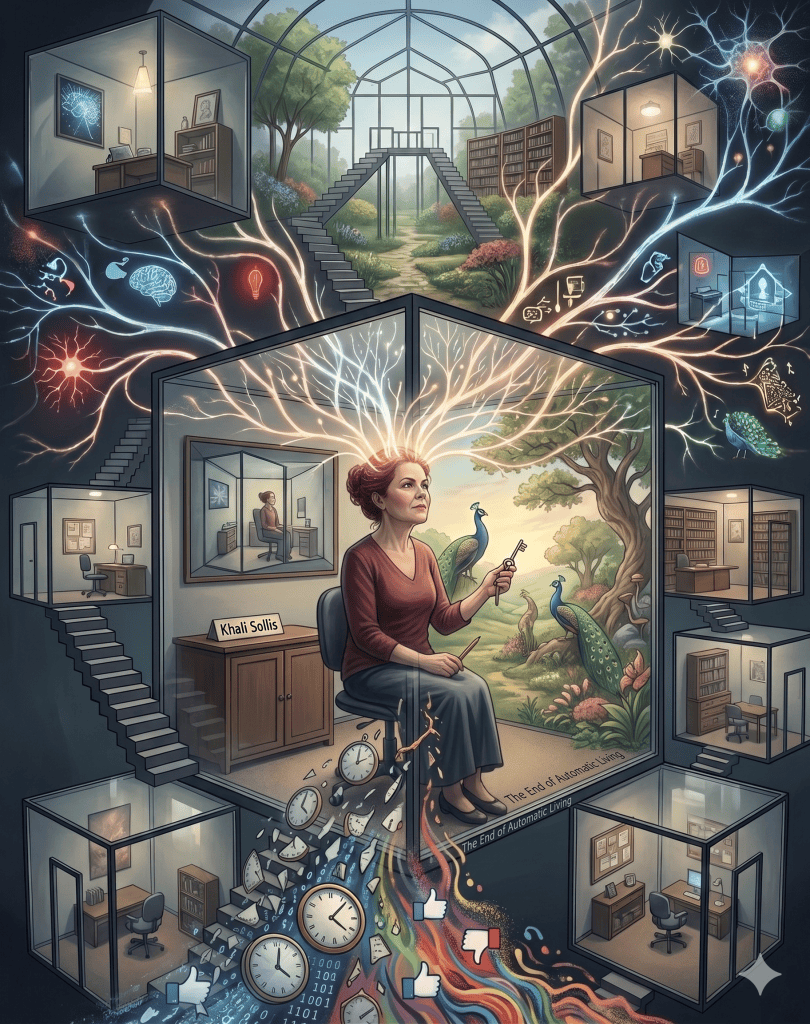
How the collapse of daily routine in 2020 triggered a massive psychological disruption — and what psychology, neuroscience, and six years of aftermath reveal about identity, habit, and how we find meaning.
There is a particular kind of stillness that descends when the world suddenly stops. Not a peaceful stillness — more like the held breath before something breaks. In early 2020, that stillness arrived globally and all at once. Offices emptied. Schools closed. Highways went quiet. Millions of people who had organized their lives around routine, obligation, and forward momentum found themselves abruptly stationary, staring at walls they had rarely stopped long enough to notice.
What happened next was a public health crisis, but it was also something rarer and harder to name. It was also something rarer and harder to name: a forced interruption of automatic living. The relentless machinery of modern life — the commutes, the schedules, the social performances, the ambient busyness — was switched off with almost no warning. And in the silence that followed, a great many people discovered that they did not particularly know who they were without it.
This essay is about that discovery. It is about what happens when external structure collapses, what psychology and neuroscience have to say about how we navigate disruption, and why the patterns that surfaced during that period did not simply disappear when the world reopened. The end of automatic living turned out to be less a temporary emergency and more a permanent renegotiation — one that is still unfolding today.
The Architecture of the Automatic Life
To understand what was disrupted, it helps to understand how thoroughly modern life had been engineered around automaticity. By the time 2020 arrived, many adults had constructed lives whose daily rhythms depended heavily on routine rather than continual conscious choice.
Wake at a fixed time. Follow a morning routine so rehearsed it happened almost unconsciously. Drive or commute along the same route. Sit at the same desk. Attend the same recurring meetings. Eat lunch at roughly the same hour. Return home. Watch something. Sleep. Repeat.
Psychologists call this behavioral automaticity — the process by which repeated actions become so ingrained that they require minimal conscious attention. Research by Wendy Wood at the University of Southern California has found that roughly 43 percent of daily behaviors are performed habitually, in the same context and at the same time each day. The brain, which is fundamentally an efficiency machine, offloads these repetitive decisions to lower-level processing so that conscious attention can remain available for genuinely novel problems.
None of that is a flaw. It is an elegant adaptation. The cognitive energy required to consciously deliberate every choice — what to wear, which route to take, when to eat — would be exhausting and paralyzing. Habit-based automaticity frees up mental resources for creative thinking, problem-solving, and social engagement. The trouble arrives when the external scaffolding that supports those habits suddenly vanishes.
When the Scaffolding Falls
The sociologist Émile Durkheim, writing in the late nineteenth century, introduced the concept of anomie to describe the disorientation that follows the collapse of social norms and structures. He observed it in individuals who had lost their place in an established order — through unemployment, displacement, sudden wealth, or social upheaval. The symptoms were not merely practical inconvenience. They were psychological: restlessness, purposelessness, a kind of free-floating anxiety that had no obvious object.
What Durkheim observed in individuals, 2020 enacted at civilizational scale. The external structures that had quietly organized billions of lives were suspended without adequate replacement. People experienced this as more than inconvenience. Many reported a strange, disorienting sense that time had become formless — that days blurred together, that they could not account for hours that seemed to vanish, that the ordinary markers of progress and meaning had dissolved.
This was not hyperbole or weakness. It reflected something real about how human beings construct a sense of identity and purpose. We are, to an uncomfortable degree, defined by what we do — by our roles, our routines, our social performances. Strip those away and the self becomes surprisingly difficult to locate.
The Neuroscience of Lost Routine
The brain, it turns out, is deeply uncomfortable with unstructured time. Not because rest is bad — rest is neurologically necessary — but because the kind of unstructured, ambiguous time that characterized pandemic lockdowns activates systems that are calibrated for threat detection rather than relaxation.
The default mode network, a set of interconnected brain regions that activates when a person is not engaged in a specific task, has long been associated with mind-wandering, self-referential thought, and rumination. In people who are psychologically healthy and reasonably content, activation of the default mode network tends to produce constructive mind-wandering: daydreaming, creative association, autobiographical reflection. In people under stress or uncertainty, the same network tends to produce something less pleasant — ruminative loops, catastrophizing, and an unpleasant magnification of unresolved anxieties.
The psychological literature on this dynamic is extensive. Matthew Killingsworth and Daniel Gilbert, in a widely cited 2010 study using real-time experience sampling, found that a wandering mind is an unhappy mind — that people reported lower wellbeing during mind-wandering episodes regardless of the activity they were notionally performing. This finding has been replicated and nuanced in subsequent research, but the basic pattern holds: unstructured mental time, without a sense of purpose or direction, tends toward unhappiness rather than peace.
Lockdown created exactly the conditions for this dynamic to flourish. Millions of people were simultaneously deprived of the external structure that had kept their default mode networks usefully occupied and left with an enormous amount of unstructured time that their brains were not well-equipped to enjoy.
The Stress Hormone Picture
There was also a more direct biological dimension. Chronic stress — the kind produced not by a single acute threat but by a prolonged, low-grade sense of uncertainty and helplessness — has well-documented effects on the body and brain. Elevated cortisol over extended periods disrupts sleep architecture, impairs prefrontal cortical function (which governs executive decision-making and emotional regulation), and increases reactivity in the amygdala, the brain’s primary threat-response center.
The result is a feedback loop that is difficult to interrupt: uncertainty produces stress, which impairs the cognitive systems best suited to managing uncertainty, which increases the subjective experience of being overwhelmed, which produces more stress. Research from the period documented significant increases in anxiety and depression symptoms across virtually every demographic studied — a pattern that persisted well beyond the acute phase of the pandemic.
This is worth dwelling on, because it complicates a narrative that became popular during the early months: the idea that enforced slowness was an opportunity for reflection, growth, and reconnection with what really mattered. That narrative was not entirely false. Some people did use the disruption productively. But for a much larger number, the disruption was not experienced as an invitation to slow down. It was experienced as disorientation, loss, and a kind of low-level suffering that was difficult to articulate precisely because it lacked a single identifiable cause.
Identity Under Pressure
One of the more psychologically revealing aspects of the disruption was what it did to people’s sense of identity — particularly those whose identities had been heavily invested in professional roles.
The sociologist William Thomas introduced the idea of the situation as the basic unit of social life: that we understand who we are primarily through the roles we occupy and the situations in which we perform them. A person is not simply a “manager” or a “teacher” or a “parent” in the abstract — they are a manager at a particular company, a teacher in a particular classroom, embedded in a particular web of relationships and responsibilities that give those roles their texture and meaning. Remove the situation and the role becomes strangely hollow.
Psychologists studying identity disruption have found that people whose sense of self is highly invested in a single domain — typically work, for high-achieving adults — are particularly vulnerable when that domain is removed or radically altered. This is related to a concept called identity foreclosure: the narrowing of self-concept around a limited set of roles or characteristics, which provides stability in normal conditions but creates fragility when circumstances change.
For many people, the pandemic did not simply interrupt their work. It forced a confrontation with the possibility that work had been functioning as a substitute for a more developed sense of self — that busyness had been performing psychological work that its owners had not consciously assigned to it.
The Role of Social Connection
Human beings are obligate social animals in a more literal neurobiological sense than the phrase usually implies. The experience of social connection activates reward circuitry in the brain that overlaps substantially with the circuitry involved in physical pleasure and pain relief. Conversely, the experience of social isolation activates the same neural systems that process physical pain. This is not metaphor. John Cacioppo’s decades of research on loneliness demonstrated that chronic social isolation produces measurable physiological changes — elevated inflammatory markers, disrupted sleep, impaired immune function — that are comparable in their health effects to smoking roughly fifteen cigarettes a day.
The rapid shift to digital social interaction that lockdown necessitated was better than nothing, but the research on its adequacy was, from the beginning, equivocal. Video calls satisfied some of the cognitive and relational components of social connection while missing others — the nonverbal cues that happen in peripheral vision, the accidental encounters that sustain weak ties, the shared physical experience of being in the same room as another person. Zoom fatigue turned out to be a real phenomenon, and research suggested it was rooted in the cognitive labor required to process social information through a degraded, two-dimensional channel.
Technology’s Complicated Role
Any honest account of the automatic life and its disruption has to grapple with the role of technology — specifically, the way that smartphones and social media platforms had, by 2020, already been doing significant structural work in people’s psychological lives.
The behavioral economist Richard Thaler and the legal scholar Cass Sunstein popularized the concept of choice architecture — the idea that the environment in which choices are made powerfully shapes which choices get made. Social media platforms were, by the time lockdown arrived, extraordinarily sophisticated pieces of choice architecture, designed by some of the most talented engineers and behavioral scientists in the world to capture and hold attention. The average American was spending between three and four hours per day on their smartphone before the pandemic began. During lockdown, that figure increased substantially.
This mattered for several reasons. First, it meant that a significant portion of the “unstructured time” created by lockdown was almost immediately colonized by algorithmically mediated content — which is to say, time that felt unstructured but was in fact being structured by systems whose goals were not necessarily aligned with the user’s wellbeing. Second, the informational environment of social media during the pandemic was particularly toxic in ways that had measurable psychological effects. Studies examining social media use during the acute phase found consistent associations between higher platform use and higher anxiety, depression, and what researchers called “pandemic rumination” — repetitive, unproductive cognitive cycling through pandemic-related concerns.
The Attention Economy’s Stress Test
The pandemic functioned, unintentionally, as a large-scale stress test of the attention economy. Under normal conditions, the costs of heavy social media use were somewhat obscured by the compensating structure of daily life — the meetings and deadlines and social obligations that prevented complete immersion. Remove that structure and the default behavior, for many people, was to fall into screens in a way that provided temporary relief from discomfort while reliably producing more of it.
This dynamic was particularly acute for adolescents, whose developmental trajectory had been more thoroughly intertwined with digital platforms than any previous generation. The research on social media and adolescent mental health was already contentious before the pandemic; the events of 2020 onward added considerable weight to the concern side of the argument. By the mid-2020s, there was a substantial and growing body of evidence linking heavy social media use among teenagers — particularly girls — to elevated rates of anxiety, depression, and what researchers called social comparison distress. Jonathan Haidt’s work, synthesizing this literature, attracted significant debate but also significant support.
The broader point is not that technology was simply bad. It was that the relationship between technology and psychological wellbeing turned out to be considerably more context-dependent and individual-specific than either the techno-optimists or the techno-pessimists had been willing to acknowledge.
The Uneven Distribution of Disruption
It would be a distortion to discuss the psychological experience of this period without noting that it was not evenly distributed. The narrative of universal existential reckoning was, in significant measure, a story told by and about people with enough material security to experience disruption primarily as a philosophical challenge.
For workers in logistics, healthcare, food production, and delivery, there was no lockdown in the sense that the professional-class narrative described. These workers faced increased exposure, increased workload, and the specific psychological strain of performing essential labor during a period when that labor had become genuinely dangerous. The burnout and moral injury documented among healthcare workers during this period represents one of the more severe and lasting psychological consequences of the era — one that has contributed to ongoing workforce shortages in medicine and nursing that persist into the mid-2020s.
For single parents, for people with disabilities, for those in abusive living situations, for children without reliable access to technology or safe home environments, the lockdown period was experienced in ways that bore little resemblance to the meditative pause described in wellness culture. Any serious analysis of what the disruption revealed about human psychology must include the uncomfortable recognition that what it revealed most clearly was the degree to which psychological wellbeing is dependent on material conditions that are very unequally distributed.
What the Disruption Revealed
Setting aside the very real differences in how it was experienced, the period did surface some patterns that appear to have genuine generalizability.
The first was a widespread renegotiation of what work meant and what it was worth. The phrase “the Great Resignation” emerged in the academic literature around 2021, coined by organizational psychologist Anthony Klotz, and became one of the dominant economic stories of the early post-pandemic period. Millions of workers quit jobs that had previously seemed fixed features of their lives, citing not only practical concerns like remote work availability but something harder to quantify: a reassessment of whether the implicit bargains they had been making — trading time, energy, and autonomy for income and status — were actually acceptable.
At its roots, though, it was a psychological event, not merely an economic one: the product of an enforced pause that allowed, or forced, a critical examination of choices that had previously been too habituated to examine.
The second pattern was a significant and lasting increase in psychological distress, particularly among younger cohorts. Worth stating plainly: none of that is a silver lining. The mental health consequences of the pandemic and its aftermath have been substantial, persistent, and in some respects still unfolding. Rates of anxiety disorder, major depression, and what clinicians call “prolonged grief disorder” remain elevated in ways that have strained mental health service systems in most developed countries.
The third pattern was an acceleration of existing social and technological trends that the disruption did not create but did catalyze. Remote work, telemedicine, e-commerce, digital entertainment — all of these were already growing. The pandemic compressed what might have been a decade of transition into roughly two years, with consequences for urban planning, commercial real estate, social geography, and the architecture of daily life that are still being worked out.
The Long Aftermath
By June 2026, the acute crisis is long past, but its psychological imprint remains visible in ways that would have been difficult to predict. The concept of post-traumatic growth — the idea that adversity, when processed well, can produce genuine psychological development — has received considerable attention in this context. The research on this phenomenon is real but needs careful interpretation. Post-traumatic growth and post-traumatic stress are not opposites; they often coexist in the same individual. Growth, in this context, does not mean the adversity was good. It means that some people, under some conditions, are able to build something meaningful from difficult experiences — which is a different and more limited claim.
What has changed, measurably and persistently, is the collective relationship with certain kinds of previously automatic behavior. Office occupancy in major cities remains below pre-pandemic levels. The proportion of workers who report prioritizing flexibility over compensation has increased substantially. Chronic illness — including long COVID, but also the broader pattern of stress-related health consequences — has become a more visible part of the social landscape in ways that have begun to shift conversations about productivity, disability, and the sustainable limits of human performance.
The automaticity framework helps make sense of several developments that have puzzled economists and organizational theorists who approached them primarily as labor market questions. Remote work normalization, the persistent resistance to return-to-office mandates, the sharp growth in freelance and independent work — these are not simply the product of changing preferences or new technology. They are, in significant part, the behavioral residue of a forced interruption. Wendy Wood’s research on habit change identifies what she calls a “habit discontinuity” — a moment when the contextual cues anchoring old automatic behaviors are removed long enough for people to consciously evaluate whether to restore them. Once someone has genuinely experienced working from home, setting their own schedule, or declining obligations they had previously accepted without question, the act of restoration becomes a deliberate choice rather than a default. Many people, having made that choice consciously for the first time, decided against full restoration.
The same logic extends beyond work. The declining institutional trust that has characterized this period across healthcare, government, media, and corporate structures may reflect something similar: automaticity had been quietly sustaining forms of trust and deference that many people began reassessing once routine itself was disrupted. The disruption did not create skepticism so much as it created the conditions in which existing doubts could no longer be suppressed by busyness. Whether that reassessment produces healthier institutions or simply deeper cynicism is, at this point, genuinely unclear — but the psychological mechanism driving it appears to be the same one that kept people from leaving jobs or questioning assumptions they had long since stopped consciously examining.
The psychological literature on meaning-making after disruption suggests that the critical variable is not what happened to people but what they did with it — whether they were able to construct a narrative that integrated the experience into a coherent sense of self and purpose, or whether the experience remained as unprocessed residue, manifesting as diffuse anxiety, cynicism, or a kind of low-grade dissatisfaction that resists diagnosis.
That process is not finished. For many people, it may never be finished in the sense of arriving at a clean resolution. But there is something valuable in recognizing that the end of automatic living — however painful its circumstances — also represented a moment when millions of people were compelled to ask questions about their lives that ordinary automaticity had been quietly foreclosing. Not everyone liked what they found when they looked. But the looking itself was not nothing.
The Ongoing Negotiation
We are not done renegotiating. The disruption that began in 2020 set in motion a series of shifts — in work culture, in technology’s role in daily life, in collective attitudes toward health and time and meaning — that do not have obvious end points. The automaticity is returning, as it must; the brain needs its habits, and society needs its routines. But the new automatic life being constructed is not simply a restoration of the old one.
The research on habit formation suggests that disruptions, while painful, create genuine windows of opportunity for behavioral change. When the contextual cues that maintain old habits are removed, new patterns become more possible — not because disruption is inherently beneficial, but because it makes conscious choice temporarily unavoidable. The pandemic was, among other things, the largest forced habit disruption in modern history.
What individuals and institutions do with that disruption — what they choose to rebuild, what they choose to change, and what they choose to examine rather than simply restore — will shape the psychological landscape of the decades ahead in ways we are only beginning to understand.
The end of automatic living was not an ending. It was, in the strict sense of the word, a revelation: something previously concealed was made visible. What people choose to see now that the concealment has been lifted is a different question entirely, and a more interesting one.









