
Originally published in June 2020 and comprehensively updated/edited in June 2026.
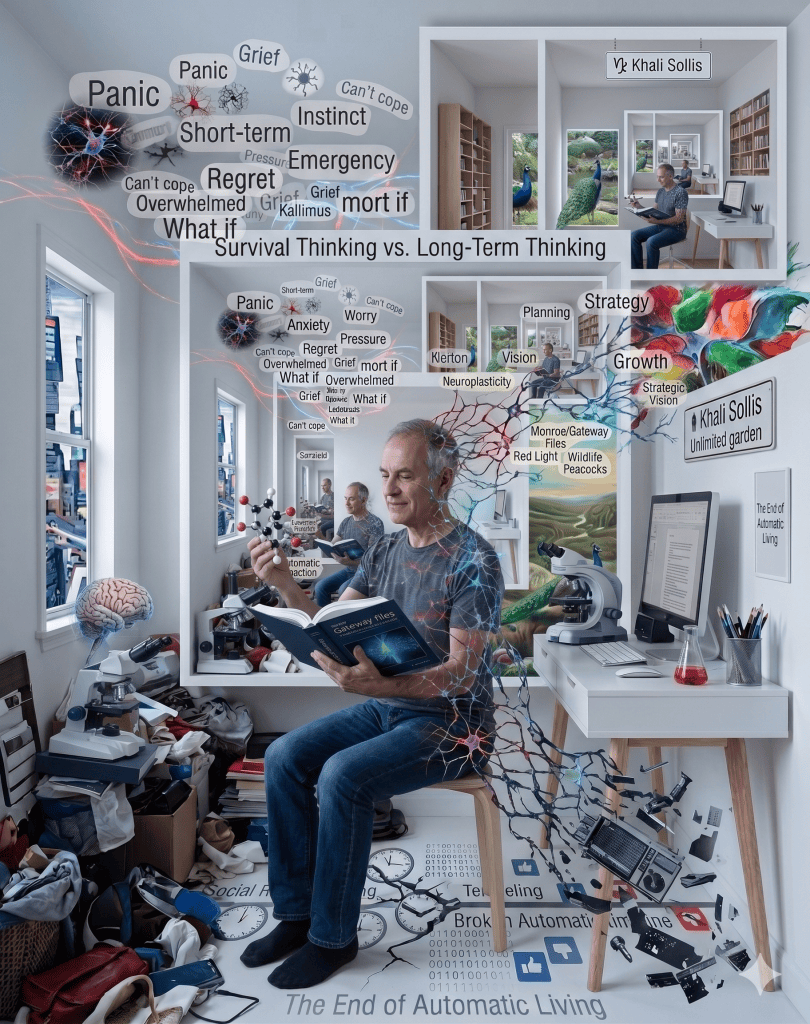
How survival thinking overtook long-term planning during the pandemic — and what psychology, neuroscience, and behavioral science reveal about how we reclaim the future.
There are moments in history when the mental climate of a society shifts almost overnight. The spring of 2020 was one of them. Within weeks, a global pandemic had shuttered economies, emptied streets, and forced billions of people indoors. Supply chains buckled. Hospitals filled. Financial markets went into freefall before staging a bewildering recovery. Across much of the world, regardless of nationality or income level, people found themselves confronting the same disorienting question: what happens next?
The honest answer, for most people, was that they didn’t know. And that uncertainty triggered something ancient and deeply wired in the human brain — a shift from long-range planning to immediate, reactive survival thinking.
Six years later, the psychological aftershocks of that period are still visible. Research across multiple domains suggests that how many people approach risk, savings, and major life decisions shifted during that period in ways that have proven slow to reverse. Understanding why this happened — and what it means for how we make decisions now — requires looking at the science of how the brain responds to threat, and what that response costs us when it becomes a long-term default.
The Biology of the Threat Response
The human nervous system evolved in an environment where threats were typically immediate and physical — a predator, a rival, a food shortage. The brain developed a rapid-response system centered on the amygdala, a small, almond-shaped structure that acts as an alarm center. When the amygdala detects danger, it triggers the release of cortisol and adrenaline, narrowing attention to the immediate environment and suppressing functions that aren’t useful for short-term survival — including forward planning, creative problem-solving, and nuanced social reasoning. Neuroscientists sometimes describe this as the brain going into “low-bandwidth mode.”
The system is extraordinarily effective for acute threats. The problem is that the brain isn’t especially good at distinguishing between a charging predator and a slow-moving, sustained crisis like a pandemic or a recession. When the threat doesn’t resolve — when the alarm stays on — the result is what researchers call temporal discounting: the brain begins to heavily favor the present over the future. Research published in Psychological Science has documented how chronic stress impairs the prefrontal cortex, the region responsible for planning and long-range thinking, in ways that make the future feel genuinely less real and less worth organizing around. This isn’t a character flaw. It’s a neurological response to environmental conditions.
It played out visibly in 2020. Consider something as routine as a 401(k) contribution. For someone in a stable job with no immediate financial pressure, pausing retirement contributions to “just see how things shake out” is, on paper, a poor long-term decision. But when the news is relentlessly alarming and the future feels genuinely uncertain, the brain isn’t running a retirement calculator. It’s scanning for exits. The future doesn’t disappear from view because people stop caring about it — it recedes because the threat system is consuming most of the available mental bandwidth. Some decisions made in that mode were rational responses to genuine disruption. Others were the product of a brain that had temporarily lost its capacity to think past the next few weeks.
When the Crisis Becomes the Baseline
What’s less often discussed is what happens when survival thinking doesn’t end with the crisis. For many people, the psychological posture they adopted during 2020 became a new baseline — not because the world remained equally dangerous, but because the nervous system had recalibrated around a higher level of chronic stress.
This is a documented phenomenon. Research on populations that have experienced prolonged adversity — war, famine, economic collapse — consistently shows that the effects on cognition and behavior persist long after the immediate threat has passed. The brain adapts to uncertainty by treating it as the new normal, remaining in a state of heightened vigilance even when objective conditions improve.
A 2022 study tracking behavioral changes through the pandemic found that risk aversion, short-term thinking, and reduced trust in institutions remained elevated well into the recovery period, even among people whose personal circumstances had stabilized. The authors described this as a “psychological lag” — the lived experience of safety hadn’t yet caught up with the neurological alarm that had been running for two years.
This matters enormously for how societies recover from large-scale disruptions. Economic recovery, for instance, depends partly on people’s willingness to invest, to take entrepreneurial risk, and to make decisions based on a believable future. When a significant portion of the population is operating in survival mode, that willingness contracts. The result can be a paradox: conditions improve materially while the psychological effects of crisis continue to shape behavior in ways that slow broader recovery.
The Unequal Distribution of Stress
Not everyone experienced the shift from long-term to survival thinking equally. This is an important piece of the picture that often gets lost in generalized discussions of collective behavior.
Chronic stress, and its attendant effects on cognition, is not randomly distributed across a population. It follows the existing fault lines of inequality. People who entered 2020 with financial precarity, unstable housing, limited access to healthcare, or jobs that couldn’t be performed remotely were exposed to a qualitatively different level of sustained threat than those with more resources and stability.
Research by behavioral economists, including work building on the foundational studies of Sendhil Mullainathan and Eldar Shafir, has established that scarcity — of money, time, or security — directly taxes cognitive bandwidth. When people are managing urgent needs, they have less mental capacity available for long-term planning. This isn’t a function of intelligence or values; it’s a structural consequence of operating under conditions of constraint. The authors describe it as a “bandwidth tax” that the poor pay — not in money, but in mental resources.
The pandemic amplified these dynamics significantly. Workers in low-wage sectors who lost income faced a version of survival thinking that was not metaphorical — it was literal. Their time horizon contracted not because of a neurological bias but because planning for next year is genuinely irrational when you’re not sure about next month. The cognitive patterns that look like “irresponsibility” from the outside are, in many cases, a rational adaptation to an irrational situation.
Understanding this distinction matters if we want to honestly evaluate post-pandemic behavior. The person who failed to rebuild their savings, who kept making short-term decisions years after conditions improved, may not have been failing to think long-term — they may never have had the conditions that make long-term thinking possible.
Social Amplification: How Threat Spreads Through Networks
The neurological effects of threat don’t operate in isolation. They spread through social networks in ways that can amplify collective anxiety far beyond what direct experience alone would produce.
Social psychologists have documented what’s sometimes called emotional contagion — the tendency for emotional states to transfer between people through observation, conversation, and shared media. This was already a known phenomenon before 2020, but the pandemic provided an unusually clear natural experiment in how it operates at scale.
The information environment of 2020 was relentlessly saturated with threat-relevant content. News cycles ran continuously. Social media amplified alarming information faster than confirming or reassuring information, in part because alarming content consistently generates higher engagement — a dynamic that platforms had optimized for years before the crisis arrived. The result was an information ecosystem that kept the amygdala activated even in people whose direct personal circumstances were relatively stable.
This created an unusual situation: people who were, by objective measures, relatively safe — financially stable, healthy, living in low-risk areas — were experiencing elevated levels of threat response because of their information environment. The brain doesn’t easily distinguish between a threat that is real and immediate and one that is vivid, emotionally resonant, and constantly present in your social environment. Both trigger similar stress responses.
Researchers in public health and media studies are increasingly examining how the chronic stress amplified by algorithmic media environments may have long-term cognitive consequences. The relationship between social media use, cortisol levels, and temporal discounting is an active area of research, and early findings are not encouraging.
Long-Term Thinking as a Learned Behavior
If survival thinking is a biological default, long-term thinking is something closer to a learned skill — one that requires the right conditions more than the right intentions.
This cuts against a common assumption: that long-term thinking is simply a matter of choosing to be responsible or disciplined. In reality, the capacity for sustained, future-oriented planning depends on preconditions that don’t apply equally to everyone.
The first is basic security. Research across developmental psychology, behavioral economics, and neuroscience converges on the finding that people plan for the future when they have a reasonable expectation that the future will arrive in a form they can influence. When that expectation is absent — because of poverty, political instability, health crises, or systemic discrimination — planning doesn’t just feel pointless. It actually is less rational.
The second is trust — in institutions, in social systems, and in other people. Long-term planning is inherently a form of investment in a future that depends on others behaving predictably. Retirement savings assume functional financial markets. Career development assumes that credentials and experience will be recognized. When trust in these systems erodes, so does the motivation for long-term investment. The trust erosion that accompanied the pandemic — in public health institutions, in government responses, in economic stability — had predictable effects on people’s planning behavior.
Rebuilding the Long View
The good news, if there is good news in any of this, is that the brain is plastic. The same adaptability that allows threat to reshape cognition also allows improved conditions to reverse those changes.
Research on stress recovery consistently shows that when the threat environment genuinely improves — when people experience a period of safety, predictability, and adequacy — the neurological changes associated with chronic stress begin to reverse. The prefrontal cortex rebounds. Temporal discounting decreases. People become more capable of holding the future in mind.
This process, however, is not automatic or immediate. It requires actually experiencing improved conditions, not just being told that conditions have improved. It requires trust that the improvement is real and durable. And it benefits enormously from social reinforcement — from being part of communities and institutions that model and reward long-term thinking.
Practical interventions that reduce the daily burden of scarcity — income supports, stable housing, accessible healthcare — have measurable effects not just on immediate welfare but on cognitive functioning and future orientation. This is one of the most robust and underappreciated findings in behavioral economics: reducing economic stress doesn’t just make people more comfortable, it makes them better at planning.
What Six Years Has Changed
The period between 2020 and 2026 has been, among other things, a large-scale experiment in how populations adapt their cognitive frameworks after a sustained crisis.
Some of the adaptations appear constructive. There is evidence of increased awareness of systemic fragility — a broader understanding that supply chains, health systems, and financial structures are more vulnerable than they appeared. This kind of updated mental model can support better long-term planning when it prompts investment in resilience rather than just efficiency.
The more concerning patterns are the ones that look like entrenched survival thinking. The rise in short-term employment arrangements, the continued reluctance to make major long-range financial commitments, the declining rates of family formation in many high-income countries — these trends have multiple causes, but contracted temporal horizons are plausibly among them. What’s difficult to disentangle is how much of this reflects a genuine recalibration of values versus a stress response that has simply not yet resolved. When the future felt unreliable for long enough, many people stopped organizing their lives around it. Whether that changes as conditions stabilize — and for whom — remains an open question.
The Tension at the Heart of the Matter
There is a genuine tension in all of this that deserves to be named rather than glossed over.
Survival thinking is not always wrong. In genuinely dangerous situations, it is adaptive and often life-saving. The bias toward the immediate, the elevated sensitivity to threat, the narrow focus on what’s controllable in the short run — these are features, not bugs, under the right circumstances.
The problem is that a cognitive system designed for acute threats is poorly suited to the chronic, diffuse, slow-moving risks that increasingly define modern life. Climate change is not a predator you can outrun. Retirement insecurity is not a wound you can dress. These problems require exactly the kind of sustained, forward-looking attention that threat response suppresses.
This creates a paradox: the conditions that most urgently require long-term thinking are often the same conditions that most powerfully impair it. Stressed populations facing uncertain futures are least able to engage with the long-range planning that might actually improve those futures.
Recognizing this dynamic doesn’t resolve it. But it reframes the conversation. The question of why people fail to think long-term isn’t primarily a question about character, values, or intelligence. It’s a question about what conditions the brain needs to function at its full temporal range — and whether those conditions exist, and for whom.
Conclusion: The Long View Requires a Stable Ground
Survival thinking and long-term thinking are not two modes that people simply choose between. They are states that environments, institutions, and nervous systems produce — sometimes together, often in tension.
The years since 2020 have made this clearer than any period in recent memory. The brain’s capacity for future orientation is not a fixed trait. It expands and contracts in response to security, trust, and the quality of the information environment — in ways that operate mostly below the level of conscious choice.
Calls for people to simply “plan ahead” or “delay gratification” miss the structural preconditions for those behaviors. Long-term thinking, at both the individual and societal level, is downstream of the conditions that allow people to believe the future is worth planning for.
The forward-looking question, then, is not just how individuals can cultivate greater temporal perspective — though that matters. It is how societies can build and maintain the conditions that make long-term thinking broadly accessible: genuine economic security, trustworthy institutions, and information environments that don’t chronically activate threat responses.
The brain evolved for survival. But human beings have spent thousands of years building institutions and cultures specifically designed to create conditions safe enough for people to think beyond the immediate. How well those institutions function, and who they protect, will determine how far into the future most people are able to see.









