
Originally published in July 2020 and comprehensively updated/edited in June 2026.
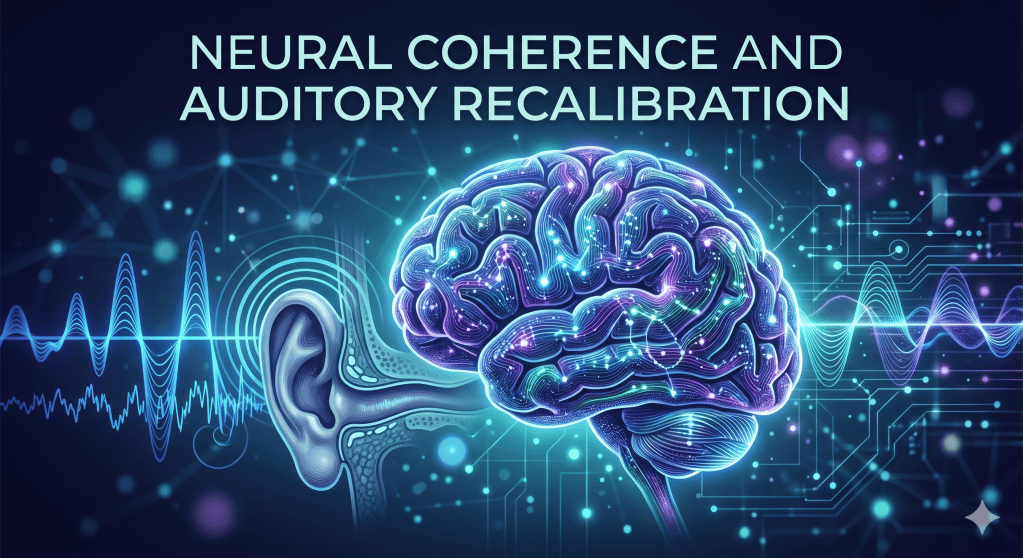
Explore how neural coherence and auditory recalibration shape the listening brain — connecting neuroscience, streaming culture, pandemic acoustics, and the psychology of sound.
There is something quietly profound about the way a song can reach across years and land in your chest like it never left. You hear the first four bars of something you haven’t thought about in a decade, and suddenly you’re nineteen again, riding in someone’s car with the windows down, before everything got complicated. That isn’t nostalgia in the sentimental sense — it’s something more specific, more neurological. It’s your brain doing exactly what it was built to do: using sound to organize time, memory, and meaning.
We live in an era of almost incomprehensible acoustic overload. Since the early 2000s, many people have been exposed to more music, more ambient noise, and more digitally mediated sound than would have been imaginable in earlier eras. Streaming platforms give us access to essentially every recording ever made. Algorithmic recommendations shape listening habits in ways users often can’t detect. And through all of it, the human brain has been quietly adapting — recalibrating, in a very real neurological sense, to an auditory environment that would have been unrecognizable to anyone born before the digital age.
This article is about that recalibration. It’s about neural coherence — the way neurons synchronize their firing in response to sound — and what happens to that process when the acoustic environment changes dramatically and rapidly. It’s about what researchers have learned about how the brain processes music and noise, how those findings connect to cultural and psychological shifts, and what all of it might mean for how we think about attention, emotion, and identity in an increasingly sonically saturated world.
What Neural Coherence Actually Means
The term “neural coherence” gets used loosely in popular science writing, so it’s worth being precise. In neuroscience, coherence refers to the degree to which different neural populations fire in a coordinated, synchronized pattern. When two brain regions are “coherent,” their electrical oscillations are phase-locked: they rise and fall together, at least for a period of time. This synchronization is thought to be one of the mechanisms by which the brain binds information across different processing areas into a unified experience.
Sound is one of the most powerful triggers of neural coherence. The auditory cortex doesn’t just receive sound passively — it actively entrains to it. The brain’s electrical rhythms literally synchronize with the rhythmic structure of what you’re hearing. This phenomenon, called neural entrainment, has been documented extensively since the 1990s and has become one of the more robust findings in auditory neuroscience. When you tap your foot to a beat, you are observing entrainment from the outside. What’s happening on the inside is that your auditory cortex, your motor cortex, and several other regions are firing in temporal alignment with the rhythmic structure of the music.
What makes this more than an interesting footnote is what entrainment connects to. Research from groups including Nina Kraus’s Auditory Neuroscience Laboratory at Northwestern has shown that neural synchronization to sound is linked to language processing, reading ability, working memory, and social bonding. The same oscillatory mechanisms that help you follow the beat of a song also help you parse the rhythmic patterns of speech. Music and language share deep neural infrastructure, and the processing systems involved overlap significantly more than was assumed as recently as thirty years ago.
Coherence also has an emotional dimension. The limbic system participates in auditory processing in ways that go beyond simple emotional tagging. Rhythmic and tonal patterns in music appear to influence limbic activity directly, which is one reason music is so effective at modulating mood and triggering memory. When neuroscientists talk about music “activating the reward system,” they’re describing a cascade that involves dopaminergic pathways and prefrontal cortex — genuine neurochemical changes in response to organized sound.
The Acoustic Environment as Psychological Infrastructure
To understand auditory recalibration, you need to understand what the acoustic environment actually does to people over time. The ambient sound conditions in which a person lives shape their nervous system in measurable ways. Research in environmental psychology has established that chronic noise exposure — particularly unpatterned, uncontrollable noise — activates the stress response in ways that are distinct from acute, startling sounds. The body treats chronic background noise as a low-grade threat. Cortisol levels are elevated. Sleep is disrupted even when people report habituating to the noise. Cognitive performance suffers. Arline Bronzaft’s landmark research at Columbia in the 1970s found that children in classrooms on the noisy side of a building near elevated train tracks scored significantly lower on reading tests than those on the quiet side — a finding that has been replicated across many different contexts since.
The inverse relationship holds too. Structured, predictable, meaningful sound appears to have restorative effects on the nervous system. Research in Attention Restoration Theory, developed by Rachel and Stephen Kaplan, has examined how natural environments aid cognitive recovery from mental fatigue. Natural soundscapes — birdsong, running water, wind through vegetation — reliably score high on restorative dimensions, in part because they have patterns and rhythms without being demanding.
Auditory Recalibration: The Brain Adapts
Auditory recalibration refers to the process by which the auditory system adjusts its sensitivity or reference points in response to changed conditions. It operates at multiple timescales — there are rapid adaptations that occur within seconds (sounds seem muffled after you leave a loud concert), and slower adaptations that occur over months and years as a result of consistent exposure patterns.
The longer-term version is what matters here. Research in auditory neuroscience has shown that the auditory cortex is substantially shaped by experience throughout life, not just during developmental windows in childhood. Musicians show measurable differences from non-musicians in the structure and function of auditory processing regions. The brainstem response to complex sounds is sharper, faster, and more accurate in people who have trained extensively with music — and these differences develop through sustained engagement, not innate ability.
The converse also occurs. Research on auditory deprivation — ranging from clinical hearing loss to years spent in acoustically impoverished environments — shows that the auditory cortex can lose processing precision when it isn’t adequately stimulated. Whether sustained exposure to compressed, narrow-dynamic-range audio might produce subtler shifts in calibration over time is a plausible hypothesis, but it remains speculative. Controlled longitudinal studies on how the general public’s auditory processing changes across decades of technological change are extraordinarily difficult to run, and the evidence here is preliminary at best.
The Pandemic as Acoustic Experiment
The period beginning in early 2020 created, inadvertently, one of the more dramatic natural experiments in auditory psychology. Lockdowns dramatically altered the acoustic environment almost overnight. Urban noise floors dropped. Traffic noise diminished. Industrial sounds receded. People who had spent their adult lives in cities reported hearing birdsong they had never consciously noticed before. Meanwhile, the domestic acoustic environment intensified — people became acutely aware of neighbors, HVAC systems, and the particular sonic character of their own homes.
From a neural coherence standpoint, this period represented a genuine recalibration event. The brain’s auditory processing systems were receiving significantly different input than they had been, and they adjusted accordingly. People reported heightened sensitivity to sounds they had previously filtered out. Some found that returning to urban environments after extended time in quieter settings felt genuinely overwhelming — the noise floor of a city, which had previously been imperceptible background, had become salient and disruptive. These reports are consistent with what neuroscience would predict: the auditory system had recalibrated to a quieter baseline, and re-exposure to the previous noise levels required readjustment.
Musicians reported something related but distinct. Extended separation from live performance and collaborative music-making produced a range of effects, from loss of fine motor precision to a sense that sounds felt less vivid, intervals less precise. These reports are consistent with research on the role of active music-making in maintaining auditory neural sharpness. Listening and playing are not equivalent from a neural standpoint — playing engages motor systems, proprioception, and social processing in addition to auditory processing, and the absence of those dimensions appears to have noticeable effects over time.
How Digital Listening Changed the Relationship
The shift from passive to active audio consumption represents one of the more significant reorganizations of human sensory experience in the past century. Before the mid-2000s, most people listened to whatever was on — you tuned in, heard what was playing, and adapted to the sequence. Streaming changed this fundamentally. The listener became a curator, and the act of choosing became a continuous part of listening.
This might seem like a trivial change, but there are psychological consequences. When you are constantly selecting, skipping, and adjusting, attention is divided between the music and the meta-task of managing the music. Studies on “lean-forward” versus “lean-back” listening suggest that active selection is associated with lower emotional arousal from music, even when listeners report preferring it — a finding that rhymes with the broader “paradox of choice” literature in cognitive psychology.
Headphone culture added another layer. Portable audio players made it possible to maintain a personal acoustic bubble in any environment, replacing the ambient soundscape with a curated feed. From a neural perspective, this may alter how the auditory system relates to the social and physical environment — the brain evolved to use environmental sound as a constant source of orientation and social information — but the specific long-term effects of this shift are still being investigated rather than established.
Sound, Identity, and Social Coordination
Music is one of the primary media through which identity is constructed and expressed, particularly in adolescence and early adulthood. Psychologist Adrian North and colleagues at Heriot-Watt University found that musical taste serves as a proxy signal for values, worldview, and social affiliation in ways that are both conscious and automatic. The neuroscience is consistent: music that aligns with a person’s existing emotional state and identity tends to produce stronger neural coherence and deeper processing than music that doesn’t fit those contours.
This takes on particular significance given how streaming platforms now mediate music discovery. Recommendation algorithms are effective at extrapolating from past listening to likely future preferences, producing a listening environment that is, in a sense, highly congruent. Whether that congruence comes at any cost is a genuinely open question — some researchers in creativity and cognitive flexibility have noted that exposure to the unexpected is part of how the brain builds more adaptable processing capacities — but the evidence connecting algorithmic curation to measurable changes in musical cognition remains thin.
What is better established is music’s role in social coordination. Studies of communal music-making, group singing, and crowd experiences at concerts have found elevated oxytocin levels, increased feelings of social connection, and enhanced cooperation following such experiences. The neural synchronization that happens within an individual listening to music appears to have a social analog — people’s neural activity becomes more coherent with one another during shared musical experiences. As listening has shifted from communal to predominantly private and individualized, that social-coordination function has changed, though not disappeared entirely.
The Longer View
The history of human beings and sound is, in one sense, the history of the nervous system adapting to a shifting environment. Every major change in the acoustic landscape — the noise of industrial cities, the introduction of recorded music, the advent of radio, the digitization of audio — has required adjustment. The current moment is distinguished mainly by the speed and scale of that change, and by the degree to which sound has become both a commodity and a therapeutic object — something bought, sold, prescribed, and optimized. The wellness industry’s embrace of sound baths, binaural beats, and noise-masking products reflects, at least in part, a recognition that the acoustic environment has become a problem requiring management.
Neural coherence and auditory recalibration are technical terms, but they describe something most people have felt without having language for it: the way certain sounds organize experience, and the way their absence leaves something unmoored.
The brain is a listening instrument. It was shaped, over millions of years, in environments full of structured, meaningful sound — human voices, natural rhythms, the patterned complexity of the acoustic world. The sounds we choose to fill our days with are, in a real sense, instructions we give our brains about what kind of world they’re living in, and the brain, as always, adapts.
Understanding the mechanisms behind that adaptation doesn’t diminish the experience of music or make it feel clinical. If anything, it makes it more remarkable. That organized vibrations in air can synchronize the electrical activity of billions of neurons, trigger neurochemical changes associated with trust and pleasure, encode memories that survive decades, and help construct a continuous sense of self — this is among the more extraordinary things we know about the relationship between the physical world and the human mind.
Further Reading
- Nina Kraus, Of Sound Mind: How Our Brain Constructs a Meaningful Sonic World (2021)
- Arline Bronzaft’s research on noise and learning, including “The Effect of a Noise Abatement Program on Reading Ability” (1981)
- Rachel and Stephen Kaplan’s work on Attention Restoration Theory, including The Experience of Nature (1989)
- Adrian North’s research on music and identity, including “The Effect of Background Music on the Taste of Wine” and related studies on music as social signal









