
Originally published in November 2020 and comprehensively updated/edited in June 2026.
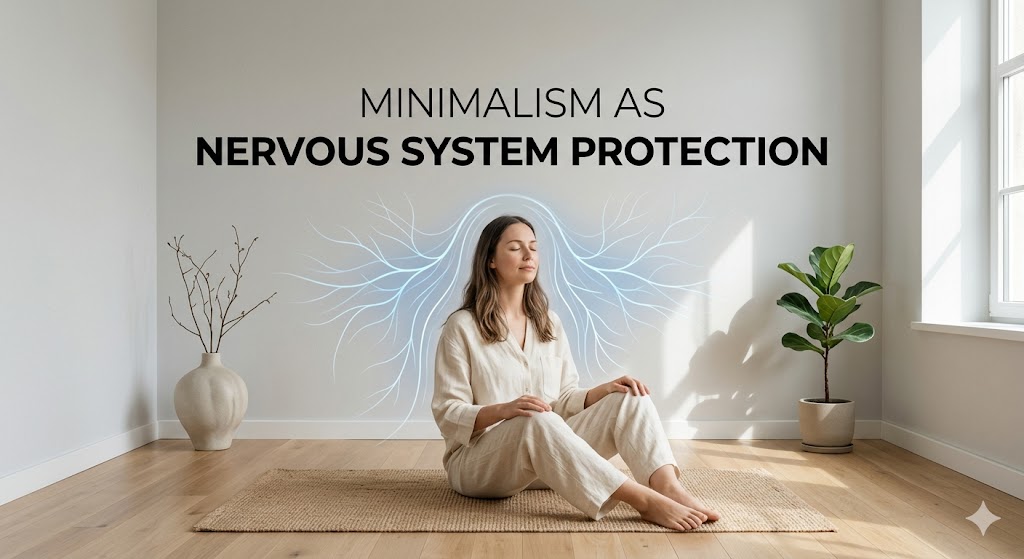
How chronic overload affects the nervous system — and why millions turned to minimalism as a form of psychological and physiological protection.
There is a particular kind of exhaustion that has become native to modern life — one that doesn’t go away after a good night’s sleep. It isn’t produced by physical labor or even by staying up too late. It comes from something harder to name: the relentless experience of being bombarded. By news, by notifications, by choices, by noise. By the feeling that the world is permanently on fire and your attention is always needed somewhere.
By late 2020, that exhaustion had become acute. A global pandemic had compressed years of social, economic, and technological change into a matter of months. Millions of people were spending more time at home than they ever had before, and many were discovering something uncomfortable: that the home they’d built — full of stuff, screens, subscriptions, and obligations — didn’t feel like rest. It felt like an extension of the overwhelm.
Out of that moment, a particular idea gained significant cultural traction. Minimalism — the practice of deliberately reducing material possessions, commitments, and sensory input — moved from an aesthetic niche into something that felt, to many people, like a genuine survival strategy. The timing wasn’t accidental. And when you understand what was actually happening inside people’s bodies and brains during that period, the appeal of minimalism as nervous system protection starts to make a great deal of scientific sense.
What the Nervous System Was Actually Dealing With
To understand why simplification appealed to so many people, it helps to understand what chronic overload actually does to the body. This isn’t metaphorical. There are real physiological mechanisms at work.
The human nervous system has two primary operating modes. The sympathetic nervous system governs the classic “fight-or-flight” response — it accelerates the heart rate, sharpens focus on immediate threats, floods the body with cortisol and adrenaline, and prepares you for action. The parasympathetic nervous system does the opposite. Sometimes called “rest and digest,” it governs recovery, digestion, sleep, immune function, and the kind of calm in which learning and creativity are possible.
These two systems are designed to take turns. A stressful event triggers the sympathetic system. Once the threat passes, the parasympathetic system takes over and the body recovers. The problem with modern life — and with 2020 in particular — is that this cycle rarely completed. The “threat” never fully passed. There was always another piece of breaking news, another alarming statistic, another decision to make, another screen demanding attention.
Research in stress physiology has demonstrated that the human stress response doesn’t distinguish particularly well between a physical threat and a psychological one. The brain’s amygdala — the region that processes threat detection — responds to a disturbing news headline with many of the same signals it uses to register a predator. When that kind of activation happens repeatedly, day after day, without adequate recovery, the physiological consequences are significant. Chronic elevated cortisol has been linked to disrupted sleep, impaired immune function, memory difficulties, and increased anxiety. The body stays in a kind of low-grade emergency mode that it was never designed to sustain.
The Attention Economy and Its Costs
Layered on top of biological stress responses was something relatively new in human history: an entire economic ecosystem built around capturing and holding human attention. Social media platforms, news organizations, streaming services, and app designers had spent the preceding decade engineering products specifically to maximize engagement — which, in practice, often meant exploiting the same threat-detection systems that kept our ancestors alive.
Outrage travels faster than calm on social networks. This isn’t a casual observation — it’s a finding backed by large-scale data analysis. A 2018 study by researchers at MIT examining the spread of true and false information on Twitter found that false stories spread significantly faster and wider than accurate ones, largely because they tended to be more novel and emotionally arousing. Platforms that reward engagement effectively reward emotional provocation.
The average American adult in 2020 was spending somewhere between seven and eleven hours per day engaged with screens, across devices. That figure had been rising for years, but the combination of pandemic-driven lockdowns and remote work accelerated it sharply. People who had previously compartmentalized their media consumption — checking the news on a commute, scrolling social media during a lunch break — were now living inside a continuous media environment with no natural interruptions.
Neuroscience research into attentional capacity offers a useful frame here. The prefrontal cortex, which governs executive function, decision-making, and the regulation of emotional responses, is also a finite resource. It can be depleted. What researchers call “decision fatigue” — the degradation of decision quality after prolonged mental effort — is a well-documented phenomenon. When every hour involves dozens of micro-decisions (what to watch, what to read, how to respond, what to buy), cognitive resources become strained in ways that affect mood, judgment, and wellbeing.
Minimalism, in this context, wasn’t simply about owning fewer things. It was about reducing the number of decisions the brain had to make, decreasing the volume of sensory and informational input, and creating conditions in which the nervous system could actually recover.
The Psychology of Stuff
Material possessions complicate things in ways that are easy to underestimate. Ownership isn’t a neutral relationship. Every object in a person’s home carries some degree of cognitive and emotional weight — a memory, an obligation, an aspiration, a guilt. The jacket you keep meaning to repair. The exercise equipment you bought with good intentions. The kitchen gadget you use once a year. These things don’t just take up physical space. They take up mental space.
Psychologists use the term “cognitive load” to describe the total amount of information the working mind is actively processing at any given time. Physical clutter contributes to cognitive load in ways that research has begun to document. A 2011 study published in the Journal of Neuroscience found that physical clutter in a person’s field of vision competed for the brain’s attention, reducing the ability to focus and increasing stress responses. A cluttered environment, the researchers found, effectively taxed the brain’s processing resources even when the person wasn’t consciously thinking about the clutter.
This helps explain why the experience of “decluttering” a space often produces feelings that go well beyond the physical. People frequently describe a sense of lightness, calm, or even emotional release after clearing out possessions — feelings that can seem out of proportion to the act of simply putting things in boxes. What’s happening, at least in part, is a reduction in low-level cognitive and emotional activation that was operating below conscious awareness.
The Accumulation Trap
There’s also a psychological dynamic that drives accumulation in the first place, and it’s worth naming. The French philosopher Denis Diderot described it in an 18th-century essay: when he received a luxurious scarlet dressing gown as a gift, he found himself gradually replacing everything in his study to match it. The new gown made his old chair look shabby. The new chair made the desk look worn. Each acquisition triggered a need for another. Consumer behavior researchers now call this the Diderot Effect, and it describes a pattern that modern marketing systems — and social media feeds curated to showcase aspirational lives — have become extraordinarily good at exploiting. The research on upward social comparison is fairly consistent: measuring yourself against people who appear to be doing better tends to reduce life satisfaction and fuel consumption as a remedy.
Minimalism, from a psychological standpoint, represented a departure from this loop. It reframed the acquisition of things not as the path to wellbeing but as a potential obstacle to it.
Historical Context: This Wasn’t the First Time
The appeal of simplicity in response to cultural excess has a long history, and situating the 2020 minimalism moment within that history reveals something important about what the movement actually was.
Henry David Thoreau’s experiment at Walden Pond in the 1840s was explicitly a reaction against what he saw as the unnecessary complexity of contemporary life — lives of “quiet desperation” spent acquiring things that owned their owners more than the reverse. The Arts and Crafts movement of the late 19th century emerged as a counter-reaction to industrialization and the mass production of cheap, ornate goods. The back-to-the-land movements of the 1960s and 1970s carried similar energy — a rejection of consumer culture in favor of something felt to be more essential.
What these moments share is a pattern: they tend to arise during periods of rapid technological and economic change, when the pace of transformation outstrips the human capacity to adapt to it. The philosopher Alvin Toffler called this “future shock” in his 1970 book of the same name — the disorientation produced by too much change happening too quickly. The nervous system of the species, shaped over hundreds of thousands of years, was not designed for the rate of change that industrial and then digital civilization produces.
The minimalism movement that crystallized around figures like Marie Kondo, Joshua Fields Millburn, Ryan Nicodemus (the duo known as “The Minimalists”), and others in the 2010s arrived during a period of exactly this kind of acceleration. Smartphones had changed the texture of daily experience within a decade. Social media had restructured social interaction, information consumption, and self-presentation. The gig economy had altered the nature of work. The 2008 financial crisis had exposed the fragility of debt-driven consumer lifestyles. Against that backdrop, the idea of voluntary simplicity carried both practical and psychological appeal.
By 2020, the pandemic added another layer. Forced to stay home, stripped of many of the external markers of status and identity — the restaurant dinners, the business travel, the social performances that consume both money and energy — many people began to question what they actually needed. The question turned out to have significant answers.
What Neuroscience Adds to the Conversation
The scientific understanding of how sensory and informational overload affects the brain has grown considerably over the past two decades, and it lends empirical weight to what minimalists have often described in more intuitive terms.
Research on the default mode network — a set of interconnected brain regions that activates during rest, mind-wandering, and self-referential thought — has revealed that downtime is not simply the absence of activity. It is an active state with essential functions. During periods of rest, the brain consolidates memories, processes emotional experiences, generates creative connections, and performs what researchers sometimes describe as maintenance on the neural architecture of cognition. When the default mode network is perpetually interrupted by incoming stimulation — the buzz of a notification, the pull of a screen, the next thing to respond to — this restorative processing is compromised.
The psychologist Mihaly Csikszentmihalyi, whose work on the concept of “flow” — the state of deep, focused engagement in a task — documented something similar from the other direction. Flow states, which tend to produce high levels of reported wellbeing and satisfaction, require a particular balance between challenge and skill, and they require genuine attention. They cannot happen in fragmented environments where attention is constantly pulled in multiple directions. An environment that makes it harder to achieve flow is, by this research, an environment that makes it harder to experience one of the most reliably satisfying states available to human beings.
Minimalism as nervous system protection, then, isn’t simply a matter of reducing visual clutter or owning fewer sweaters. It is the creation of conditions in which the brain can do what it needs to do — rest, recover, focus, and connect — without constant interference.
The Particular Role of Digital Minimalism
The philosopher and computer scientist Cal Newport drew a clear distinction in his 2019 book Digital Minimalism between the broader minimalist movement and the specific challenge posed by digital technology. Newport’s argument was that social media and smartphone apps had been deliberately engineered to be as engaging as possible — which meant they had been designed, intentionally or not, to crowd out precisely the kinds of quiet, slow-burning activities that research consistently links to human flourishing: sustained reading, conversation without distraction, creative work, time in nature, meaningful relationships. Studies published in the late 2010s and early 2020s found associations between heavy social media use and increased rates of depression and anxiety, particularly among adolescents — though the relationships were often correlational rather than causal, and some researchers pushed back on overstated claims about harm.
What distinguished digital minimalism from simple technology skepticism was its intentionality. Newport and others were not arguing for technological abstinence. They were arguing for deliberate choice — using tools purposefully rather than compulsively, and protecting time and attention as finite resources rather than surrendering them by default.
Minimalism and Nervous System Regulation in Practice
So what does minimalism as nervous system protection actually look like in practice? The scientific and psychological literature points toward several specific mechanisms.
Reducing environmental stimulation — visual clutter, background noise, the number of objects competing for attention — appears to lower background arousal levels in ways that make parasympathetic recovery more accessible. Creating predictable, low-stimulation spaces, particularly in sleeping and resting areas, supports the neurological conditions for sleep quality. Sleep, in turn, is one of the most powerful regulators of cortisol, emotional reactivity, immune function, and cognitive performance. The cascade of benefits from better sleep is difficult to overstate.
Simplifying decision-making environments — reducing the number of choices available, standardizing certain recurring decisions, eliminating options that require cognitive effort — preserves executive function for decisions that actually matter. This is part of the reasoning behind what became well-known choices by figures like Steve Jobs or Barack Obama to wear essentially the same clothing every day. The reasoning has a real scientific basis in decision fatigue research, even if the specific individual choices are more complicated than the folklore suggests.
Reducing media and information intake — particularly the consumption of distressing news at high frequency — directly affects cortisol regulation. Research has shown that negative news exposure elevates stress hormones and increases anxiety, and that people who consume news compulsively often experience it more as a source of distress than of useful information. Limiting intake doesn’t require indifference to the world. It requires recognizing that the nervous system has real capacity limits, and that exceeding them doesn’t produce better-informed citizens so much as more anxious and overwhelmed ones.
The Limits of Minimalism as Solution
Intellectual honesty requires acknowledging something that enthusiastic minimalist discourse can sometimes obscure: simplifying one’s life is not available to everyone in equal measure, and the structural causes of overwhelm cannot be resolved through individual lifestyle choices.
The choice to own less, to curate one’s media environment, to work fewer hours — these are options that require a degree of material security, cultural capital, and structural flexibility that large portions of the population simply do not have. A single parent working two jobs in a small apartment does not face the same set of available choices as a remote worker with disposable income and a spare room to turn into a meditation space. Minimalism as it has often been marketed has tended to assume a level of privilege that makes it inaccessible as a universal framework.
There is also a critique — made thoughtfully by scholars in cultural studies and sociology — that minimalism, in its dominant cultural form, risks becoming an aesthetic of conspicuous restraint: a way of displaying that one is sophisticated enough to transcend consumerism, while still participating in a consumer culture of high-quality, expensive, carefully curated goods. The irony of $400 linen sheets and architecturally perfect capsule wardrobes as markers of minimalist living has not been lost on observers.
These critiques don’t invalidate the underlying science or the genuine benefits that intentional simplification can produce. But they are worth holding alongside the enthusiasm, particularly when minimalism is framed as a universal solution to problems that are partly structural and not merely personal.
Looking Forward
In the years following 2020, the patterns that made minimalism feel urgent didn’t resolve. If anything, they intensified — and in ways that make the information environment of 2020 look, in retrospect, almost quaint.
Artificial intelligence has emerged as a powerful new amplifier of the attention crisis that minimalism was, in part, a response to. Where the previous decade brought an explosion in the volume of content humans could produce and share, AI systems can now generate text, images, audio, and video at a scale and speed that no human workforce could match. The result is an information environment that is categorically different from anything that existed even five years ago — one where the ratio of content to human attention has shifted so dramatically that filtering, not finding, has become the central cognitive challenge of daily life. The nervous system that struggled to keep up in 2020 faces an objectively steeper climb today.
What the minimalism moment of that year illuminated, perhaps most usefully, was something that had been gradually becoming apparent for years: that the default settings of modern life — the accumulation, the connectivity, the always-on information consumption — were not neutral. They had costs measurable in stress hormones, attention spans, sleep quality, and reported wellbeing. Recognizing those costs required naming them first, and the cultural conversation around minimalism helped do exactly that.
The scientific understanding of those costs continues to develop. Research into attention, stress physiology, and the relationship between environment and mental health has become increasingly sophisticated, lending empirical weight to what many people were arriving at intuitively. But the core recognition doesn’t require a laboratory. It requires only noticing that the human nervous system has limits — genuine, physiological limits — that the pace of modern life rarely respects and that no amount of productivity optimization fully resolves.
The real lesson of 2020 was not that people owned too much. It was that many people discovered those limits firsthand, often for the first time, in the forced stillness of a pandemic. Minimalism emerged not because people suddenly stopped wanting things, but because they started wanting something more fundamental: enough space to think, recover, and feel fully present again. In an era of AI-generated abundance, that need has only grown more pressing — and the deliberate choice to protect one’s attention has only become more countercultural, and more necessary.









