
Originally published in June 2021 and comprehensively updated/edited in June 2026.
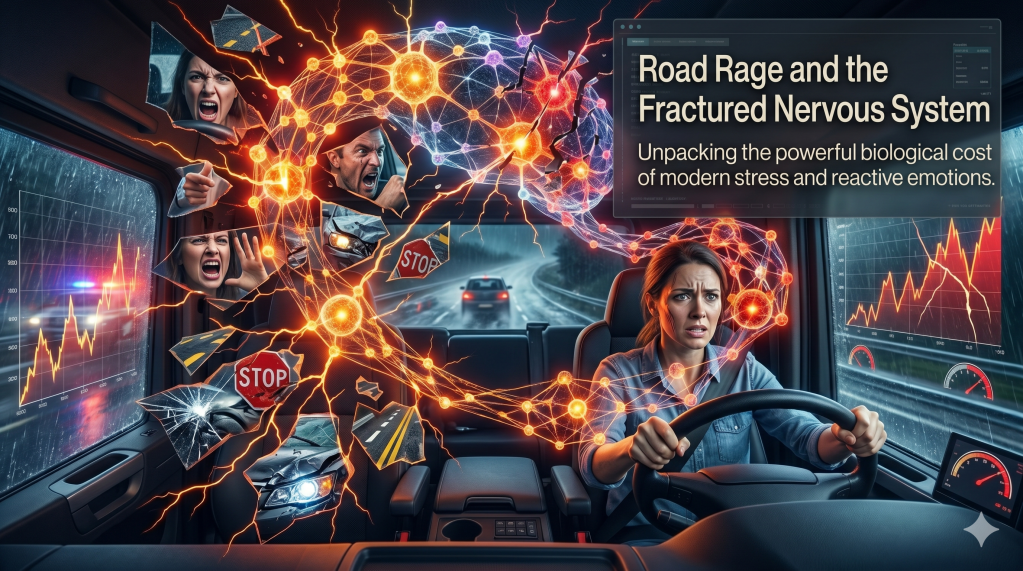
Road rage surged during and after the pandemic. This essay examines the neuroscience, psychology, and social forces behind aggressive driving and what the data reveals about human behavior under stress.
On the morning of May 21, 2021, Joanna Cloonan was driving her six-year-old son Aiden to kindergarten on the 55 Freeway in Orange County, California. Another car cut her off. She felt a flash of anger and made a gesture out the window. The driver of the other car — a passenger, actually, riding with his girlfriend — reached into the back seat pocket, pulled out a handgun, and fired at Cloonan’s vehicle. The bullet passed through the trunk, through the back seat, and struck Aiden in his booster seat. He died at the hospital thirty minutes later. His killer was convicted of second-degree murder in 2024.
Cases like this are rare, but they reveal in extreme form the same psychological processes that drive millions of less severe road rage incidents every year.
How does a cut-off on a freeway become a homicide? How does a hand gesture, visible for perhaps two seconds, produce a sequence of decisions that ends with a six-year-old dying on his way to school? The mechanics of that collapse are not as mysterious as they appear. They follow a logic — a broken one, but a logic nonetheless. And in the years surrounding 2020 and the COVID-19 pandemic, the conditions that produce that logic were more widespread, more entrenched, and more dangerous than they had been in decades.
Road rage has been woven into the fabric of modern driving since automobiles became a mass phenomenon, but something shifted during the pandemic years. Traffic violence didn’t just continue along its familiar patterns. It escalated sharply, in ways that alarmed researchers, law enforcement agencies, and public health officials. Road rage shootings roughly doubled between 2018 and 2022, according to Everytown Research’s analysis of Gun Violence Archive data. Speeding citations involving speeds above 100 mph roughly doubled in many states during 2020 and 2021, even as total vehicle miles traveled initially dropped. People were driving less — and yet they were driving worse, and more dangerously.
Understanding why requires looking at road rage not merely as a traffic problem, but as a window into how stress fractures human behavior. It connects neuroscience, social psychology, and the specific cultural pressures of one of the most disorienting periods in modern American life. What happens in the brain during a road rage episode is not a mystery. What is harder to explain — and more important to understand — is why so many people arrived at the wheel in those years already primed for the worst version of themselves.
The Birth of a Phrase
The term “road rage” is more recent than most people assume. The phrase emerged in the late 1980s amid media coverage of rising violent incidents, particularly freeway shootings in Los Angeles, and the Oxford English Dictionary records its earliest known use in 1988 in a Florida newspaper. The phenomenon that prompted the phrase was visceral and specific. In the summer of 1987, a series of shootings terrorized Southern California freeways — by the end of August, five people were dead and eleven more injured, with hundreds of additional incidents reported statewide.
Los Angeles in 1987 was a city under pressure from an infrastructure that hadn’t kept pace with explosive population growth. The freeway system, once the envy of the country, had become a daily exercise in compression and frustration. The media called it “highway hostility.” The phrase “road rage” wouldn’t fully enter the cultural vocabulary until the mid-1990s, when a new wave of incidents prompted renewed national coverage — but the underlying forces had been building for decades.
Between 1990 and 1996, road rage caused more than 200 fatalities and 12,600 injuries. Those numbers look modest only in hindsight. By the time the pandemic years arrived, the scale of the problem had grown considerably, and the combination of chronic stress, widespread firearms, and altered driving norms would push it to new extremes.
What the Brain Is Actually Doing
Road rage is not simply rudeness at high speed. It is, in a meaningful neurological sense, a temporary reorganization of how the brain processes information and controls behavior.
The amygdala — the brain’s fast-acting threat detector — fires before the conscious mind has fully registered what happened. That surge of anger, that sudden impulse to retaliate, is already in motion while the prefrontal cortex is still processing the situation. This is not a metaphor or a simplification. These are two distinct brain systems operating on different timescales, and in moments of perceived threat or provocation, the older, faster, more reactive system tends to get there first.
The prefrontal cortex is where the more deliberate aspects of human behavior live: impulse control, the ability to consider consequences, the capacity to imagine what things look like from another person’s perspective. Under acute anger, its influence over behavior is measurably reduced. A person in the middle of a road rage episode is, in a neurological sense, less rational and less empathetic than that same person sitting quietly at home.
Cortisol, testosterone, and adrenaline combine to produce the fight-or-flight response: heart rate climbs, muscles tense, peripheral vision narrows. This system evolved to handle immediate physical threats — a predator, a falling rock. It didn’t evolve for merge lanes. But the brain doesn’t draw that distinction cleanly. A driver who cuts you off triggers roughly the same cascade of stress chemistry as a physical confrontation, and the body responds accordingly, flooding the system with hormones that are useful for fighting or fleeing but counterproductive for making calm, rational decisions about traffic.
People with what psychologists call high trait anger — a stable tendency to experience anger more frequently and more intensely — don’t just get angrier behind the wheel. They stay angrier for longer, ruminate on perceived injustices, and are more likely to retaliate. This matters because chronic background stress, the kind that accumulated throughout the pandemic period, has a measurable effect on baseline anger levels. It shifts the threshold. It takes less to trigger the cascade, and once triggered, it takes longer to come down.
The Car as a Permission Structure
Beyond the neuroscience of anger itself, there is something specific about the driving environment that changes how people behave. It begins with anonymity.
Psychologists call the relevant phenomenon “deindividuation” — a loss of self-awareness and, along with it, individual accountability. Anonymity is always a key ingredient, and cars work much the same way as an identity-masking hood. Inside a vehicle, you are visible to other drivers in only the most superficial sense. They can see your car, perhaps your silhouette. They cannot read your expression, make meaningful eye contact, or access any of the social information that ordinarily regulates how people treat one another. The usual feedback mechanisms of human behavior are stripped away.
The anonymity provided by being inside a vehicle creates a sense of detachment from social norms and accountability. It is why people who are, by every measure, decent and considerate in their face-to-face lives will do things behind the wheel they would never consider doing in any other social context. The car becomes a kind of permission structure — a space where the ordinary consequences of aggression feel distant, and where the usual social cues that trigger empathy and restraint are absent.
The car also encourages a particular kind of cognitive distortion in how we perceive other drivers. Research on driving behavior suggests that we process other vehicles somewhat differently than we process other people. They become obstacles, impediments, categories — the slow driver, the aggressive one, the idiot who just merged without signaling. The three-dimensional human inside the other car, with their own anxieties and bad days and entirely defensible reasons for their driving decisions, gets flattened into a type.
This pattern has a name in social psychology: the fundamental attribution error. When another driver does something annoying, we tend to explain it by their character — they’re reckless, inconsiderate, a bad driver. When we do the same thing, we attribute it to circumstances — we were in a hurry, we didn’t see the sign, that merge was objectively confusing. The car amplifies this tendency because it removes the human signals that ordinarily help us extend the benefit of the doubt.
The Territorial Dimension
There is another layer to this that doesn’t get discussed enough: the psychology of territory. Humans have a deep-seated tendency to treat the space around them as an extension of themselves, and the car activates this instinct in an unusually direct way. Lane position, following distance, right-of-way, and parking spaces are not experienced by many drivers as abstract traffic concepts. They are experienced as possessions — boundaries to be defended, encroachments to be answered.
The vehicle itself becomes an extension of the self. When another driver cuts into your lane, the psychological register isn’t always “that was an inconvenient traffic maneuver.” Often it feels closer to “that person took something from me.” Evolutionary psychologists would point out that humans share this territorial instinct with a broad range of other species, and that challenges to territory trigger threat-response systems that evolved long before cars existed. The road, for drivers operating under this frame, stops being shared public infrastructure and becomes a contested space where every interaction has a winner and a loser. That framing makes de-escalation extraordinarily difficult, because backing down doesn’t feel like avoiding unnecessary conflict — it feels like losing.
A Nervous System Under Siege
To understand the road rage surge of the pandemic years, it helps to understand what was happening to the average American nervous system before they ever started the car.
The COVID-19 pandemic was not merely a public health crisis. It was a sustained, multidimensional stressor that operated simultaneously on physical safety, economic stability, social connection, and existential certainty. The most common psychological disorders emerging during this period were anxiety, insomnia, depressive symptoms, and post-traumatic stress — not only as a direct consequence of the virus itself, but driven heavily by the effects of prolonged social isolation. Research published in The Lancet found that periods of isolation, even those lasting fewer than ten days, could produce psychiatric symptoms that persisted for up to three years afterward.
But there was a more diffuse form of strain that is harder to quantify and arguably just as important: cognitive overload. By 2021, many people were spending their days managing unprecedented amounts of information and uncertainty simultaneously. Pandemic protocols changed by the week. Economic conditions shifted beneath people’s feet. Remote work blurred the boundaries between professional and domestic life in ways that gave many people no true pause. Notifications, news cycles, and the ambient hum of unresolved anxiety competed for attention around the clock. Decision fatigue — the depletion of mental resources that results from a constant stream of choices — was widespread and largely unacknowledged.
Driving no longer occurred against a backdrop of psychological calm. It occurred against a backdrop of chronic cognitive load. The drive home, once a transition between two distinct mental states, had become just another stretch of time in a day that offered no clear delineation between stress and recovery. The brain that arrived at the steering wheel was often one that had already been processing at high intensity for hours, with depleted resources for the kind of patient, perspective-taking, low-reactivity thinking that safe driving — and peaceful coexistence on the road — depends on.
When people began driving again in significant numbers, they brought all of that with them. The commute that might once have been mildly irritating became, for many people, an encounter between a highly primed nervous system and an environment full of potential provocations. Smaller things hit harder. Reset time — the window in which a person returns to emotional baseline after an irritating event — was shorter, or didn’t happen reliably at all. Chronic stress keeps cortisol elevated even in the absence of an immediate trigger. A person in that state is not driving in the same way as a person whose stress load is manageable.
Researchers also noted an additional factor specific to the early pandemic period: emptier roads appeared to have altered driving norms in ways that persisted even as traffic returned. People drove faster when roads were empty. Some of those habits, once acquired, proved difficult to shed.
The Escalation Factor
What separates road rage from ordinary driving frustration is escalation — the process by which a minor irritation compounds into something dangerous. Understanding that process requires looking at the interaction between individual psychology and the specific social dynamics of the driving environment.
The psychology behind tailgating and aggressive driving connects directly to the deindividuation dynamics described above, but adds an additional element: the illusion of control. Following extremely closely gives aggressive drivers a feeling of pressure and influence over the driver ahead — a proxy for the control they feel they’ve lost by being delayed or blocked. Control, or the perception of losing it, is central to how road rage unfolds. Driving, by its nature, involves an unusual degree of dependence on the behavior of strangers. Every driver on the road is making constant decisions that affect every other driver, and none of those decisions are coordinated or predictable in the way that most social interactions are.
When something violates a driver’s expectations — when someone cuts them off, slows them down, or fails to follow the informal rules of the road as that driver understands them — the experience is often coded as an injustice, not merely an inconvenience. And perceived injustice is one of the most reliable triggers of the kind of anger that doesn’t dissipate quickly. It has a staying power that ordinary frustration doesn’t. The driver who feels wronged begins to assign intent to the other person’s behavior, imagines the other driver as contemptuous or deliberately hostile, and the escalation that follows has its own logic, even if that logic is deeply counterproductive.
Being tailgated, meanwhile, elevates stress significantly in the driver ahead. Cortisol rises, attention narrows, and the driver often makes worse decisions as a result — braking more sharply, making erratic lane changes. The aggressive driver’s behavior creates the exact situation they were frustrated by. It is a feedback loop, and it is genuinely dangerous for everyone around it.
When Road Rage Turns Deadly
Most road rage incidents end with gestures, shouting, or reckless driving. The encounter is unpleasant, the adrenaline takes a few minutes to clear, and both parties continue on their way. The danger lies in the small percentage of incidents that keep escalating after both parties have had opportunities to disengage — where pride, perceived humiliation, or territorial instinct overrides the offramp that exits the conflict.
That escalation path becomes catastrophically short when a firearm is present. The numbers from the pandemic era don’t admit of comfortable interpretation. In 2021, more than 500 people were shot and wounded or killed in over 700 incidents involving road rage and guns. A person was shot and either injured or killed in a road rage incident every 17 hours, on average, during that year. An average of 44 people per month were shot and killed or wounded — double the pre-pandemic average. Road rage gun incidents increased by 98% from 2017 to 2021 — measured by the total number of people shot, both killed and injured, according to The Trace’s analysis of Gun Violence Archive data.
Research has consistently shown that the presence of a firearm in a vehicle is associated with more aggressive driving behavior, not less. The weapon changes the calculus of an encounter, sometimes in ways the person carrying it doesn’t consciously anticipate, but that emerge when an encounter escalates beyond the point they’d planned for. The territorial instinct, the amygdala’s threat response, the anonymity of the car, the depletion of cognitive resources — any one of these factors might be manageable in isolation. Together, and combined with a loaded weapon, they produce outcomes that leave six-year-olds dying in their booster seats on the way to kindergarten.
Who Is Most at Risk — and Why
Road rage is not evenly distributed across the population, and understanding who is most susceptible to it helps illuminate the underlying mechanisms.
Research consistently finds that men engage in aggressive driving behaviors at higher rates than women, and that drivers between the ages of 25 and 39 exhibit the most road rage behaviors. About 37.8% of men and 29.3% of women have prevented another vehicle from merging by following too closely, according to AAA data. The gender differences are consistent with broader patterns in aggression research, where testosterone and different socialization around the expression of anger play documented roles.
Personality factors also matter considerably. Research has drawn a direct line between narcissistic traits and aggressive driving — a finding that has clear intuitive logic. Certain personality traits, including high trait anger, impulsivity, and narcissistic entitlement, consistently predict aggressive driving behavior across research populations. The driver who believes they have a fundamental right to be somewhere first, who interprets the normal friction of traffic as a personal affront, is operating from a frame of reference that makes escalation much more likely.
But it would be a mistake to treat road rage as purely a trait-level phenomenon — a problem of certain kinds of people that can be distinguished cleanly from the behavior of everyone else. Research suggests that roughly 82% of people report committing an act of road rage in the past year, according to a 2019 survey of nearly 1,000 drivers conducted by The Zebra. That’s not a small subset of pathological individuals. That’s almost everyone. The question is less whether a given person is capable of road rage behavior, and more what conditions push ordinary people across the threshold into it — and what those conditions reveal about the broader state of human stress tolerance at a given moment in time.
The Longer Shadow
The road rage surge of the pandemic era did not resolve cleanly when the pandemic’s acute phase ended. Local law enforcement leaders and researchers have described the increase as the culmination of personal stress, a changing modern culture, and habits formed during the pandemic that proved resistant to change. The behavioral shifts were stickier than the circumstances that produced them.
Traffic fatality rates in 2022, while slightly lower than their 2021 peak, remained elevated compared to the pre-pandemic year of 2019. Before the pandemic, that rate had been on a general downward trajectory since 2002 — the result of safer vehicles, better road design, improved emergency medicine, and cultural shifts around drunk driving. The pandemic disrupted that trend. Some of that disruption reflects specific changes from the crisis years. Some of it reflects something harder to name: a broader shift in how people manage stress, relate to shared social spaces, and treat strangers.
The car, for all its practical utility, has always been a strange social environment — a place where the ordinary rules of human interaction apply only partially, where the feedback loops that regulate behavior in face-to-face encounters are absent, and where the consequences of losing control can be catastrophic in ways that losing control in a conversation never is. Road rage sits at the intersection of all the things that are difficult about being human in a complex society: stress, anonymity, status competition, the perception of injustice, territorial instinct, cognitive depletion, and the biology of threat response.
It is, in that sense, a diagnostic. A mirror held up to the internal state of a population.
What the pandemic years revealed, in the data from speeding citations and shooting incidents and fatality statistics, was a population under more strain than its infrastructure — social, psychological, or physical — was designed to handle. The fractures showed up on the road because the road is where millions of people share space with strangers while operating powerful machinery, with minimal regulation of how they treat one another in the thousands of small moments that constitute a commute. In that environment, what people carry inside them tends to come out.
The road rage problem is not, in the end, a driving problem. It is a human problem that happens to have particularly measurable and dangerous consequences when it plays out at sixty miles an hour.









