
Originally published in July 2021 and comprehensively updated/edited in June 2026.
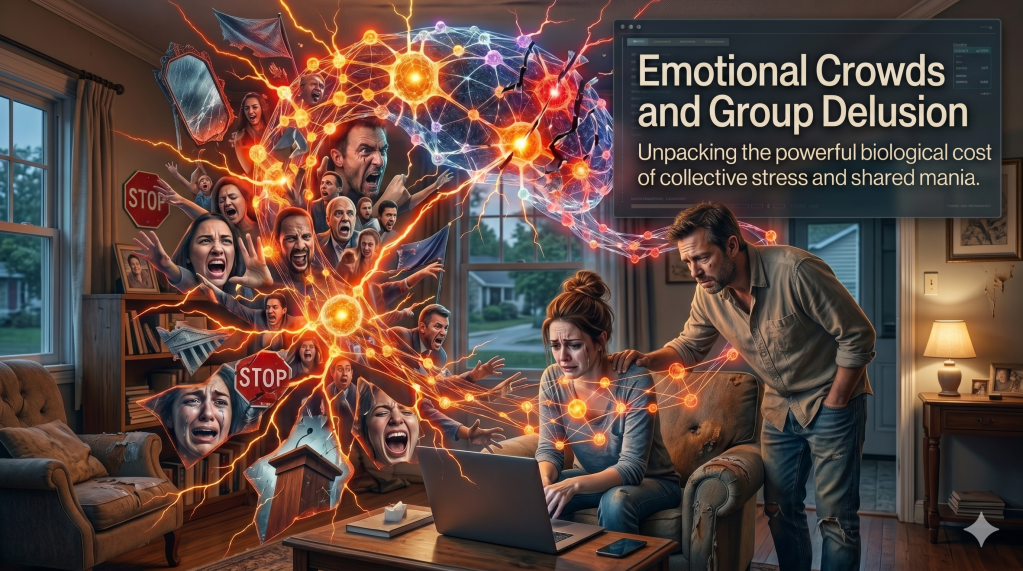
Explore the psychology of emotional crowds and group delusion — how shared emotion, social identity, and digital platforms shape what we believe and why evidence alone rarely changes minds.
A person standing alone rarely starts a riot, buys a stock at ten times its value, or becomes convinced that an invisible enemy is everywhere. Yet groups do these things repeatedly, across centuries and cultures, in ways that seem inexplicable after the fact. The individuals involved are not, in most cases, unusually foolish or unusually dangerous. They are ordinary people caught inside something larger than themselves — a shared emotional current that rewrites what feels true, what feels possible, and what feels necessary.
The years between 2020 and 2022 offered a concentrated laboratory for watching this phenomenon unfold in real time. A global pandemic, political polarization at historic levels, the rapid spread of health misinformation, social media algorithms rewarding outrage, and mass psychological stress all converged in a way that made the dynamics of emotional crowds and group delusion unusually visible. But the forces at work were not new. They have been present throughout human history, documented in religious revivals and stock market panics, in witch trials and revolutionary movements, in sports riots and moral crusades.
What psychology, neuroscience, and sociology have learned about these dynamics is both illuminating and humbling. Understanding why humans are so susceptible to collective irrationality does not make us immune to it. But it does make the patterns harder to ignore.
What Happens to the Mind Inside a Crowd
The Individual Dissolves — Partially
The French sociologist Gustave Le Bon wrote about crowd psychology in 1895, and while his work reflected the anxieties and prejudices of his era, his core observation held up: something genuinely changes about human cognition and behavior when people become part of a group in a heightened emotional state. He called it a kind of psychological submersion — the individual’s critical faculties reduced, their suggestibility increased, and their sense of personal responsibility diffused across the collective.
Modern psychology has filled in the mechanisms Le Bon could only describe impressionistically. One of the most important concepts is deindividuation — the psychological state in which a person’s sense of individual identity weakens within a group context. When people feel anonymous, less personally accountable, and caught up in shared emotion, they are more likely to act on impulse, conform to group norms, and abandon the internal checks that normally regulate behavior. Experiments going back to Philip Zimbardo’s work in the 1960s and 1970s confirmed this effect, though later research has refined our understanding: deindividuation does not simply release “the beast within.” It makes people more responsive to whatever identity and norms the group is projecting. A crowd united around charitable giving can become more generous. A crowd united around hostility becomes more hostile. The group sets the template; deindividuation amplifies conformity to it.
Emotional Contagion and the Spread of Feeling
Another mechanism at work in emotional crowds is emotional contagion — the automatic, largely unconscious process by which emotions spread from person to person. Researchers Elaine Hatfield, John Cacioppo, and Richard Rapson described this in detail in the 1990s: humans unconsciously mimic the facial expressions, body language, and vocal tones of those around them, and through that mimicry, they begin to feel what others are feeling. It is a feature of social bonding, not a bug — it is what allows us to empathize, to coordinate, to care for each other.
But in a crowd gripped by fear, anger, or moral outrage, emotional contagion becomes a kind of amplifier. Fear spreads and intensifies. Outrage feeds on itself. The individual who enters a gathering feeling mildly irritated can leave convinced that something catastrophic is happening, because the emotional temperature of the group has rewritten their own internal state. Neuroimaging studies have shown that seeing emotional expressions in others activates the same brain regions as experiencing those emotions directly — the boundary between feeling something and watching someone else feel it is thinner than most people assume.
Social media has turbocharged this effect by removing the need for physical proximity. A tweet, a video, a post portraying outrage can reach millions of people in hours, activating the same emotional circuitry as being physically present in an angry crowd. Research published in Science in 2018 found that false information spreads faster and farther on Twitter than true information, and that emotional responses — especially surprise and disgust — drive much of the sharing. The crowd, in the digital age, never has to assemble in one place to behave like a crowd.
Group Delusion: When Shared Belief Becomes Untethered from Evidence
Defining the Phenomenon
Group delusion is a term that needs careful handling. In clinical psychiatry, a delusion is a fixed, false belief held with strong conviction despite clear contradictory evidence, and it is a symptom of serious mental illness. Group delusion, as studied in sociology and social psychology, is something different — it refers to beliefs shared by a large number of people that are factually false or wildly distorted, maintained and spread through social rather than purely individual processes, and resistant to correction through evidence.
The history of mass psychogenic illness — once called mass hysteria — offers the most dramatic examples. In 1962, workers at a textile factory in the American South began reporting symptoms of nausea, fainting, and numbness after some noticed an unusual smell. The symptoms spread rapidly through the workforce, with over a hundred people affected. Extensive investigation found no toxin, no pathogen, no environmental hazard that could account for the outbreak. The symptoms were real — people genuinely felt ill — but the cause was social transmission of fear rather than a physical agent. Similar episodes have been documented in schools, military units, and communities throughout history and across cultures.
These cases are often presented as curiosities, but they illuminate something important: the social environment can directly produce physical symptoms. The mind and body are not separate systems, and when a group’s shared belief is strong enough — particularly a belief about danger — it can generate real physiological responses. This is not weakness or gullibility on the part of those affected. It is the human nervous system responding to social signals the way it was shaped to respond over millions of years of evolution.
The Role of Stress and Uncertainty
Psychological research consistently finds that people are more susceptible to group delusion and conspiracy thinking under conditions of stress, uncertainty, and perceived threat. This makes sense from a cognitive standpoint. The human brain is a prediction machine that craves coherent explanations. When reality becomes chaotic and threatening, and when official explanations feel inadequate or untrustworthy, the mind will reach for any narrative that organizes the chaos into something meaningful — something with cause, effect, and identifiable agents.
Researchers like Karen Douglas and Robbie Sutton, who study conspiracy belief, have found that people are drawn to conspiratorial thinking when they feel powerless, anxious, and uncertain. The conspiracy theory restores a sense of order: there are actors with intentions, plans, and goals. Even a malevolent order can feel more tolerable than pure randomness. This is why conspiracy theories flourish in the aftermath of disasters, economic shocks, and political upheavals — exactly the conditions that produce emotional crowds and heightened group cohesion.
The same stress-and-uncertainty mechanism that drives conspiratorial belief also drives collective financial manias. In January 2021, retail investors coordinating on Reddit’s WallStreetBets forum drove the price of GameStop stock up by more than 1,700 percent in a matter of weeks. The episode was not primarily about rational return on investment. It was a collective performance — a shared narrative about sticking it to hedge funds, proving that ordinary people had power, and belonging to something that felt historic. The financial logic mattered far less than the emotional and tribal logic. Similar dynamics have recurred in cryptocurrency markets, where assets with no underlying revenue or utility have periodically surged to extraordinary valuations before collapsing, driven by communities that had fused financial belief with group identity to a degree that made skepticism feel like betrayal.
The COVID-19 pandemic added another dimension to this landscape, compressing multiple group-delusion dynamics into an unusually short period. As a genuinely novel and frightening pathogen spread across the world, accompanied by rapidly changing guidance and governments visibly struggling to respond, the conditions were close to ideal for false beliefs to take root. Health misinformation spread at extraordinary speed, and specific claims — about vaccines, treatments, and the origins of the virus — became markers of group identity. What began as factual disagreement calcified, in many cases, into tribal allegiance. Correction through evidence alone proved nearly impossible, for reasons the research on identity-protective cognition predicts precisely.
Emerging technologies tend to generate their own versions of this cycle. When a new capability appears that feels historic — the internet, social media, and more recently artificial intelligence — it attracts both fervent believers and fervent critics whose certainty routinely outruns the evidence. The structural features are familiar: ingroup loyalty, rapid spread of claims, and social costs for those who urge patience. The specific technology changes; the crowd dynamics do not.
The Social Architecture of Belief
Why Evidence Rarely Wins
One of the most counterintuitive findings in social psychology is that presenting people with factual corrections to false beliefs often fails, and can sometimes backfire. This “backfire effect” — originally documented by Brendan Nyhan and Jason Reifler — has been partially revised by subsequent research; it turns out not to be as universal as initially thought. But the broader insight holds: belief is not primarily a product of rational evidence evaluation. It is shaped by identity, emotion, social belonging, and trust.
When a false belief is embedded in a social group’s identity — when holding the belief signals loyalty, signals who you are and who your people are — then presenting evidence against it is not received as helpful information. It is received as an attack. The person defending the belief is not defending a proposition; they are defending themselves, their community, their sense of having understood something that others have missed. This is why the tone and source of correction matter as much as its content. A correction from someone perceived as an outsider or an elite is far less likely to land than the same information delivered by a trusted community member.
Neuroscience adds another layer. Research using fMRI has shown that when people encounter information that challenges their deeply held beliefs, particularly politically and socially charged ones, the brain regions associated with threat detection and emotional processing become active. The prefrontal cortex — associated with deliberate reasoning — tends to be recruited afterward, often in service of motivated reasoning: finding ways to dismiss the threatening information rather than evaluate it dispassionately. We are reasoning creatures, but we are also rationalizing creatures, and the two processes are frequently in conflict.
Identity, Tribe, and the Cost of Doubt
Anthropologists and evolutionary psychologists have noted for decades that humans are intensely social animals whose survival has long depended on group membership. Exclusion from the group was, for most of human history, a genuine threat to survival. The psychological mechanisms that evolved to maintain group belonging — sensitivity to social acceptance and rejection, powerful drives toward conformity, heightened suspicion of outgroup members — remain fully operational in modern humans, even when the stakes are not actually survival.
This means that doubting the group’s shared belief carries a psychological cost that has nothing to do with the belief’s truth value. To doubt is to risk separation. To dissent publicly is to invite ostracism. In tightly knit communities, whether physical or online, where a set of beliefs defines membership, the social pressure to maintain those beliefs can be overwhelming — not as explicit coercion, but as the ambient pressure of wanting to belong.
Research by social psychologist Solomon Asch in the 1950s demonstrated the power of this dynamic starkly. In his famous conformity experiments, subjects consistently gave answers they could plainly see were wrong — about which lines on a card were the same length — when the experimental confederates around them unanimously gave the wrong answer. They were not all deceived; many knew the right answer. But the social pressure to agree was enough to override their private judgment. Asch found that having even one ally — one other person giving the correct answer — dramatically reduced conformity. The isolation of dissent was the key mechanism.
Emotional Crowds in the Digital Age
Algorithms and the Architecture of Outrage
The platforms that now host much of human social life were not designed to promote measured deliberation. They were designed to maximize engagement, and the emotions that maximize engagement are not calm, not reflective, and not nuanced. They are outrage, fear, moral indignation, and tribal solidarity. These emotions are sticky. They make people return, share, comment, and argue. They generate the behavioral data on which recommendation algorithms are trained.
The result is a media environment that systematically rewards the most emotionally intense and divisive content. This does not mean that social media creates group delusion from nothing — the underlying human tendencies were always there. But it has changed the scale, the speed, and the self-reinforcing quality of emotional crowds. A belief system that might once have stayed confined to a regional subculture can now recruit globally in weeks. A false claim that might once have faded for lack of amplification can now reach millions before any correction appears.
Frances Haugen’s disclosures from inside Facebook in 2021 confirmed what researchers had suspected: the company’s own internal studies showed that its engagement-optimization algorithms were amplifying divisive content and that this was understood internally as a problem. The commercial incentives of platform design and the psychology of emotional crowds had been quietly aligned for years, with significant consequences for public belief and political behavior.
Echo Chambers and the Collapse of Shared Reality
Closely related to the algorithm problem is the phenomenon of epistemic filtering — the process by which people selectively consume information that confirms their existing beliefs. This existed long before the internet; humans have always preferred agreeable information. But digital platforms have made this filtering vastly more efficient. It is now possible to inhabit an information environment so carefully curated, whether by algorithmic selection or personal choice, that one’s worldview is almost never meaningfully challenged.
Researchers disagree about how sealed these echo chambers actually are in practice. Some studies have found that people’s online information diets are more varied than the echo chamber thesis implies. Others have found significant polarization effects, particularly among the most politically engaged. But even if echo chambers are not perfect, the trend toward fragmented information environments is real, and its consequences for shared reality — for the existence of a common set of facts that different groups agree on — appear to be serious.
When groups operate from fundamentally different factual premises, communication across group lines becomes not merely difficult but often pointless. Each side experiences the other as not just wrong but irrational, because they are reasoning from incompatible starting points. What looks like willful stupidity from outside is often simply the product of a genuinely different information environment reinforced by social identity.
Historical Echoes
It would be a mistake to treat the dynamics described here as uniquely modern problems. The Salem witch trials of 1692 showed how fear, community stress, social accusation, and the logic of contagion could spread false and deadly beliefs through a small community. The Dutch tulip mania of the 1630s showed how collective belief in rising asset values could become self-fulfilling and then catastrophically self-defeating. Moral panics about new media — the novel, the penny press, the radio, the television — have recurred with each generation, each time carrying the same structure of collective fear about corrupting influences.
What seems to change across historical periods is not the underlying psychology but the specific content of shared fears and false beliefs, the speed at which they spread, and the scale at which they can operate. The printing press accelerated the spread of both the Reformation and anti-Semitic slanders simultaneously. Telegraph and radio made it possible for propaganda to reach entire nations in ways that would have been impossible with slower communication. Each new communication technology has amplified both the best and worst tendencies of emotional crowds.
The sociologist Émile Durkheim, writing at the turn of the twentieth century, introduced the concept of collective effervescence — the heightened sense of energy and meaning that individuals experience when gathered together in shared ritual or purpose. This state is not inherently destructive; it underlies religious experience, political solidarity, artistic communities, and social movements that have genuinely improved human life. The same capacity for collective feeling that can produce group delusion can also produce acts of extraordinary collective courage and generosity.
What Research Suggests — and What It Doesn’t
It would be dishonest to conclude that psychology and behavioral science have a clear prescription for solving the problem of group delusion and emotional crowds. The research illuminates mechanisms; it does not offer a straightforward cure. But the field has produced some findings solid enough to be useful, even if none of them scale as easily as the problems they address.
Prebunking Works Better Than Debunking
One of the more encouraging findings of recent years is that prebunking — warning people in advance that they may encounter manipulative or misleading content, and walking them through the specific techniques used — appears more effective than trying to correct false beliefs after they have taken hold. Research by Sander van der Linden and colleagues at Cambridge has found that exposing people to a weakened “dose” of misinformation, along with an explanation of why it is misleading, inoculates them against stronger versions of the same argument later. The metaphor is deliberately medical: just as a vaccine introduces a weakened pathogen to prepare the immune system, prebunking introduces manipulative rhetoric in a context where the person can examine it critically.
This matters because it shifts the intervention from reactive to proactive. Fact-checking after the fact is necessary, but it has significant limitations: it reaches people who already doubt the claim, it can trigger backfire effects in people who are deeply identified with the belief, and it will always lag behind the initial spread. Prebunking can be embedded in media literacy education, in platform design, and in the broader culture of how institutions communicate with the public during periods of uncertainty.
Media Literacy Needs to Teach Process, Not Just Content
A related insight is that effective media literacy education focuses less on identifying specific false claims and more on building the habit of asking how information is produced, by whom, and with what incentives. Teaching people to evaluate sources rather than just content produces more durable skepticism, because it gives people a general tool rather than a specific fact-check. Researchers call this “lateral reading” — the practice of opening new tabs to check what other sources say about a claim or outlet, rather than reading the original source deeply and trying to evaluate it in isolation. Studies at Stanford found that professional fact-checkers do this almost instinctively, while students and even academic historians often do not.
None of this is simple to scale through formal education systems, which move slowly and are themselves subject to political pressures. But the evidence that process-based literacy works better than content-based literacy points to something important about how misinformation actually spreads: it rarely wins through the quality of its arguments. It wins through volume, repetition, and the absence of friction.
Cultures That Protect Dissent and Reward Uncertainty
Asch’s conformity research showed that having a single ally — one other person willing to give the correct answer — dramatically reduced the rate at which subjects conformed to the wrong group consensus. Organizations, communities, and platforms that actively protect dissenting voices are more resistant to group delusion than those that do not. Intelligence analysts, military planners, and medical institutions have all developed formal mechanisms — red teams, pre-mortems, mandatory dissent procedures — specifically because they know that the natural social dynamics of groups will suppress doubt at exactly the moments when it is most needed.
Closely related is the capacity psychologists call intellectual humility — genuinely recognizing the limits of one’s own knowledge and remaining open to revision. Research finds it can be cultivated, and that people who score high on it are less likely to treat disagreement as a personal attack and more willing to update when evidence shifts. The obstacle is cultural: confidence is rewarded, uncertainty is treated as weakness, and the public figure who says “I was wrong” rarely benefits from the admission. These norms are not fixed, but changing them is slow work that no single intervention can accomplish.
Institutional Credibility as Infrastructure
Perhaps the most underrated safeguard against group delusion is the existence of trusted institutions with the competence and legitimacy to serve as credible sources of shared reality. This is not an argument for deference to authority; institutions can be wrong, can be captured by interests, and should be questioned. But when institutions lack credibility — when large portions of the public believe they are systematically dishonest or incompetent — the epistemic vacuum that results is filled by something, and what fills it is rarely more accurate or more trustworthy.
The erosion of institutional trust that has characterized the early twenty-first century in many democracies is, from this perspective, not just a political problem. It is a cognitive infrastructure problem. It removes the shared reference points that make it possible for people with different perspectives to argue from a common factual baseline. Rebuilding that trust requires institutions to actually perform well, to communicate honestly about their uncertainties, and to admit and learn from their mistakes — all of which are easier to describe than to accomplish.
The uncomfortable truth is that none of these interventions — prebunking, media literacy, dissent cultures, intellectual humility, institutional credibility — is sufficient on its own, and together they remain modest relative to the scale of the challenge. The social media companies have significant financial incentives to maintain engagement, which means maintaining emotional intensity. Political actors have significant incentives to exploit group delusion rather than correct it. And the human cognitive architecture that makes us susceptible to these dynamics was not designed for the information environment we have built — it was designed for small-group social life on the East African savanna, and it is being run through conditions it was never equipped to handle.
Understanding as a Starting Point
The study of emotional crowds and group delusion does not lead to optimism or pessimism in any simple way. It leads to a more accurate picture of what human beings are: intensely social creatures whose beliefs are formed as much through tribal belonging as through evidence, whose emotions spread like viruses, and who are capable of collectively believing things that no individual among them, examined separately, would endorse.
This is not a comfortable picture. But it is a clarifying one. Understanding that belief is social before it is rational helps explain why simply presenting people with facts so rarely changes their minds, and why designing better information environments matters as much as producing better information. Understanding that emotional contagion is a feature of human neurology — not a character flaw — makes it easier to have compassion for people caught up in collective delusion while still taking seriously the real harm that false beliefs can cause.
Recent history has made these dynamics unusually visible — hard to look away from, harder still to dismiss. Whether that visibility translates into something more durable — better institutional design, wiser platform governance, more psychologically literate public culture — remains genuinely uncertain. Human beings have shown, throughout history, both a remarkable capacity to be swept up in group delusion and a remarkable capacity, eventually, to step back and assess what happened. The distance between those two moments, and what fills the space between them, is one of the defining questions of this era. The challenge may not be teaching people what to think, but preserving the conditions that make it possible to think independently at all.









