
Originally published in August 2021 and comprehensively updated/edited in June 2026.
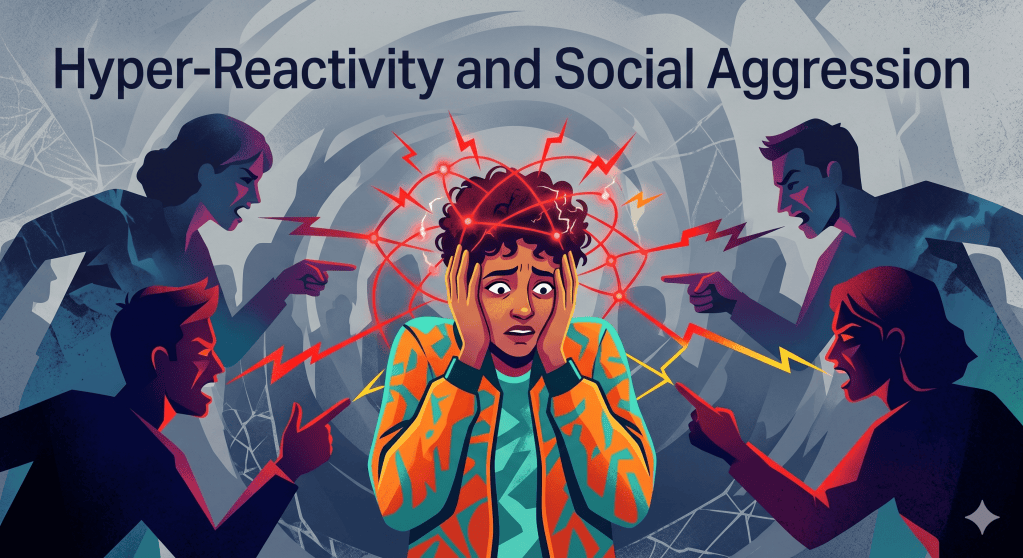
Hyper-reactivity and social aggression surged in the early 2020s. Explore the psychology, neuroscience, and social forces behind why people became so reactive — and what it costs us.
There was a particular quality to human interaction in those years that is difficult to describe without sounding melodramatic. Conversations that would have once been forgettable — a disagreement about a news story, a debate about a policy, even a difference in personal taste — were becoming charged with an urgency that felt almost physical. People weren’t just disagreeing; they were reacting. And not in the measured, thoughtful way that word might imply. They were snapping, escalating, withdrawing, or attacking — often within seconds of encountering something that challenged them.
This wasn’t imaginary, and it wasn’t limited to one country or political persuasion. Something had shifted in the baseline emotional temperature of public discourse. The question worth asking — carefully, without assuming the worst about human nature — is why. What combination of psychological, neurological, social, and technological forces produces a population that seems perpetually poised to detonate? And what does that state of readiness cost us, individually and collectively?
Hyper-reactivity and social aggression are not new phenomena. But the specific conditions of the past several years accelerated and amplified them in ways that researchers are still working to fully understand. This essay attempts to lay out what we know, what we can reasonably infer, and what remains genuinely uncertain.
What Hyper-Reactivity Actually Means
The word “reactive” gets used loosely, so it’s worth being precise. In psychology and neuroscience, reactivity refers to the speed and intensity with which a person responds to a stimulus — particularly an emotional or social one. Everyone has a reactivity threshold, shaped by genetics, early life experience, chronic stress levels, sleep quality, and a dozen other factors. When that threshold drops — when it takes less to set someone off, and the response when triggered is more intense — we say that person is hyper-reactive.
This isn’t a moral failing or a character flaw. It’s a physiological state. The amygdala, the brain region most closely associated with threat detection and emotional response, becomes more easily activated under certain conditions: chronic stress, sleep deprivation, social isolation, and prolonged exposure to unpredictability. When the amygdala fires frequently and intensely, it can actually weaken the regulatory capacity of the prefrontal cortex — the area responsible for impulse control, perspective-taking, and deliberate reasoning. Neuroscientist Joseph LeDoux spent decades mapping this circuitry, and his work helps explain why people under sustained psychological pressure don’t just feel worse; they literally become less capable of modulating their own responses.
What makes this particularly relevant to social behavior is that the amygdala isn’t only processing personal threats. It’s deeply involved in social evaluation — in reading faces, interpreting tones of voice, and assessing whether the people around us are allies or adversaries. When the system is running hot, ambiguous social signals get read as threatening ones. A neutral comment gets heard as a criticism. A question gets interpreted as an accusation. The result is a kind of social hair-trigger, and it was being pulled, repeatedly, by the conditions of modern life.
The Stress Infrastructure of the Early 2020s
To understand why hyper-reactivity became so widespread, it helps to look at the environmental conditions that were producing it. The years between 2019 and 2023 subjected large portions of the global population to an extraordinary accumulation of stressors — not one or two, but many layered on top of each other in ways that made recovery difficult.
A Compounding Crisis
The COVID-19 pandemic was the most obvious and acute stressor, but it wasn’t just the disease itself that affected people psychologically. It was the sustained uncertainty — weeks turning into months turning into years of not knowing what was safe, what was true, or when things would return to something recognizable. Research on stress responses consistently shows that unpredictability is among the most psychologically damaging forms of adversity. The brain can adapt to hardship it understands. Hardship without a predictable end point is harder to metabolize.
Layered onto the pandemic were economic disruptions that threatened financial security for millions of people. Job losses, supply chain failures, inflation — each one a distinct stressor, but arriving simultaneously and without clear resolution. And beneath all of it, a set of pre-existing pressures that had been building for years: widening economic inequality, eroding institutional trust, and a media and information environment that had become genuinely difficult to navigate.
The cumulative effect was what psychologists sometimes call “allostatic overload” — a state in which the body’s stress-response systems, designed for short-term emergencies, have been running continuously for so long that they’ve begun causing damage rather than providing protection. Chronically elevated cortisol levels suppress immune function, disrupt sleep, impair memory, and — critically for our purposes — heighten emotional reactivity and reduce empathy. People weren’t just anxious. Many were in a sustained physiological state that made measured social interaction genuinely harder.
What this looked like from the inside is easy to misread. Hyper-reactivity is often mistaken for excess emotional intensity — a person overflowing with feeling. In many cases it may reflect the opposite: a system so depleted that it no longer has the energy required for restraint. Self-regulation is metabolically expensive. The capacity to pause before reacting, to consider another person’s perspective, to hold two contradictory things in mind at once — these are not passive states. They require neural resources. When people are chronically stressed, sleep-deprived, socially isolated, and cognitively overloaded, that capacity becomes genuinely harder to access. The short fuse isn’t a character trait. It’s often a sign that there’s nothing left in reserve.
Isolation and Its Social Consequences
The social isolation of pandemic-era lockdowns compounded things in ways that are easy to underestimate. Humans are social animals in a neurological sense, not merely a poetic one. Physical proximity to others, shared laughter, casual unscripted interaction — these experiences regulate our nervous systems in ways that no amount of video calling fully replicates. Research on social isolation shows that it increases amygdala reactivity, decreases the brain’s reward response to positive social cues, and elevates baseline anxiety.
When people reemerged into social life, many found that their social muscles had atrophied. Tolerance for disagreement, patience with social friction, the ability to read and respond to subtle interpersonal cues — these capacities require ongoing exercise, and they had gone unexercised. The result was social environments that felt simultaneously starved for connection and bristling with the potential for conflict.
The Digital Amplifier
None of this existed in isolation from technology. The social media ecosystem that had been developing for fifteen years had, by the start of the 2020s, become the primary venue through which many people experienced public discourse. And that ecosystem was not a neutral conduit for human communication. It had specific architectural features that systematically amplified hyper-reactivity and social aggression.
Engagement Optimization and Emotional Provocation
Social media platforms are built around a single metric: engagement. Every design decision is optimized to maximize the time users spend on the platform. The problem is that the emotions most reliably associated with high engagement are not curiosity, joy, or affection. They are outrage, fear, and moral indignation.
This isn’t a conspiracy; it’s a consequence of optimization. Researchers including William Brady at New York University have found that content expressing moral outrage spreads significantly farther and faster than content without it. When platforms optimize for engagement, they are, whether intentionally or not, optimizing for outrage. Repeated exposure to that content creates a kind of emotional habituation — the brain begins to expect a certain level of stimulation, and may gradually lower the threshold at which outrage responses are triggered, including offline. The training effect of social media on emotional reactivity is an active area of research, but the correlational evidence is difficult to dismiss.
The Architecture of Conflict
Beyond content optimization, social media platforms have specific structural features that facilitate social aggression while discouraging the kinds of interaction that might defuse it.
Anonymity, or even pseudonymity, reliably increases willingness to express hostility. This is well established in the psychology of online behavior — the reduced accountability of online contexts allows people to say things they would not say face-to-face, and to say them without the social feedback that might otherwise regulate their behavior. A person receiving a hostile comment in an online thread sees text, not a face. They cannot read the emotional state of the person who wrote it, cannot hear tone of voice, cannot engage in the micro-level social negotiation that human beings evolved to conduct in person.
Public shaming and pile-on dynamics — in which many people direct hostility at a single target, often someone with no real power to cause collective harm — are another feature of these environments. Psychologist Jon Ronson documented these phenomena extensively, observing that the experience of participating in a pile-on can produce a sensation that feels righteous and satisfying in the moment, even as the aggregate effect is often deeply disproportionate to whatever the original transgression was. The individual is expressing moral disapproval; the crowd is sometimes destroying a person’s life.
These dynamics didn’t create hyper-reactivity, but they provided an environment in which it could be expressed, reinforced, and transmitted to others with minimal friction.
Social Aggression as Group Behavior
Hyper-reactivity is an individual condition. Social aggression is what happens when enough reactive individuals share an identity, a grievance, and a communication platform. The relationship between the two is less like cause and effect and more like kindling and a match.
Social aggression — behavior aimed at damaging someone’s standing, relationships, or sense of belonging — is ancient. What changes across time and culture is the speed at which it can be organized, and the scale at which it can be deployed. What was distinctive about pandemic-era society was a particular convergence: individually elevated reactivity, group-level identity polarization, and communication technologies that could transform a local spark into a coordinated blaze within hours.
Identity, Threat, and Tribalism
People become more aggressive toward outsiders when they believe their group is under attack. This is not simply prejudice; it appears to be a deeply embedded feature of human social cognition, traceable to conditions in which group cohesion was genuinely a matter of survival. The mechanism is old. What the period between 2020 and 2023 changed was the volume and velocity of threat signals being fed into it.
The information environment had become extraordinarily efficient at producing threat narratives — stories in which your group’s values, status, or survival were in imminent danger. The brain often responds to rhetorically constructed threats using many of the same systems it uses to process genuine ones. Both can produce heightened vigilance, narrowed trust, and an accelerating willingness to treat ordinary social friction as enemy action. Political media on all sides had learned that threat framing produced engagement. The result was populations running in a kind of permanent emergency mode, responding to neighbors and colleagues with the wariness more appropriate to a war footing.
Moral Licensing and Righteous Aggression
One of the more uncomfortable findings from social psychology is the concept of moral licensing — the tendency for people who perceive themselves as acting from moral motives to feel licensed to engage in behavior they would otherwise consider unacceptable. When aggression feels like justice, the normal inhibitions against harming others are weakened.
This is not a phenomenon unique to any particular political tribe. It appears reliably across ideological lines, in religious and secular contexts, among the privileged and the marginalized alike. The specific content of the moral narrative changes; the underlying psychology does not. When people believe they are fighting for what is right against what is wrong, the ordinary social brakes — empathy, restraint, proportionality — tend to loosen. What would ordinarily read as cruelty reads instead as accountability, or as necessary force in defense of something important.
The danger of this dynamic is not that people have moral commitments — moral commitments are essential to functioning societies. The danger is when moral conviction becomes decoupled from accurate perception of the situation, and from proportionality in response. At that point, moral frameworks designed to protect human dignity can become instruments of its violation.
What the Research Says About Reducing Reactivity
If hyper-reactivity is partly a physiological state — and the evidence suggests it is — then it can, at least in principle, be shifted by changing the conditions that produce it. This is easier said than done at a societal level, but the research points to a few consistent findings.
Sleep is perhaps the most underappreciated variable. Studies have repeatedly shown that sleep deprivation — even modest, chronic sleep reduction of the kind that is extremely common in industrialized societies — substantially elevates emotional reactivity and reduces the capacity for empathy and perspective-taking. A population that collectively sleeps poorly is, neurologically speaking, a more reactive and less socially tolerant population. This is not a comfortable finding because it suggests that some portion of social conflict is being driven by something as unglamorous as insufficient rest.
Physical exercise and time in natural environments both show documented effects on amygdala activity and cortisol levels. Social connection — the real, embodied kind — appears to have regulatory effects on the nervous system that digital interaction does not replicate. None of these are especially surprising. What is perhaps surprising is how little of our infrastructure is oriented toward supporting them.
At the interpersonal level, research on conflict de-escalation identifies a few consistent features of interactions that reduce rather than amplify reactivity: acknowledging rather than dismissing the other person’s emotional state, slowing the pace of interaction, reducing performative certainty, and creating conditions in which both parties feel safe enough to be less defensive. These are simple to describe and genuinely difficult to execute when one or both parties are already in a reactive state.
The Broader Significance
By 2026, some of the acute conditions of pandemic-era society have changed, but many of the underlying factors have not. Chronic stress remains endemic. Digital media environments continue to optimize for engagement over genuine communication. Trust in institutions — including media, government, science, and each other — remains at historically low levels in many countries. The specific flashpoints of those years have mostly receded, but the emotional infrastructure that made those flashpoints so explosive is largely still in place.
This matters because a hyper-reactive social environment is not simply unpleasant — though it is that. It is also epistemically costly. When people are operating in a heightened state of reactivity and threat perception, their capacity for careful reasoning about complex issues is genuinely impaired. The very conditions that generate the most urgent need for clear collective thinking are the conditions that make such thinking most difficult. This is a significant problem for democratic societies that depend on some degree of shared capacity for public deliberation.
It also matters because sustained social aggression — even of the relatively low-level, non-physical variety that characterizes most online conflict — has measurable effects on mental health, civic participation, and the willingness of thoughtful people to engage in public life. When participating in public discourse reliably produces hostility, the people most sensitive to that hostility tend to withdraw. The voices that remain are disproportionately those most comfortable with conflict — which tends to make the environment still more hostile, in a self-reinforcing cycle.
Understanding hyper-reactivity and social aggression as phenomena with psychological, neurological, and environmental causes is not the same as excusing them. It is, rather, a precondition for addressing them sensibly. Moral condemnation of reactivity doesn’t reduce it; understanding its causes might. And the causes, it turns out, are at least partly modifiable — not easily or quickly, but in principle.
The lesson may be that social aggression is not merely a moral problem. It is also an environmental one. Human beings become more reactive when surrounded by systems that continuously amplify uncertainty, threat, exhaustion, and outrage. The early 2020s revealed what happens when those pressures accumulate faster than our capacity to regulate them — when the conditions for restraint erode faster than the conditions for conflict can spread. Whether we learned enough from that experiment to do anything differently remains, as of this writing, genuinely open.









