
Originally published in September 2021 and comprehensively updated/edited in June 2026.
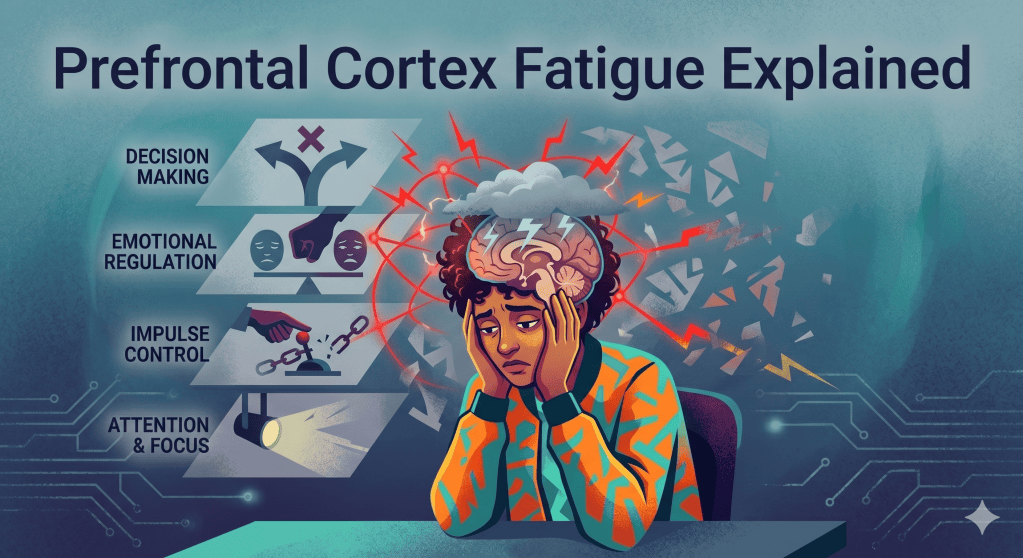
Prefrontal cortex fatigue drains your brain’s executive control center. Learn the neuroscience behind why modern life depletes it — and how to recover.
There’s a particular kind of exhaustion that doesn’t respond to sleep, caffeine, or a quiet weekend. You rest, and yet on Monday morning you find yourself staring at a simple decision — what to eat, what email to answer first, whether a sentence in a work document actually sounds right — and your mind just slides off it like water off glass. The words are there. The thought is there. And yet something isn’t working.
This isn’t laziness or burnout in the conventional sense, though it can look like both. It’s a functional state that neuroscientists and psychologists have been studying with growing attention: prefrontal cortex fatigue. And understanding what it is, what causes it, and how it accumulates tells us a great deal not just about individual brain function, but about the modern conditions under which most people now live and work.
The prefrontal cortex — the region of the brain sitting just behind your forehead — is arguably the most distinctly human part of the human brain. It governs the capacities that separate us from other animals: planning, abstract reasoning, impulse control, moral judgment, the ability to weigh future consequences against immediate desires. It is also, research increasingly shows, the part of the brain most vulnerable to the kind of relentless cognitive demands that characterize contemporary life. When it fatigues, the effects ripple outward in ways that are often mistaken for personality flaws, motivational failures, or even the early signs of something more serious.
This article explores what prefrontal cortex fatigue actually is at a neurological level, what modern life does to accelerate it, how it shapes behavior in ways people rarely recognize in themselves, and what the science suggests about managing it.
What the Prefrontal Cortex Actually Does
To understand prefrontal cortex fatigue, it helps to appreciate just how much work this region of the brain is quietly doing at any given moment.
The prefrontal cortex (PFC) sits at the front of the frontal lobe and is divided into several subregions, each with specialized roles. The dorsolateral prefrontal cortex handles working memory and cognitive flexibility — holding information in mind while manipulating it. The ventromedial prefrontal cortex is involved in emotional regulation and value-based decision making. The orbitofrontal cortex integrates sensory information with emotional context to guide reward-related decisions. These regions work together to produce what researchers broadly call executive function: the suite of higher-order mental processes that allow you to plan, focus, switch between tasks, regulate your emotions, and inhibit impulsive responses.
What makes the PFC unusual is that it operates under a kind of biological constraint that other brain regions don’t face as acutely. Executive function is metabolically expensive. It requires not just glucose but a finely balanced neurochemical environment — particularly adequate levels of dopamine and norepinephrine, which modulate the strength and stability of the neural signals the PFC needs to function properly. When you engage in sustained cognitive effort, you’re not just “thinking hard” in some abstract sense. Research suggests that sustained cognitive effort alters the neurochemical environment required for optimal PFC performance, generating byproducts that, if not cleared through rest, progressively impair the PFC’s ability to maintain signal clarity.
This is the physiological basis of prefrontal cortex fatigue: the gradual depletion of the neurochemical and metabolic resources the PFC needs to sustain high-quality cognitive performance. It’s not a metaphor. It’s a measurable change in how the brain functions.
The Ego Depletion Debate and What It Means
For many years, the dominant psychological model for understanding this phenomenon was “ego depletion,” a concept introduced by social psychologist Roy Baumeister and colleagues in a landmark 1998 paper. Their research suggested that self-control draws on a limited resource — analogous to a muscle — and that exerting willpower in one domain leaves less available for subsequent tasks. The metaphor was elegant and intuitive, and it generated hundreds of follow-up studies over the following two decades.
However, attempts to replicate the core ego depletion findings produced inconsistent results, and by the mid-2010s the model was facing serious criticism. A large-scale 2016 replication study involving over 2,000 participants across 24 labs found little evidence for the basic ego depletion effect under controlled conditions. This set off a significant reassessment in the field.
What emerged from that reassessment wasn’t a rejection of cognitive fatigue as a real phenomenon — the subjective and behavioral effects of mental effort are too robust and well-documented for that. Rather, researchers moved toward more neurologically precise explanations. The accumulation of glutamate in synaptic spaces, the depletion of neurotransmitter precursors, the role of metabolic byproducts like reactive oxygen species — these became the focus of updated models. A notable 2022 study from researchers at the Paris Brain Institute used magnetic resonance spectroscopy to directly measure glutamate concentrations in the lateral prefrontal cortex of participants engaged in sustained cognitive work. They found that glutamate did accumulate over the course of a cognitively demanding day, and that this accumulation correlated with behavioral signs of fatigue and a shift toward lower-effort choices.
So the mechanism is real, even if the original “limited resource” metaphor oversimplified it. The brain doesn’t have a fixed tank of willpower that empties linearly. What it has is a complex neurochemical system that degrades in function under sustained demand — and the prefrontal cortex is uniquely vulnerable to that degradation.
The Modern Context: Why PFC Fatigue Has Become a Widespread Problem
Prefrontal cortex fatigue is not a new phenomenon. Human beings have always been capable of mental exhaustion. What has changed dramatically in recent decades — and with particular acceleration since the early 2020s — is the nature and volume of the cognitive demands placed on ordinary people in the course of a normal day.
The shift is structural. The economy of the late twentieth century still required a large portion of the workforce to perform primarily physical or routine procedural labor. Cognitive demand existed, but it was bounded by the physical rhythms of the workday: a shift ended, a commute separated work from home, and the brain had periods of low-demand time that allowed for recovery. The information economy that has come to dominate employment in developed countries replaced much of that with continuous, variable, high-stakes cognitive labor — and crucially, it removed many of the natural boundaries that allowed recovery.
Attention as a Resource Under Siege
The digital environment deserves particular scrutiny here. Smartphones and always-on internet access changed not just how much information people process but the character of that processing. The prefrontal cortex is heavily involved in directing attention — in deciding what to focus on and suppressing awareness of what isn’t relevant. Every notification, every tab switch, every ambient awareness that an unread message exists creates what psychologists call an “attentional residue.” When you shift your attention from one task to a notification and then back, part of your cognitive focus remains on the first task. But each subsequent interruption compounds this residue, leaving the PFC doing extra work to maintain task engagement against a growing background noise of incomplete cognitive threads.
Research by psychologist Gloria Mark and colleagues at UC Irvine has documented the attention recovery costs of workplace digital interruptions extensively. Their work suggests that after being interrupted, it can take over 20 minutes for a worker to return to a state of deep focus — and that workers in modern office environments are interrupted or switch tasks roughly every few minutes. The math here is stark. In an environment structured around continuous partial interruption, the prefrontal cortex never gets the sustained, uninterrupted engagement period that would allow it to function at full capacity. Instead, it operates in a perpetual state of partial recovery.
The post-pandemic shift toward remote and hybrid work introduced additional complexity. On one hand, remote workers often gained autonomy over their physical environment. On the other hand, many found that the collapse of the commute — which had functioned as an unconscious mental transition period — left them without the neurological boundary between work and rest. Video conferencing created what researchers began calling “Zoom fatigue”: the specific cognitive strain of maintaining sustained visual attention and interpreting social cues through a flattened, delayed, low-bandwidth medium. A Stanford University study published in 2021 identified four key mechanisms behind this: the excessive close-up eye contact, the unusual cognitive effort required to interpret non-verbal communication on video, the self-evaluation created by seeing one’s own face, and the reduction in physical mobility. Each of these places specific demands on PFC-mediated processes.
Decision Overload in Everyday Life
One of the more underappreciated drivers of prefrontal cortex fatigue is the sheer volume of decisions that characterize modern daily life. Decision-making, particularly when it involves genuine tradeoffs, is among the most PFC-intensive tasks the brain performs.
The psychological concept of “decision fatigue” describes the degradation in decision quality that follows extended periods of choosing. Studies of judges found that parole decisions became more favorable after food breaks and more punitive as the session wore on — a finding that has been replicated in various contexts, though with ongoing debate about the precise mechanism. What’s consistent across the research is that decision quality degrades with volume.
The cumulative nature of this loading matters. What to have for breakfast, how to phrase a sensitive message, whether to accept a calendar invite, which version of a product to buy — these are all PFC-intensive operations, regardless of how trivial they seem individually. The person who makes complex strategic decisions with ease in the morning and finds themselves irritable or indecisive by late afternoon is often experiencing exactly this: a prefrontal cortex that has been progressively taxed by the ordinary demands of the day.
How Prefrontal Cortex Fatigue Changes Behavior
Understanding the neuroscience is useful, but the reason prefrontal cortex fatigue matters practically is what it does to how people act — and how poorly those behavioral changes are usually understood.
Impaired Inhibitory Control
One of the most reliable signatures of PFC fatigue is a reduction in inhibitory control: the ability to suppress impulsive responses in favor of more considered ones. The PFC normally exerts a regulatory influence over the limbic system — particularly the amygdala, which generates rapid, emotionally charged responses to stimuli. When the PFC is functioning well, it can modulate those responses, introducing the pause between stimulus and action that allows for deliberate choice. When it’s depleted, that regulatory capacity weakens.
The practical consequences are familiar to most people, even if they don’t frame them in these terms. Emotional reactions that would normally be managed — irritability with a partner, frustration with a slow internet connection, snapping at a child — become more likely in the evening, after a long day of cognitive work. Cravings for high-calorie food, alcohol, or other immediate rewards become harder to resist. Social impulses that would normally be filtered — sending an impulsive message, saying something sharper than intended — feel less controlled.
This isn’t a character defect. It’s the predictable behavioral output of a fatigued inhibitory system. Understanding it as such is not an excuse for the behavior, but it is an accurate description of the mechanism — and accurate descriptions are the prerequisite for effective intervention.
The Shift Toward Cognitive Shortcuts
A fatigued prefrontal cortex doesn’t shut down. It adapts. And one of its primary adaptations is a shift away from effortful, evidence-based reasoning toward reliance on heuristics — cognitive shortcuts that reach conclusions quickly and with minimal processing cost. Psychologists Daniel Kahneman and Amos Tversky mapped many of these heuristics across decades of research. They’re not irrational in an absolute sense; they’re fast approximations that work well enough in familiar, low-stakes situations. But they fail systematically in complex situations that require nuanced evaluation.
When the PFC is fatigued, people become more susceptible to availability bias (weighting information that comes to mind easily over information that’s more accurate but less salient), confirmation bias (defaulting to information consistent with existing beliefs), and anchoring effects (over-weighting initial information when making estimates). They also become more susceptible to persuasion techniques that bypass analytical evaluation — including the social proof and artificial scarcity cues that populate most digital commercial environments. It’s not coincidental that much of consumer marketing is optimized for delivery in the evening, when PFC resources are typically at their daily low.
This has implications that extend well beyond individual consumer decisions. A fatigued PFC also makes people more reactive and less empathetic — not because they become genuinely less caring, but because accurate perspective-taking is cognitively expensive, requiring the sustained maintenance and integration of another person’s viewpoint alongside one’s own. When cognitive resources are depleted, that process degrades, and interactions that require genuine empathetic engagement become harder to sustain.
Procrastination and Task Avoidance
Prefrontal cortex fatigue also helps explain a pattern that many people find particularly confusing and self-critical: the tendency to avoid tasks not because they’re difficult in any objective sense, but because they require initiating cognitive effort. Task initiation is a specific executive function — one that requires the PFC to overcome the inertia of the current state and engage with a new cognitive demand. When the PFC is fatigued, this initiation cost rises sharply.
This is why people who are genuinely exhausted often find themselves doing low-value tasks (reorganizing a desk, scrolling through social media) rather than the important work they know they need to do. The low-value tasks require minimal PFC engagement; the important work requires precisely the resource that’s been depleted. The behavior looks like procrastination — and in a functional sense, it is — but the underlying mechanism is neurological rather than motivational in the simple sense that word usually implies.
Recovery and What the Science Actually Supports
The science of cognitive recovery has become increasingly sophisticated, moving beyond vague recommendations to more specific evidence about what actually restores prefrontal function.
Sleep as the Primary Recovery Mechanism
Sleep is not just rest. It is the brain’s primary maintenance window, during which the glymphatic system — a network of channels surrounding brain blood vessels — clears metabolic waste products that accumulate during waking cognitive activity, including the glutamate buildup that the Paris Brain Institute study linked to PFC fatigue. During the deepest stages of sleep, neurochemical levels reset and the precursors for the next day’s dopamine and norepinephrine production are replenished.
Sleep quality matters as much as quantity here. The deep, slow-wave stages that carry out the most significant restorative work are the ones most disrupted by alcohol, blue-light exposure before bed, irregular sleep timing, and chronic stress — all common features of modern life. This helps explain why some people sleep adequate hours and still wake feeling cognitively sluggish: the recovery work depends on sleep architecture, not duration alone.
Nature, Novelty, and Directed Attention Restoration
Attention Restoration Theory, developed by environmental psychologists Rachel and Stephen Kaplan in the 1980s and tested extensively since, proposes that environments rich in natural elements promote the recovery of directed attentional capacity by engaging a different attentional mode — what the Kaplans called “involuntary attention” or “fascination” — that doesn’t require PFC regulation. When you watch clouds move, look at a river, or walk through a park, your attention is gently held by the environment without the effort of deliberate focus. This allows the PFC-mediated directed attention system to rest and recover.
The empirical support for this has grown considerably beyond the original theory. A 2019 study found that just 20 to 30 minutes in a natural setting produced measurable reductions in cortisol levels and improvements in sustained attention, and more recent neuroimaging work has broadly confirmed that natural environments modulate the attentional networks the Kaplans originally described. The restorative effect appears specific to environments with certain qualities — complexity without threat, scope (a sense of extent), and a sense of being away from the demands of ordinary cognitive life. Urban environments, however designed, tend not to produce this effect to the same degree because they continuously generate stimuli that demand directed attention.
The Counterintuitive Role of Boredom
One of the more surprising findings in cognitive recovery research involves boredom. Contemporary culture treats boredom as a problem to be eliminated — the smartphone has made unoccupied moments almost universally available for filling with content. But research suggests that mind-wandering during low-demand states, far from being wasted time, is associated with activity in the brain’s default mode network (DMN): a set of regions active during rest, self-reflection, and future-oriented thinking. The DMN appears to play an important role in consolidating experiences, generating creative insight, and maintaining a coherent sense of self over time.
Filling every unoccupied moment with external content may be depriving the brain of the background processing time that the DMN requires — and potentially contributing to the sense of cognitive fatigue that many people experience despite objectively low levels of demanding activity. Being bored, at least occasionally, may be a form of cognitive recovery that contemporary life makes structurally difficult.
Strategic Management of Cognitive Load
Perhaps the most actionable insight from the research on prefrontal cortex fatigue is the value of scheduling. If the PFC is a finite daily resource that depletes progressively, then front-loading the most demanding cognitive work — complex decisions, creative work, difficult conversations, learning new material — into the first part of the day, before significant depletion has occurred, should produce meaningfully better outcomes than tackling those tasks at the end of a long day of meetings and emails.
This isn’t a radical claim, but many workplace structures are implicitly organized in the opposite direction: the morning fills with administrative tasks and meetings, and the work that actually requires deep cognitive engagement gets squeezed into whatever attention remains. Understanding the neurological basis for scheduling work around cognitive resource availability gives a more principled foundation to practices that might otherwise feel merely like personal productivity habits.
Prefrontal Cortex Fatigue and Mental Health
The relationship between chronic PFC fatigue and mental health conditions is worth acknowledging carefully, because it’s an area where the evidence is real but the risk of overstatement is high. While prefrontal cortex fatigue can mimic symptoms seen in conditions such as depression, anxiety, or ADHD, temporary cognitive fatigue is not itself a clinical diagnosis — and conflating the two does a disservice to both.
The prefrontal cortex is deeply implicated in multiple mental health conditions. Reduced PFC volume and activity have been observed in depression, anxiety disorders, ADHD, and PTSD. Chronic stress — which sustains elevated cortisol levels — is known to structurally impair the PFC over time, both through the suppression of neuroplasticity and through the promotion of dendritic atrophy in prefrontal neurons. This means that the kind of chronic, low-level cognitive overload that characterizes sustained periods of stress doesn’t just cause temporary fatigue — it can, over time, produce lasting changes in PFC structure and function.
This is not to say that occupational stress causes depression or ADHD. The relationship between chronic stress, prefrontal impairment, and clinical mental health conditions is bidirectional and mediated by multiple genetic and environmental factors. But it does suggest that chronic PFC loading, without adequate recovery, is not a trivially manageable inconvenience. Its long-term consequences for cognitive and emotional health are worth taking seriously.
The inverse relationship is also meaningful: interventions that support PFC recovery — adequate sleep, aerobic exercise, mindfulness practices, nature exposure — have well-documented effects on depression, anxiety, and cognitive function. They work, in part, by directly supporting the neurochemical and structural health of the prefrontal system.
Looking Forward
As of 2026, the conditions that drive prefrontal cortex fatigue show no signs of abating. If anything, the expansion of generative AI tools into everyday professional life has introduced a new layer of cognitive demand: the need to evaluate, prompt, verify, and integrate AI-generated content adds its own layer of PFC-intensive monitoring work, even as those tools are sold as labor-saving. The boundary between cognitive aid and cognitive load turns out to be more porous than the marketing suggests.
At the same time, there is growing sophistication in how organizations, researchers, and individuals think about cognitive resource management. The four-day workweek experiments that have proliferated across Europe and North America can be viewed, in part, as experiments in whether reducing weekly cognitive load produces recoverable output — and the results have been largely positive. The growing attention to “deep work” as a distinct and increasingly scarce cognitive commodity reflects an implicit recognition that not all hours of cognitive activity are equal.
The science of prefrontal cortex fatigue gives a neurological vocabulary to intuitions that thoughtful people have been acting on for a long time. We are not machines that run at constant output until they’re turned off. We’re biological systems whose highest functions depend on conditions — rest, recovery, modulated demand — that modern life often fails to provide. Understanding this isn’t an argument for doing less. It’s an argument for doing the most demanding things when the biology is actually capable of doing them well, and for taking seriously the conditions under which the human brain recovers its capacity to function at its best.









